+91 9911020626
Announcement Master UPSC with ExamPrep IAS Complete Foundation Mentorship Programme
This Just In:
UPSC CSE 2026-27 Mission
Old Rajinder Nagar HQ

Master Civil Services with Authoritative Pedagogy

Rigorous Daily News Analysis, anchored question-style editorials, evaluated mains answer writing, and classroom coaching across 11 national learning centres headquartered in Old Rajinder Nagar, Delhi.

11
National Centres
100%
Bilingual Pedagogy
Top 50
Consistent AIR Selections
Today's Lead Editorial 14 Nov 2026
Daily News Analysis

ASI to Conserve Ancient Buddhist Site Near Kanaganahalli

The Archaeological Survey of India (ASI) has initiated an extensive conservation project for the ancient Buddhist settlement at Sannati-Kanaganahalli in Kalaburagi, Karnataka.

Latest Current Affairs Updates

Exam-calibrated daily updates refreshed in real-time

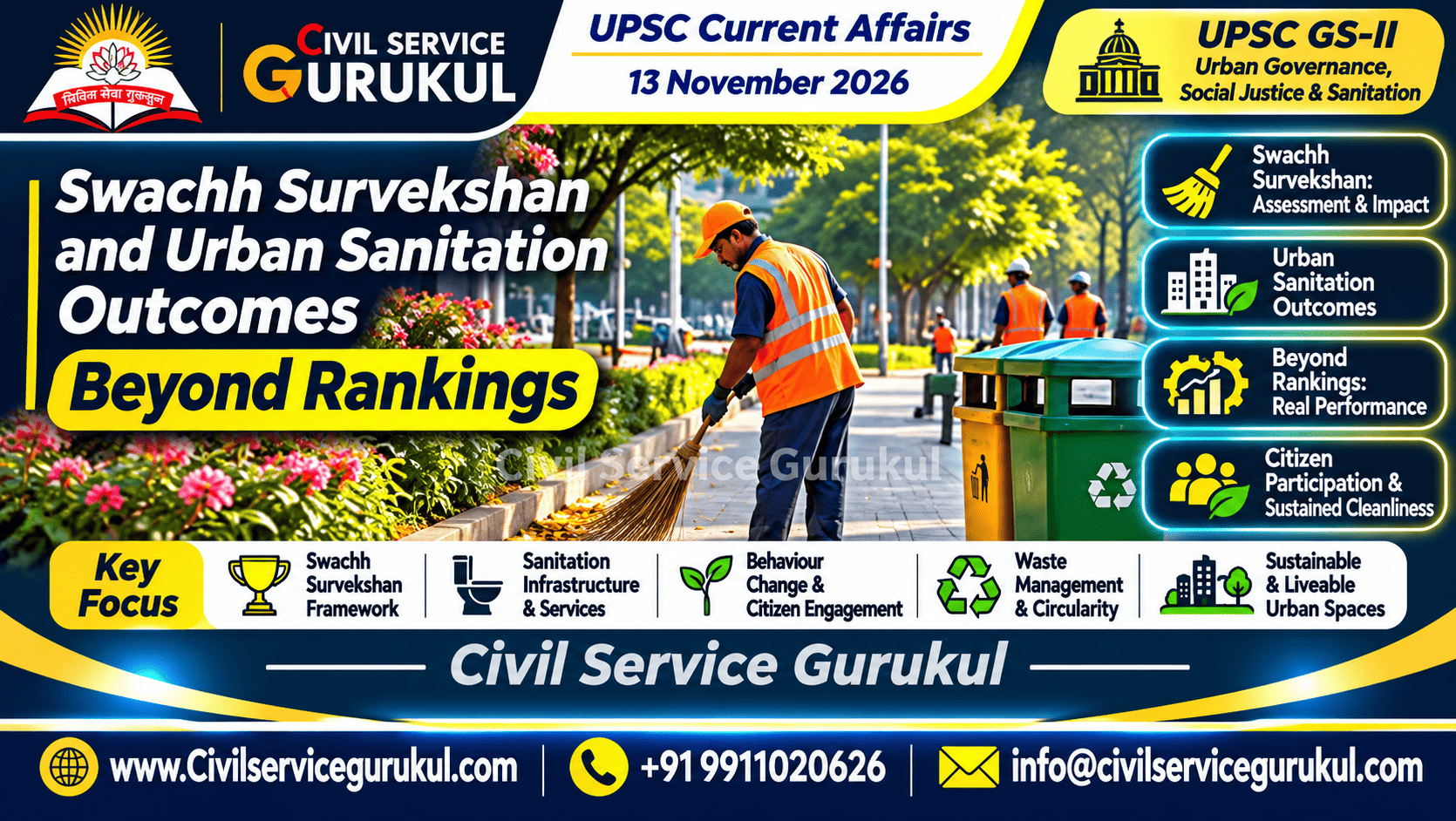
Swachh Survekshan 2026: India's Cleanest Cities, Urban Sanitation & Beyond Rankings | UPSC
01. 13 Nov

Swachh Survekshan 2026: India's Cleanest Cities, Urban Sanitation & Beyond Rankings | UPSC

Swachh Survekshan has become a prominent mechanism for assessing cleanliness and sanitation performance in Indian cities. Yet a high rank alone cannot establish whether waste is scientifically processed, sanitation workers are protected or underserved neighbourhoods receive equitable services. This Civil Service Gurukul UPSC 2027 analysis explores the Swachh Bharat Mission–Urban, urban local bodies, source segregation, material recovery facilities, decentralised waste processing, wastewater management and the limitations of competitive city rankings. It also examines the importance of independent audits, transparent waste-flow data, citizen feedback, inclusion and long-term environmental outcomes, with original Prelims MCQs, a GS-II Mains model answer and rapid revision notes.
5 min Read →
India Battery Recycling 2026: Black Mass Export Ban, Critical Minerals & Circular Economy | UPSC
02. 13 Nov

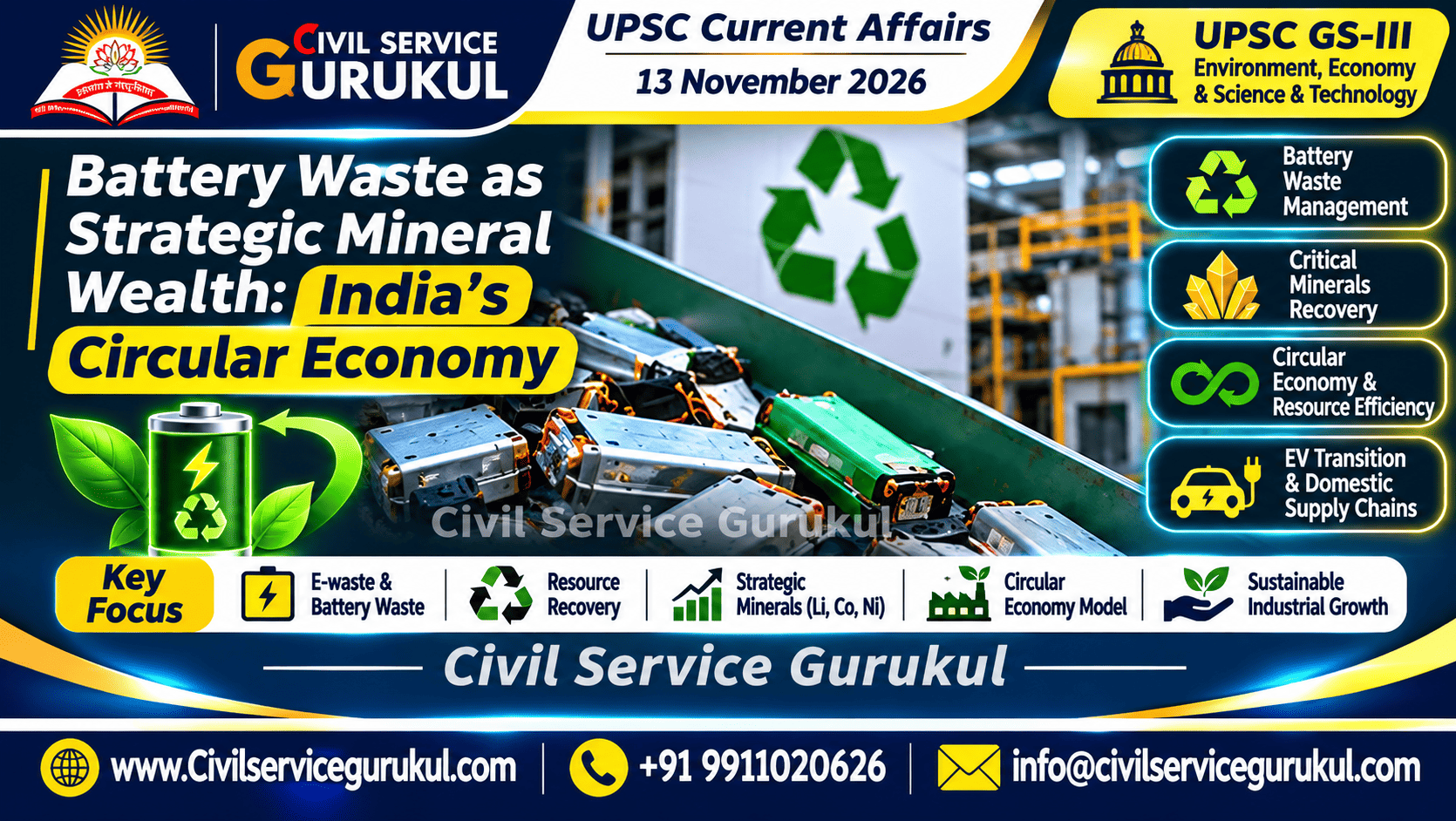
India Battery Recycling 2026: Black Mass Export Ban, Critical Minerals & Circular Economy | UPSC

India's battery waste is emerging as a strategic source of critical minerals essential for electric vehicles, renewable energy storage, electronics and advanced manufacturing. In November 2026, the government prohibited exports of specified lithium-ion battery black mass to strengthen domestic recycling and mineral recovery. The move complements the ₹1,500 crore critical mineral recycling incentive scheme under the National Critical Mineral Mission and the Battery Waste Management Rules, 2022. This Civil Service Gurukul UPSC 2027 article examines lithium-ion battery chemistry, urban mining, Extended Producer Responsibility, black mass, recycling technologies, environmental risks, India's mineral security and circular-economy policies. It includes original Prelims MCQs, a GS-III Mains model answer and an exam-oriented revision card.

5 min Read →
Tamil Nadu Industrial Water Crisis 2026: Wastewater Reuse, Water Pricing & River Health | UPSC
03. 13 Nov

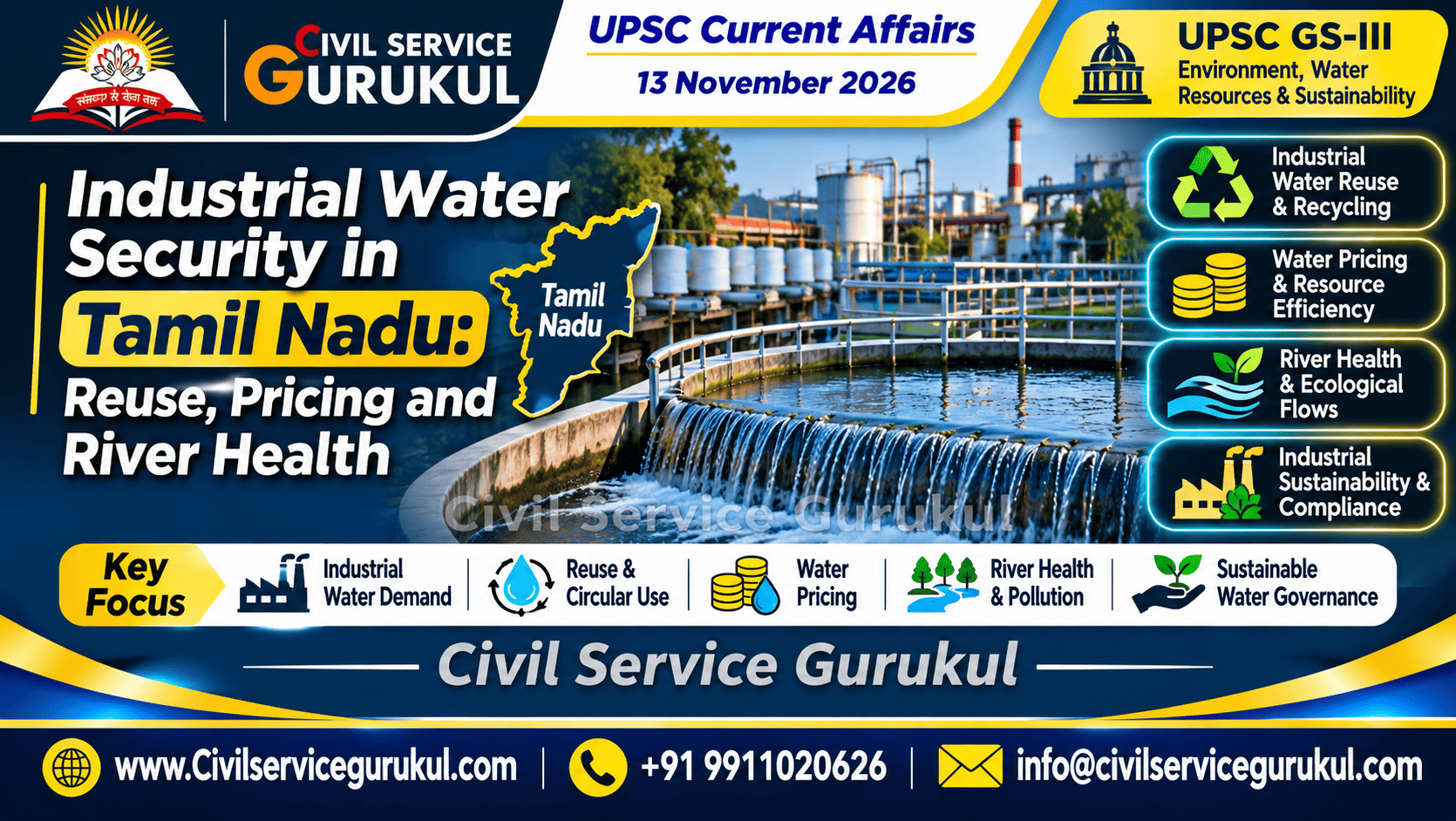
Tamil Nadu Industrial Water Crisis 2026: Wastewater Reuse, Water Pricing & River Health | UPSC

Tamil Nadu's industrial growth creates an urgent need to balance manufacturing competitiveness with freshwater availability, groundwater sustainability and healthy river ecosystems. Seasonal rainfall, urban demand, agricultural irrigation and industrial withdrawals place competing pressures on limited water resources. This Civil Service Gurukul analysis examines the role of treated wastewater reuse, closed-loop industrial recycling, realistic water pricing, effluent regulation, basin-level governance and transparent water accounting. It explains key concepts such as water withdrawal versus consumption, Zero Liquid Discharge, Common Effluent Treatment Plants, environmental flows and the polluter-pays principle, with UPSC Prelims MCQs, a GS-III Mains model answer and a rapid revision framework.

5 min Read →
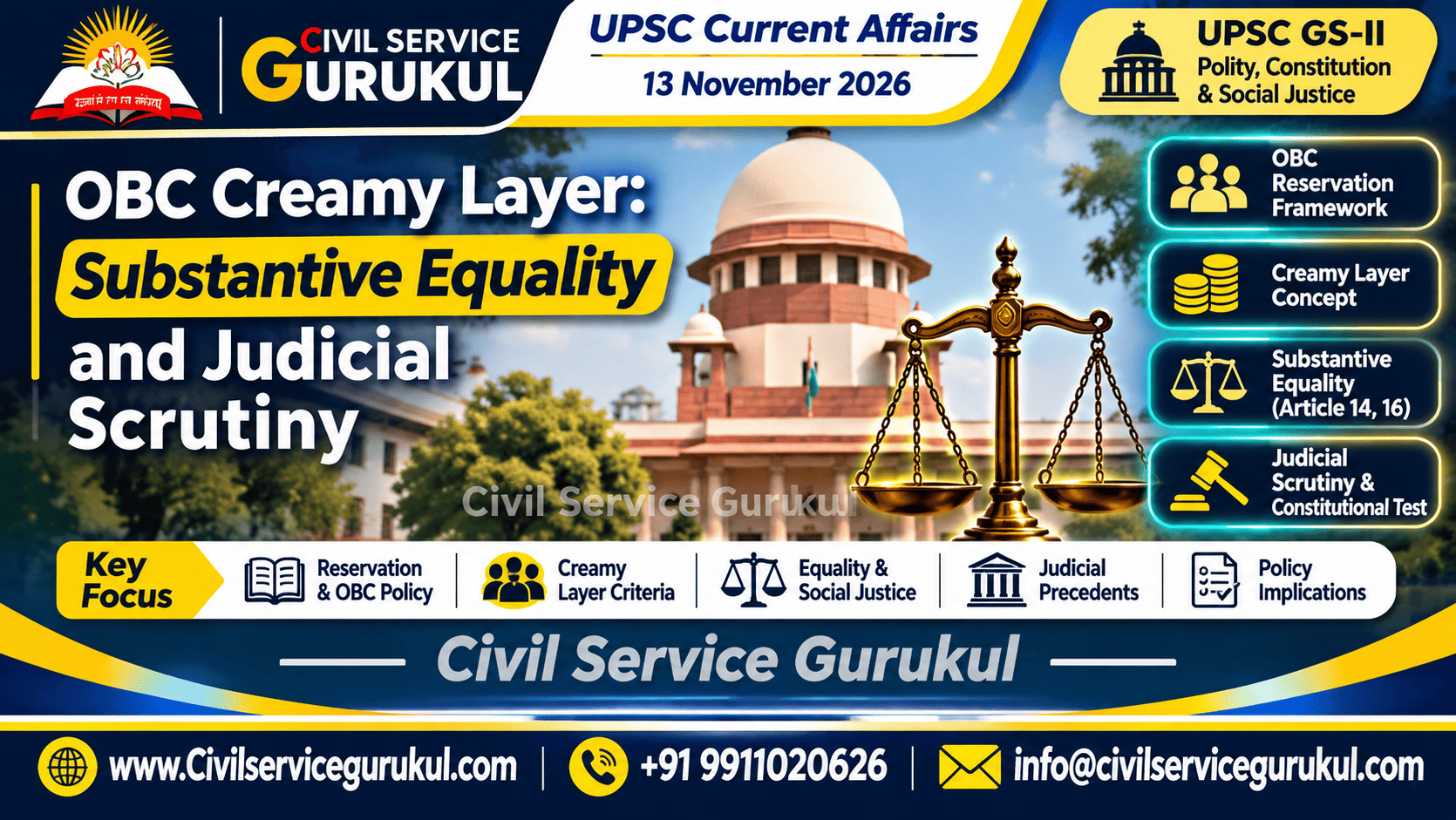
OBC Creamy Layer 2026: Supreme Court Principles, ₹8 Lakh Rule & Substantive Equality | UPSC
04. 13 Nov

OBC Creamy Layer 2026: Supreme Court Principles, ₹8 Lakh Rule & Substantive Equality | UPSC

The creamy-layer principle is a central feature of India's OBC reservation framework, designed to ensure that affirmative-action benefits reach socially and educationally disadvantaged sections rather than becoming concentrated among relatively advanced families. Rooted in the Supreme Court's landmark Indra Sawhney judgment of 1992, the principle raises important questions about substantive equality, the relationship between economic advancement and social disadvantage, and the fairness of administrative eligibility tests. This Civil Service Gurukul article examines Articles 14, 15 and 16, the central OBC creamy-layer framework, the ₹8 lakh income ceiling and its limitations, judicial scrutiny, distinctions involving SC/ST reservation, and policy reforms. It includes original UPSC Prelims questions, a GS-II Mains model answer and a rapid revision card.

5 min Read →
India–France Relations 2026: Economic Security, Critical Technology & Strategic Autonomy | UPSC
05. 13 Nov

India–France Relations 2026: Economic Security, Critical Technology & Strategic Autonomy | UPSC

India–France strategic cooperation is expanding beyond traditional defence engagement into economic security, critical and emerging technologies, supply-chain resilience, clean energy, space and advanced manufacturing. Against the backdrop of November 2026 reporting on bilateral economic-security and technology discussions, this Civil Service Gurukul article explains the historical foundations of the partnership, the Horizon 2047 roadmap, strategic autonomy, defence industrial cooperation, semiconductor and AI ecosystems, civil nuclear energy, Indo-Pacific interests, technology-transfer challenges and policy priorities. Designed for UPSC Prelims and Mains 2027, it includes factual distinctions, original statement-based MCQs, a GS-II/GS-III model answer, revision notes and analytical frameworks.

5 min Read →
India Visa Reform 2026: 9 Categories, 70% Shorter Forms, e-Visa & UPSC GS-II Analysis
06. 13 Nov

India Visa Reform 2026: 9 Categories, 70% Shorter Forms, e-Visa & UPSC GS-II Analysis

India has undertaken a major rationalisation of its visa regime, reducing the number of main categories from 13 to nine and sub-categories from 49 to 23, while cutting application-form fields by 65–70%. The reform includes renaming the Tourist Visa as the Visitor Visa, introducing differentiated provisions for business, medical treatment, AYUSH, education and research, and updating digital immigration systems. With e-Visa facilities available to nationals of 172 countries, the policy aims to improve tourism, investment, medical-value travel, international education and administrative efficiency. Civil Service Gurukul examines the Ministry of Home Affairs' November 2026 announcement, the nine-category structure, V-1 and V-2 visas, e-Visa versus regular visa, immigration governance, security and privacy concerns, implementation challenges, UPSC Prelims MCQs and a GS-II Mains model answer.

5 min Read →
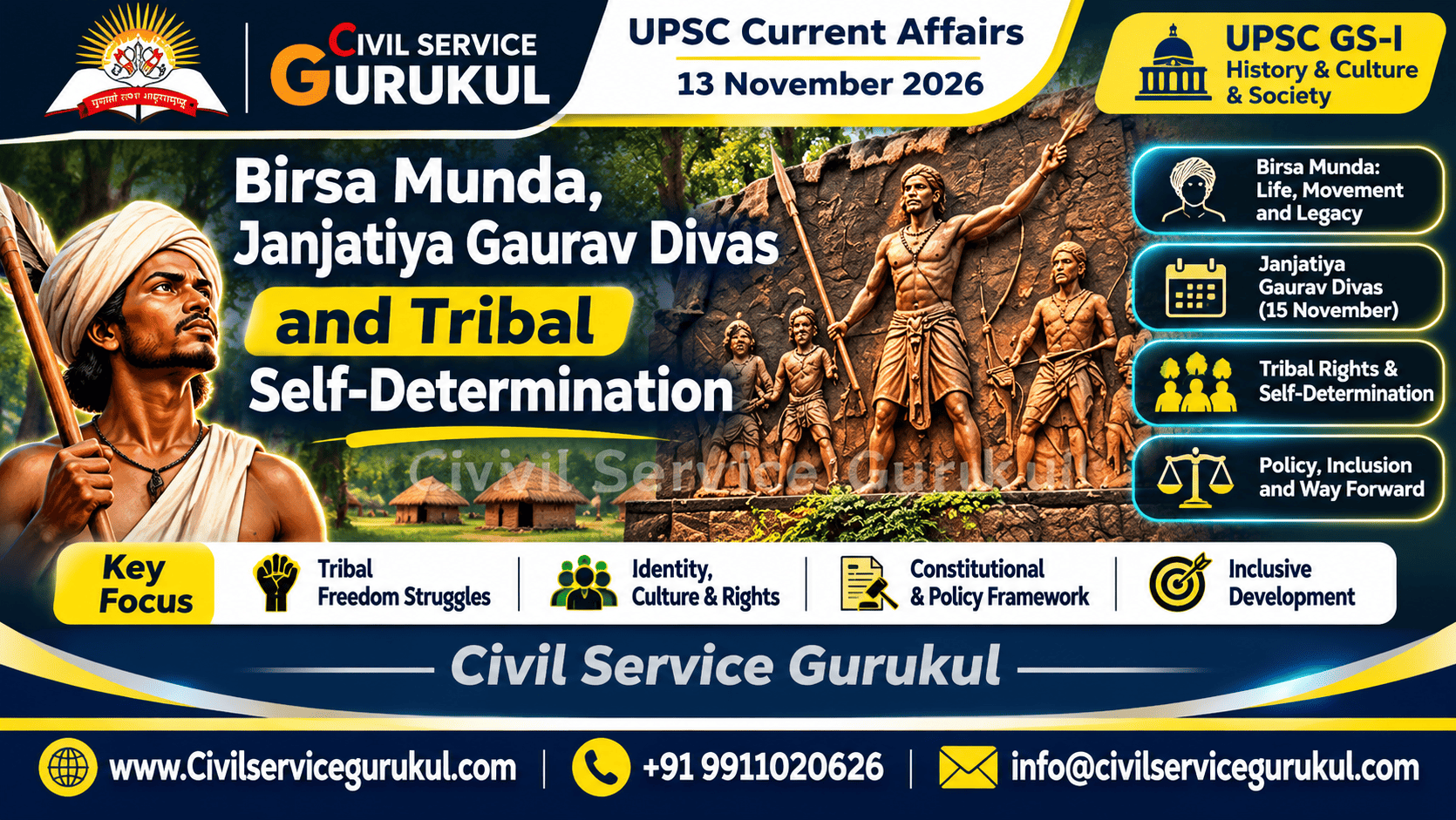
Birsa Munda & Janjatiya Gaurav Divas 2026: Ulgulan, PESA, FRA and Tribal Rights | UPSC 2027
07. 13 Nov

Birsa Munda & Janjatiya Gaurav Divas 2026: Ulgulan, PESA, FRA and Tribal Rights | UPSC 2027

Janjatiya Gaurav Divas is observed across India on 15 November to commemorate the birth anniversary of Birsa Munda, the tribal freedom fighter who led the Ulgulan movement against colonial authority and exploitative agrarian relations in Chotanagpur. The 2026 Janjatiya Gaurav Pakhwada runs from 1 to 15 November, with government-announced initiatives related to tribal education, culture, healthcare, forest rights and rural development. This Civil Service Gurukul UPSC 2027 article examines Birsa Munda's historical contributions, the Munda land system, colonial exploitation, the Ulgulan movement, the Chota Nagpur Tenancy Act, Fifth and Sixth Schedules, PESA 1996, Forest Rights Act 2006 and contemporary questions of community self-governance. It also provides original UPSC Prelims MCQs, GS-I and GS-II Mains analysis and a concise revision framework.

5 min Read →
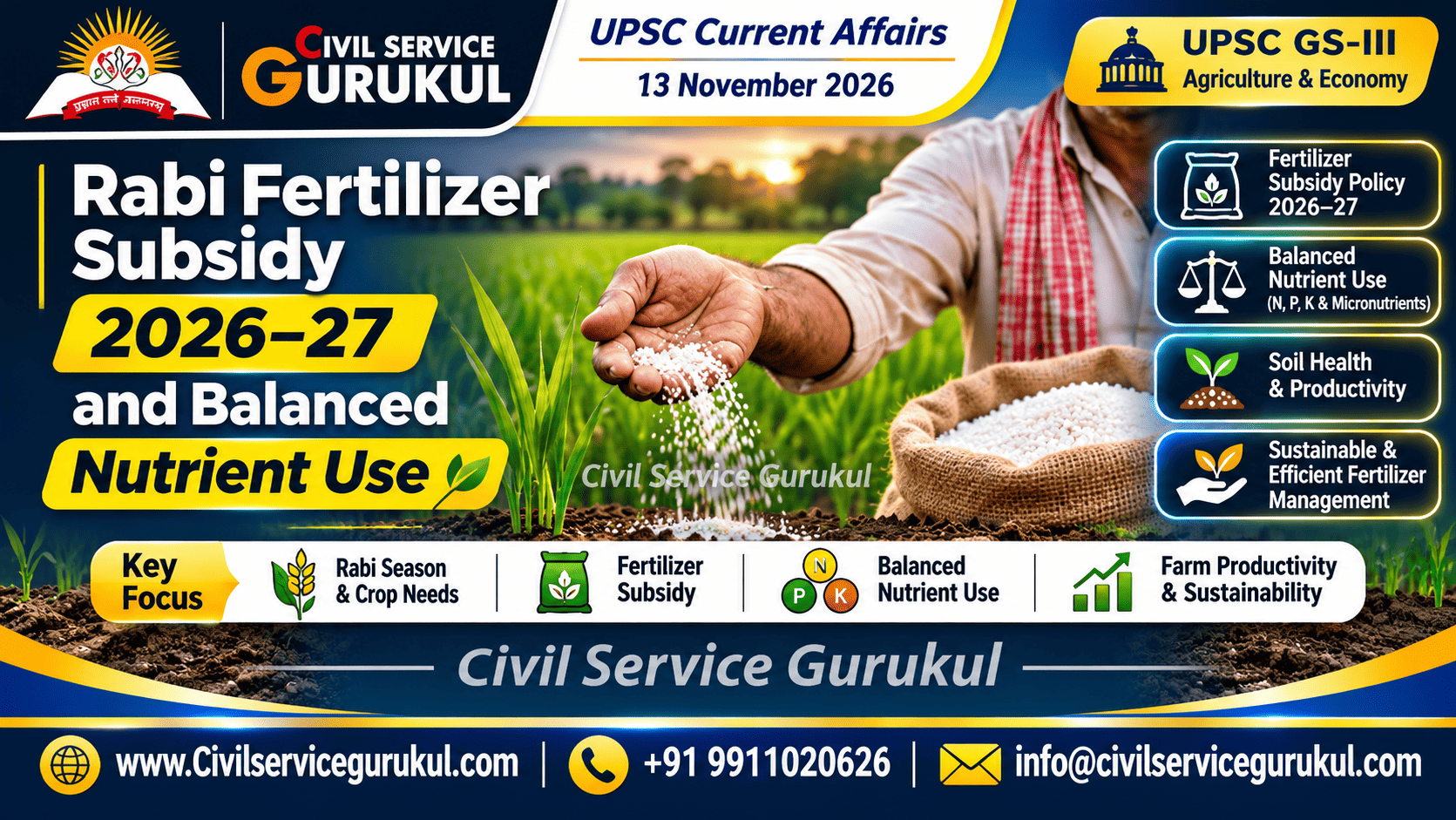
Rabi Fertiliser Subsidy 2026–27: 64% Increase, NBS Rates, Budget Impact & UPSC Analysis
08. 13 Nov

Rabi Fertiliser Subsidy 2026–27: 64% Increase, NBS Rates, Budget Impact & UPSC Analysis

India's Union Cabinet approved a tentative ₹62,370.02 crore subsidy requirement for phosphatic and potassic fertilisers during Rabi 2026–27, representing an approximately 64% increase over the previous Rabi season. The revised Nutrient Based Subsidy rates apply from 1 October 2026 to 31 March 2027 and cover nitrogen, phosphorus, potassium and sulphur content in 28 grades of P&K fertilisers. Along with the Kharif 2026 provision, the combined seasonal P&K requirement reaches approximately ₹1.04 lakh crore against the FY 2026–27 Budget Estimate of ₹54,000 crore. Civil Service Gurukul examines the NBS framework, DAP price protection, differences between urea and P&K subsidies, global price pressures, fiscal implications, soil nutrient imbalance, sustainable agriculture reforms, UPSC Prelims MCQs and a GS-III Mains model answer.

5 min Read →
01. 18 Sep

कणगनहल्ली के समीप प्राचीन बौद्ध स्थल का संरक्षण: भारतीय पुरातत्व सर्वेक्षण

भारतीय पुरातत्व सर्वेक्षण (ASI) ने कर्नाटक के कालबुर्गी स्थित सन्नति-कणगनहल्ली में प्राचीन बौद्ध स्थल के व्यापक संरक्षण का कार्य आरंभ किया है।

6 मिनट पढ़ें →
02. 18 Sep

ऊर्जा निर्धनता और भारत का स्वच्छ ऊर्जा संक्रमण प्रतिमान

डीकार्बोनाइजेशन के महत्वाकांक्षी लक्ष्यों को न्यायसंगत ऊर्जा उपलब्धता के साथ संतुलित करना भारतीय नीति निर्माताओं के लिए एक प्रमुख सामाजिक-आर्थिक अनिवार्यता है।

6 मिनट पढ़ें →
03. 18 Sep

राष्ट्रीय हरित हाइड्रोजन मिशन: डीकार्बोनाइजेशन हेतु रणनीतिक हस्तक्षेप

नवीन एवं नवीकरणीय ऊर्जा मंत्रालय ने भारत को हरित हाइड्रोजन का वैश्विक निर्यातक केंद्र बनाने हेतु इलेक्ट्रोलाइज़र विनिर्माण प्रोत्साहन जारी किए।

6 मिनट पढ़ें →
04. 18 Sep

रोका-छेका अभियान: छत्तीसगढ़ में पारंपरिक पशुधन एवं फसल प्रबंधन

राज्य सरकार ने खरीफ फसलों की सुरक्षा और खुले में चराई रोकने हेतु पारंपरिक सामुदायिक रोका-छेका अभियान को गति प्रदान की।

6 मिनट पढ़ें →
05. 17 Sep

संसद टीवी चर्चा: जेनेरेटिव एआई हेतु नैतिक एवं नियामक रूपरेखा

संसदीय परिचर्चा में तकनीकी संप्रभुता, कॉपीराइट संरक्षण, डीपफेक रोकथाम और नवाचार के संतुलन पर विचार-विमर्श किया गया।

6 मिनट पढ़ें →
06. 17 Sep

नीति आयोग राष्ट्रीय बहुआयामी निर्धनता सूचकांक: प्रगति रिपोर्ट का सार

वर्ष 2015-16 से 2019-21 के मध्य 13.5 करोड़ से अधिक भारतीय बहुआयामी निर्धनता से बाहर निकले; पोषण, स्वच्छता एवं स्वच्छ ईंधन में उल्लेखनीय सुधार।

6 मिनट पढ़ें →
08. 17 Sep

टू द पॉइंट: मौद्रिक नीति समिति एवं लचीला मुद्रास्फीति लक्ष्यीकरण

एमपीसी संरचना, सीपीआई मुद्रास्फीति लक्ष्य (4% +/- 2%), रेपो दर संचरण और तरलता प्रबंधन उपकरणों पर त्वरित पुनरावलोकन नोट्स।

6 मिनट पढ़ें →
1

Daily News Analysis (DNA)

The Hindu & Indian Express news curated rigorously for GS Papers I to IV with integrated PYQ mapping.

Explore DNA Archive →
2

Editorial Analysis

Balanced perspectives on multidimensional policy issues, ethical dilemmas, and administrative viewpoints.

Read Editorials →
3

Free Downloads & Resources

Download verified syllabus breakups, monthly current affairs digests, and past year question compilations.

Browse Downloads →
National Headquarters & Main Learning Campus New Delhi

Delhi Old Rajinder Nagar (National Headquarters)

The epicenter of UPSC CSE preparation in India. State-of-the-art audiovisual classrooms, 24x7 study library, evaluated mains answer writing lab, and face-to-face faculty mentorship.

Official Registered Campus
Office No 57/16, Karol Bagh, Rajinder Nagar, Delhi, 110060
Landmark: Near Rajinder Place / Karol Bagh Metro Station
✓ 24x7 AC Study Hall ✓ Daily Faculty Doubt Counter ✓ Offline Test Series Centre ✓ Smart Digital Classrooms
Free Mentorship Call

Book a Free 1-on-1 Counselling Session

Get personalized guidance on syllabus decoding, optional subject selection, and preparation timetable from senior faculty.

+91
Protected by Cloudflare Turnstile human bot verification.