
Agrivision 2026: Transforming Indian Agriculture Through Innovation, Market-Driven Farming and Agri-Food Value Chains | UPSC Current Affairs
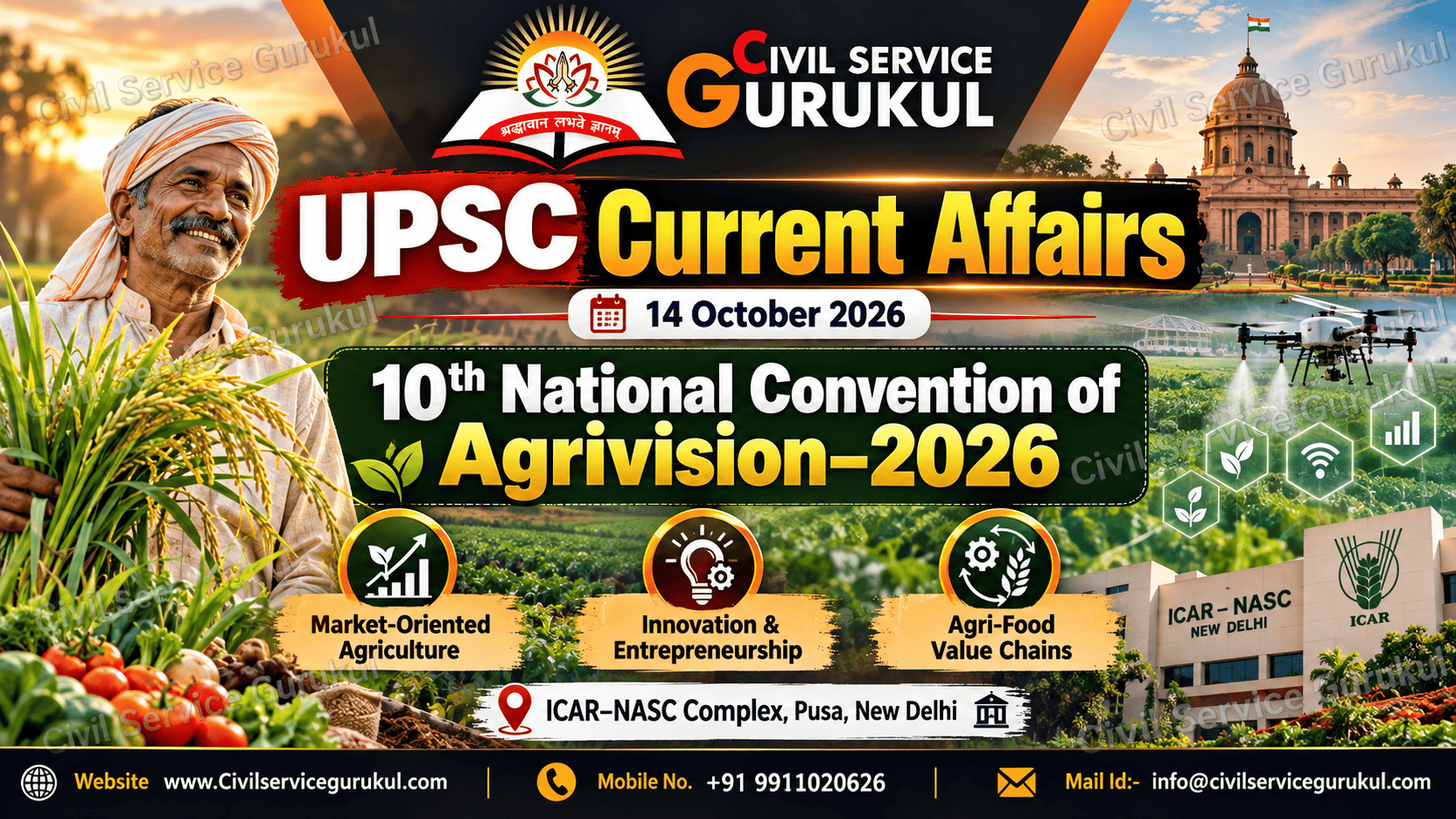
UPSC CURRENT AFFAIRS | 14 OCTOBER 2026
Agrivision 2026: India's Shift from Production-Centric Farming to Market-Driven Agriculture
A comprehensive UPSC analysis of agricultural transformation, agri-food value chains, rural entrepreneurship, farmer profitability and technology-led agricultural development.
GS Paper III | Agriculture | Economy | Rural Development
Why Is Agrivision 2026 in the News?
The 10th National Convention of Agrivision was held in New Delhi on 13–14 October 2026, bringing together agricultural students, researchers, scientists, policymakers, farmers and entrepreneurs.
The convention highlighted an important policy direction: Indian agriculture needs to evolve beyond simply increasing crop output and move towards creating higher value, stronger market access and better incomes for farmers.
The event provided a platform for discussing agricultural entrepreneurship, technological innovation, agricultural education and closer cooperation among farmers, universities, research institutions and industry.
What Is Agrivision?
Agrivision is an initiative that promotes dialogue and collaboration among agricultural students and other stakeholders involved in agriculture and allied sectors.
Its national conventions encourage agricultural education, entrepreneurship, research, innovation and farmer-centric development.
Key Facts for UPSC Prelims
| Particular | Important Information |
|---|---|
| Event | 10th National Convention of Agrivision |
| Dates | 13–14 October 2026 |
| Venue | ICAR-NASC Complex, Pusa, New Delhi |
| Organisation | Agrivision, with ICAR agricultural education involvement |
| Participation | About 450 agricultural students from 25 states |
| Central Theme | Market-oriented agriculture and stronger agri-food value chains |
| UPSC Papers | GS-II, GS-III and Essay |
Production-Centric vs Market-Driven Agriculture
India's agricultural policies have historically placed considerable emphasis on expanding food production, improving yields and strengthening food security.
These priorities remain important. However, high agricultural output alone does not guarantee adequate farmer income.
A market-driven approach recognises that farmers also require reliable information about consumer demand, opportunities for value addition, efficient supply chains and access to remunerative markets.
| Production-Centric Farming | Market-Driven Farming |
|---|---|
| Emphasis on crop quantity | Emphasis on quality, value and profitability |
| Limited market intelligence | Demand forecasting and market information |
| Sale of unprocessed produce | Processing, grading and packaging |
| Dependence on local traders | Diversified market channels |
| Focus on farm-level production | Integration of the entire value chain |
| Income linked mainly to yield and price | Income supported by productivity, value addition and market access |
What Are Agricultural Value Chains?
An agricultural value chain includes all activities required to transform farm inputs into agricultural products and deliver them to final consumers.
It includes input supply, production, aggregation, storage, processing, transportation, distribution and retail marketing.
Seeds & Inputs → Cultivation → Harvesting → Aggregation → Storage → Processing → Packaging → Transport → Market → Consumer
Importance of Agri-Food Value Chains
- Reduce post-harvest losses through better handling and storage.
- Increase opportunities for value addition.
- Improve quality and product standardisation.
- Connect farmers with organised domestic and export markets.
- Create employment in processing, logistics and retail.
- Support diversification into higher-value agricultural products.
Role of Agricultural Entrepreneurship
Agripreneurship involves developing enterprises that address challenges across agriculture and allied activities.
Agricultural graduates and rural entrepreneurs can contribute through technology-enabled services, farm mechanisation, advisory platforms, food processing, cold-chain businesses and innovative marketing systems.
Emerging Opportunities
- AgriTech: Precision farming, drones, sensors and AI-based advisory services.
- Food Processing: Developing market-ready agricultural products.
- Digital Agriculture: Digital trading, traceability and data-driven farm services.
- Supply-Chain Startups: Aggregation, warehousing and last-mile distribution.
- Climate-Smart Agriculture: Water-efficient technologies and resilient cultivation practices.
- Farmer Producer Organisations: Collective procurement, processing and marketing.
Role of ICAR and Agricultural Education
The Indian Council of Agricultural Research (ICAR) is an important institution for coordinating agricultural research and education in India.
Agricultural universities and research institutions contribute to the development of improved crop varieties, farm technologies, skill development and scientific agricultural practices.
Why Industry-Academia-Farmer Collaboration Matters
- Researchers identify scientific solutions to agricultural problems.
- Universities equip students with practical technical knowledge.
- Private enterprises help commercialise suitable technologies.
- Farmers provide field-level feedback on effectiveness and affordability.
- Extension institutions help translate research into widespread adoption.
The greatest benefits arise when research addresses farmers' actual needs rather than remaining confined to laboratories and academic publications.
Relevant Government Initiatives
Agrivision 2026 should be studied alongside India's broader agricultural development framework.
| Scheme / Initiative | UPSC Relevance |
|---|---|
| e-NAM | Digital agricultural market integration |
| Formation and Promotion of 10,000 FPOs | Collective farmer bargaining and market access |
| Agriculture Infrastructure Fund | Investment in post-harvest and community farming infrastructure |
| PM Formalisation of Micro Food Processing Enterprises Scheme | Micro food processing and enterprise formalisation |
| Digital Agriculture Mission | Digital public infrastructure and technology-enabled agriculture |
| PM-KISAN | Income support for eligible farmer families |
Major Challenges in Market-Oriented Agriculture
1. Small and Fragmented Landholdings
Smallholders often face difficulties achieving economies of scale, accessing technology and negotiating favourable terms with buyers.
2. Inadequate Storage and Cold Chains
Insufficient post-harvest infrastructure increases losses and limits opportunities for farmers to sell produce at the most advantageous time.
3. Information Asymmetry
Many farmers have limited access to timely market information, demand forecasts and quality requirements.
4. Limited Processing Capacity
Insufficient local processing facilities can restrict opportunities for capturing higher value within rural communities.
5. Climate and Price Risks
Weather variability, market volatility and rising input costs can reduce the benefits of commercial agricultural production.
6. Finance and Skill Gaps
Small enterprises may struggle with credit access, business planning, modern technology and marketing expertise.
Way Forward: Transforming India's Agricultural Economy
- Strengthen FPOs and collective marketing systems.
- Expand decentralised storage and cold-chain infrastructure.
- Promote food processing near agricultural production clusters.
- Increase access to market intelligence and digital advisory services.
- Support agripreneurship through incubation, training and appropriate financing.
- Improve rural roads, logistics and supply-chain connectivity.
- Encourage crop diversification and climate-resilient technologies.
- Promote transparent contracts and effective farmer grievance-redressal systems.
UPSC Mains: GS Paper III Analysis
"India must move from production-centric agriculture towards market-oriented agri-food value chains to enhance farmers' income." Discuss the opportunities, challenges and policy measures required for this transformation.
Original practice question for Civil Service Gurukul; not represented as an actual UPSC previous-year question.
Model Answer
Introduction: India has achieved substantial progress in foodgrain production, but farm profitability remains constrained by fragmented holdings, price volatility and limited value addition. Market-oriented agriculture seeks to connect production decisions with consumer demand, processing and remunerative markets.
Opportunities: Better market intelligence can support informed cropping choices. Food processing, grading and cold chains can reduce losses and enhance value realisation. FPOs can improve collective bargaining, while digital platforms can widen market access. Agripreneurship can generate rural employment and accelerate technology adoption.
Challenges: Small landholdings restrict scale; infrastructure gaps raise transaction costs; information asymmetry weakens bargaining power; and inadequate institutional finance slows investment. Climate risks and price fluctuations further complicate market-oriented production.
Way Forward: India should strengthen farmer collectives, invest in rural storage and logistics, expand processing clusters, promote digital agricultural services and support local enterprises. Transparent market institutions, quality standards and safeguards against unequal contractual relationships are equally important.
Conclusion: Agricultural transformation should combine productivity with value addition, market access and risk management. A farmer-centric value-chain approach can promote resilient agriculture, rural employment and sustainable income growth.
UPSC Prelims Practice MCQs
The following are original exam-style practice questions, not previous-year UPSC questions.
Consider the following statements about the 10th National Convention of Agrivision:
- It was held in New Delhi in October 2026.
- It emphasised market-oriented agriculture and value addition.
- It focused exclusively on increasing foodgrain production.
Which statements are correct?
(a) 1 only
(b) 1 and 2 only
(c) 2 and 3 only
(d) 1, 2 and 3
The convention highlighted market-linked agricultural development, value chains and entrepreneurship rather than an exclusive focus on foodgrain production.
Which of the following activities form part of an agricultural value chain?
- Input supply
- Primary production
- Processing and packaging
- Distribution and marketing
(a) 1 and 2 only
(b) 2, 3 and 4 only
(c) 1, 3 and 4 only
(d) 1, 2, 3 and 4
Agricultural value chains include interconnected activities from input supply to final consumption.
The primary objective of e-NAM is to:
(a) Provide universal crop insurance
(b) Integrate agricultural markets through an electronic trading platform
(c) Replace all physical mandis
(d) Distribute fertilisers free of cost
The National Agriculture Market (e-NAM) promotes electronic trading and improved market integration. It does not abolish physical mandis.
Which one of the following is most directly associated with a Farmer Producer Organisation?
(a) Collective agricultural business and marketing
(b) Regulation of monetary policy
(c) Conducting parliamentary elections
(d) Administration of international trade treaties
FPOs bring producers together to improve scale, input access, market connections and collective bargaining.
Consider the following statements:
- Value addition may improve the economic return from agricultural produce.
- Cold-chain infrastructure can help reduce losses of perishable products.
- Market-driven agriculture necessarily eliminates price risks.
(a) 1 and 2 only
(b) 2 and 3 only
(c) 1 and 3 only
(d) 1, 2 and 3
Market integration may improve opportunities for farmers, but price volatility and other business risks can remain.
Most Important Topics for UPSC Revision
| Priority | Revision Topic | Focus Area |
|---|---|---|
| Very High | Agricultural Marketing | e-NAM, APMC, market reforms |
| Very High | FPOs | Collective farming services and marketing |
| Very High | Food Processing | Value addition, supply chains, losses |
| High | AgriTech | AI, precision farming and digital agriculture |
| High | Agricultural Infrastructure | Warehousing, logistics and cold storage |
| High | Farmers' Income | Profitability, diversification and risk reduction |
| Medium | Agrivision 2026 | Date, venue, focus and participation |
Conclusion
The 10th National Convention of Agrivision 2026 highlights a significant direction in India's agricultural development: linking productivity with market opportunities, scientific innovation and improved farmer profitability.
Agricultural transformation requires more than production growth. It also depends on processing, infrastructure, entrepreneurship, collective institutions, financial access and effective market linkages.
For UPSC aspirants, Agrivision 2026 provides a contemporary example that can enrich answers on agricultural marketing, farmer income, food processing, rural development and technology adoption under GS Paper III.
Prepare with Mentors Who Cleared the Exam
Get personalized study plans, evaluated answer models, and test series access.