
Andaman Cobra: Conservation & UPSC Notes 2026
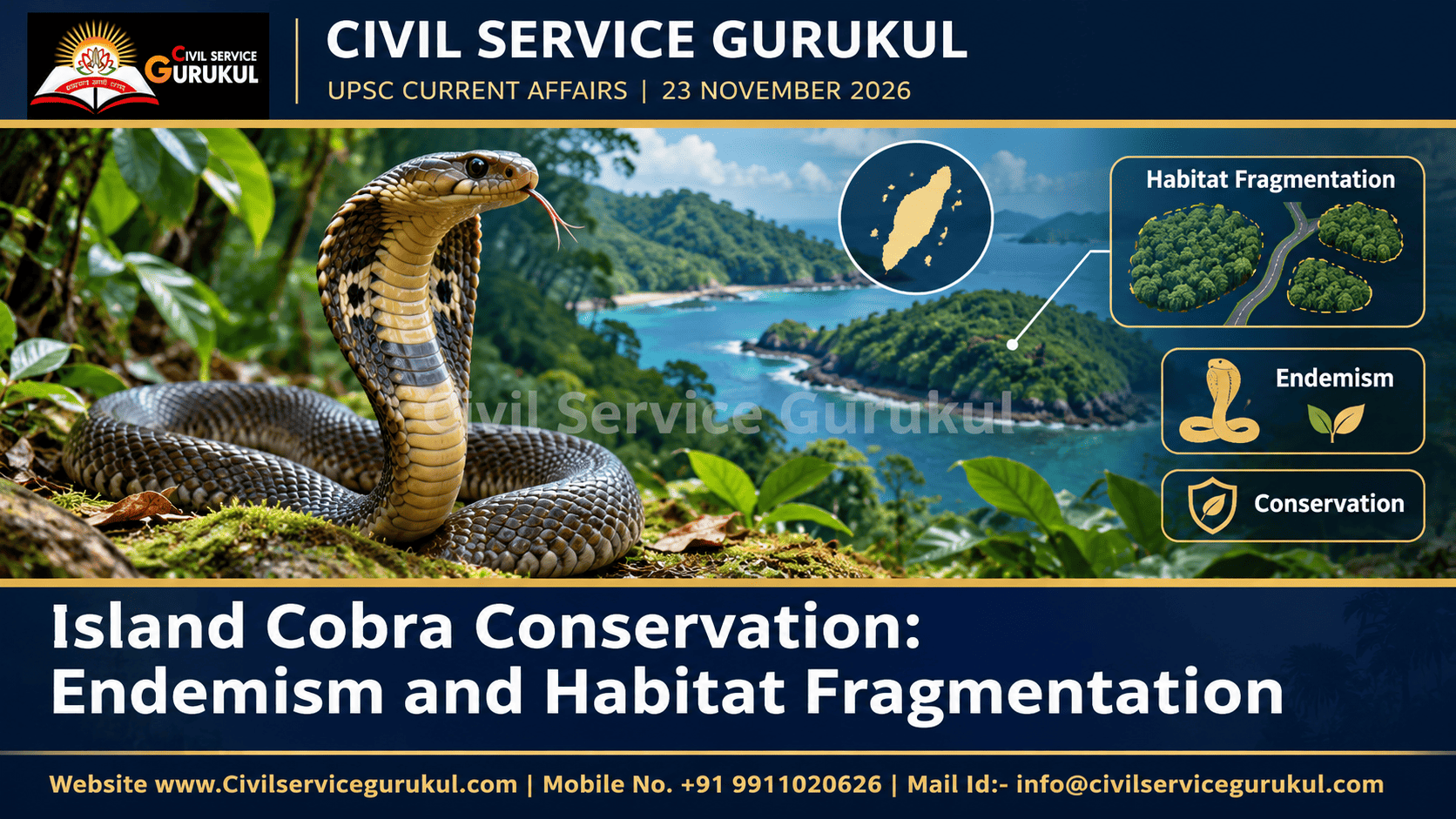
Andaman Cobra: Why India's Endangered Island Snake Faces Habitat Loss, Genetic Isolation and Conservation Challenges
Why are species found only on islands particularly vulnerable to extinction? The Andaman cobra offers an important case study of island biogeography, habitat fragmentation, genetic isolation, conservation science and the relationship between biodiversity protection and human safety.
India's island ecosystems are among the country's most distinctive centres of biodiversity. Their geographical isolation has contributed to the evolution of species that are found nowhere else in the world. However, the same isolation may increase extinction risks when habitats are damaged or populations become fragmented.
An important example is the Andaman cobra (Naja sagittifera), a venomous snake endemic to the Andaman Islands.
This species has been assessed as Endangered on the International Union for Conservation of Nature's Red List.
Recent conservation reporting has drawn attention to its restricted range, human-snake conflict, habitat pressures and limited scientific research.
For UPSC aspirants, the case connects environmental geography, ecology, evolutionary biology, wildlife conservation, public health and ethics.
- GS I: Physical geography, island systems, geographical isolation and environmental characteristics.
- GS III: Biodiversity, conservation, environmental degradation, wildlife protection and ecological sustainability.
- GS IV: Environmental ethics, compassion towards wildlife, responsible governance and human-wildlife coexistence.
- Essay: Development versus conservation, human-nature relationships and intergenerational equity.
- Prelims: Species identification, IUCN categories, island biogeography, genetic drift and wildlife conservation.
1. Why Is the Andaman Cobra in the News?
In November 2026, reporting on India's island biodiversity highlighted the conservation challenges facing the Andaman cobra.
Despite being described scientifically more than a century ago, the species remains comparatively poorly studied.
Conservation concerns include habitat conversion, geographical isolation, limited information about population trends and conflict with people.
The issue also highlights the public-health implications of venomous snake conservation, particularly where standard antivenom products may not provide adequate protection against geographically distinct snake venoms.
Why Is This Important for UPSC?
- It provides an example of island endemism.
- It illustrates the effects of habitat fragmentation.
- It connects evolutionary biology with conservation.
- It highlights the need for scientific wildlife monitoring.
- It links snake conservation with public health.
- It raises ethical questions about human-wildlife coexistence.
2. Andaman Cobra: Complete Species Profile for UPSC
The Andaman cobra is a venomous snake belonging to the genus Naja and family Elapidae.
Its scientific name is Naja sagittifera.
It was formally described by the herpetologist Frank Wall in 1913.
| Characteristic | Important Fact |
|---|---|
| Common name | Andaman Cobra |
| Scientific name | Naja sagittifera |
| Animal group | Reptile |
| Order | Squamata |
| Family | Elapidae |
| Genus | Naja |
| Endemic range | Andaman Islands, India |
| IUCN category | Endangered (EN) |
| Original description | Frank Wall, 1913 |
| Conservation relevance | Restricted range and island habitat vulnerability |
| Public-health relevance | Venomous snake requiring species-sensitive clinical research |
Andaman Cobra vs Indian Cobra
The Andaman cobra and the more widely distributed Indian spectacled cobra are not the same species.
| Feature | Andaman Cobra | Indian Cobra |
|---|---|---|
| Scientific name | Naja sagittifera | Naja naja |
| Distribution | Andaman Islands | Mainland South Asia |
| Family | Elapidae | Elapidae |
| Conservation issue | Restricted endemic range | Different conservation context |
| Venom | Distinct venom composition | Distinct venom composition |
3. Why Are the Andaman Islands Biogeographically Important?
The Andaman Islands form part of India's island territory in the Bay of Bengal.
Geographical isolation, tropical climate, forest ecosystems and evolutionary history have contributed to their distinctive biodiversity.
The Andaman and Nicobar island groups are separated by the Ten Degree Channel.
Two Important Biodiversity Regions
- Andaman Islands: Associated with the Indo-Burma biodiversity hotspot.
- Nicobar Islands: Associated with the Sundaland biodiversity hotspot.
A species naturally restricted to the Andaman Islands should not automatically be described as occurring throughout the Nicobar Islands.
4. What Is Endemism? Understanding Island Biogeography
Endemism refers to the condition in which a species or other taxon is naturally restricted to a particular geographical area.
For example, the Andaman cobra is an endemic species because its natural distribution is restricted to the Andaman Islands.
Endemic vs Native vs Invasive
| Term | Meaning |
|---|---|
| Native Species | A species occurring naturally in a region. |
| Endemic Species | A species naturally restricted to a defined geographical area. |
| Invasive Alien Species | A non-native species whose establishment and spread threatens biodiversity or ecosystems. |
| Threatened Species | A species classified as Vulnerable, Endangered or Critically Endangered on the IUCN Red List. |
Why Do Islands Produce Endemic Species?
Island species may evolve under conditions of long-term geographical separation from mainland populations.
Over evolutionary time, mutations, genetic drift, natural selection and reproductive isolation may contribute to the development of distinct species.
These processes are central to the study of island biogeography.
Important Ecological Principles
- Larger islands may support more habitat types and greater species richness.
- More isolated islands may receive fewer natural colonising species.
- Limited dispersal can encourage evolutionary divergence between populations.
- Small and geographically restricted populations may be vulnerable to disturbance and extinction.
5. Habitat Fragmentation: Meaning and Ecological Effects
Habitat fragmentation occurs when a relatively continuous natural habitat becomes divided into smaller and more isolated patches.
Potential causes include forest clearing, road construction, settlement expansion and conversion of land to agriculture.
How Fragmentation Affects Wildlife
Natural habitat is reduced or altered.
Remaining populations become separated.
Movement and breeding between groups may decline.
Small populations may face elevated local extinction risk.
Ecological Consequences
- Reduced dispersal: Individuals may find it harder to move between habitat patches.
- Lower gene flow: Genetic exchange between populations may decrease.
- Edge effects: Habitat boundaries may have different temperature, light and disturbance conditions.
- Higher conflict: Wildlife may encounter people more frequently near fragmented habitats.
- Population decline: Small patches may be unable to support long-term population survival.
For an island endemic, fragmentation may compound the vulnerability already created by geographical isolation.
6. Genetic Drift, Inbreeding and the Risk of Small Populations
Island conservation is closely connected to population genetics.
What Is Genetic Drift?
Genetic drift refers to changes in the frequency of genetic variants within a population due to random processes.
Its effects tend to be more pronounced in small populations.
What Is Inbreeding?
Inbreeding is reproduction between genetically related individuals.
In a small and isolated population, the likelihood of related individuals breeding may increase.
What Is Inbreeding Depression?
Inbreeding depression refers to reduced biological fitness that can arise when harmful recessive genetic variants are expressed more often.
Possible effects in some populations include lower reproductive success or reduced survival.
| Concept | Definition | Conservation Relevance |
|---|---|---|
| Genetic Drift | Random change in allele frequencies | Can reduce genetic variation in small populations |
| Gene Flow | Movement of genes between populations | Can support genetic exchange and connectivity |
| Inbreeding | Breeding between genetically related individuals | May increase in isolated populations |
| Founder Effect | Genetic changes when a population originates from few individuals | May influence genetic diversity on islands |
| Population Bottleneck | Sharp reduction in population size | Can reduce genetic diversity |
7. Major Conservation Threats Facing the Andaman Cobra
The Andaman cobra faces a combination of documented conservation concerns and broader risks associated with island ecosystems.
Habitat Conversion
Forest clearing and land-use changes may reduce the area of suitable natural habitat.
Restricted Distribution
The species has a small geographical range relative to widely distributed mainland snakes.
Human-Snake Conflict
Fear of venomous snakes may lead to deliberate killing during encounters.
Population Isolation
Fragmentation may restrict movement and increase genetic vulnerability.
Research Gaps
Limited field data can make population trends and habitat requirements difficult to assess accurately.
Broader Island Pressures
Extreme weather, invasive species and environmental change can threaten island biodiversity, although their species-specific impacts require investigation.
Why Is a Restricted Range Important?
If a species occupies only a small area, a major environmental disturbance can affect a substantial proportion of its total population or habitat.
Unlike widely distributed species, restricted-range endemics may have few external populations capable of recolonising an affected area.
8. Ecological Importance of Snakes in Island Ecosystems
Snakes are an important part of many terrestrial food webs.
Depending on the species and habitat, they may function as predators, prey or both.
Why Protect Venomous Snakes?
- They form part of natural ecological relationships.
- Some snakes help regulate prey populations.
- They contribute to ecological diversity and food-web complexity.
- Their evolutionary history may offer valuable scientific insights.
- Their conservation supports the protection of broader habitats and ecological processes.
The exact diet and ecological function of the Andaman cobra require species-specific field research.
9. Andaman Cobra Venom and the Antivenom Research Challenge
The Andaman cobra also presents a significant scientific and public-health question: how should snakebite treatment account for variation in venom between species and geographical regions?
Important Scientific Research
A 2021 study published in Frontiers in Pharmacology examined the venom composition and toxicity of Naja sagittifera.
The researchers compared the Andaman cobra with other cobra species and evaluated the neutralising performance of selected antivenoms in preclinical experiments.
The study reported significant differences in venom composition and inadequate preclinical neutralisation by the tested Indian polyvalent and Thai monovalent antivenoms.
Why Does This Matter?
Antivenoms developed using venom from one species or region may not perform equally well against other species or geographical populations.
This creates a need for improved venom research, region-specific testing and appropriate medical preparedness.
What Is Venomics?
Venomics is the study of the composition and biological characteristics of animal venoms, often using proteomic and related methods.
It helps researchers understand venom variation and evaluate potential treatment strategies.
10. Snake Conservation, Public Health and the One Health Approach
Conservation measures for venomous snakes must account for human safety and access to healthcare.
A policy that focuses exclusively on protecting the animal while ignoring snakebite treatment would be incomplete.
Similarly, eliminating snakes out of fear is not a sustainable biodiversity management strategy.
National Action Plan for Snakebite Envenoming
India launched the National Action Plan for Prevention and Control of Snakebite Envenoming (NAPSE) on 12 March 2024.
Its objective includes halving deaths due to snakebite by 2030 through a One Health approach.
What Does One Health Mean?
One Health recognises the interconnectedness of human, animal and environmental health.
In snakebite prevention, it supports collaboration among healthcare workers, wildlife specialists, communities and public authorities.
| Component | Potential Action |
|---|---|
| Human Health | Emergency care, trained staff and improved snakebite treatment |
| Animal Conservation | Species research, habitat protection and safe conflict management |
| Environmental Health | Healthy habitats and reduced ecological disturbance |
| Community Participation | Awareness, safe reporting and access to trained responders |
11. Conservation Law, IUCN and Biodiversity Institutions
Wildlife conservation in India is supported by domestic laws, protected-area management, research institutions and international conservation frameworks.
Wild Life (Protection) Act, 1972
The Wild Life (Protection) Act, 1972, as amended, provides a central legal framework for wildlife protection in India.
It includes provisions concerning protected wildlife, hunting, protected areas, trade and enforcement.
IUCN Red List
The IUCN Red List assesses extinction risk using scientific criteria.
The Andaman cobra is listed as Endangered (EN).
Important Distinction
IUCN categories and schedules under Indian wildlife law are separate classification systems.
The former concerns extinction-risk assessment; the latter concerns legal protection and regulation.
Other Relevant Institutions
- Ministry of Environment, Forest and Climate Change: National environmental and wildlife policy.
- Forest and Wildlife Departments: Habitat management, wildlife protection and field enforcement.
- Zoological Survey of India: Faunal research, surveys and taxonomy.
- IUCN: Global conservation assessment and scientific guidance.
- Convention on Biological Diversity: International framework covering biodiversity conservation, sustainable use and benefit-sharing.
12. Way Forward: An Integrated Andaman Cobra Conservation Strategy
A scientifically sound conservation programme must address the restricted range of the species and the needs of nearby communities.
- Conduct Scientific Field Surveys: Identify occupied habitats, population distribution and important ecological requirements.
- Protect Suitable Habitats: Incorporate endemic wildlife needs into land-use and forest management.
- Assess Habitat Connectivity: Identify opportunities to maintain ecological connections where safe and appropriate.
- Undertake Genetic Research: Examine population structure, gene flow and genetic diversity.
- Improve Human-Snake Coexistence: Develop local awareness, incident reporting and safe conflict response systems.
- Strengthen Snakebite Healthcare: Improve clinical preparedness, emergency referrals and medically appropriate treatment capacity.
- Advance Venom Research: Support rigorous testing and development of regionally appropriate antivenom strategies.
- Monitor Development Impacts: Assess land-use proposals for effects on sensitive habitats and endemic fauna.
- Engage Local Communities: Involve communities in conservation education and appropriate monitoring.
- Create Long-Term Monitoring: Use repeat surveys and clearly defined conservation indicators.
13. Development and Conservation: The UPSC Mains Debate
Island development can improve transport, healthcare, communications and economic opportunities.
However, poorly planned land-use change can damage ecologically sensitive habitats and restrict wildlife movement.
Development Priorities
- Improved public infrastructure.
- Better connectivity and access to services.
- Employment and livelihood opportunities.
- Disaster resilience and essential facilities.
Conservation Priorities
- Protection of endemic species.
- Maintenance of habitat integrity.
- Respect for fragile island ecosystems.
- Evidence-based environmental assessment.
- Long-term ecological monitoring.
The appropriate solution is not to assume that all development is harmful or that all conservation restrictions are costless.
Public decisions should evaluate site-specific impacts, alternatives, community needs and ecological risks.
14. UPSC Prelims 2027: Quick Revision Table
| Concept | Exam-Ready Fact |
|---|---|
| Andaman cobra | Naja sagittifera |
| Family | Elapidae |
| Genus | Naja |
| Distribution | Endemic to India's Andaman Islands |
| IUCN assessment | Endangered (EN) |
| Original description | Frank Wall, 1913 |
| Endemism | Natural restriction to a geographical region |
| Habitat fragmentation | Division of continuous habitat into smaller patches |
| Gene flow | Movement of genetic material between populations |
| Genetic drift | Random change in allele frequencies |
| Inbreeding depression | Possible reduction in fitness due to inbreeding |
| Ten Degree Channel | Separates Andaman and Nicobar island groups |
| Indo-Burma | Biodiversity hotspot associated with the Andaman Islands |
| Sundaland | Biodiversity hotspot associated with the Nicobar Islands |
| Venomics | Study of venom composition and biological properties |
| NAPSE | National Action Plan for Prevention and Control of Snakebite Envenoming |
| NAPSE launch | 12 March 2024 |
| NAPSE approach | One Health |
Six Important UPSC MCQ Traps
- Trap 1: Endemic species are always Endangered. Incorrect.
- Trap 2: The Andaman cobra and Indian cobra have the same scientific name. Incorrect.
- Trap 3: Habitat fragmentation always increases gene flow. Incorrect.
- Trap 4: All island species have been accurately assessed for population size. Incorrect.
- Trap 5: IUCN categories and Indian wildlife schedules are identical systems. Incorrect.
- Trap 6: Preclinical antivenom testing automatically establishes clinical effectiveness in humans. Incorrect.
15. Original UPSC Prelims MCQs with Answer Reveal
MCQ 1. The Andaman cobra belongs to which of the following species?
Reveal Answer and Explanation
Correct Answer: B
The Andaman cobra is Naja sagittifera. It is endemic to the Andaman Islands.
Naja naja is the Indian spectacled cobra.
Ophiophagus hannah is the traditionally recognised king cobra name, while Bungarus caeruleus is the common krait.
MCQ 2. Consider the following statements about endemism:
1. An endemic species is naturally restricted to a particular geographical region.
2. Every endemic species is necessarily Critically Endangered.
3. Geographical isolation can contribute to the evolution of endemic species.
Which statements are correct?
Reveal Answer and Explanation
Correct Answer: C
Statements 1 and 3 are correct.
Statement 2 is incorrect because endemism describes distribution, not necessarily extinction risk.
MCQ 3. Habitat fragmentation can result in:
1. Isolation of wildlife populations.
2. Reduced dispersal between habitat patches.
3. Reduced gene flow in some species.
Reveal Answer and Explanation
Correct Answer: D
All three outcomes can result from habitat fragmentation.
The exact effects depend on species, landscape structure and movement ability.
MCQ 4. Which of the following correctly describes genetic drift?
Reveal Answer and Explanation
Correct Answer: B
Genetic drift involves random changes in the frequencies of genetic variants.
Movement of genes between populations is called gene flow.
MCQ 5. With reference to Andaman and Nicobar geography, consider:
1. The Ten Degree Channel separates the Andaman and Nicobar island groups.
2. The Andaman Islands are associated with the Indo-Burma biodiversity hotspot.
3. The Nicobar Islands are associated with the Sundaland biodiversity hotspot.
Reveal Answer and Explanation
Correct Answer: D
All three statements are correct.
This distinction is important for environmental geography and biodiversity questions.
MCQ 6. India's National Action Plan for Snakebite Envenoming is associated with:
Reveal Answer and Explanation
Correct Answer: A
NAPSE was launched in March 2024 with the aim of halving deaths due to snakebite by 2030 using a One Health approach.
The other statements are incorrect.
MCQ 7. Consider the following statements:
1. The IUCN Red List assesses species extinction risk.
2. Indian wildlife protection schedules and IUCN categories are identical.
3. The Andaman cobra is assessed as Endangered by the IUCN.
Reveal Answer and Explanation
Correct Answer: B
Statements 1 and 3 are correct.
Statement 2 is incorrect. IUCN conservation assessments and Indian legal protection schedules serve different purposes.
MCQ 8. The 2021 research on Andaman cobra venom is important because it:
Reveal Answer and Explanation
Correct Answer: C
The research identified important venom differences and inadequate neutralisation by tested antivenoms under preclinical conditions.
It did not prove that every snakebite treatment would fail in human patients.
16. UPSC Mains Questions with Model Answers
Question 1: "Island-endemic species are particularly vulnerable to habitat fragmentation and population isolation." Discuss with reference to the Andaman cobra.
Suggested Answer Structure
- Introduction: Define endemism with the species example.
- Explain island biogeography and restricted distribution.
- Analyse fragmentation, gene flow and population genetics.
- Discuss human-wildlife conflict and research gaps.
- Recommend habitat protection, research and community participation.
Illustrative Model Answer
Island ecosystems are important centres of biodiversity because geographical isolation can encourage the evolution of species found nowhere else. However, restricted distribution also increases vulnerability to habitat change.
The Andaman cobra (Naja sagittifera), an Endangered species endemic to India's Andaman Islands, illustrates this challenge.
Habitat fragmentation: Forest conversion and infrastructure development may divide suitable habitats into isolated patches, reducing movement between populations.
Genetic vulnerability: Small and isolated populations may experience stronger genetic drift, reduced gene flow and increased risk of inbreeding. The actual extent of these effects requires field research.
Human-wildlife conflict: Encounters with venomous snakes may lead to fear-driven killing. Limited public awareness and inadequate response systems can make coexistence difficult.
Scientific challenges: Incomplete population data and species-specific venom research complicate conservation planning and public-health preparedness.
Way forward: Priority actions should include long-term ecological surveys, habitat protection, genetic monitoring, appropriate connectivity measures, community education and accessible snakebite healthcare.
Conclusion: Conservation of island endemics requires integrated ecological, scientific and social planning that protects both biodiversity and human well-being.
Question 2: Explain the relationship between habitat fragmentation, gene flow and inbreeding depression.
Model Answer
Habitat fragmentation divides continuous habitats into smaller and often isolated patches.
This may restrict the movement of individuals between populations and reduce gene flow, which is the exchange of genetic material between groups.
In small isolated populations, random genetic drift may become more important and genetic diversity may decline.
Reduced population size can also increase the chance of related individuals breeding.
In some cases, this may cause inbreeding depression, which refers to reduced biological fitness associated with inbreeding.
However, the severity of these effects depends on species biology and population history.
Conservation measures include protecting suitable habitats, maintaining appropriate connectivity and monitoring genetic diversity.
Question 3: "Conservation of venomous wildlife requires a balance between human safety and environmental ethics." Examine.
Answer-Writing Points
- Intrinsic value of biodiversity.
- Duty to protect human life.
- Compassion and responsible coexistence.
- Evidence-based wildlife management.
- Community participation and trust.
- Accessible emergency snakebite treatment.
- Scientific rather than fear-driven decision-making.
Suggested Conclusion
Ethically sound wildlife policy should protect human life without encouraging unnecessary destruction of wild animals.
Education, safe conflict management, habitat conservation and timely healthcare can support both human welfare and ecological responsibility.
17. Final Revision: Ten Key Takeaways
- The Andaman cobra is scientifically known as Naja sagittifera.
- It belongs to the family Elapidae.
- It is endemic to the Andaman Islands.
- Its IUCN status is Endangered.
- Frank Wall formally described the species in 1913.
- Endemism concerns restricted geographical distribution.
- Habitat fragmentation may reduce movement and gene flow.
- Small isolated populations may face genetic and demographic risks.
- Research has highlighted species-specific venom and antivenom challenges.
- Conservation must combine habitat management, scientific monitoring, community awareness and public-health preparedness.
Frequently Asked Questions (FAQs)
1. What is the scientific name of the Andaman cobra?
The Andaman cobra is known as Naja sagittifera and belongs to the family Elapidae.
2. Where is the Andaman cobra found?
It is endemic to India's Andaman Islands in the Bay of Bengal.
3. What is its IUCN conservation status?
The Andaman cobra is assessed as Endangered (EN) on the IUCN Red List.
4. Why are island-endemic species vulnerable?
They may have small geographical ranges, isolated populations and limited capacity for natural recolonisation following habitat loss.
5. What is habitat fragmentation?
It is the division of continuous natural habitat into smaller, separated patches.
6. What is the relationship between fragmentation and gene flow?
Fragmentation can limit movement between populations and reduce genetic exchange, depending on species characteristics.
7. What did the 2021 venom study find?
The study reported important venom differences and inadequate preclinical neutralisation by selected antivenoms tested against Andaman cobra venom.
8. What is India's National Action Plan for Snakebite Envenoming?
NAPSE was launched on 12 March 2024 to support snakebite prevention and control, with a One Health approach and a target of halving snakebite deaths by 2030.
9. Is every endemic species Endangered?
No. Endemism describes geographical distribution, while Endangered is an extinction-risk category.
10. Which UPSC papers cover Andaman cobra conservation?
The issue is especially relevant to GS III, with connections to GS I geography, GS IV ethics, Prelims and Essay.
Related UPSC Environment and Ecology Topics
Master Environment and Ecology for UPSC 2027
Civil Service Gurukul helps aspirants connect current environmental developments with the UPSC Civil Services Examination syllabus.
Our preparation approach emphasises NCERT fundamentals, conceptual clarity, scientifically verified facts, Prelims practice, Mains answer writing and systematic revision.
Strengthen your UPSC preparation through subject-wise current affairs, structured mock tests and examination-focused learning resources.
Explore Civil Service Gurukul Contact Our TeamMobile: +91 9911020626
Prepare with Mentors Who Cleared the Exam
Get personalized study plans, evaluated answer models, and test series access.