
Board of Peace for Gaza 2026: UN Resolution 2803, India & UPSC
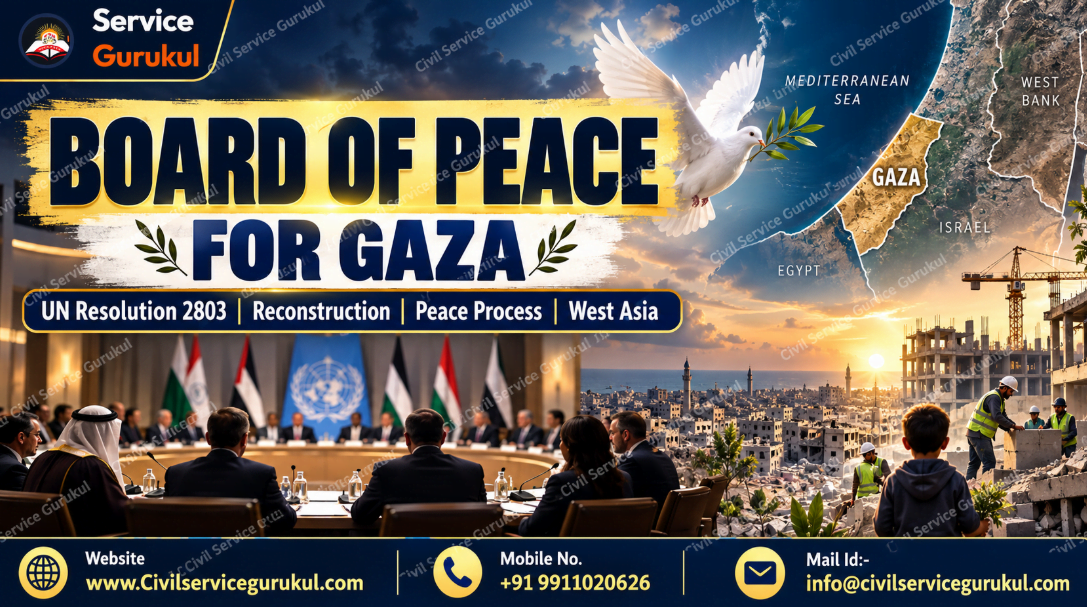
Board of Peace for Gaza: A New Global Peace Framework or Another Test of International Diplomacy?
Understanding Trump's peace initiative, UN Security Council Resolution 2803, Palestinian transitional governance, Gaza reconstruction and India's strategic interests.
1. Why Is the Board of Peace in the News?
The Board of Peace (BoP) is an international mechanism established to help coordinate the implementation of a US-backed plan for stabilisation and reconstruction in Gaza.
The initiative emerged from a 20-point Comprehensive Plan to End the Gaza Conflict, announced in September 2025. A ceasefire framework came into effect in October 2025.
On 17 November 2025, the United Nations Security Council adopted Resolution 2803, welcoming the establishment of the Board of Peace as a transitional administration.
The Board's charter was formally launched in Davos on 22 January 2026, with US President Donald Trump as chairman.
A year after the ceasefire, implementation remains seriously constrained. Important disagreements persist over Hamas disarmament, Israeli withdrawal, Palestinian transitional governance and the deployment of an international force.
Reconstruction has advanced only to a limited extent, while humanitarian needs remain severe. The proposed arrangements should therefore not be confused with fully functioning institutions on the ground in Gaza.
2. Historical Background of the Israel-Palestine Conflict
A. UN Partition Plan, 1947
UN General Assembly Resolution 181 proposed partitioning British Mandatory Palestine into Jewish and Arab states, with a special international arrangement for Jerusalem.
B. Arab-Israeli War, 1948
The establishment of Israel in 1948 was followed by war involving neighbouring Arab states. Large numbers of Palestinians became refugees.
C. Six-Day War, 1967
Israel occupied the West Bank, including East Jerusalem, and the Gaza Strip during the 1967 war. These territories became central to subsequent peace negotiations and disputes.
D. Oslo Accords, 1993–1995
The Oslo process created a framework for Israeli-Palestinian negotiations and the establishment of the Palestinian Authority. It did not resolve final-status issues.
E. Gaza Since 2007
Following internal Palestinian political conflict, Hamas established control over Gaza in 2007, while the Palestinian Authority continued to administer parts of the West Bank.
F. War Beginning in October 2023
The Hamas-led attacks on Israel on 7 October 2023 and the subsequent Israeli military campaign produced extensive loss of life, hostage-taking, displacement, destruction and humanitarian suffering.
3. Timeline: From Gaza War to Board of Peace
4. What Is the Board of Peace?
The Board of Peace is a US-led international mechanism associated with the transitional administration and reconstruction of Gaza.
Resolution 2803 welcomes the Board's establishment as a transitional administration with international legal personality.
The Board is intended to coordinate funding, redevelopment and oversight under the Comprehensive Plan.
Main Objectives
- Support implementation of the ceasefire framework.
- Coordinate humanitarian recovery and reconstruction.
- Oversee transitional governance arrangements.
- Help mobilise international financial resources.
- Support security arrangements and demilitarisation objectives.
- Facilitate conditions for eventual Palestinian administration.
The Board of Peace is not the United Nations Security Council, the International Court of Justice or a UN specialised agency.
It is a distinct international mechanism welcomed by the Security Council for implementation of the Gaza peace framework.
5. UN Security Council Resolution 2803 (2025)
| Feature | Important Detail |
|---|---|
| Resolution | 2803 (2025) |
| Date | 17 November 2025 |
| Votes in favour | 13 |
| Votes against | 0 |
| Abstentions | China and Russia |
| Core subject | Comprehensive Plan to End the Gaza Conflict |
| Important body | Board of Peace |
| Security mechanism | International Stabilization Force |
Important Provisions
- Endorsement of the Comprehensive Plan to End the Gaza Conflict.
- Recognition of the Board of Peace's transitional role.
- Support for humanitarian assistance and redevelopment.
- Authorisation of arrangements connected with an International Stabilization Force.
- Provision for a Palestinian technocratic committee for day-to-day governance.
- Recognition of a possible pathway to Palestinian self-determination and statehood.
Security Council recognition of the Board does not make it identical to a traditional UN peacekeeping mission. The International Stabilization Force is a separately authorised arrangement under the resolution.
6. Institutional Structure: Who Does What?
Board of Peace
International political, financial and transitional oversight mechanism chaired by Donald Trump.
Palestinian Technocratic Committee
The National Committee for the Administration of Gaza is intended to manage public services and municipal administration.
International Stabilization Force
A proposed multinational security arrangement to support stabilisation and implementation of the peace framework.
Palestinian Authority
Envisaged as a potential longer-term governing authority following reforms and progress in reconstruction.
Board of Peace vs UN Peacekeeping
| Board of Peace / Gaza Framework | Traditional UN Peacekeeping |
|---|---|
| Distinct US-led peace and transitional governance mechanism | UN missions authorised or established through UN processes |
| Focused on the Gaza peace framework | Operates in different conflict situations |
| Provides political, financial and transitional oversight | May involve monitoring, civilian protection and peace implementation |
| Associated with an authorised International Stabilization Force | Usually operates through a UN mission structure |
7. Why Is the Board of Peace Important?
A. International Security
Gaza's conflict has wider implications for the stability of West Asia, Israeli and Palestinian security and relations among regional and global powers.
B. Reconstruction and Development
The destruction of housing, healthcare, transport, water infrastructure and other services requires substantial long-term reconstruction.
C. Palestinian Governance
The proposed transitional arrangements seek to establish administrative mechanisms that can deliver essential public services.
D. International Cooperation
Successful implementation would require coordination among Israel, Palestinian representatives, regional mediators, international institutions and participating states.
E. Two-State Solution
The framework refers to conditions that could create a pathway to Palestinian self-determination and eventual statehood.
However, a political reference to statehood does not guarantee its achievement.
8. Major Challenges Facing the Board
Disarmament Dispute
Disagreement over the timing, verification and conditions of Hamas disarmament continues to obstruct implementation.
Israeli Military Withdrawal
The sequencing of security arrangements and Israeli troop withdrawal remains a central dispute.
Palestinian Legitimacy
An enduring settlement requires politically credible Palestinian participation, accountability and meaningful self-government.
Humanitarian Emergency
Displacement, damaged infrastructure and inadequate essential services continue to affect Gaza's population.
Financing Gap
The financial resources required for large-scale recovery exceed funds that can be rapidly deployed.
International Trust
Differences among major powers and regional stakeholders can undermine implementation and public confidence.
The existence of the Board and its internationally recognised framework should not be confused with successful implementation of all elements of the peace plan.
By October 2026, several core security, governance and reconstruction objectives remain incomplete.
9. International Law and Humanitarian Principles
The Gaza peace framework raises major issues under international law and global humanitarian governance.
A. UN Charter
The UN Charter provides the international framework for peace and security, peaceful dispute settlement and the role of the Security Council.
B. International Humanitarian Law
International humanitarian law requires protection of civilians and regulates the conduct of hostilities.
C. Self-Determination
The right of Palestinians to self-determination is central to the broader political settlement.
D. Humanitarian Assistance
Aid delivery must consider civilian needs, humanitarian principles, and relevant legal obligations.
E. Accountability
Durable peace requires credible mechanisms for accountability, legal protection and prevention of future violations.
10. India's Position and Strategic Interests
A. India-Israel Relations
India has substantial cooperation with Israel in defence technology, agriculture, water management, innovation and trade.
B. India-Palestine Relations
India has historically supported Palestinian aspirations and a negotiated two-state solution.
C. Strategic Autonomy
India seeks to maintain constructive ties with Israel, Palestine, the United States and important Arab partners, without being bound to a single regional bloc.
D. Energy Security
Instability in West Asia can affect energy supplies, oil prices, shipping insurance and transportation costs.
E. Indian Diaspora
Millions of Indians live and work across West Asia, making regional peace important for livelihoods and remittances.
F. Connectivity
Regional stability is relevant to India's wider connectivity interests, including the proposed India–Middle East–Europe Economic Corridor.
Support peaceful dialogue, protect civilians, encourage humanitarian access, promote a negotiated two-state solution and maintain balanced strategic partnerships.
11. Important Terms for UPSC Prelims
| Term | Meaning |
|---|---|
| Board of Peace | International transitional and redevelopment mechanism associated with the Gaza plan |
| UNSC Resolution 2803 | 2025 resolution endorsing the Comprehensive Plan |
| NCAG | National Committee for the Administration of Gaza |
| ISF | International Stabilization Force |
| Palestinian Authority | Palestinian governing institution established under the Oslo process |
| UNRWA | UN agency serving Palestine refugees |
| Two-state solution | Political framework envisaging Israel and a sovereign Palestinian state |
| Oslo Accords | Israeli-Palestinian interim peace agreements of the 1990s |
12. Six Actual UPSC Previous Year Questions
The following six questions are historical UPSC Civil Services Mains GS II questions. They are related to West Asia, India's foreign policy and international institutions.
They are descriptive questions, so there are no multiple-choice options. Model answer frameworks are provided instead.
PYQ 1. India's Energy Security and West Asia
The question of India's energy security constitutes the most important part of India's economic progress. Analyse India's energy policy cooperation with West Asian countries.
- India's dependence on imported hydrocarbons.
- Strategic importance of West Asian energy exporters.
- Long-term energy contracts and economic cooperation.
- Energy transportation routes and maritime security.
- Risks from regional conflicts and supply disruptions.
- Diversification, strategic reserves and renewable energy.
Link with Gaza: Regional instability can influence energy prices, maritime risk and India's strategic economic interests.
PYQ 2. United Nations Economic and Social Council
What are the main functions of the United Nations Economic and Social Council (ECOSOC)? Explain different functional commissions attached to it.
- ECOSOC is one of the principal organs of the UN.
- Coordinates economic, social and related activities.
- Provides a platform for policy discussions and recommendations.
- Supports sustainable development cooperation.
- Functional commissions work on areas including social development, population and statistics.
Link with Gaza: Understand the institutional architecture of the UN and distinguish its principal organs from special-purpose peace mechanisms.
PYQ 3. India-Israel Relations
"India's relations with Israel have, of late, acquired a depth and diversity, which cannot be rolled back." Discuss.
- Full diplomatic relations established in 1992.
- Defence and security cooperation.
- Agricultural technology and water management.
- Innovation, technology and economic cooperation.
- India's continuing relationship with Palestine.
- Importance of diplomatic balance and strategic autonomy.
Link with Gaza: India's approach combines strong ties with Israel and longstanding support for Palestinian self-determination.
PYQ 4. US-Iran Nuclear Pact Controversy
In what ways would the ongoing US-Iran Nuclear Pact Controversy affect the national interest of India? How should India respond to this situation?
- Impact on crude oil prices and energy imports.
- US sanctions and financial transactions.
- Strategic importance of Iran and Chabahar.
- India's relations with the US and Gulf states.
- Connectivity and regional economic interests.
- Independent diplomacy and dialogue.
Link with Gaza: West Asian conflicts often create interconnected diplomatic, economic and strategic challenges for India.
PYQ 5. NATO and Strategic Partnerships
"The expansion and strengthening of NATO and a stronger US-Europe strategic partnership works well for India." What is your opinion about this statement? Give reasons and examples to support your answer.
- Potential benefits of stronger security cooperation.
- Effects on global and regional stability.
- Consequences for India's ties with major powers.
- Risks of rigid military blocs and polarisation.
- Strategic autonomy and multipolar diplomacy.
Link with Gaza: Evaluate how US-led security frameworks interact with multilateral institutions and regional political realities.
PYQ 6. International Maritime Organization
"Sea is an important component of the Cosmos." Discuss, in the light of this statement, the role of the International Maritime Organization in protecting the environment and enhancing maritime safety and security.
- IMO is a UN specialised agency.
- Supports international shipping safety.
- Develops maritime environmental standards.
- Important conventions include SOLAS and MARPOL.
- International coordination supports maritime security.
- Environmental protection and shipping efficiency are interconnected.
Link with Gaza: Regional conflict can affect shipping, maritime security and international transport networks.
13. UPSC PYQ Trend Analysis
The six selected questions span 2017–2023. They provide evidence of relevant syllabus themes, not a complete statistical survey of all past UPSC papers.
| Year | PYQ Topic | Core Demand | Relevance to Gaza |
|---|---|---|---|
| 2017 | West Asian energy security | Economic and strategic analysis | High |
| 2017 | ECOSOC | International institution functions | High |
| 2018 | India-Israel | Bilateral relations | Very High |
| 2018 | US-Iran controversy | Regional instability and India | High |
| 2023 | NATO and strategic partnerships | Security and foreign policy | Medium |
| 2023 | IMO | Institutional mandate and maritime security | Medium |
A. What Does the Selected Mains PYQ Sample Suggest?
- UPSC expects analysis of India's national interests in West Asian developments.
- International institutions should be studied through their functions and limitations.
- Bilateral partnerships must be linked to broader geopolitical developments.
- Security developments should be analysed alongside economic consequences.
- Balanced diplomatic arguments are important for GS II answers.
B. Prelims Preparation Pattern
For Prelims, the Board of Peace topic can be converted into factual and conceptual areas:
- UNSC composition and voting procedures.
- Resolution 2803 and its date.
- Board of Peace versus UN peacekeeping.
- International Stabilization Force and NCAG.
- Geographical locations in West Asia.
- UNRWA, UNHRC, ICJ and ICC distinctions.
- Oslo Accords and the two-state solution.
14. Most Important Topics to Revise for UPSC 2027
Priority I: Very High
1. Israel-Palestine Conflict
- 1947 UN Partition Plan
- 1948 Arab-Israeli War
- 1967 Six-Day War
- Oslo Accords
- Palestinian Authority and Hamas
- West Bank, Gaza and East Jerusalem
- Two-state solution
2. UN Security Council
- 15-member composition
- Five permanent members
- Veto powers
- Voting requirements
- Chapter VI and Chapter VII
- Resolution 2803 (2025)
- UNSC and General Assembly differences
3. Board of Peace and Transitional Governance
- Purpose and establishment
- Trump's 20-point plan
- UNSC legal framework
- Board of Peace structure
- NCAG and Palestinian administration
- International Stabilization Force
- Current implementation challenges
4. India-Israel-Palestine Relations
- India's diplomatic relationships
- India's two-state solution position
- Defence and technology ties with Israel
- India's relationship with Palestine
- Strategic autonomy
- Humanitarian diplomacy
Priority II: High
5. West Asia Geography
- Gaza Strip and West Bank
- Israel and neighbouring states
- Egypt and Rafah crossing
- Mediterranean Sea
- Red Sea and Suez Canal
- Strait of Hormuz
- Bab el-Mandeb Strait
6. International Humanitarian Law
- Geneva Conventions
- Protection of civilians
- Humanitarian principles
- ICJ versus ICC
- UNRWA and humanitarian assistance
- Right to self-determination
7. West Asia and India's Economy
- Energy imports
- Oil-price volatility
- Shipping-route security
- Indian diaspora
- Remittances
- IMEC connectivity
- Regional diplomacy
Priority III: Supporting
8. Peacebuilding and International Institutions
- UN peacekeeping principles
- UN-authorised multinational operations
- Peacebuilding Commission
- Reconstruction finance
- Conflict resolution and mediation
- Institutional accountability
15. Original UPSC Prelims Practice MCQs
Question 1. Resolution 2803
Consider the following statements:
1. UNSC Resolution 2803 was adopted in 2025.
2. It welcomed the Board of Peace.
3. China and Russia voted against the resolution.
Which statements are correct?
(a) 1 only
(b) 1 and 2 only
(c) 2 and 3 only
(d) All three
Resolution 2803 was adopted in November 2025 and welcomed the Board of Peace. China and Russia abstained rather than voting against.
Question 2. UN Security Council
Consider the following statements:
1. The UNSC has 15 members.
2. All 15 members possess veto powers.
3. China is a permanent member.
Choose the correct answer:
(a) 1 and 3 only
(b) 1 and 2 only
(c) 2 and 3 only
(d) All three
The UNSC has five permanent members and ten elected non-permanent members. Only the permanent members possess veto powers.
Question 3. Gaza Geography
Which statements are correct?
1. Gaza has a coastline on the Mediterranean Sea.
2. Gaza shares a land boundary with Egypt.
3. Gaza is located east of the West Bank.
(a) 1 only
(b) 1 and 2 only
(c) 2 and 3 only
(d) All three
Gaza lies along the Mediterranean coast and borders Egypt and Israel. The West Bank lies to the east of Gaza.
Question 4. International Institutions
Consider the following:
1. ICJ is the principal judicial organ of the UN.
2. ICC prosecutes individuals for certain international crimes.
3. UNRWA is an international military alliance.
Which are correct?
(a) 1 and 2 only
(b) 2 and 3 only
(c) 1 and 3 only
(d) All three
ICJ handles disputes between states and certain advisory proceedings. ICC is a separate treaty-based criminal court. UNRWA is a UN agency providing services to Palestine refugees.
Question 5. Board of Peace
Which statement is most accurate?
(a) It is a permanent principal organ of the UN.
(b) It is identical to the International Court of Justice.
(c) It is a transitional international mechanism welcomed under UNSC Resolution 2803.
(d) It is the same as the Palestinian Authority.
The Board is a distinct international mechanism associated with Gaza's transitional governance and reconstruction.
16. Important Mains Practice Questions
Critically evaluate the potential of the Board of Peace to contribute to sustainable peace in Gaza.
Discuss the role of the UN Security Council in post-conflict reconstruction and transitional political arrangements, with reference to Gaza.
Explain how India can balance its strategic partnership with Israel and its support for Palestinian self-determination.
Examine the implications of prolonged West Asian instability for India's energy security, maritime trade and regional connectivity.
17. Three-Day Revision Plan
| Day | Topics | Task |
|---|---|---|
| Day 1 | Israel-Palestine history, West Asia mapping | Atlas practice and 20 MCQs |
| Day 2 | UNSC, Resolution 2803, Board of Peace, ICJ and ICC | Institution chart and PYQ revision |
| Day 3 | India's West Asia policy, energy security, Mains analysis | Two 250-word answers |
18. Last-Minute Revision Facts
- The Board of Peace is associated with the Gaza peace framework.
- Donald Trump chairs the Board.
- Relevant UN resolution: 2803 (2025).
- Resolution adopted: 17 November 2025.
- Voting: 13 in favour, none against, two abstentions.
- China and Russia abstained.
- Board charter launched in Davos in January 2026.
- NCAG refers to the National Committee for the Administration of Gaza.
- ISF refers to the International Stabilization Force.
- The Palestinian Authority is distinct from Hamas.
- Gaza lies on the Mediterranean coast.
- Gaza shares a border with Egypt.
- The Oslo Accords were signed in the 1990s.
- India supports a negotiated two-state solution.
- Major implementation challenges persisted in October 2026.
19. Conclusion
The Board of Peace represents an ambitious attempt to create an international framework for Gaza's transitional governance, security and reconstruction.
Its success depends not merely on agreements or institutional structures, but on effective implementation, Palestinian participation, credible security arrangements, humanitarian relief and political legitimacy.
For India, the issue illustrates the importance of diplomatic balance, strategic autonomy and peaceful conflict resolution.
Study the Board of Peace through five dimensions: UN institutions, West Asian geography, international humanitarian law, India's foreign policy and post-conflict reconstruction.
20. Frequently Asked Questions
What is the Board of Peace for Gaza?
It is an international mechanism intended to coordinate the Gaza peace plan, transitional governance and reconstruction.
Which UN resolution is associated with it?
UNSC Resolution 2803 (2025).
Is the Board of Peace a UN specialised agency?
No. It is a distinct international mechanism welcomed under the Security Council resolution.
What is the International Stabilization Force?
It is an authorised multinational security framework proposed to support implementation of the Gaza peace plan.
Why is Gaza important for India?
The issue affects India's West Asia diplomacy, regional stability, energy security, international connectivity and humanitarian interests.
UPSC Syllabus Relevance
Prepare with Mentors Who Cleared the Exam
Get personalized study plans, evaluated answer models, and test series access.