
C-Section Deliveries India 2026: Rates & UPSC Analysis
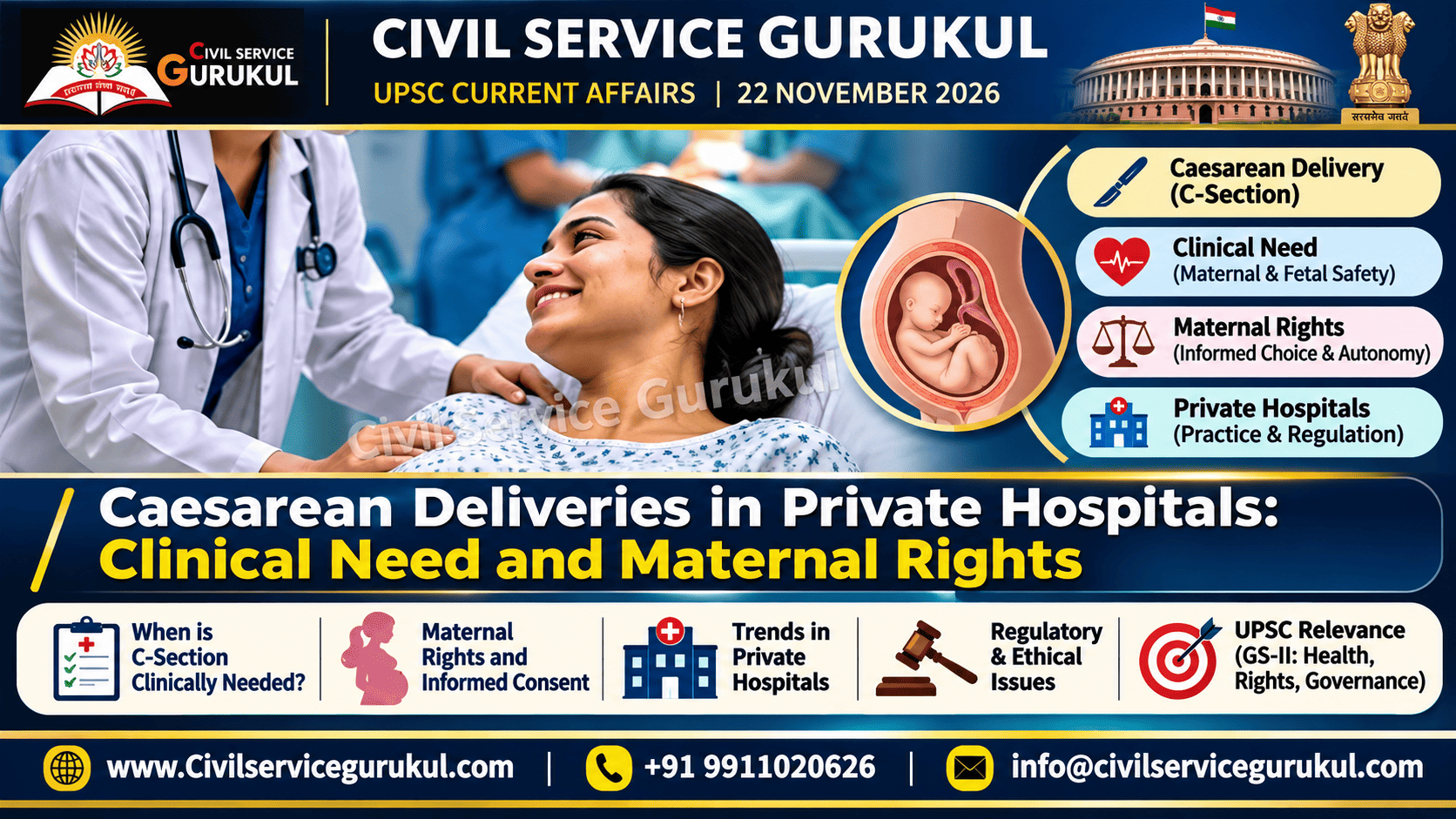
UPSC CURRENT AFFAIRS | PUBLIC HEALTH | GS PAPER II & IV
C-Section Deliveries in India 2026: Private Hospital Trends, Maternal Health Rights, WHO Guidelines and UPSC Analysis
A comprehensive examination of rising Caesarean deliveries, private healthcare, clinical decision-making, informed consent, maternal rights and public health governance.
Published: 22 November 2026
1. Why Are Caesarean Deliveries in the News?
A study published by Plum DataLabs in November 2026 has drawn attention to the high proportion of Caesarean section deliveries among insured, urban and white-collar working families in India.
The report, titled Maternity in Corporate India, analysed maternity-related health insurance claims over a three-year period.
It found that approximately 68.8% of deliveries in its insured cohort were performed through Caesarean section, commonly called C-section.
The report examined 16,192 childbirth cases within a broader group of 17,799 pregnancies resulting in hospitalisation claims.
The findings have renewed discussion about the balance between medically necessary surgical deliveries, patient autonomy, private healthcare practices and financial protection.
2. What Is a Caesarean Section?
A Caesarean section is a surgical procedure used to deliver a baby through incisions made in the mother's abdomen and uterus.
It is an important life-saving medical intervention when vaginal delivery poses significant risks to the mother or baby.
However, because it is major abdominal surgery, it involves potential short-term and long-term health risks.
When May a C-Section Be Medically Necessary?
- Obstructed labour or failure of labour to progress safely.
- Certain abnormal fetal presentations.
- Placenta previa or other serious placental problems.
- Evidence of significant fetal compromise requiring urgent delivery.
- Certain multiple pregnancies or other high-risk obstetric conditions.
- Specific circumstances following previous uterine surgery.
The appropriate mode of delivery depends on individual clinical assessment rather than a single factor or hospital-wide target.
3. What Does NFHS-6 Reveal About C-Section Rates?
The National Family Health Survey-6 (2023–24) provides updated information on reproductive, maternal and child health in India.
The survey was conducted under the Ministry of Health and Family Welfare, with the International Institute for Population Sciences as the nodal agency.
Its findings show an increase in the proportion of Caesarean deliveries compared with NFHS-5 (2019–21).
| Indicator | NFHS-5 (2019–21) | NFHS-6 (2023–24) |
|---|---|---|
| National C-section Rate | 21.5% | 27.2% |
| Private Health Facility C-section Rate | 47.4% | 54.1% |
| Public Health Facility C-section Rate | 14.3% | 16.9% |
| Institutional Deliveries | 88.6% | 90.6% |
What Do These Trends Indicate?
India has made significant progress in increasing institutional childbirth, with approximately nine out of every ten births now taking place in healthcare facilities.
However, the proportion of births delivered through C-section has also increased.
The substantial difference between public and private facility rates makes clinical auditing and quality-of-care assessment important public health priorities.
Nevertheless, aggregate differences alone cannot demonstrate that particular surgeries were unnecessary.
4. Key Findings of the November 2026 Study
The Plum DataLabs study provides additional insights into childbirth patterns among insured working families.
A. High Caesarean Delivery Rate
Approximately 68.8% of recorded deliveries in the study cohort were through C-section.
B. Differences by Maternal Age
The reported rate increased from approximately 63% among mothers younger than 25 years to about 76% among mothers aged 35 years and above.
Maternal age may influence pregnancy risk, but age alone does not prove a medical indication for surgical delivery.
C. Differences Across Hospitals
The study reported C-section rates generally between approximately 68.6% and 72.7% across several private hospital categories.
Mission and trust hospitals recorded a lower rate of approximately 51.5% within the study cohort.
D. Financial Burden
The report also indicated that approximately 82% of insured families incurred out-of-pocket expenditure.
This highlights that health insurance coverage does not necessarily eliminate the financial burden of maternity care.
E. Repeat Caesarean Deliveries
The report discussed the tendency toward repeat C-sections following a previous surgical delivery.
For appropriately selected women, vaginal birth after Caesarean (VBAC) may be a clinical option where suitable monitoring and emergency surgical facilities are available.
5. What Does WHO Say About Caesarean Section Rates?
The World Health Organization (WHO) recognises Caesarean section as an essential intervention when medically indicated.
WHO's population-level research found that increasing C-section rates up to approximately 10% was associated with reductions in maternal and neonatal mortality.
Above that level, further increases were not associated with additional reductions in those mortality indicators in the analysed population data.
However, this finding does not establish that every hospital must achieve a fixed 10% or 15% rate.
Important WHO Clarification
- WHO does not recommend one universal C-section rate for every hospital.
- Hospitals have different patient populations, referral patterns and pregnancy risk profiles.
- Some specialist hospitals appropriately manage a higher proportion of complicated pregnancies.
- The priority is medically appropriate care and better maternal and newborn outcomes.
6. What Is the Robson Ten-Group Classification?
The Robson Classification is a WHO-supported framework for assessing, monitoring and comparing Caesarean section rates.
It classifies women admitted for childbirth into ten mutually exclusive and collectively exhaustive groups using obstetric characteristics.
Five Key Classification Characteristics
| Characteristic | What It Examines |
|---|---|
| Parity and Previous C-Section | Previous childbirth history and uterine surgical history |
| Onset of Labour | Spontaneous labour, induction or pre-labour C-section |
| Gestational Age | Preterm or term pregnancy |
| Fetal Presentation or Lie | Cephalic, breech or transverse position |
| Number of Fetuses | Single or multiple pregnancy |
Why Is Robson Classification Important?
- Helps identify which obstetric groups contribute most to total C-sections.
- Supports comparisons between similar patient populations.
- Improves clinical auditing and monitoring.
- Helps detect patterns that warrant further quality review.
- Supports evidence-based maternity care improvement.
7. Why Might Caesarean Rates Be High in Private Hospitals?
There may be several overlapping clinical, organisational and non-clinical factors.
A. Clinical Risk Factors
Some facilities serve patients with a higher prevalence of pregnancy complications, previous C-sections, multiple pregnancies or other conditions requiring specialist care.
B. Hospital Referral Patterns
Tertiary and specialist hospitals may receive complicated referrals from smaller facilities. This can legitimately increase their C-section rates.
C. Scheduling and Organisational Factors
Surgical deliveries can be scheduled, whereas labour may require prolonged monitoring and unpredictable staffing.
Such organisational pressures may influence practice patterns, but their effect must be assessed using reliable evidence.
D. Financial Incentives
Differences in hospital billing arrangements and payment systems may create incentives that warrant scrutiny.
However, a high C-section rate does not, by itself, prove financial misconduct or unnecessary surgery.
E. Defensive Medicine
Concern about adverse outcomes and legal disputes can influence clinical decisions.
F. Patient Preferences
Some women may prefer a planned delivery, but genuine informed choice requires balanced information about benefits, risks and alternatives.
G. Availability of Labour Support
Shortages of skilled midwives, continuous labour support, pain-relief services or emergency referral systems may influence the available options.
8. Benefits and Risks of Caesarean Deliveries
| Potential Benefits When Indicated | Potential Risks |
|---|---|
| Can prevent serious maternal complications | Surgical bleeding and infection |
| Can prevent harm to a baby when urgent delivery is needed | Anaesthesia-related complications |
| Can be appropriate in specific high-risk pregnancies | Longer postoperative recovery |
| May provide a safer delivery route in certain obstetric conditions | Potential complications in future pregnancies |
Clinical decisions should consider both the benefits and risks of the available delivery methods.
Emergency obstetric care must remain readily accessible, while unnecessary medical interventions should be avoided.
9. Maternal Rights and Informed Consent
Maternal healthcare involves more than providing medical technology and surgical facilities.
It also requires respect for the dignity, autonomy, privacy and well-being of pregnant women.
Important Principles
- Informed Consent: Patients should receive understandable information about the proposed procedure, important risks, benefits and reasonable alternatives.
- Respectful Care: Women should receive dignified and non-discriminatory maternity services.
- Privacy and Confidentiality: Personal medical information must be protected.
- Clinical Transparency: Relevant indications and treatment decisions should be documented.
- Financial Transparency: Patients should be informed about expected charges and applicable insurance coverage.
- Access to Emergency Care: Necessary interventions must not be delayed merely to meet statistical targets.
10. Financial Burden of Surgical Childbirth
Caesarean deliveries may involve expenses associated with surgery, anaesthesia, hospitalisation, medicines and postoperative care.
The total cost of delivery can vary significantly depending on the hospital, location and clinical complexity.
The November 2026 insurance-based study found that many families incurred out-of-pocket expenditure despite having maternity insurance coverage.
Important Public Policy Concerns
- Limited maternity insurance sublimits.
- Differences between public and private hospital charges.
- Unexpected costs associated with newborn complications.
- Unequal access to high-quality obstetric care.
- Financial vulnerability among lower-income households.
Improved financial protection should be combined with quality-of-care measures rather than focusing only on reimbursement.
11. Government Initiatives for Maternal Healthcare
India has introduced multiple programmes to improve maternal healthcare access, institutional delivery and the quality of childbirth services.
| Initiative | Major Objective |
|---|---|
| Janani Suraksha Yojana (JSY) | Promoting institutional delivery among eligible beneficiaries |
| Janani Shishu Suraksha Karyakram (JSSK) | Specified free and cashless maternal and newborn services in public facilities |
| Pradhan Mantri Surakshit Matritva Abhiyan (PMSMA) | Improving antenatal assessment and care |
| SUMAN Initiative | Promoting assured, respectful and quality maternal and newborn healthcare |
| LaQshya Programme | Improving quality of care in labour rooms and maternity operation theatres |
| Pradhan Mantri Matru Vandana Yojana (PMMVY) | Maternity benefits for eligible women under scheme conditions |
These programmes address important aspects of the maternal healthcare continuum, including antenatal care, safe delivery, financial support and quality assurance.
12. Ethical Issues: UPSC GS Paper IV
The debate concerning Caesarean deliveries raises important questions about professional ethics and public accountability.
Autonomy
Women should be supported in making informed decisions about their maternity care, with appropriate clinical counselling.
Beneficence
Healthcare professionals should act in the best medical interests of their patients.
Non-Maleficence
Unnecessary harm and avoidable medical intervention should be minimised.
Justice
Access to safe maternal healthcare should not depend solely on income, location or insurance status.
Professional Integrity
Clinical decisions should be based on medical judgement, evidence and professional standards rather than inappropriate external pressures.
Accountability
Healthcare institutions should maintain appropriate records, quality audits and effective grievance mechanisms.
13. Way Forward: Improving Maternal Healthcare
- Risk-Adjusted Clinical Audits: Use patient risk profiles and the Robson Classification to review C-section patterns.
- Improve Informed Consent: Ensure balanced clinical counselling and proper documentation of treatment decisions.
- Strengthen Public Facilities: Expand access to safe emergency obstetric services, referral systems and skilled staff.
- Improve Labour Support: Strengthen trained midwifery, pain-relief services and continuous monitoring.
- Promote Clinical Guidelines: Use evidence-based protocols without imposing inappropriate numerical targets.
- Strengthen Financial Protection: Improve transparency of charges and insurance benefits.
- Independent Quality Review: Monitor outcomes, complications and patient experiences alongside procedure rates.
- Respectful Maternity Care: Protect dignity, privacy, choice and meaningful communication.
14. UPSC Prelims 2027: Rapid Revision
- Caesarean section is a surgical method of childbirth.
- NFHS stands for National Family Health Survey.
- NFHS-6 reference period: 2023–24.
- NFHS-6 national C-section rate: 27.2%.
- NFHS-6 private facility C-section rate: 54.1%.
- NFHS-6 public facility C-section rate: 16.9%.
- November 2026 insured-cohort study: 68.8% C-sections.
- WHO does not recommend a universal hospital-level C-section target.
- Robson Classification: 10 obstetric groups.
- Robson groups use five obstetric characteristics.
- Article 21 is relevant to health, dignity and personal autonomy.
- LaQshya focuses on quality improvement in maternity care.
- SUMAN promotes assured, respectful maternal and newborn healthcare services.
15. Original UPSC Prelims Practice MCQs
Question 1
With reference to Caesarean deliveries, consider the following statements:
- WHO prescribes an identical C-section target for all hospitals.
- The medical need for a C-section may vary according to a hospital's patient population.
- The Robson Classification can be used to monitor Caesarean delivery rates.
Which of the above statements are correct?
(A) 1 and 2 only
(B) 2 and 3 only
(C) 1 and 3 only
(D) 1, 2 and 3
View Answer and Explanation
Correct Answer: (B)
Statement 1 is incorrect. WHO does not prescribe one fixed rate for all hospitals.
Statement 2 is correct. Different facilities serve different obstetric risk groups.
Statement 3 is correct. The Robson system helps assess and compare C-section use.
Question 2
Which one of the following best describes the Robson Classification?
(A) A system for
measuring maternal mortality
(B) A system for classifying
women into ten obstetric groups
(C) A system for determining
hospital insurance premiums
(D) A mandatory target
for hospital surgical deliveries
View Answer and Explanation
Correct Answer: (B)
Robson Classification organises women into ten obstetric groups to help evaluate Caesarean delivery patterns.
Question 3
According to India's NFHS-6 (2023–24), which of the following statements is correct?
(A) The national
C-section rate
was 54.1%.
(B) The private facility
C-section rate
was 27.2%.
(C) The national
C-section rate
was 27.2%.
(D) Every delivery
occurred in a
healthcare institution.
View Answer and Explanation
Correct Answer: (C)
The national C-section rate was 27.2%.
The private facility rate was 54.1%. Institutional deliveries were 90.6%, not 100%.
Question 4
With reference to the November 2026 insurance-based maternity study, consider the following:
- The reported 68.8% rate represented the study cohort.
- It automatically established the national C-section rate for India.
- Insurance claims alone can conclusively determine that every surgical delivery was unnecessary.
Which statement is correct?
(A) 1 only
(B) 1 and 2 only
(C) 2 and 3 only
(D) All three
View Answer and Explanation
Correct Answer: (A)
Statement 1 is correct. The statistic describes the insured study cohort.
Statements 2 and 3 are incorrect. Claims data are not automatically nationally representative, and clinical necessity requires appropriate medical assessment.
16. UPSC Mains Practice: GS Paper II
Question – 15 Marks | 250 Words
"The rising prevalence of Caesarean deliveries in private hospitals raises questions of healthcare quality, maternal autonomy and public accountability."
Critically examine the statement in the context of recent Indian maternal health data. Suggest measures to ensure medically appropriate and rights-based maternity care.
Suggested Answer Framework
Introduction: Define Caesarean delivery and briefly mention the NFHS-6 and November 2026 study findings.
Clinical Dimension: Explain the importance of life-saving surgical delivery and variation in obstetric risk.
Governance Dimension: Discuss informed consent, hospital transparency, clinical audits and patient rights.
Challenges: Analyse financial incentives, uneven clinical capacity, referral patterns and insurance costs.
Way Forward: Recommend Robson-based audits, better labour support, transparent records and accessible emergency obstetric care.
Conclusion: The objective should be safe and person-centred childbirth rather than achieving an arbitrary C-section percentage.
17. GS Paper IV: Ethical Case Study
Case Study
You are a District Health Officer. A review of several private hospitals indicates unusually high Caesarean delivery rates.
However, the hospitals argue that they serve patients with high-risk pregnancies.
Some patients complain about inadequate counselling and unexpected surgical charges.
Questions:
- Identify the ethical issues involved.
- What evidence would you collect before drawing conclusions?
- What measures would you adopt to protect maternal rights without restricting necessary emergency care?
View Suggested Approach
The ethical issues include autonomy, informed consent, professional integrity, justice, transparency and patient safety.
The officer should review risk-adjusted delivery data, clinical indications, obstetric records, patient complaints and hospital referral patterns.
Appropriate measures include professional clinical audit, transparent counselling, billing review, grievance redressal and stronger quality monitoring.
Decisions should be evidence-based and consistent with applicable legal and professional requirements.
18. Frequently Asked Questions
What is a Caesarean section?
A Caesarean section is a surgical procedure used to deliver a baby through incisions in the abdomen and uterus.
What was India's national C-section rate in NFHS-6?
The national rate was 27.2% during the NFHS-6 reference period of 2023–24.
What was the C-section rate in private facilities?
NFHS-6 reported 54.1% for births in private health facilities.
What did the November 2026 study report?
Plum DataLabs reported that approximately 68.8% of deliveries in its insured working-family cohort occurred through C-section.
Does WHO prescribe a fixed 10–15% rate for every hospital?
No. WHO does not recommend a single fixed Caesarean rate for every hospital. Medical need varies across patient populations.
What is the Robson Classification?
It is a system that groups women into ten obstetric categories for assessing and monitoring Caesarean delivery practices.
Why is this topic important for UPSC?
It connects public health, women's rights, healthcare regulation, evidence-based governance and medical ethics, particularly under GS Papers II and IV.
19. Conclusion
The rise in Caesarean deliveries in India presents a complex public health issue.
Caesarean section remains an essential life-saving intervention for women and newborns when medically necessary.
At the same time, the high rates reported in some private healthcare populations highlight the need for careful analysis of clinical decisions, hospital practices, financial pressures and maternal rights.
The November 2026 study and NFHS-6 findings should encourage better clinical audits and public debate without assuming that every C-section is unnecessary.
India's maternal health strategy must focus on safe childbirth, informed consent, financial protection, quality care and accessible emergency obstetric services.
Prepare UPSC Prelims & Mains 2027
Daily Current Affairs | Indian Polity | Social Justice | Public Health | Ethics | Mains Answer Writing
Build conceptual clarity with analytical explanations, UPSC-standard MCQs and structured answer-writing practice.
Website
www.civilservicegurukul.com
Mobile
+91 9911020626
Prepare with Mentors Who Cleared the Exam
Get personalized study plans, evaluated answer models, and test series access.