
Deep-Sea Mining in India: Critical Minerals, Deep Ocean Mission & UPSC Analysis
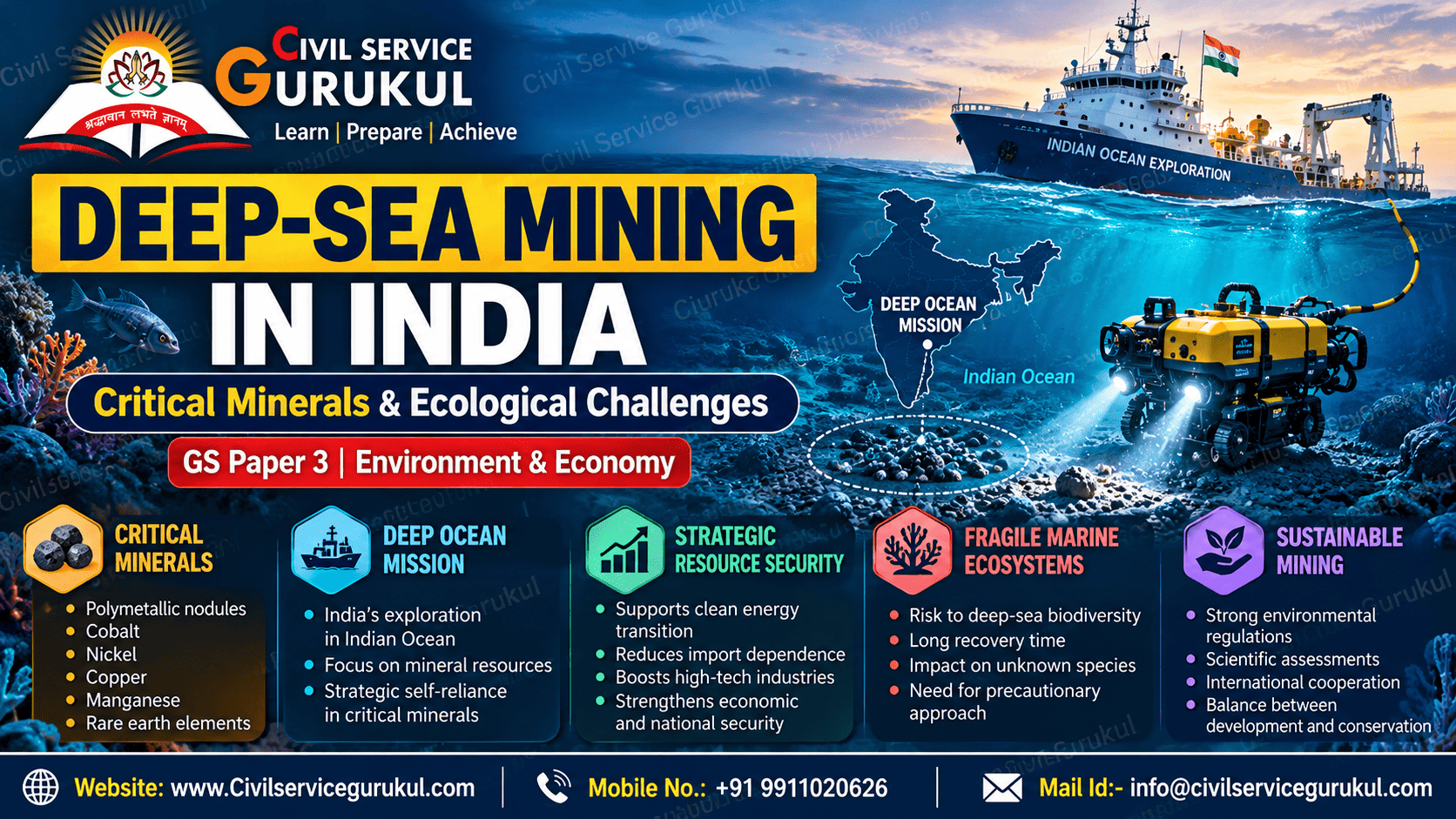
Deep-Sea Mining in India: Can Critical Mineral Security Be Achieved Without Sacrificing Ocean Ecology?
India's Deep Ocean Mission is expanding scientific and technological capabilities to explore mineral resources thousands of metres beneath the ocean surface. Yet the same seabed that contains nickel, cobalt, copper and manganese also supports some of Earth's least understood ecosystems, creating a major policy dilemma for India and the world.
Deep-sea mining involves extracting mineral-rich deposits such as polymetallic nodules, polymetallic sulphides and cobalt-rich crusts from the ocean floor. For India, these resources could strengthen access to critical minerals required for electric vehicles, renewable energy, batteries and strategic technologies. Through the Deep Ocean Mission, India is developing capabilities such as MATSYA-6000, underwater robotics and seabed mining systems. However, fragile marine habitats, sediment plumes, biodiversity loss and an incomplete global regulatory framework make commercial deep-sea mining a significant environmental challenge. The central policy question is whether technological capability should automatically lead to commercial exploitation.
GS Paper 3: Environment, Conservation, Science & Technology, Infrastructure, Economic Development.
Prelims: Deep Ocean Mission, MATSYA-6000, International Seabed Authority, UNCLOS, polymetallic nodules, critical minerals.
Essay: Technology vs Ecology, Blue Economy, Sustainable Development, Intergenerational Equity.
What Is Deep-Sea Mining?
Deep-sea mining refers to the exploration and potential extraction of mineral deposits located on or beneath the ocean floor, often at depths between approximately 3,000 and 6,000 metres.
The principal mineral resources of interest include:
- polymetallic nodules;
- polymetallic sulphides;
- cobalt-rich ferromanganese crusts.
These deposits can contain economically important metals required by modern industry and the clean-energy transition.
Why Are Deep-Sea Minerals Important?
The global transition toward electric mobility, renewable energy, digital infrastructure and advanced defence technologies is increasing demand for critical minerals.
| Mineral | Strategic Uses |
|---|---|
| Nickel | Batteries, stainless steel and energy-storage systems. |
| Cobalt | Lithium-ion batteries, aerospace and advanced alloys. |
| Copper | Electric grids, EVs, electronics and renewable-energy systems. |
| Manganese | Batteries, steel production and industrial applications. |
Critical minerals increasingly influence not only economic competitiveness but also energy security, industrial policy, defence preparedness and strategic autonomy.
India's Deep Ocean Mission
The Deep Ocean Mission is a major programme of the Ministry of Earth Sciences aimed at strengthening India's scientific and technological capabilities in the deep ocean.
It covers areas including:
- deep-sea mining technologies;
- human submersibles;
- underwater robotics;
- deep-sea biodiversity;
- ocean climate services;
- deep-ocean surveys;
- marine biological research;
- ocean-based energy and freshwater technologies.
What Is MATSYA-6000?
MATSYA-6000 is India's indigenously developed human-rated deep-sea submersible under the Samudrayaan component of the Deep Ocean Mission.
It is designed to carry three persons to depths of up to 6,000 metres.
Its scientific purpose includes observation and exploration of:
- deep-sea biodiversity;
- geological formations;
- mineral resources;
- oceanographic processes.
Its development represents an important step toward Indian technological self-reliance in extreme ocean environments.
India's Seabed Mining Technology
The National Institute of Ocean Technology has developed a seabed mining system intended for exploration and possible future harvesting of polymetallic nodules.
Mobility and system-powering trials have already been conducted at depths of approximately 5,270 metres in the Central Indian Ocean.
Such technological achievements demonstrate India's growing engineering capability in one of the world's most difficult operating environments.
India's Polymetallic Nodule Resources
India has undertaken extensive exploration in its allocated area of the Central Indian Ocean Basin.
The region is estimated to contain approximately 366 million metric tonnes of polymetallic nodules.
These nodules contain combinations of manganese, nickel, copper and cobalt.
India's allocated Central Indian Ocean Basin area contains an estimated 366 million metric tonnes of polymetallic nodules. This is an important figure for GS Paper 3 answers on critical minerals and the Deep Ocean Mission.
International Seabed Authority and India's Exploration Rights
Mineral resources located in international seabed areas beyond national jurisdiction are regulated under the international law of the sea.
India has secured exploration contracts with the International Seabed Authority (ISA) for mineral resources in the Indian Ocean.
India's exploration areas include portions of:
- Central Indian Ocean Basin;
- Central Indian Ridge;
- Carlsberg Ridge.
These contracts permit exploration and scientific work subject to international rules and environmental obligations.
UNCLOS and the “Common Heritage of Mankind”
Part XI of the United Nations Convention on the Law of the Sea provides the legal foundation for governance of mineral resources in international seabed areas.
These resources are treated as the Common Heritage of Mankind.
The International Seabed Authority is responsible for organising and regulating mineral-related activities in such areas.
Can Commercial Deep-Sea Mining Begin Immediately?
No.
Exploration capability should not be confused with unrestricted commercial exploitation.
The comprehensive international rules governing commercial exploitation, including environmental safeguards, liability mechanisms, monitoring and benefit-sharing arrangements, remain a major area of global negotiation.
Exploration ≠ Commercial Exploitation. India currently possesses exploration contracts and is developing technology, but international commercial mining requires an appropriate ISA exploitation framework.
The Core Dilemma: Minerals vs Marine Ecology
The deep ocean is one of the least understood ecosystems on Earth.
Scientific knowledge about many deep-sea species, food webs and ecological relationships remains incomplete.
Mining therefore creates a fundamental policy dilemma:
Major Environmental Risks of Deep-Sea Mining
1. Destruction of Benthic Habitats
Polymetallic nodules may take millions of years to form.
They also provide hard surfaces on an otherwise soft seabed, supporting specialised organisms.
Removing them can therefore destroy habitats on geological time scales.
2. Sediment Plumes
Mining machines moving across the seabed can disturb sediments and generate large underwater plumes.
These plumes may:
- smother bottom-dwelling organisms;
- affect filter feeders;
- transport metals and particles;
- disturb ecological processes away from the immediate mining site.
3. Noise and Vibration
Heavy machinery can generate persistent underwater noise and vibration.
This could affect species dependent on acoustic signals for communication, navigation and feeding.
4. Artificial Light
The deep ocean is naturally dark.
Industrial lighting could disrupt species that have evolved under near-total darkness and rely on bioluminescence.
5. Loss of Undiscovered Species
Large areas of the deep ocean remain scientifically unexplored.
Mining could potentially destroy rare or endemic organisms before they have even been identified by science.
6. Extremely Slow Recovery
Deep-sea ecological processes often operate far more slowly than those in shallow-water ecosystems.
Damage caused in a few years could therefore persist for decades, centuries or longer.
Why the Precautionary Principle Matters
The precautionary principle suggests that lack of complete scientific certainty should not be used as a reason to proceed with potentially serious or irreversible environmental harm.
In the case of deep-sea mining, this implies that commercial extraction should not move ahead merely because the necessary machinery has become technically feasible.
Strategic Arguments in Favour of Deep-Sea Exploration
Despite environmental concerns, exploration itself has important strategic benefits for India.
- Critical mineral security: Reduces vulnerability to concentrated global supply chains.
- Technological capability: Builds expertise in robotics, submersibles and marine engineering.
- Scientific knowledge: Expands understanding of ocean geology and biodiversity.
- Blue Economy: Supports long-term ocean-based economic capability.
- Strategic presence: Strengthens India's role in Indian Ocean governance.
- Industrial spin-offs: Deep-ocean technology can support defence, research and offshore industries.
Why Critical Mineral Security Matters for India
India's ambitions in renewable energy, electric mobility and advanced manufacturing require large quantities of minerals whose global supply chains can be geographically concentrated.
Supply disruptions could affect:
- EV manufacturing;
- battery production;
- solar and wind energy;
- electronics;
- defence systems;
- advanced manufacturing.
Deep-sea exploration can therefore be seen as part of a broader strategy for long-term resource security.
But Is Deep-Sea Mining Strategically Necessary?
This is an important analytical question for UPSC.
Before moving toward seabed extraction, countries can also reduce mineral pressure through:
- battery recycling;
- urban mining;
- material substitution;
- resource-efficient manufacturing;
- circular-economy systems;
- strategic international partnerships.
The existence of mineral resources on the seabed does not automatically make their extraction economically or environmentally necessary. Alternatives should be evaluated first.
Deep-Sea Mining and the Circular Economy
Urban mining refers to recovering valuable materials from discarded electronics, batteries, vehicles and industrial products.
For critical minerals, a strong recycling ecosystem can:
- reduce import dependence;
- lower pressure on terrestrial mines;
- reduce the need for new seabed extraction;
- create domestic recycling industries;
- support resource security.
Therefore, deep-ocean strategy should complement—not replace—India's circular-economy agenda.
India's Three Strategic Choices
| Approach | Advantages | Risks |
|---|---|---|
| Immediate Commercial Mining | Earlier mineral access | High ecological and regulatory uncertainty |
| Exploration Without Exploitation | Builds technology and knowledge while limiting environmental damage | Delayed commercial returns |
| Precautionary Moratorium | Maximum ecosystem protection until science improves | Could slow strategic resource development |
What Should India Do?
1. Separate Exploration From Exploitation
India should continue scientific exploration and technological development without assuming that commercial mining must immediately follow.
2. Build Comprehensive Environmental Baselines
Long-term data is needed on:
- species distribution;
- sediment behaviour;
- deep-sea food webs;
- carbon cycling;
- ecosystem recovery rates.
3. Establish Ecological No-Touch Zones
Sensitive seamounts, hydrothermal vents and biodiversity-rich areas should be protected from industrial disturbance.
4. Strengthen India's Voice at the ISA
India can advocate globally for:
- strong environmental standards;
- scientifically defined mining thresholds;
- transparent monitoring;
- effective liability rules;
- equitable benefit-sharing.
5. Prioritise Critical Mineral Recycling
End-of-life batteries, electronics and industrial products should become major domestic sources of critical minerals.
6. Develop Low-Impact Ocean Technology
India should invest in autonomous sensors, remotely operated vehicles and non-destructive observation platforms.
7. Apply the Precautionary Principle
Where scientific uncertainty and potential irreversible damage are both high, environmental caution should guide policy.
Deep Ocean Mission vs Deep-Sea Mining
Students should not treat these terms as identical.
| Deep Ocean Mission | Deep-Sea Mining |
|---|---|
| A broad national programme. | A specific activity involving seabed mineral extraction. |
| Includes biodiversity, climate services and ocean technology. | Primarily concerned with mineral resources. |
| Scientific and technological mission. | Potential future commercial activity. |
| Includes MATSYA-6000 and underwater robotics. | Would involve mining systems, collection and processing. |
UPSC Concept: Blue Economy
The Blue Economy refers broadly to the sustainable use of ocean resources for economic growth, livelihoods and improved well-being while maintaining the health of marine ecosystems.
Deep-sea mining therefore tests the meaning of the Blue Economy itself.
If ocean-based economic development destroys irreplaceable ecosystems, it cannot be considered genuinely sustainable.
Intergenerational Equity
Deep-sea resources and ecosystems belong not only to the present generation but also to future generations.
Extracting non-renewable minerals while causing irreversible ecological loss raises questions of intergenerational justice.
Policy should therefore consider both:
- today's demand for critical minerals; and
- future generations' right to healthy ocean ecosystems.
UPSC Prelims Quick Revision
- Deep Ocean Mission: Ministry of Earth Sciences.
- MATSYA-6000: Human-rated submersible designed for depths up to 6,000 metres.
- NIOT: National Institute of Ocean Technology.
- ISA: International Seabed Authority.
- UNCLOS Part XI: Deals with the international seabed area.
- Common Heritage of Mankind: Principle governing resources of the international seabed area.
- Polymetallic Nodules: Contain metals including manganese, nickel, copper and cobalt.
- Central Indian Ocean Basin: Important area for India's polymetallic nodule exploration.
UPSC Mains Answer Framework
Possible Question:“India's deep-sea mineral ambitions present both strategic opportunities and ecological risks. Discuss.”
Introduction:
Define deep-sea mining and link it with the Deep Ocean Mission.
Opportunities:
Critical minerals, strategic autonomy, technological capability, Blue Economy and scientific research.
Challenges:
Biodiversity loss, sediment plumes, scientific uncertainty, irreversibility and regulatory gaps.
International Dimension:
Mention UNCLOS and the International Seabed Authority.
Way Forward:
Exploration before exploitation, precautionary principle, recycling, environmental baselines and ecological no-touch zones.
Conclusion:
Technological capability should be guided by ecological responsibility.
Possible UPSC Mains Questions
- “Describe the significance of India's Deep Ocean Mission. Evaluate its strategic and economic implications.”
- “Deep-sea mining can strengthen India's critical-mineral security but may create irreversible ecological damage. Discuss.”
- “Technological capability does not necessarily justify ecological exploitation. Examine with reference to deep-sea mining.”
- “Discuss the role of the International Seabed Authority in regulating deep-sea mineral resources.”
Frequently Asked Questions
Civil Service Gurukul Takeaway
For UPSC, India's deep-sea mining debate should not be presented simply as a choice between development and environmental conservation.
A strong answer should integrate:
- critical-mineral security;
- technological self-reliance;
- Blue Economy opportunities;
- marine biodiversity protection;
- international ocean governance;
- the precautionary principle.
The best policy approach is to strengthen India's capacity to explore, understand and monitor the deep ocean before taking irreversible decisions to commercially exploit it.
Conclusion
India's Deep Ocean Mission represents an important step toward scientific, technological and strategic capability in the oceans.
Critical minerals located on the seabed may eventually contribute to energy security and advanced manufacturing, but the ecological cost of extracting them remains uncertain and potentially irreversible.
India therefore has an opportunity to demonstrate a model of ocean governance in which technological power is matched by environmental responsibility.
The deeper lesson is clear: the ability to mine the ocean floor should not automatically become a justification to do so.
Prepare with Mentors Who Cleared the Exam
Get personalized study plans, evaluated answer models, and test series access.