
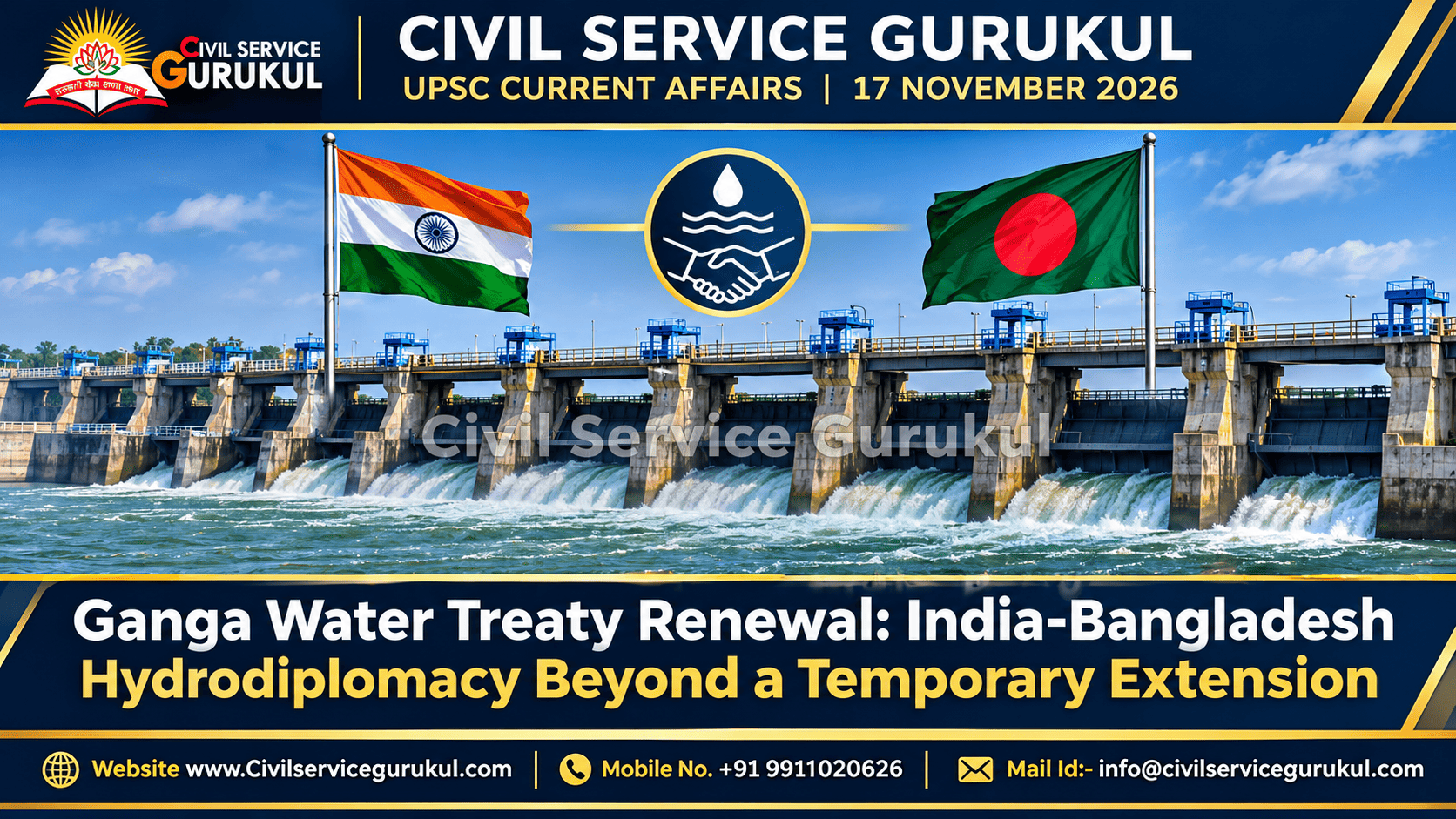
Why Is the Ganga Water Treaty in the News?
The supplied editorial refers to a 16 November 2026 news index discussing an expert proposal for a temporary renewal of the India–Bangladesh Ganga Water Treaty.
The proposal has drawn attention because the 1996 treaty was concluded for a period of 30 years, making 2026 a crucial year for bilateral review and negotiation.
However, an expert proposal for temporary renewal must not be presented as a concluded bilateral agreement.
The uploaded editorial identifies a proposal for temporary renewal, not a confirmed new treaty.
Any final renewal, extension or revised water-sharing arrangement should be verified against official India–Bangladesh documentation.
UPSC Syllabus Relevance
| UPSC Paper | Relevant Topics |
|---|---|
| GS Paper I | Indian geography, river systems, monsoon variability and physical geography |
| GS Paper II | India–Bangladesh relations, neighbourhood diplomacy, bilateral agreements and international cooperation |
| GS Paper III | Water resource management, climate change, ecological flows and environmental sustainability |
| Prelims | Farakka Barrage, Ganga river system, transboundary rivers and treaty-related facts |
What Is the 1996 Ganga Water Sharing Treaty?
The Ganga Water Sharing Treaty was signed between India and Bangladesh in 1996 to establish arrangements for sharing Ganga waters at Farakka during the dry season.
The treaty was concluded for a 30-year period.
Its importance lies in creating a bilateral framework for managing water-sharing concerns in a river system used by both countries.
Major Features
- Bilateral agreement between India and Bangladesh.
- Concerns sharing of Ganga waters at Farakka.
- Focuses on dry-season water availability.
- Originally concluded for 30 years.
- Provides an institutional reference for bilateral water cooperation.
The 1996 Ganga Water Sharing Treaty is between India and Bangladesh, not India and Nepal.
Why Is Farakka Important?
Farakka lies on the Ganga in West Bengal.
Its geographical position makes it important to discussions concerning Ganga water flows and India–Bangladesh water sharing.
The Farakka Barrage is associated with water management in the Ganga river system.
Important Geographical Points
- Farakka is located in West Bengal.
- It is associated with the Ganga river system.
- The 1996 treaty concerns water sharing at Farakka.
- Dry-season flows are central to the treaty framework.
What Is Hydrodiplomacy?
Hydrodiplomacy refers to the use of dialogue, negotiation and institutional cooperation to manage shared water resources across political boundaries.
Transboundary rivers require cooperation because water use in one jurisdiction may affect availability and ecological conditions elsewhere.
Important Elements of Hydrodiplomacy
- Sharing reliable hydrological information.
- Negotiating equitable water allocation.
- Managing seasonal variability.
- Considering ecological requirements.
- Resolving disputes through dialogue.
- Building long-term institutional trust.
Why Do Shared Rivers Require Cooperation?
A river crossing national boundaries creates interdependent water management interests.
Decisions relating to irrigation, urban supply and other water uses may have implications beyond one country's territory.
Cooperation can improve information sharing, reduce uncertainty and support predictable water management arrangements.
Why Is 2026 a Crucial Year?
The 1996 treaty was concluded for 30 years.
Its original duration makes 2026 a significant period for reviewing future water-sharing arrangements.
The supplied editorial reports an expert proposal for temporary renewal.
Such a proposal may seek to avoid an immediate institutional gap while allowing time for more comprehensive negotiations.
However, the proposal's existence does not establish that a new agreement has been concluded.
Temporary Extension vs Long-Term Treaty Reform
| Dimension | Temporary Extension | Long-Term Reform |
|---|---|---|
| Primary objective | Maintain continuity in arrangements | Develop an updated framework |
| Negotiation period | May provide additional time | Requires comprehensive agreement |
| Climate adaptation | May preserve existing provisions | Can introduce adaptive mechanisms |
| Institutional trust | May reduce immediate uncertainty | Can strengthen long-term cooperation |
| Major limitation | May defer structural changes | May require more difficult negotiations |
A short extension may prevent an immediate legal or institutional gap, but it can also postpone necessary adaptation to changing hydrological conditions.
Major Challenges in Ganga Water Sharing
1. Dry-Season Water Availability
Lean-season flows create important allocation challenges because available water may be limited relative to competing demands.
2. Monsoon Variability
Changes in rainfall timing and intensity may affect river flow patterns.
3. Upstream Water Demand
Irrigation, urban requirements and other water uses can influence water allocation priorities.
4. Sediment Dynamics
Sediment movement affects river morphology and water management conditions.
5. Ecological Flows
River ecosystems require adequate flow conditions to support ecological functions.
6. Institutional Trust
Reliable data and transparent monitoring are important for sustaining bilateral confidence.
Climate Variability and River Treaty Design
Water-sharing agreements are affected by the hydrological conditions under which they operate.
Changes in rainfall patterns, drought frequency or extreme flow conditions may complicate fixed allocation arrangements.
Future treaty design can therefore consider adaptive mechanisms that respond to changing water availability.
Possible Adaptive Measures
- Regular review of hydrological data.
- Agreed drought-response arrangements.
- Procedures for extreme-flow conditions.
- Transparent monitoring and reporting.
- Periodic treaty review triggers.
- Cooperation on ecological assessments.
Why Is Joint Hydrological Data Important?
Hydrological data provides the evidence needed to understand river flow and water availability.
When countries use jointly validated datasets, they can reduce disagreements about measurement and strengthen negotiation credibility.
Important Benefits
- Improved transparency.
- Greater confidence in flow measurements.
- Better assessment of seasonal variability.
- More informed allocation discussions.
- Stronger institutional accountability.
Transparent joint gauging can strengthen bilateral trust while respecting each country's legitimate water management priorities.
Ecological Flows and River Sustainability
Environmental or ecological flows refer to water flow conditions needed to support river ecosystems and associated ecological functions.
Water-sharing negotiations should consider not only immediate human demand but also the ecological health of the river system.
Why Ecological Flows Matter
- Support aquatic ecosystems.
- Maintain important river functions.
- Influence downstream environmental conditions.
- Contribute to long-term river sustainability.
Downstream Livelihoods and Water Security
Changes in water availability may affect different users in different ways.
Agriculture, fisheries, urban communities and river-dependent livelihoods may have distinct water requirements.
Water diplomacy should therefore consider the distribution of benefits and costs across affected groups.
| Stakeholder | Potential Concern | Policy Consideration |
|---|---|---|
| Farmers | Dry-season irrigation availability | Predictable allocation and planning |
| Urban communities | Water supply reliability | Demand assessment and efficiency |
| Fishing communities | River ecosystem conditions | Ecological monitoring |
| River ecosystems | Flow alteration | Environmental flow considerations |
| Governments | Allocation disagreements | Transparent joint data and negotiation |
Institutional Cooperation in India–Bangladesh Water Relations
Shared water management depends on sustained communication between the governments and relevant technical institutions.
Institutional arrangements can support data exchange, joint assessment and discussion of water-sharing concerns.
A future framework may benefit from clearly defined responsibilities, transparent review procedures and reliable technical cooperation.
India's Neighbourhood Diplomacy and Water Cooperation
Water cooperation is an important dimension of relations between neighbouring countries sharing river systems.
For India and Bangladesh, the Ganga Water Treaty provides a case study in managing interdependence through bilateral agreements.
A durable arrangement can support predictable relations and reduce uncertainty over a shared natural resource.
Governance Trade-Offs in Treaty Renewal
Continuity vs Adaptation
A temporary extension may support continuity, but long-term conditions may require revised provisions.
National Priorities vs Shared Interests
Each country has domestic water needs, while both benefit from cooperative management.
Human Use vs Ecological Needs
Water allocation must consider competing demands and river ecosystem requirements.
Negotiation Speed vs Comprehensive Reform
Rapid agreement may reduce uncertainty, while comprehensive reform may require greater technical and diplomatic engagement.
Ethical Dimensions of Transboundary Water Sharing
1. Equity
Water allocation should consider the legitimate needs of affected populations.
2. Transparency
Shared information should support credible decision-making.
3. Accountability
Institutions should evaluate whether arrangements deliver their intended outcomes.
4. Intergenerational Responsibility
River management should account for long-term ecological sustainability.
5. Prudence
Negotiations should recognise uncertainty in future hydrological conditions.
Way Forward: A Climate-Resilient Water-Sharing Framework
- Publish jointly validated datasets: Improve access to reliable flow and water-demand information.
- Introduce adaptive provisions: Consider agreed responses to drought and extreme-flow conditions.
- Define review triggers: Create clear procedures for periodic assessment and adjustment.
- Consider ecological flows: Include river ecosystem requirements in future negotiations.
- Consult stakeholders: Consider downstream livelihoods and other affected water users.
- Strengthen technical cooperation: Improve joint monitoring and institutional dialogue.
- Improve transparency: Communicate relevant technical findings and policy decisions clearly.
- Evaluate outcomes: Measure the effectiveness of agreed arrangements over time.
A durable Ganga water-sharing framework should combine equitable allocation, transparent hydrological data, ecological sustainability and adaptive climate governance.
UPSC Prelims Quick Revision
- The 1996 Ganga Water Sharing Treaty is between India and Bangladesh.
- The treaty concerns dry-season water sharing at Farakka.
- Farakka is located in West Bengal.
- The original treaty duration was 30 years.
- 2026 is a significant year for bilateral review and negotiation.
- An expert proposal for renewal is not a concluded agreement.
- Hydrodiplomacy concerns cooperation over shared water resources.
- Monsoon variability may complicate water allocation.
- Joint hydrological monitoring can improve transparency.
- Ecological flows are relevant to sustainable river management.
Original UPSC Prelims Practice MCQs
Question 1: Ganga Water Sharing Treaty
Consider the following statements:
1. The 1996
Ganga Water
Sharing Treaty
was signed
between India
and Bangladesh.
2. The treaty
concerns dry-season
water sharing
at Farakka.
3. The treaty
was originally
concluded for
a 30-year
period.
Which statements are correct?
(a) 1 and 2 only
(b) 2 and 3 only
(c) 1 and 3 only
(d) 1, 2 and 3
View Answer and Explanation
Correct Answer: (d) 1, 2 and 3.
All three statements describe the 1996 India–Bangladesh Ganga Water Sharing Treaty.
Question 2: Farakka
Consider the following statements:
1. Farakka
is located
in West
Bengal.
2. Farakka
is associated
with the
Ganga river
system.
3. The 1996
Ganga Water
Treaty was
negotiated between
India and
Nepal.
Which statements are correct?
(a) 1 and 2 only
(b) 2 and 3 only
(c) 1 and 3 only
(d) 1, 2 and 3
View Answer and Explanation
Correct Answer: (a) 1 and 2 only.
Farakka lies in West Bengal on the Ganga. The treaty is between India and Bangladesh.
Question 3: Hydrodiplomacy
Consider the following statements:
1. Hydrodiplomacy
involves cooperation
over shared
water resources.
2. Joint
hydrological monitoring
may improve
trust between
riparian countries.
3. Transboundary
river agreements
necessarily eliminate
all future
water disputes.
Which statements are correct?
(a) 1 and 2 only
(b) 2 and 3 only
(c) 1 and 3 only
(d) 1, 2 and 3
View Answer and Explanation
Correct Answer: (a) 1 and 2 only.
Cooperation and shared data can improve water management, but agreements do not automatically eliminate disputes.
Question 4: Treaty Renewal
Consider the following statements:
1. A temporary
treaty extension
may help
maintain continuity.
2. A temporary
extension automatically
resolves all
long-term climate
adaptation challenges.
3. Adaptive
provisions may
help respond
to changing
hydrological conditions.
Which statements are correct?
(a) 1 and 2 only
(b) 1 and 3 only
(c) 2 and 3 only
(d) 1, 2 and 3
View Answer and Explanation
Correct Answer: (b) 1 and 3 only.
A temporary extension may maintain continuity, but structural adaptation may still be necessary.
Question 5: Ecological Flows
Which of the following best explains the importance of ecological flows in river management?
(a) They eliminate the need for all human water use.
(b) They support river ecosystems and ecological functions.
(c) They guarantee constant river discharge throughout the year.
(d) They are unrelated to water-sharing negotiations.
View Answer and Explanation
Correct Answer: (b).
Ecological flows help support river ecosystems and are relevant to sustainable water management.
UPSC Mains Practice Question
"The future of transboundary river diplomacy lies not merely in extending existing agreements but in adapting them to climate variability and ecological requirements." Discuss with reference to the India–Bangladesh Ganga Water Sharing Treaty.
Suggested Answer-Writing Framework
Introduction: Briefly explain the 1996 Ganga Water Sharing Treaty and its 30-year duration.
Geographical Context: Discuss Farakka, dry-season flows and the shared Ganga river system.
Major Challenges: Explain water demand, monsoon variability, sediment and ecological needs.
Diplomatic Dimension: Examine temporary extension versus long-term reform.
Way Forward: Recommend jointly validated data, adaptive provisions and stakeholder consultation.
Conclusion: Emphasise equitable, transparent and climate-resilient water cooperation.
Key Takeaways for UPSC Aspirants
- The Ganga Water Sharing Treaty was concluded between India and Bangladesh in 1996.
- The treaty concerns dry-season water sharing at Farakka.
- The original duration of the treaty was 30 years.
- The supplied editorial reports a temporary-renewal proposal, not a concluded agreement.
- Hydrodiplomacy is central to managing shared river systems.
- Joint hydrological data can strengthen transparency and trust.
- Climate variability creates challenges for long-term water allocation.
- Ecological flows and downstream livelihoods require attention.
- Adaptive treaty provisions can support future water cooperation.
Frequently Asked Questions
1. What is the Ganga Water Sharing Treaty?
It is a 1996 agreement between India and Bangladesh concerning dry-season Ganga water sharing at Farakka.
2. Where is Farakka located?
Farakka is located in West Bengal, India.
3. Why is 2026 important for the treaty?
The 1996 treaty was concluded for 30 years, making 2026 a significant year for review and negotiation.
4. Has a new Ganga Water Treaty been concluded?
The supplied editorial reports an expert proposal for temporary renewal. It does not establish that a new bilateral agreement has been concluded.
5. What is hydrodiplomacy?
Hydrodiplomacy is cooperation and negotiation over shared water resources across political boundaries.
6. Why are ecological flows important?
Ecological flows help maintain river ecosystem functions and support sustainable water management.
Conclusion: From Temporary Extension to Long-Term Water Security
The 1996 Ganga Water Sharing Treaty provides an important example of bilateral cooperation over a shared river system.
As its original 30-year period approaches completion in 2026, future negotiations face questions of continuity, climate adaptation and ecological sustainability.
A temporary extension may provide negotiating space, but long-term cooperation requires reliable data, adaptive provisions and attention to downstream livelihoods.
India and Bangladesh can strengthen hydrodiplomacy through transparent technical cooperation, equitable dialogue and accountable institutional arrangements.
The ultimate objective should be sustainable water security and durable bilateral trust.
Prepare for UPSC Prelims & Mains with Civil Service Gurukul
Strengthen your understanding of International Relations, Indian Geography, Environment, Water Resource Management and Current Affairs through conceptual learning, original MCQs and structured Mains answer-writing practice.
Visit Civil Service Gurukul Contact Our TeamEditorial Note
This is an original educational analysis based on the topic and context supplied in the uploaded editorial.
The supplied material refers to a 16 November 2026 news index discussing an expert proposal for temporary renewal of the India–Bangladesh Ganga Water Treaty.
The proposal should not be represented as a concluded bilateral agreement without official confirmation.