
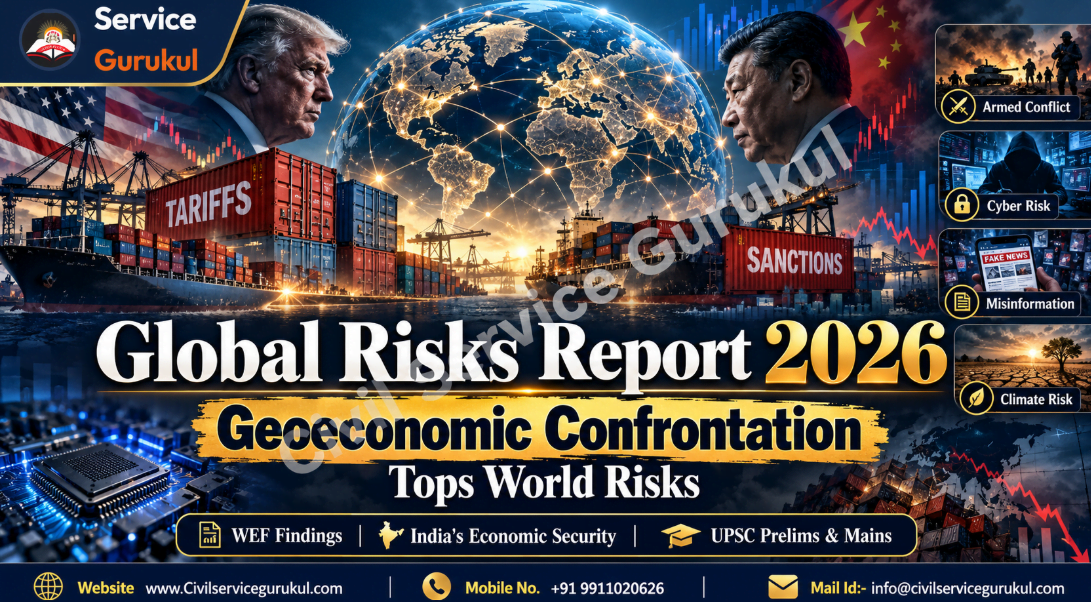
The World Economic Forum's Global Risks Report 2026 identifies geoeconomic confrontation as the risk most frequently selected by respondents as likely to trigger a material global crisis in 2026. It highlights increasing use of trade restrictions, economic coercion, sanctions, technology controls and strategic supply-chain dependencies.
The report also examines armed conflicts, misinformation, societal polarisation, technological risks and environmental deterioration. Civil Service Gurukul presents the major findings, global risk rankings, implications for India, UPSC Prelims facts, original practice questions, Mains analysis and revision priorities.
1. Why Is the Global Risks Report 2026 in the News?
The World Economic Forum released the Global Risks Report 2026 on 14 January 2026. The report analyses major threats confronting governments, economies, societies and the environment.
It identifies geoeconomic confrontation as the leading risk selected by respondents for triggering a material global crisis in 2026.
The finding reflects growing international tensions in which trade, finance, technology and access to strategic resources are increasingly employed as instruments of national power.
- Report: Global Risks Report 2026.
- Publisher: World Economic Forum (WEF).
- Publication: 14 January 2026.
- Theme: The Age of Competition.
- Top immediate risk: Geoeconomic confrontation.
- Top ten-year risk: Extreme weather events.
- Survey: Global Risks Perception Survey.
- Time horizons: Immediate, two-year and ten-year outlooks.
Why Is This Report Important?
The report reflects changing perceptions of global instability. While environmental risks continue to dominate the long-term outlook, geopolitical and economic competition are receiving greater attention over the shorter term.
The strategic use of tariffs, investment restrictions, export controls and other economic measures can disrupt international trade and weaken confidence in global institutions.
2. What Is the Global Risks Report?
The Global Risks Report is an annual publication of the World Economic Forum. It provides a structured assessment of risks that could adversely affect global stability, economic performance and human well-being.
The report uses survey responses and expert analysis to understand the changing severity and interconnected nature of global risks.
Major Risk Categories
- Economic: Inflation, recession, debt and asset-market instability.
- Geopolitical: Armed conflict and geoeconomic confrontation.
- Environmental: Extreme weather, biodiversity loss and planetary-system changes.
- Societal: Inequality, polarisation and misinformation.
- Technological: Cyber insecurity and adverse outcomes of AI technologies.
About the World Economic Forum
- Founded in 1971 by Klaus Schwab.
- Headquartered in Cologny, Switzerland.
- Promotes public-private cooperation.
- Known for its Annual Meeting in Davos.
- Not a United Nations specialised agency.
3. What Are the Most Important Global Risks in 2026?
The report examines risks across different time horizons. It is important to distinguish the immediate 2026 ranking from the severity rankings for the next two and ten years.
A. Immediate Risk Outlook for 2026
| Rank | Risk | Significance |
|---|---|---|
| 1 | Geoeconomic Confrontation | Strategic use of economic restrictions and dependencies. |
| 2 | State-Based Armed Conflict | Risk of military escalation and regional instability. |
B. Top Risks Over the Next Two Years
| Rank | Risk | UPSC Relevance |
|---|---|---|
| 1 | Geoeconomic Confrontation | Economic sanctions, trade wars and strategic competition. |
| 2 | Misinformation and Disinformation | Governance, elections and digital misinformation. |
| 3 | Societal Polarisation | Social cohesion and institutional stability. |
| 4 | Extreme Weather Events | Climate adaptation and disaster management. |
| 5 | State-Based Armed Conflict | International relations and global security. |
| 6 | Cyber Insecurity | Cybersecurity and critical infrastructure. |
C. Top Five Risks Over the Next Ten Years
| Rank | Risk | Main Concern |
|---|---|---|
| 1 | Extreme Weather Events | Climate disasters and economic disruption. |
| 2 | Biodiversity Loss and Ecosystem Collapse | Ecological degradation and threats to livelihoods. |
| 3 | Critical Change to Earth Systems | Large-scale disruption of planetary systems. |
| 4 | Misinformation and Disinformation | Long-term weakening of information integrity. |
| 5 | Adverse Outcomes of AI Technologies | Technological disruption and governance challenges. |
4. What Is Geoeconomic Confrontation?
Geoeconomic confrontation refers to the strategic use of economic capabilities, relationships and restrictions to influence the behaviour of other countries or gain geopolitical advantages.
It reflects the growing use of economic power as an instrument of international competition.
Major Instruments
Trade Tariffs
Higher import duties may be used to protect domestic industries or pressure trading partners.
Economic Sanctions
Governments may restrict trade, financial transactions or access to important markets.
Export Controls
Restrictions on semiconductors, advanced technologies and strategic equipment can affect industrial capabilities.
Investment Restrictions
Foreign investment screening may limit acquisitions or investment in sensitive sectors.
Critical Mineral Controls
Concentration of mineral supply and processing capacity can create strategic dependencies.
Financial Restrictions
Restrictions involving international financial systems can be used to exert geopolitical pressure.
Geoeconomics vs Geopolitics
| Basis | Geopolitics | Geoeconomics |
|---|---|---|
| Primary Focus | Political and strategic power. | Economic instruments used for strategic objectives. |
| Common Instruments | Diplomacy, military capabilities and alliances. | Tariffs, technology controls and sanctions. |
| Security Dimension | Military and territorial security. | Economic and technological security. |
5. Why Is Geoeconomic Confrontation Increasing?
1. US-China Competition
Strategic competition in semiconductors, artificial intelligence, technology and advanced manufacturing has increased the use of economic restrictions.
2. Growing Protectionism
Trade barriers, tariffs and industrial subsidies are becoming important instruments of economic policy.
3. Strategic Supply-Chain Dependencies
Concentration of production and processing in a small number of countries can expose economies to supply disruptions.
4. Critical Mineral Competition
Lithium, cobalt, nickel, graphite and rare earth elements are important for clean energy, electronics and defence technologies.
5. Weaponisation of Interdependence
Control over crucial international financial, technological or logistical networks can provide strategic influence.
6. Weakening Multilateral Cooperation
Trade disputes and unilateral restrictions may undermine the effectiveness of rules-based international cooperation.
6. What Other Risks Does the Report Highlight?
State-Based Armed Conflict
Military conflicts can disrupt energy, food supplies, trade routes and global investment.
Misinformation and Disinformation
Misleading information and AI-generated content may threaten social trust and democratic institutions.
Societal Polarisation
Deepening political and social divisions can weaken governance and institutional legitimacy.
Cyber Insecurity
Cyberattacks on financial systems, government networks and essential infrastructure may create severe economic consequences.
Climate and Environmental Risks
Extreme weather, biodiversity loss and changes to Earth systems remain particularly serious over longer time horizons.
Artificial Intelligence Risks
Adverse outcomes of AI may include employment disruption, information manipulation, security risks and challenges to governance.
7. How Can Geoeconomic Confrontation Affect India?
India is increasingly integrated with international supply chains, investment networks and technology markets. This creates opportunities but also exposes the economy to external disruptions.
Impact on Key Sectors
| Sector | Potential Challenge | Policy Priority |
|---|---|---|
| International Trade | Tariffs and market-access restrictions. | Export diversification and trade diplomacy. |
| Energy | Oil-price volatility and import disruptions. | Energy diversification and strategic reserves. |
| Electronics | Semiconductor supply-chain restrictions. | Domestic technology and manufacturing capacity. |
| Critical Minerals | Concentrated sources of minerals. | International partnerships and recycling. |
| Financial Markets | Market volatility and shifts in capital flows. | Macroeconomic stability. |
| Agriculture | Fertiliser supply and shipping disruptions. | Supply resilience and logistics diversification. |
India's Strategic Concerns
- Dependence on imported crude oil.
- Need for secure semiconductor access.
- Availability of critical minerals.
- Resilience of international trade routes.
- Access to export markets.
- Protection of strategic autonomy.
8. What Should Be India's Response?
A. Diversify Trade Relationships
India should expand access to different international markets and reduce excessive dependence on single destinations.
B. Strengthen Domestic Manufacturing
Competitive manufacturing capabilities can improve resilience to international shocks.
C. Secure Critical Minerals
Mineral exploration, overseas partnerships, processing and recycling can strengthen supply security.
D. Develop Technology Capabilities
Semiconductor manufacturing, research and innovation ecosystems should receive continued strategic attention.
E. Strengthen Energy Security
India can diversify energy sources, expand renewables and strengthen strategic energy infrastructure.
F. Promote Multilateral Cooperation
Engagement through the G20, WTO and other international platforms can support economic dialogue and more predictable trade arrangements.
9. Why Is the Global Risks Report 2026 Important for UPSC?
| Paper | Relevant Syllabus Areas |
|---|---|
| Prelims GS I | International reports, organisations, economy, environment and technology. |
| Mains GS II | International relations, multilateralism and geopolitical competition. |
| Mains GS III | Indian economy, security, technology and supply chains. |
| Essay | Global cooperation, economic interdependence and strategic autonomy. |
| PSIR Optional | Power, global political economy and international institutions. |
10. Most Important Topics to Revise for UPSC 2027
| Priority | Topic | Revision Focus |
|---|---|---|
| Very High | Global Risks Report 2026 | Publisher, methodology and rankings. |
| Very High | Geoeconomic Confrontation | Definition, instruments and consequences. |
| Very High | India's Economic Security | Energy, trade, critical minerals and supply chains. |
| Very High | Global Risk Time Horizons | Immediate, two-year and ten-year rankings. |
| High | Trade Protectionism | Tariffs, sanctions and WTO-related concepts. |
| High | AI and Cybersecurity | Disinformation, cyber threats and governance. |
| High | Climate Change | Extreme weather, biodiversity and Earth systems. |
| High | Strategic Autonomy | India's foreign policy and economic resilience. |
11. UPSC Prelims Practice MCQs with Answers
The following are original practice questions prepared for examination revision. They are not actual UPSC previous-year questions.
Who publishes the Global Risks Report?
- International Monetary Fund
- World Bank
- World Economic Forum
- United Nations Development Programme
The World Economic Forum publishes the Global Risks Report using survey responses and expert analysis.
Which risk ranks first in the immediate outlook for 2026?
- Extreme weather events
- Geoeconomic confrontation
- Biodiversity loss
- Cyber insecurity
Geoeconomic confrontation was selected by 18% of respondents as the leading immediate risk.
Consider the following statements:
- Geoeconomic confrontation can involve export restrictions.
- It necessarily requires direct military conflict.
- It may affect global supply chains.
Which statements are correct?
- 1 and 2 only
- 2 and 3 only
- 1 and 3 only
- 1, 2 and 3
Economic pressure can operate without direct military conflict. Export restrictions and supply-chain disruptions are important geoeconomic tools.
Which risk ranks first in the ten-year severity outlook?
- Economic downturn
- State-based armed conflict
- Extreme weather events
- Societal polarisation
Environmental risks dominate the ten-year outlook, led by extreme weather events.
Which is NOT primarily a geoeconomic instrument?
- Trade tariffs
- Economic sanctions
- Export controls
- Conventional military invasion
Geoeconomic confrontation principally involves economic instruments rather than direct conventional military force.
With reference to the Global Risks Report 2026, consider:
- Geoeconomic confrontation ranks first in the two-year severity outlook.
- Misinformation and disinformation rank second in the two-year outlook.
- Extreme weather events rank first in the ten-year outlook.
Which statements are correct?
- 1 and 2 only
- 2 and 3 only
- 1 and 3 only
- 1, 2 and 3
All three statements correctly describe the report's stated rankings for their respective time horizons.
12. UPSC Mains Answer-Writing Framework
"Geoeconomic confrontation has emerged as a major threat to global economic stability." Examine its causes and implications for India. Suggest measures to strengthen India's economic resilience.
15 Marks | 250 WordsModel Answer
Introduction:
The World Economic Forum's Global Risks Report 2026 identifies geoeconomic confrontation as the leading immediate global risk. It involves the use of economic restrictions and strategic dependencies to pursue geopolitical objectives.
Major Causes:
- Intensifying geopolitical and technological competition.
- Growing trade protectionism.
- Concentration of critical mineral supply chains.
- Economic sanctions and export restrictions.
- Weakening multilateral economic cooperation.
Implications for India:
- Greater uncertainty for exports and manufacturing.
- Vulnerability to energy-price shocks.
- Restricted access to certain critical technologies.
- Potential fluctuations in investment and capital flows.
- Need for secure critical mineral supplies.
Way Forward:
- Diversify trading partners and export markets.
- Strengthen domestic manufacturing competitiveness.
- Secure critical mineral supply arrangements.
- Invest in semiconductor and technological capabilities.
- Improve energy resilience.
- Promote multilateral trade cooperation.
Conclusion:
India should pursue economic diversification, strategic autonomy and competitive domestic capabilities while maintaining constructive international partnerships. A resilient economy requires both national strength and effective global cooperation.
Additional Mains Practice Questions
GS II | 10 Marks
Discuss the impact of geoeconomic competition on multilateral institutions.
GS III | 15 Marks
Examine the importance of critical minerals and semiconductor supply chains for India's economic security.
GS III | 10 Marks
How can India reduce vulnerabilities arising from international supply-chain concentration?
Essay
"Economic interdependence can be both a foundation of cooperation and an instrument of geopolitical competition."
13. Last-Minute Revision: 10 Facts for UPSC
- Report: Global Risks Report 2026.
- Publisher: World Economic Forum.
- Publication date: 14 January 2026.
- Theme: The Age of Competition.
- Top immediate risk: Geoeconomic confrontation.
- Share of responses: 18% selected it as the top immediate risk.
- Second immediate risk: State-based armed conflict.
- Top two-year severity risk: Geoeconomic confrontation.
- Top ten-year severity risk: Extreme weather events.
- India relevance: Trade, technology, energy and supply-chain security.
14. Frequently Asked Questions
What is the Global Risks Report 2026?
It is the World Economic Forum's annual assessment of major economic, geopolitical, societal, technological and environmental risks across different time horizons.
Which is the biggest immediate global risk in 2026?
Geoeconomic confrontation ranks first in the immediate 2026 assessment.
What is geoeconomic confrontation?
It involves the strategic use of economic instruments such as tariffs, sanctions, export controls and investment restrictions.
Which risk ranks first over ten years?
Extreme weather events rank first in the ten-year severity outlook.
How does geoeconomic confrontation affect India?
It may affect India's exports, energy imports, technological access, investment conditions and international supply chains.
Why is the report important for UPSC?
The report connects international relations, economic security, climate risks, technology governance and India's strategic autonomy.
Conclusion: Economic Security in an Age of Competition
The Global Risks Report 2026 highlights how international economic relationships are increasingly becoming instruments of strategic competition.
Geoeconomic confrontation can threaten global trade, investment confidence, technological cooperation and supply-chain stability.
For India, a balanced response requires economic diversification, strategic autonomy, technological development and constructive international engagement.
At the global level, cooperation, predictable economic rules and stronger international institutions remain important for reducing systemic vulnerabilities.