
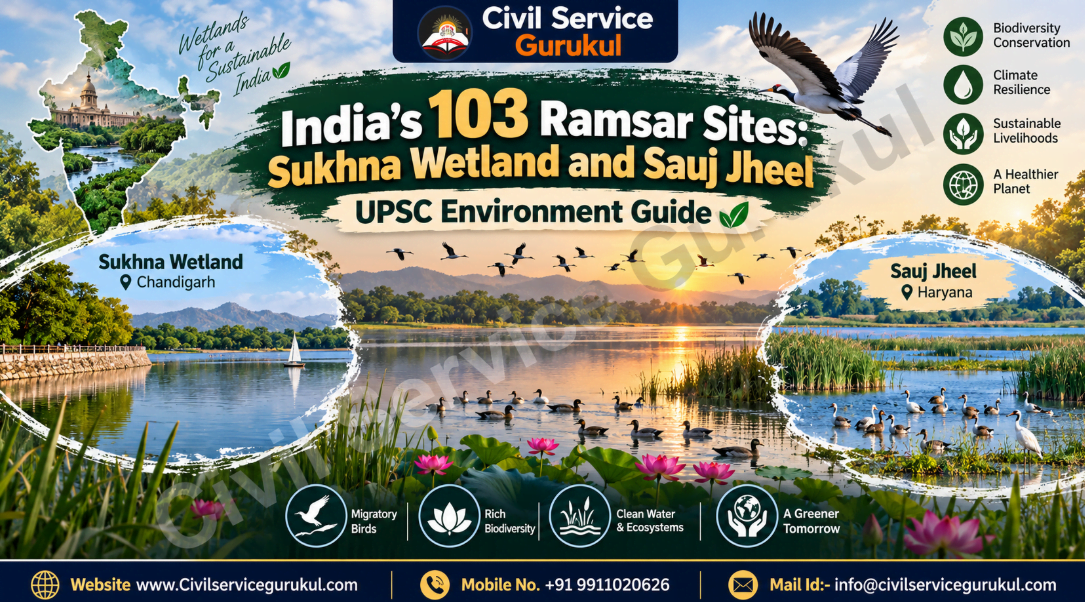
India’s 103 Ramsar Sites: Sukhna Wetland and Sauj Jheel — UPSC Environment Guide
CSG
CIVIL SERVICE GURUKUL
Learn • Analyse • Lead
UPSC Environment & EcologyIndia's Ramsar Sites: Sukhna Wetland and Sauj Jheel Explained
Understand the importance of India's wetlands, their biodiversity, ecological services and conservation challenges through two important sites for UPSC Civil Services preparation.
16 October 2026 UPSC Prelims & Mains Civil Service Gurukul
Wetlands are among the most valuable ecosystems on Earth. They support aquatic biodiversity, provide habitats for resident and migratory birds, regulate water flows and sustain livelihoods. Yet drainage, pollution, encroachment and changes in land use continue to threaten wetland ecosystems across the world.
India's Ramsar network recognises wetlands of international importance. The designation of Sukhna Wetland in Chandigarh and Sauj Jheel in Uttar Pradesh highlights the need to protect both urban-associated freshwater ecosystems and floodplain wetlands. These sites offer useful examples for understanding biodiversity, conservation policy and sustainable water management.
Ramsar Convention An international framework for wetland conservation and wise use.
Sukhna Wetland Located in Chandigarh near the foothills of the Shivalik range.
Sauj Jheel A shallow floodplain wetland in Mainpuri district, Uttar Pradesh.
Table of Contents
- What Is the Ramsar Convention?
- Why Are Wetlands Important?
- Sukhna Wetland, Chandigarh
- Sauj Jheel, Uttar Pradesh
- Sukhna Wetland vs Sauj Jheel
- Threats to Wetland Ecosystems
- Conservation and Way Forward
- UPSC Prelims and Mains Relevance
- Practice Question
- Frequently Asked Questions
1. What Is the Ramsar Convention?
The Convention on Wetlands, commonly known as the Ramsar Convention, is an international treaty adopted in Ramsar, Iran, in 1971. It provides a framework for the conservation and wise use of wetlands through national action and international cooperation.
Core objectives
- Promote the conservation of wetlands and their ecological functions.
- Encourage the wise use of wetland resources.
- Identify and designate wetlands of international importance.
- Support cooperation where wetlands and water systems cross national boundaries.
- Improve public awareness of the ecological, economic and social value of wetlands.
What does Ramsar designation mean?
Designation identifies a wetland as internationally important under agreed criteria. It signals the need for conservation and wise use, but does not mean that every activity in or around the site is automatically prohibited. Management depends on the applicable laws, ecological requirements and site-specific plans.
UPSC Prelims fact: The Ramsar Convention was adopted in 1971 in Ramsar, Iran. Its central idea is the conservation and wise use of wetlands.
2. Why Are Wetlands Important?
Wetlands include marshes, lakes, floodplains, mangroves, peatlands and other areas where water shapes ecological processes. Their value extends beyond the presence of water: wetlands connect terrestrial and aquatic habitats and support complex food webs.
Major ecological services
Water regulation and flood moderation
Wetlands can temporarily store excess water and slow its movement through a landscape. Their effectiveness depends on wetland size, soil, vegetation, catchment conditions and the scale of a flood event.
Biodiversity conservation
Wetlands provide breeding, nesting, feeding and resting areas for birds, fish, amphibians, reptiles, invertebrates and aquatic plants. Some wetlands are important stopovers for migratory species travelling along international flyways.
Water quality and nutrient cycling
Wetland soils and vegetation can retain sediments and transform certain nutrients. However, wetlands have limits: excessive pollution can overwhelm their natural filtering capacity and damage aquatic life.
Livelihoods and local economies
Properly managed wetlands support fisheries, compatible agriculture, nature-based tourism and other livelihoods. Conservation planning should recognise the needs of communities who depend on these ecosystems.
Climate relevance
Some wetlands store substantial quantities of carbon, particularly peatlands and certain vegetated wetland ecosystems. Their climate role varies by wetland type, hydrology and management. Degradation can release stored carbon and reduce ecosystem resilience.
3. Sukhna Wetland, Chandigarh
Sukhna Wetland is associated with Sukhna Lake, a major freshwater reservoir in Chandigarh near the Shivalik foothills. It illustrates the ecological value of a human-created water body and its surrounding wetland and catchment landscape.
Location and background
- Location: Chandigarh, a Union Territory of India.
- Geographical setting: Near the foothills of the Shivalik range.
- Origin: Sukhna Lake was created in 1958 by damming the seasonal Sukhna Choe stream.
- Landscape: A freshwater system influenced by the surrounding catchment and seasonal water levels.
- Ramsar identification: The site is listed in Ramsar materials as Sukhna Lake; consult the current official profile for the latest site particulars.
Ecological significance
The wetland supports aquatic habitats and provides a refuge for wildlife in an urban and peri-urban setting. Its seasonal water conditions create different habitats, from open water to shallow margins and vegetated areas.
Importance for birds and other wildlife
Wetland and lake habitats can provide feeding and resting areas for resident and migratory waterbirds. Sukhna's wider ecological value depends on maintaining water quality, suitable shoreline habitats and connectivity with the surrounding landscape.
Key conservation concerns
- Siltation: Soil erosion in the catchment can reduce water-storage capacity.
- Urban pressures: Runoff and pollutants can affect water quality.
- Invasive species: Some invasive aquatic plants can alter habitat conditions.
- Habitat disturbance: Poorly managed human activity can disturb birds and other wildlife.
- Water management: Changes in inflow and seasonal water levels can affect ecological conditions.
Prelims takeaway: Remember Chandigarh, the Shivalik foothills and the lake's catchment-management challenges. The ecological health of the water body is closely connected with land use upstream.
4. Sauj Jheel, Uttar Pradesh
Sauj Jheel is a shallow floodplain wetland in Mainpuri district of Uttar Pradesh. Its location in the Indo-Gangetic plains makes it relevant to the study of freshwater wetlands, seasonal hydrology and waterbird habitats.
Location and physical features
- State: Uttar Pradesh.
- District: Mainpuri.
- Geographical setting: Indo-Gangetic floodplain landscape.
- Wetland type: A shallow, perennial floodplain lake as described in the current-affairs report.
- Ecological context: Aquatic vegetation, waterbird habitat and a wider wetland landscape.
Why is Sauj Jheel significant?
Shallow lakes and floodplain wetlands can support a wide range of aquatic plants, invertebrates, fish and birds. Vegetation along wetland margins can provide shelter and nesting habitat, while open water and shallow feeding areas support different bird species.
Sauj Jheel is also relevant to the wider conservation landscape of Mainpuri district, which includes other wetlands and bird habitats. Protecting ecological connectivity can help maintain habitat quality across the region.
Conservation priorities
- Control untreated sewage, agricultural runoff and solid-waste pollution.
- Maintain natural water flows and seasonal wetland conditions.
- Protect bird nesting and feeding habitats from excessive disturbance.
- Use fishing practices that minimise harm to non-target wildlife.
- Work with local communities on sustainable use and monitoring.
Map-based revision: Locate Mainpuri district in Uttar Pradesh and connect the wetland with the broader Indo-Gangetic plain. Verify current site boundaries and designation details against the official Ramsar site profile.
5. Sukhna Wetland vs Sauj Jheel
| Feature Sukhna Wetland Sauj Jheel | ||
| Location | Chandigarh | Mainpuri district, Uttar Pradesh |
| Setting | Near the Shivalik foothills | Indo-Gangetic floodplain |
| Wetland characteristics | Human-created lake and freshwater wetland ecosystem | Shallow floodplain lake and wetland habitat |
| Ecological importance | Aquatic habitats, urban ecological functions and waterbirds | Aquatic vegetation and waterbird habitats |
| Key management focus | Catchment protection, siltation and water quality | Water quality, habitat protection and sustainable use |
| UPSC connection | Urban ecology, hydrology and wetland management | Floodplain ecology, biodiversity and wetland conservation |
The comparison shows that wetlands differ in their geographical setting and management needs. Effective conservation should be based on local hydrology, species requirements, catchment conditions and community use rather than applying an identical plan to every site.
6. Major Threats to Wetland Ecosystems in India
1. Encroachment and land-use change
Construction, land reclamation and the conversion of wetland margins can reduce habitat area, disrupt water movement and isolate wetland ecosystems.
2. Pollution and eutrophication
Sewage, fertilisers and other pollutants can increase nutrient loading and promote excessive algal or aquatic plant growth. These changes may reduce dissolved oxygen and harm aquatic life.
3. Changes in hydrology
Drainage, excessive water extraction, altered inflows and infrastructure can change natural water levels and seasonal cycles on which wetland species depend.
4. Invasive alien species
Some introduced species spread rapidly and compete with native organisms, alter food webs or obstruct waterways. Management requires site-specific assessment rather than indiscriminate removal.
5. Climate change
Changing rainfall patterns, heatwaves, droughts and intense rainfall can affect wetland water balance, species distribution and the frequency of ecological disturbances.
6. Weak monitoring and fragmented governance
Wetland management may involve several departments and local institutions. Limited ecological data, unclear responsibilities and weak enforcement can undermine conservation outcomes.
7. Wetland Conservation: Way Forward
Adopt a catchment-based approach
Wetland management should cover the surrounding catchment, not only the visible water body. Soil conservation, appropriate land use and the control of polluted runoff can improve ecological conditions over time.
Strengthen wastewater management
Cities and settlements near wetlands should improve sewage collection, treatment and monitoring. Industrial discharges and other pollution sources require effective regulation.
Restore natural hydrology
Conservation plans should protect suitable inflows, maintain ecological water requirements and avoid unnecessary drainage or modifications that disrupt wetland processes.
Use scientific monitoring
Regular monitoring of water quality, vegetation, bird populations, invasive species and changes in wetland area can help managers identify emerging threats and evaluate whether interventions are working.
Promote community participation
Local communities can contribute knowledge, stewardship and practical monitoring. Conservation strategies are more durable when they account for local livelihoods and support sustainable use.
Integrate conservation with urban planning
Wetlands should be considered in land-use plans, drainage systems and infrastructure decisions. Buffer zones and ecologically appropriate development controls can reduce pressure on vulnerable habitats.
Core policy message: Ramsar designation is a starting point, not the end of conservation. Long-term results depend on effective management, reliable ecological data, pollution control and cooperation among authorities and communities.
8. UPSC Prelims and Mains Relevance
For UPSC Prelims
- Know the purpose and background of the Ramsar Convention.
- Revise the states and Union Territories where important wetlands are located.
- Understand the difference between lakes, floodplains, marshes and other wetland types.
- Connect wetlands with migratory birds, aquatic vegetation and biodiversity.
- Revise ecological services such as flood moderation, water-quality processes and habitat support.
For UPSC Mains — GS Paper III
Wetland conservation is relevant to biodiversity, environmental pollution, ecological restoration, climate resilience and sustainable development. Answers should connect ecological functions with governance challenges and practical solutions.
For Essay and Ethics
Wetlands offer examples of intergenerational equity, responsible resource use and the balance between development and conservation. They also illustrate why public institutions must consider long-term ecological costs when making land-use decisions.
Suggested Mains question
“Wetland conservation is essential for biodiversity protection and climate resilience, but it requires more than formal designation.” Discuss with suitable examples from India.
9. UPSC Practice Question
QuestionConsider the following statements about wetlands:
- Wetlands can provide habitats for resident and migratory birds.
- All wetlands are natural ecosystems and none can be human-created.
- Wetlands may contribute to flood moderation, depending on their characteristics and condition.
Which of the statements given above are correct?
- 1 only
- 1 and 2 only
- 1 and 3 only
- 1, 2 and 3
Reveal the correct answerCorrect answer: C — 1 and 3 only.
Wetlands support resident and migratory birds, and many can store or slow water flows. Wetlands can be natural or human-created, so statement 2 is incorrect.
10. Frequently Asked Questions
What is a Ramsar site?
A Ramsar site is a wetland designated as internationally important under the Convention on Wetlands. Designation supports conservation and the wise use of wetland resources.
Where is Sukhna Wetland located?
Sukhna Wetland is located in Chandigarh near the foothills of the Shivalik range. Sukhna Lake was created in 1958.
Where is Sauj Jheel located?
Sauj Jheel is located in Mainpuri district, Uttar Pradesh, in the Indo-Gangetic floodplain region.
Why are wetlands important for biodiversity?
Wetlands provide feeding, breeding and sheltering habitats for many species, including waterbirds, fish, amphibians, reptiles and aquatic plants.
Does Ramsar designation prohibit every human activity?
No. Ramsar designation promotes conservation and wise use. Activities are managed through applicable laws, site protections and conservation plans.
How should UPSC aspirants revise Ramsar sites?
Prepare a map-based list with each wetland's location, ecological features, important species and conservation concerns. Verify changing site totals and designations against the latest official Ramsar information.
Conclusion
Sukhna Wetland and Sauj Jheel demonstrate the ecological diversity of India's wetlands and the importance of location-specific conservation. While Sukhna highlights the relationship between a water body, its catchment and urban pressures, Sauj Jheel illustrates the ecological value of floodplain wetlands and their bird habitats.
For UPSC aspirants, the subject connects factual preparation with broader questions of biodiversity, water management, environmental governance and sustainable development. Effective wetland protection requires scientific monitoring, pollution control, sound land-use planning and meaningful community participation.
Civil Service GurukulLearn • Analyse • Lead
Original educational content for UPSC Civil Services Examination preparation.
Prepare with Mentors Who Cleared the Exam
Get personalized study plans, evaluated answer models, and test series access.