
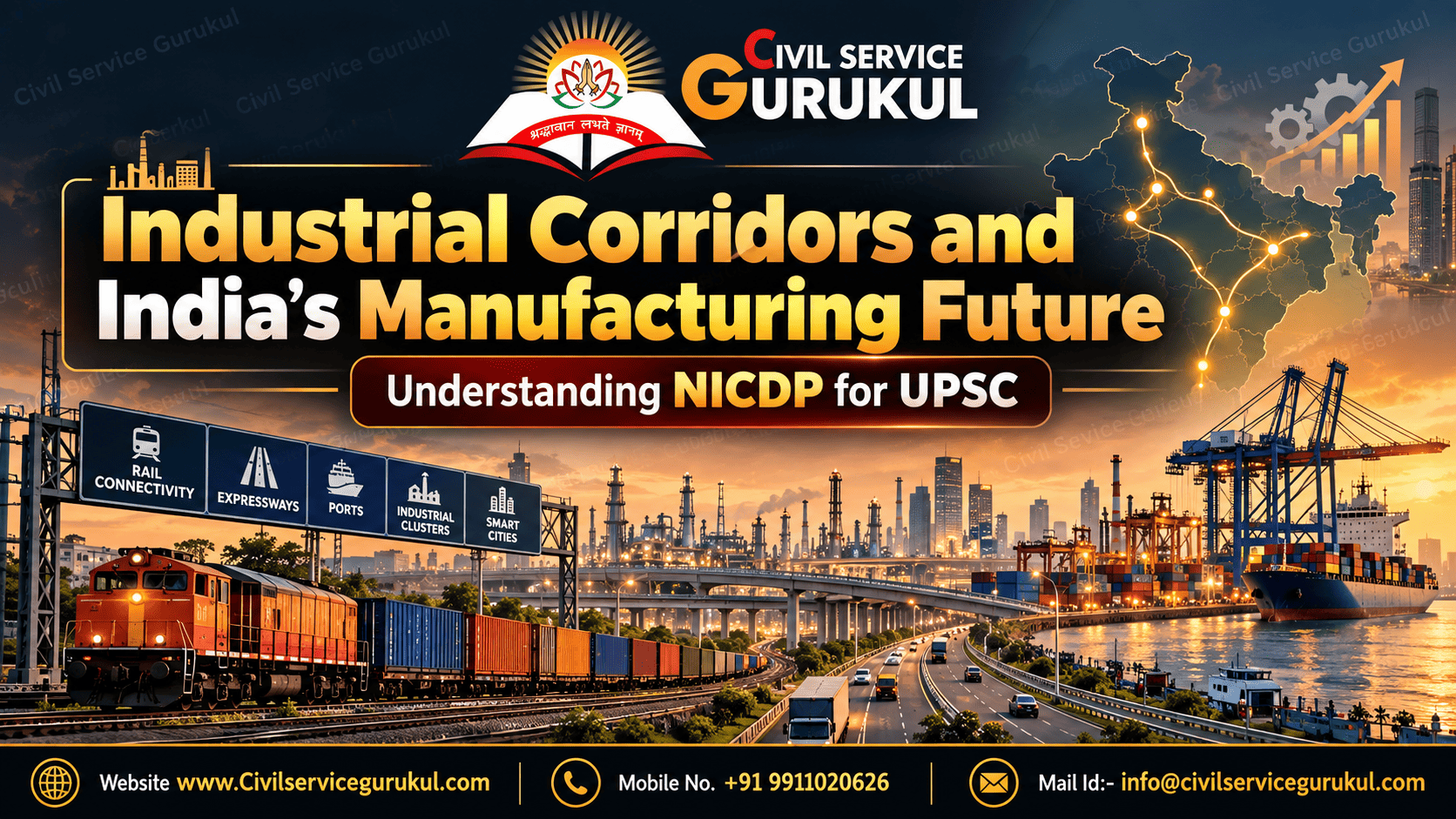
Industrial Corridors and India’s Manufacturing Future: Understanding NICDP for UPSC
<!DOCTYPE html>
<html lang="en">
<head>
<meta charset="UTF-8">
<meta name="viewport" content="width=device-width, initial-scale=1.0">
<title>Industrial Corridors and India’s Manufacturing Future: NICDP Explained for UPSC | Civil Service Gurukul</title>
<meta name="description" content="Understand the National Industrial Corridor Development Programme (NICDP) for UPSC GS Paper 1 and GS Paper 3: industrial corridors, multimodal logistics, smart cities, GVCs, regional development, challenges and way forward.">
<meta name="keywords" content="NICDP UPSC, National Industrial Corridor Development Programme, Industrial Corridors UPSC, GS Paper 1, GS Paper 3, DMIC, CBIC, AKIC, industrial smart cities, PM GatiShakti, logistics India, manufacturing India, Civil Service Gurukul">
<meta name="author" content="Civil Service Gurukul Editorial Team">
<meta name="robots" content="index, follow, max-image-preview:large, max-snippet:-1, max-video-preview:-1">
<link rel="canonical" href="https://www.civilservicegurukul.com/industrial-corridors-nicdp-india-manufacturing-upsc">
<!-- Open Graph -->
<meta property="og:type" content="article">
<meta property="og:title" content="Industrial Corridors and India’s Manufacturing Future: NICDP Explained for UPSC">
<meta property="og:description" content="A complete UPSC-ready analysis of NICDP, industrial corridors, multimodal infrastructure, GVCs, regional development and key challenges.">
<meta property="og:url" content="https://www.civilservicegurukul.com/industrial-corridors-nicdp-india-manufacturing-upsc">
<meta property="og:site_name" content="Civil Service Gurukul">
<!-- Twitter / X -->
<meta name="twitter:card" content="summary_large_image">
<meta name="twitter:title" content="NICDP for UPSC: Industrial Corridors and India’s Manufacturing Future">
<meta name="twitter:description" content="UPSC-focused analysis of industrial corridors, smart cities, logistics, GVCs and regional development.">
<style>
:root{
--black:#111318;
--navy:#12233f;
--blue:#1f4f7d;
--gold:#d89b2b;
--gold2:#f4bf58;
--cream:#fbf7ef;
--green:#18705a;
--red:#b43b3b;
--white:#ffffff;
--text:#252b34;
--muted:#687384;
--border:#e5e0d6;
--shadow:0 14px 34px rgba(17,19,24,.10);
}
*{box-sizing:border-box;}
html{scroll-behavior:smooth;}
body{
margin:0;
font-family:Arial, Helvetica, sans-serif;
background:#f2f0eb;
color:var(--text);
line-height:1.72;
}
.page{
width:min(1180px,94%);
margin:30px auto;
background:#fff;
border-radius:22px;
overflow:hidden;
box-shadow:var(--shadow);
}
.hero{
padding:58px 56px 48px;
color:#fff;
background:
radial-gradient(circle at top right,rgba(216,155,43,.18),transparent 36%),
linear-gradient(135deg,#0d1118,#17253b 62%,#22446d);
}
.brand{
display:inline-block;
background:#fff;
color:#111;
padding:9px 18px;
border-radius:999px;
font-weight:700;
margin-bottom:22px;
}
.brand span{color:var(--gold);}
.hero h1{
margin:0;
font-size:47px;
line-height:1.14;
max-width:1060px;
}
.hero p{
max-width:940px;
font-size:18px;
color:#e8edf5;
margin-top:18px;
}
.meta-row{
display:flex;
flex-wrap:wrap;
gap:10px;
margin-top:26px;
}
.meta-pill{
border:1px solid rgba(255,255,255,.22);
background:rgba(255,255,255,.10);
padding:8px 14px;
border-radius:999px;
font-size:14px;
}
.content{
padding:42px 54px 58px;
}
.excerpt{
background:linear-gradient(135deg,#fff8eb,#fffdf9);
border-left:6px solid var(--gold);
padding:24px 26px;
border-radius:16px;
margin-bottom:32px;
}
h2{
color:var(--navy);
font-size:30px;
position:relative;
padding-left:16px;
margin:44px 0 18px;
}
h2::before{
content:"";
position:absolute;
left:0;
top:6px;
width:5px;
height:30px;
background:var(--gold);
border-radius:5px;
}
h3{
color:var(--blue);
font-size:22px;
margin:28px 0 10px;
}
p{margin:10px 0 16px;}
ul,ol{padding-left:24px;}
li{margin:7px 0;}
.keyline{
background:var(--navy);
color:#fff;
padding:19px 22px;
border-radius:14px;
margin:22px 0;
text-align:center;
font-weight:700;
font-size:19px;
}
.highlight{
padding:20px 22px;
border-radius:14px;
margin:20px 0;
border:1px solid #e3e8ef;
background:#f8fafc;
}
.highlight.gold{
background:#fff7e8;
border-color:#eed9ad;
}
.highlight.green{
background:#eef8f4;
border-color:#cbe7dc;
}
.grid{
display:grid;
grid-template-columns:repeat(3,1fr);
gap:16px;
margin:24px 0;
}
.card{
border:1px solid #e4e8ee;
border-radius:15px;
padding:20px;
background:#fff;
box-shadow:0 5px 16px rgba(0,0,0,.04);
}
.card h3{
margin-top:0;
font-size:20px;
}
.card.gold{border-top:5px solid var(--gold);}
.card.green{border-top:5px solid var(--green);}
.card.blue{border-top:5px solid var(--blue);}
.table{
width:100%;
border-collapse:collapse;
margin:24px 0;
border-radius:14px;
overflow:hidden;
box-shadow:0 5px 16px rgba(0,0,0,.04);
}
.table th{
background:var(--navy);
color:#fff;
text-align:left;
padding:14px 15px;
}
.table td{
padding:14px 15px;
border-bottom:1px solid #e7ebf0;
}
.table tr:nth-child(even) td{
background:#f8fafc;
}
.mains-box{
background:linear-gradient(135deg,#111827,#213858);
color:#fff;
border-radius:18px;
padding:28px;
margin:36px 0;
}
.mains-box h2{
color:#fff;
margin-top:0;
}
.mains-box h2::before{
background:var(--gold2);
}
.mains-question{
background:#fff;
color:var(--navy);
padding:16px 18px;
border-radius:12px;
font-weight:700;
margin-top:16px;
}
.checklist{
list-style:none;
padding:0;
display:grid;
grid-template-columns:1fr 1fr;
gap:12px 18px;
counter-reset:item;
}
.checklist li{
counter-increment:item;
position:relative;
margin:0;
background:#f8fafc;
border:1px solid #e3e8ef;
border-radius:12px;
padding:14px 16px 14px 50px;
}
.checklist li::before{
content:counter(item);
position:absolute;
left:14px;
top:12px;
width:27px;
height:27px;
display:flex;
align-items:center;
justify-content:center;
border-radius:50%;
background:var(--gold);
color:#111;
font-weight:700;
}
details{
border:1px solid var(--border);
border-radius:12px;
margin:12px 0;
overflow:hidden;
}
summary{
cursor:pointer;
background:#f8fafc;
color:var(--navy);
font-weight:700;
padding:16px 18px;
}
details p{
padding:0 18px 16px;
}
.cta{
margin-top:40px;
padding:30px;
border-radius:18px;
border:1px solid var(--border);
text-align:center;
background:linear-gradient(135deg,#fff8eb,#f8fbff);
}
.cta h3{
margin-top:0;
color:var(--navy);
font-size:27px;
}
.cta a{
display:inline-block;
text-decoration:none;
background:var(--gold);
color:#111;
font-weight:700;
padding:12px 23px;
border-radius:999px;
margin-top:10px;
}
.seo-section{
margin-top:44px;
padding-top:27px;
border-top:1px solid var(--border);
}
.seo-item{
background:#f8fafc;
border:1px solid #e3e8ef;
border-radius:10px;
padding:12px 14px;
margin:8px 0;
}
footer{
display:flex;
flex-wrap:wrap;
justify-content:space-between;
gap:14px 28px;
padding:27px 34px;
background:#0c111a;
color:#fff;
font-size:14px;
}
footer a{
color:#fff;
text-decoration:none;
}
@media(max-width:900px){
.hero{padding:42px 24px;}
.hero h1{font-size:35px;}
.content{padding:32px 24px 42px;}
.grid{grid-template-columns:1fr;}
.checklist{grid-template-columns:1fr;}
}
@media(max-width:600px){
.page{width:100%;margin:0;border-radius:0;}
.hero h1{font-size:30px;}
h2{font-size:25px;}
}
</style>
<!-- Article Schema -->
<script type="application/ld+json">
{
"@context":"https://schema.org",
"@type":"Article",
"headline":"Industrial Corridors and India’s Manufacturing Future: NICDP Explained for UPSC",
"description":"A UPSC-ready analysis of the National Industrial Corridor Development Programme, multimodal logistics, manufacturing, smart cities, GVCs, regional development and challenges.",
"author":{
"@type":"Organization",
"name":"Civil Service Gurukul"
},
"publisher":{
"@type":"Organization",
"name":"Civil Service Gurukul",
"url":"https://www.civilservicegurukul.com"
},
"mainEntityOfPage":{
"@type":"WebPage",
"@id":"https://www.civilservicegurukul.com/industrial-corridors-nicdp-india-manufacturing-upsc"
},
"keywords":[
"NICDP",
"Industrial Corridors",
"UPSC GS Paper 1",
"UPSC GS Paper 3",
"DMIC",
"PM GatiShakti",
"Global Value Chains",
"Manufacturing India"
]
}
</script>
<!-- FAQ Schema -->
<script type="application/ld+json">
{
"@context":"https://schema.org",
"@type":"FAQPage",
"mainEntity":[
{
"@type":"Question",
"name":"What is the National Industrial Corridor Development Programme?",
"acceptedAnswer":{
"@type":"Answer",
"text":"NICDP is an integrated industrial development programme that links manufacturing nodes with multimodal transport, logistics, utilities, smart urban infrastructure and investment-ready industrial ecosystems."
}
},
{
"@type":"Question",
"name":"Why are industrial corridors important for UPSC?",
"acceptedAnswer":{
"@type":"Answer",
"text":"Industrial corridors are relevant to economic geography, regional development, manufacturing, logistics, infrastructure, urbanisation, global value chains and strategic autonomy."
}
},
{
"@type":"Question",
"name":"Which major industrial corridors should UPSC aspirants know?",
"acceptedAnswer":{
"@type":"Answer",
"text":"Important corridors include the Delhi-Mumbai Industrial Corridor, Chennai-Bengaluru Industrial Corridor, Amritsar-Kolkata Industrial Corridor, East Coast Industrial Corridor and Bengaluru-Mumbai Industrial Corridor."
}
}
]
}
</script>
</head>
<body>
<article class="page">
<header class="hero">
<div class="brand">
CIVIL SERVICE <span>GURUKUL</span>
</div>
<h1>
Industrial Corridors and India’s Manufacturing Future:
Understanding NICDP for UPSC
</h1>
<p>
A GS Paper 1 and GS Paper 3 oriented analysis of how industrial corridors
are reshaping manufacturing geography, logistics, urbanisation,
global value-chain participation and regional development in India.
</p>
<div class="meta-row">
<div class="meta-pill">GS Paper 1</div>
<div class="meta-pill">GS Paper 3</div>
<div class="meta-pill">Economic Geography</div>
<div class="meta-pill">Infrastructure</div>
<div class="meta-pill">Manufacturing</div>
<div class="meta-pill">UPSC Mains</div>
</div>
</header>
<main class="content">
<section class="excerpt">
<strong>Excerpt / Brief Summary:</strong><br>
The National Industrial Corridor Development Programme is transforming India's
manufacturing landscape by integrating industrial nodes with Dedicated Freight Corridors,
expressways, ports, airports, logistics parks and smart urban infrastructure.
For UPSC, NICDP is important for understanding economic geography, manufacturing competitiveness,
regional urbanisation, global value chains, logistics reform and balanced development.
</section>
<p>
Industrial corridors are becoming central to India's strategy of building a modern,
globally competitive manufacturing economy.
</p>
<p>
Unlike traditional industrial estates, which often operate as isolated production clusters,
the industrial corridor model seeks to create integrated economic regions where
manufacturing, logistics, housing, utilities, digital systems and social infrastructure
are planned together.
</p>
<div class="keyline">
Industrial Corridors Are Spatial Reorganisers of Economic Activity — Not Merely Transport Projects
</div>
<h2>What Is an Industrial Corridor?</h2>
<p>
An industrial corridor is a planned economic zone developed along major
high-capacity transport routes such as Dedicated Freight Corridors,
expressways, national highways, ports, airports and waterways.
</p>
<p>
The objective is to connect production centres with markets and logistics networks
while creating large-scale, investment-ready industrial ecosystems.
</p>
<div class="grid">
<div class="card gold">
<h3>Manufacturing</h3>
<p>
Large industrial nodes and production clusters form the economic core.
</p>
</div>
<div class="card blue">
<h3>Logistics</h3>
<p>
Freight corridors, ports, airports and expressways reduce transit friction.
</p>
</div>
<div class="card green">
<h3>Urban Development</h3>
<p>
Housing, schools, healthcare, utilities and green spaces support planned industrial cities.
</p>
</div>
</div>
<h2>What Is the National Industrial Corridor Development Programme?</h2>
<p>
The National Industrial Corridor Development Programme seeks to develop
integrated, multimodal and globally competitive industrial ecosystems across India.
</p>
<p>
Its strategic approach is aligned with:
</p>
<ul>
<li>Make in India</li>
<li>Atmanirbhar Bharat</li>
<li>PM GatiShakti National Master Plan</li>
<li>National Logistics Policy</li>
<li>Export-led manufacturing</li>
<li>Global value-chain integration</li>
</ul>
<div class="highlight gold">
<strong>UPSC Concept:</strong>
NICDP combines infrastructure planning with economic geography,
manufacturing policy, logistics efficiency and urban development.
</div>
<h2>Key Features of the Industrial Corridor Model</h2>
<h3>1. Multimodal Infrastructure Integration</h3>
<p>
Industrial nodes are linked with major transport arteries such as Dedicated Freight Corridors,
expressways, seaports, cargo airports and logistics hubs.
</p>
<p>
Such integration reduces freight time, transport bottlenecks and logistics costs.
</p>
<h3>2. Plug-and-Play Industrial Ecosystems</h3>
<p>
Industrial areas increasingly aim to provide pre-developed land,
utility networks, power, water, factory-ready spaces and streamlined clearances.
</p>
<p>
The objective is to reduce the time between investment approval and commercial production.
</p>
<h3>3. Work-Live-Play Urban Planning</h3>
<p>
Modern industrial corridors integrate factories with residential areas,
healthcare, education, commercial spaces and green infrastructure.
</p>
<div class="highlight green">
This model can reduce commuting pressure, urban congestion and unplanned migration
toward already saturated metropolitan centres.
</div>
<h3>4. Sustainability and Circularity</h3>
<p>
New industrial nodes increasingly incorporate water recycling,
effluent treatment, renewable energy, green buildings and resource-efficient infrastructure.
</p>
<p>
Such features can improve India's competitiveness as global markets impose
tighter environmental and carbon standards.
</p>
<h3>5. Digital Governance</h3>
<p>
Smart industrial cities may use ICT systems, command-and-control platforms,
digital land allotment, traffic management and technology-enabled utility monitoring.
</p>
<h2>Major Industrial Corridors in India</h2>
<table class="table">
<thead>
<tr>
<th>Industrial Corridor</th>
<th>UPSC Relevance</th>
</tr>
</thead>
<tbody>
<tr>
<td>Delhi–Mumbai Industrial Corridor (DMIC)</td>
<td>Western DFC, Dholera, Shendra-Bidkin, Greater Noida</td>
</tr>
<tr>
<td>Chennai–Bengaluru Industrial Corridor (CBIC)</td>
<td>Southern manufacturing and logistics integration</td>
</tr>
<tr>
<td>Amritsar–Kolkata Industrial Corridor (AKIC)</td>
<td>Eastern DFC and Indo-Gangetic manufacturing belt</td>
</tr>
<tr>
<td>East Coast Industrial Corridor (ECIC)</td>
<td>Port-led industrialisation and east-coast connectivity</td>
</tr>
<tr>
<td>Bengaluru–Mumbai Industrial Corridor (BMIC)</td>
<td>Links technology and manufacturing clusters</td>
</tr>
</tbody>
</table>
<h2>Why Industrial Corridors Matter for India's Economy</h2>
<h3>1. Lower Logistics Costs</h3>
<p>
Efficient multimodal transport can reduce freight delays and improve the competitiveness
of Indian manufacturing.
</p>
<h3>2. Global Value Chain Integration</h3>
<p>
Large industrial clusters with reliable utilities and connectivity can help attract
global production in sectors such as:
</p>
<ul>
<li>Electronics</li>
<li>Semiconductors</li>
<li>Electric vehicles</li>
<li>Pharmaceuticals</li>
<li>Telecommunications equipment</li>
</ul>
<h3>3. Strategic Autonomy</h3>
<p>
Strong domestic manufacturing clusters can reduce external dependence for critical goods
and make supply chains more resilient to geopolitical disruptions.
</p>
<h3>4. Balanced Regional Urbanisation</h3>
<p>
Industrial corridors can create new growth centres in Tier-2 and Tier-3 regions,
reducing excessive concentration of jobs and investment in major metros.
</p>
<div class="keyline">
Manufacturing Clusters + Logistics + Skills + Urban Infrastructure = Regional Economic Transformation
</div>
<h2>Major Challenges</h2>
<div class="grid">
<div class="card gold">
<h3>Land Acquisition</h3>
<p>
Large contiguous land parcels can face compensation disputes, litigation and delays.
</p>
</div>
<div class="card blue">
<h3>Centre-State Coordination</h3>
<p>
Multiple ministries, state agencies and SPVs must synchronise implementation.
</p>
</div>
<div class="card green">
<h3>Last-Mile Connectivity</h3>
<p>
Strong national corridors are not sufficient without efficient feeder networks.
</p>
</div>
</div>
<p>
Other important concerns include:
</p>
<ul>
<li>High greenfield capital expenditure</li>
<li>Long project gestation periods</li>
<li>Environmental clearance challenges</li>
<li>Skill mismatches</li>
<li>Uneven local development benefits</li>
<li>Risk of speculative real-estate development</li>
</ul>
<h2>Way Forward</h2>
<ol class="checklist">
<li>Use PM GatiShakti for integrated spatial planning</li>
<li>Strengthen Centre-State project coordination</li>
<li>Improve last-mile logistics and feeder connectivity</li>
<li>Expand public-private partnerships</li>
<li>Link industrial nodes with ITIs and polytechnics</li>
<li>Ensure sustainable land acquisition and rehabilitation</li>
<li>Promote renewable energy and circular infrastructure</li>
<li>Strengthen single-window approvals and digital governance</li>
</ol>
<h2>UPSC Prelims Pointers</h2>
<div class="highlight">
<ul>
<li>DMIC is associated with the Western Dedicated Freight Corridor.</li>
<li>AKIC is linked with the Eastern Dedicated Freight Corridor.</li>
<li>ECIC focuses strongly on coastal and port-led industrialisation.</li>
<li>Industrial corridors combine transport connectivity with manufacturing and urban development.</li>
<li>PM GatiShakti and the National Logistics Policy complement corridor development.</li>
</ul>
</div>
<section class="mains-box">
<h2>UPSC Mains Enrichment</h2>
<p>
Industrial corridors can be used in answers on:
</p>
<ul>
<li>Economic geography</li>
<li>Regional development</li>
<li>Manufacturing policy</li>
<li>Infrastructure</li>
<li>Urbanisation</li>
<li>Logistics</li>
<li>Global value chains</li>
<li>Strategic autonomy</li>
</ul>
<div class="mains-question">
Mains Practice Question:
“Industrial corridors act as spatial reorganisers of economic activity rather than mere infrastructure projects. Examine their role in regional integration and discuss the challenges in achieving balanced spatial outcomes.”
</div>
</section>
<h2>How to Write This Topic in UPSC Mains</h2>
<div class="keyline">
Introduction → Define Industrial Corridor → Explain NICDP → Economic Benefits → Spatial Impact → Challenges → Balanced Way Forward
</div>
<p>
A strong answer should avoid treating industrial corridors purely as transport infrastructure.
It should connect them to manufacturing geography, urbanisation, employment,
logistics competitiveness, regional inequality and global value chains.
</p>
<h2>Conclusion</h2>
<p>
The National Industrial Corridor Development Programme represents a shift
from fragmented industrial estates toward integrated economic regions.
</p>
<p>
By connecting manufacturing centres with freight corridors, ports,
urban infrastructure and smart logistics, NICDP can strengthen India's
manufacturing competitiveness and create new regional growth centres.
</p>
<p>
Its long-term success, however, will depend on better land management,
last-mile connectivity, environmental sustainability, skill integration
and effective coordination across levels of government.
</p>
<div class="keyline">
For UPSC, NICDP Is Best Understood as a Link Between Economic Geography, Manufacturing, Logistics and Regional Development
</div>
<h2>Frequently Asked Questions</h2>
<details>
<summary>What is NICDP?</summary>
<p>
NICDP is India's industrial corridor development framework aimed at creating
integrated industrial ecosystems with multimodal transport, logistics,
utilities, digital infrastructure and planned urban development.
</p>
</details>
<details>
<summary>Why are industrial corridors important for GS Paper 1?</summary>
<p>
They are relevant to economic geography, spatial distribution of industries,
urbanisation and regional development.
</p>
</details>
<details>
<summary>Why are they also relevant for GS Paper 3?</summary>
<p>
They are directly linked to infrastructure, manufacturing,
logistics, investment, employment and economic growth.
</p>
</details>
<details>
<summary>Which industrial corridors are most important for Prelims?</summary>
<p>
DMIC, CBIC, AKIC, ECIC and BMIC are especially important,
along with their freight-corridor, port and regional linkages.
</p>
</details>
<section class="cta">
<h3>Prepare Current Affairs the UPSC Way</h3>
<p>
Civil Service Gurukul converts daily developments into
Prelims facts, GS linkages, Mains arguments and answer-writing material.
</p>
<a href="https://www.civilservicegurukul.com">
Visit Civil Service Gurukul
</a>
</section>
<section class="seo-section">
<h2>SEO Details</h2>
<div class="seo-item">
<strong>Unique Post Title:</strong><br>
Industrial Corridors and India’s Manufacturing Future: Understanding NICDP for UPSC
</div>
<div class="seo-item">
<strong>SEO Title:</strong><br>
NICDP for UPSC: Industrial Corridors, Manufacturing & Regional Development
</div>
<div class="seo-item">
<strong>Meta Title:</strong><br>
NICDP Explained for UPSC | Civil Service Gurukul
</div>
<div class="seo-item">
<strong>Meta Description:</strong><br>
Understand NICDP for UPSC: industrial corridors, multimodal logistics,
manufacturing clusters, PM GatiShakti, GVCs, regional development,
challenges and Mains-ready analysis.
</div>
<div class="seo-item">
<strong>URL Slug:</strong><br>
industrial-corridors-nicdp-india-manufacturing-upsc
</div>
<div class="seo-item">
<strong>Focus Keyphrase:</strong><br>
NICDP UPSC
</div>
<div class="seo-item">
<strong>Secondary Keywords:</strong><br>
National Industrial Corridor Development Programme,
industrial corridors UPSC, DMIC UPSC, PM GatiShakti UPSC,
manufacturing India UPSC, logistics India UPSC,
economic geography UPSC, global value chains India
</div>
<div class="seo-item">
<strong>Best SEO Tags:</strong><br>
NICDP, Industrial Corridors, UPSC Current Affairs, GS Paper 1,
GS Paper 3, Economic Geography, Manufacturing,
DMIC, CBIC, AKIC, ECIC, BMIC, PM GatiShakti,
National Logistics Policy, Global Value Chains,
Infrastructure, Regional Development, Civil Service Gurukul
</div>
<div class="seo-item">
<strong>Category:</strong><br>
UPSC Current Affairs / GS Paper 1 / Economic Geography
</div>
<div class="seo-item">
<strong>Excerpt / Brief Summary:</strong><br>
The National Industrial Corridor Development Programme is transforming
India's manufacturing geography by integrating industrial nodes with
freight corridors, expressways, ports, logistics networks and planned smart cities.
This Civil Service Gurukul guide explains NICDP from a UPSC perspective,
covering economic significance, major corridors, challenges, Prelims facts
and Mains-ready analysis.
</div>
<div class="seo-item">
<strong>Featured Image Headline:</strong><br>
NICDP: Building India’s Industrial Future
</div>
<div class="seo-item">
<strong>Featured Image Subheading:</strong><br>
Industrial Corridors | Manufacturing | Logistics | PM GatiShakti
</div>
<div class="seo-item">
<strong>Image Alt Text:</strong><br>
NICDP and industrial corridors in India explained for UPSC by Civil Service Gurukul
</div>
</section>
</main>
<footer>
<div><strong>Civil Service Gurukul</strong></div>
<div>Website: <a href="https://www.civilservicegurukul.com">www.Civilservicegurukul.com</a></div>
<div>Mobile: +91 9911020626</div>
<div>Email: info@civilservicegurukul.com</div>
</footer>
</article>
</body>
</html>
Prepare with Mentors Who Cleared the Exam
Get personalized study plans, evaluated answer models, and test series access.