
Onboard Satellite Computing: AI in Space UPSC 2026
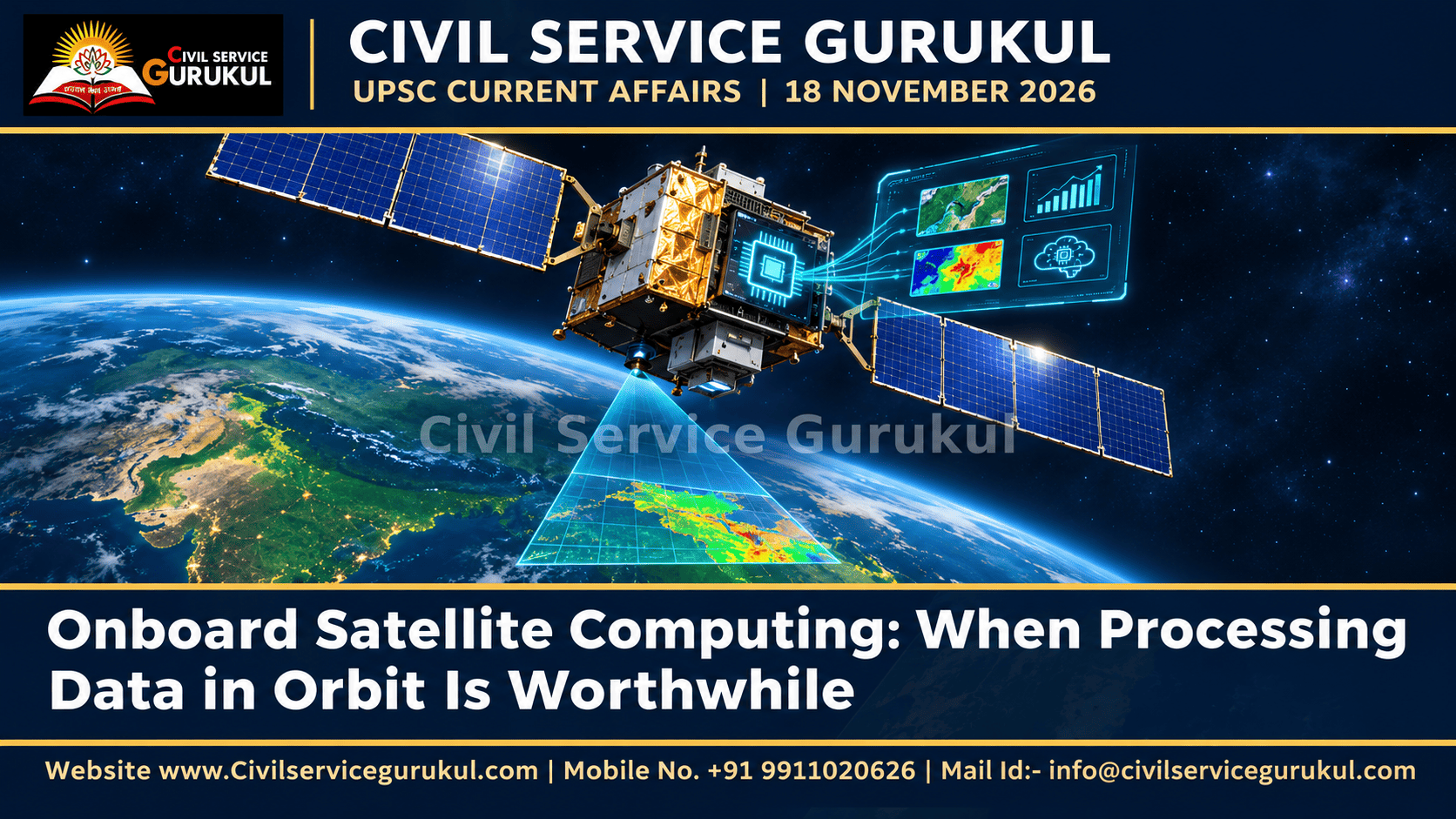
Onboard Satellite Computing: How AI in Space Is Transforming Earth Observation and India's Space Future
A comprehensive UPSC analysis of satellite edge computing, onboard artificial intelligence, data processing in orbit, technical challenges and future applications.
1. Introduction: Why Process Satellite Data in Space?
Modern Earth-observation satellites collect enormous quantities of imagery and sensor measurements. Traditionally, much of this information is transmitted to ground stations for processing.
However, communication bandwidth, contact windows and processing delays can restrict how quickly information becomes available.
Onboard satellite computing offers an alternative: performing selected data-processing tasks directly in orbit.
The central policy and engineering question is not whether all processing should move to space, but when the benefits of processing in orbit justify its costs and technical risks.
2. What Is Onboard Satellite Computing?
Onboard satellite computing refers to processing data using computing hardware installed on a satellite.
Instead of sending all raw data to Earth, the satellite may analyse, compress, classify or prioritise selected information before transmission.
Onboard satellite computing is the execution of data processing and analytical tasks within a spacecraft, reducing dependence on ground-based processing for selected operations.
What Is Edge Computing?
Edge computing means processing data close to the point where it is generated.
For an Earth-observation satellite, the satellite itself can act as an edge-computing platform.
This does not eliminate ground stations or ground-based analysis. It changes which tasks are performed at each location.
3. How Does Onboard Satellite Computing Work?
- Data collection: Satellite sensors capture images or measurements.
- Initial processing: Onboard processors prepare the data for analysis.
- Algorithm execution: Suitable software identifies selected patterns or features.
- Filtering: Unnecessary or lower-priority information may be reduced.
- Prioritisation: Important data products receive higher transmission priority.
- Downlink: Selected information is transmitted to Earth.
- Ground validation: Ground systems perform additional processing, interpretation and verification where required.
Example: Cloud-Cover Filtering
An optical Earth-observation satellite may capture imagery that is heavily covered by clouds.
A suitable onboard algorithm can identify cloud-covered scenes and assign lower transmission priority to some of them.
This can conserve communication resources when the mission does not require every raw image to be transmitted.
However, cloud-covered data may still be scientifically useful for certain purposes. Therefore, filtering rules must match the mission objectives.
4. Onboard Computing vs Ground-Based Processing
| Parameter | Onboard Computing | Ground Processing |
|---|---|---|
| Processing Location | Inside the satellite | Earth-based infrastructure |
| Data Transmission | Can reduce raw-data downlink | May require more raw data |
| Computing Capacity | Constrained by spacecraft resources | Can use larger computing systems |
| Power Availability | Limited spacecraft power budget | Generally more flexible |
| Thermal Management | Spacecraft-specific constraints | More conventional cooling options |
| Algorithm Updates | Can be operationally constrained | Generally easier to update |
| Human Validation | Limited direct intervention | Greater analyst involvement possible |
| Best Use | Selective, time-sensitive processing | Complex analysis and archival processing |
A hybrid architecture may combine onboard filtering with more advanced ground-based analysis.
5. Major Benefits of Onboard Satellite Computing
Filtering or compressing selected data can reduce transmission requirements.
Potentially important events can be identified before a complete raw-data downlink.
Suitable systems may prioritise observations relevant to floods, fires or other hazards.
Computing and communication resources can be allocated according to mission priorities.
Selected onboard decisions may reduce dependence on continuous ground instructions.
Automated screening may assist Earth-observation applications.
6. When Is Processing Data in Orbit Worthwhile?
The benefits depend on the mission's data volume, communication constraints, power availability and operational objectives.
| Situation | Potential Suitability | Reason |
|---|---|---|
| Large raw imagery volume | Potentially high | Filtering may reduce downlink demand. |
| Time-sensitive anomaly detection | Potentially high | Selected results can be prioritised. |
| Complex scientific modelling | Often better on ground | May require extensive computing resources. |
| Frequently changing AI models | Requires careful evaluation | Updates and validation may be difficult. |
| Limited satellite power | Potentially constrained | Processing consumes energy. |
| Critical raw-data preservation | Hybrid approach preferable | Premature filtering could discard useful information. |
7. Technical Challenges of Computing in Space
A. Radiation Exposure
Space radiation can interfere with electronic components and cause computing errors.
Space-qualified hardware and fault-tolerant designs are therefore important.
B. Limited Power
Satellites operate within constrained power budgets. Additional processing competes with other spacecraft systems for energy.
C. Thermal Management
Computing hardware generates heat. Managing this heat in space requires specialised thermal engineering.
D. Limited Memory and Processing Capacity
Large AI models may require more memory, storage or computing power than a particular satellite can provide.
E. Algorithm Reliability
An onboard algorithm may misclassify images or fail to detect an important event.
If relevant raw data is discarded prematurely, later verification may become difficult.
F. Cybersecurity
Software integrity, secure communications and controlled updates are important for reliable spacecraft operations.
8. Relevance for India's Space Programme
India has a substantial Earth-observation and remote-sensing ecosystem.
Onboard processing is relevant to the broader technological development of this ecosystem.
Potential Applications
- Agriculture: Prioritising observations relevant to crop monitoring.
- Disaster management: Screening selected imagery for possible hazards.
- Environmental monitoring: Supporting analysis of land and environmental change.
- Maritime observation: Identifying selected patterns for further analysis.
- Urban planning: Improving the handling of large remote-sensing datasets.
- Scientific research: Supporting mission-specific autonomous processing.
9. Institutional Relevance: ISRO, Research and Innovation
India's space technology ecosystem includes ISRO, research institutions, industry participants and emerging space-sector enterprises.
Advances in space-qualified electronics, embedded computing, AI algorithms and communications may contribute to future mission capabilities.
For UPSC, students should connect such technologies with indigenous innovation, strategic capability, public service delivery and scientific self-reliance.
10. Ethical and Governance Challenges
Onboard AI raises questions about reliability, accountability and the interpretation of automatically generated information.
Incorrect classification can affect the quality of satellite-derived information.
Users should understand relevant limitations and uncertainties.
Critical observations should not be lost through unsuitable filtering.
Important decisions should have appropriate verification and review mechanisms.
11. Way Forward for Onboard Satellite Computing
- Evaluate onboard processing using mission-specific bandwidth and latency models.
- Invest in reliable and space-qualified computing hardware.
- Develop energy-efficient algorithms suitable for constrained systems.
- Maintain appropriate ground-based validation mechanisms.
- Test algorithm performance under realistic mission conditions.
- Strengthen cybersecurity and software integrity.
- Preserve important raw data where scientifically or operationally necessary.
- Support research collaboration and domestic technological capability.
12. UPSC Prelims 2027: Important Facts
- Edge computing processes data near its source.
- Onboard satellite computing takes place within the spacecraft.
- It may reduce raw-data transmission requirements.
- It does not eliminate the need for ground communication.
- Radiation and thermal constraints affect spacecraft electronics.
- Power and memory limitations influence onboard AI design.
- Ground processing remains useful for complex analysis and validation.
- Onboard computing and ground computing can be complementary.
13. Original UPSC Prelims MCQs with Explanations
Question 1
With reference to onboard satellite computing, consider the following statements:
- It allows selected data-processing tasks to be performed within a satellite.
- It necessarily eliminates the requirement for ground stations.
- It may reduce the volume of raw data transmitted to Earth.
Which statements are correct?
(A) 1 and 2 only
(B) 1 and 3 only
(C) 2 and 3 only
(D) 1, 2 and 3
Statement 1 is correct because onboard processors can perform selected operations in orbit.
Statement 2 is incorrect because communication, telemetry, control and data transmission may still require ground infrastructure.
Statement 3 is correct because filtering and compression can reduce the amount of raw data requiring downlink.
Question 2
Which of the following can constrain the use of advanced AI processors on satellites?
- Radiation exposure
- Limited electrical power
- Thermal management requirements
(A) 1 only
(B) 1 and 2 only
(C) 2 and 3 only
(D) 1, 2 and 3
All three are important engineering constraints in spacecraft computing systems.
Question 3
The primary objective of edge computing is to:
(A) Store all information permanently in cloud servers
(B) Process data closer to where it is generated
(C) Eliminate communication networks entirely
(D) Replace all human decision-making
Edge computing places selected processing functions near the data source.
Question 4
Consider the following statements:
- Ground-based processing can be preferable for computationally intensive tasks.
- Onboard AI always provides more accurate results than ground processing.
- Hybrid satellite architectures can combine onboard and ground-based analysis.
(A) 1 and 3 only
(B) 2 only
(C) 1 and 2 only
(D) 1, 2 and 3
Statements 1 and 3 are correct. Statement 2 is incorrect because accuracy depends on algorithms, data and validation rather than processing location alone.
Question 5
Which one of the following best explains why onboard processing may be useful for Earth-observation missions?
(A) Satellites no longer require electrical power
(B) All scientific analysis becomes unnecessary
(C) Selected high-priority information can be identified before downlink
(D) Space radiation has no effect on computing hardware
Onboard processing may help identify and prioritise selected information before transmission.
14. UPSC Mains Practice Question
"Onboard satellite computing can improve the efficiency of Earth-observation missions, but its usefulness depends on technical and operational constraints." Discuss.
Word Limit: 250 words
15. Model UPSC Mains Answer
Introduction
Onboard satellite computing refers to processing selected data within a spacecraft rather than transmitting all raw observations to Earth. It represents an application of edge computing in space systems.
Potential Advantages
- Bandwidth efficiency: Filtering and compression can reduce unnecessary downlink.
- Timeliness: High-priority observations can be identified earlier.
- Autonomy: Selected functions can operate with reduced dependence on immediate ground instructions.
- Public applications: Potential benefits include disaster monitoring and environmental observation.
Major Challenges
- Space radiation can affect processor reliability.
- Power and thermal budgets restrict computing capacity.
- Large AI models may exceed available memory or processing resources.
- Algorithm errors can lead to the loss or misclassification of useful information.
- Ground validation remains necessary for many applications.
Way Forward
Mission designers should evaluate the trade-off between communication savings and computing costs, use reliable hardware, test algorithms and preserve appropriate ground-based verification.
Conclusion
Onboard computing should complement, not automatically replace, ground processing. A mission-specific, reliable and accountable approach can improve the effectiveness of future Earth-observation systems.
16. UPSC Mains Answer-Writing Framework
| Component | What to Write |
|---|---|
| Introduction | Define onboard satellite computing and edge computing. |
| Technology | Explain sensing, onboard analysis, filtering and downlink. |
| Benefits | Bandwidth efficiency, timeliness and mission autonomy. |
| Challenges | Radiation, power, heat, memory and algorithm errors. |
| India Relevance | Earth observation, disaster management and domestic innovation. |
| Conclusion | Recommend mission-specific hybrid processing and validation. |
17. Quick Revision: One-Minute Summary
- Concept: Processing selected satellite data in orbit.
- Technology: Edge computing and suitable onboard algorithms.
- Benefit: Reduced transmission and improved prioritisation.
- Constraints: Radiation, power, heat, memory and reliability.
- Alternative: Ground-based computing.
- Best Approach: Mission-specific hybrid architecture.
- UPSC Relevance: GS III Science and Technology; GS IV accountability.
18. Frequently Asked Questions
What is onboard satellite computing?
It is the processing of selected data within a satellite using onboard computing hardware.
What is satellite edge computing?
It is an application of edge computing in which selected data processing occurs near the satellite sensors that generate the information.
Does onboard AI eliminate ground stations?
No. Ground communications, control, software updates and further data analysis may still be required.
What are the biggest technical challenges?
Radiation, limited power, thermal management, processing capacity and algorithm reliability are major challenges.
Why is onboard computing important for UPSC?
It connects space technology, artificial intelligence, remote sensing, disaster management and ethical governance.
Is onboard processing always better than ground processing?
No. The preferred architecture depends on mission requirements, communication constraints, hardware resources and validation needs.
19. Conclusion: The Future Is Mission-Specific Computing in Space
Onboard satellite computing can help spacecraft handle growing data volumes more efficiently.
Its value is especially relevant where communication capacity is constrained or selected information must be prioritised quickly.
However, technical limitations and algorithm reliability mean that processing in orbit is not universally superior to ground processing.
The most effective approach will depend on mission design, data requirements, computing resources and the need for independent validation.
Prepare UPSC Prelims & Mains 2027 with Civil Service Gurukul
Strengthen your preparation with concept-based current affairs, GS subject analysis, Prelims practice, Mains answer writing and structured mentoring.
CIVIL SERVICE GURUKUL
UPSC | IAS | State PCS | Prelims & Mains
Visit Our Website Call +91 9911020626 Email for Enquirywww.civilservicegurukul.com
Editorial Disclaimer: This educational article is based on the uploaded 17 November 2026 science topic concerning onboard satellite computing. The original topic is a technology explainer, not a confirmed new satellite launch announcement. Additional conceptual explanations, examples and UPSC practice questions have been developed for educational purposes. Illustrative applications should not be treated as announcements of specific operational missions.
Prepare with Mentors Who Cleared the Exam
Get personalized study plans, evaluated answer models, and test series access.