
RBI Raises Repo Rate to 5.50%: What It Means for Inflation, Loans and India’s Economy
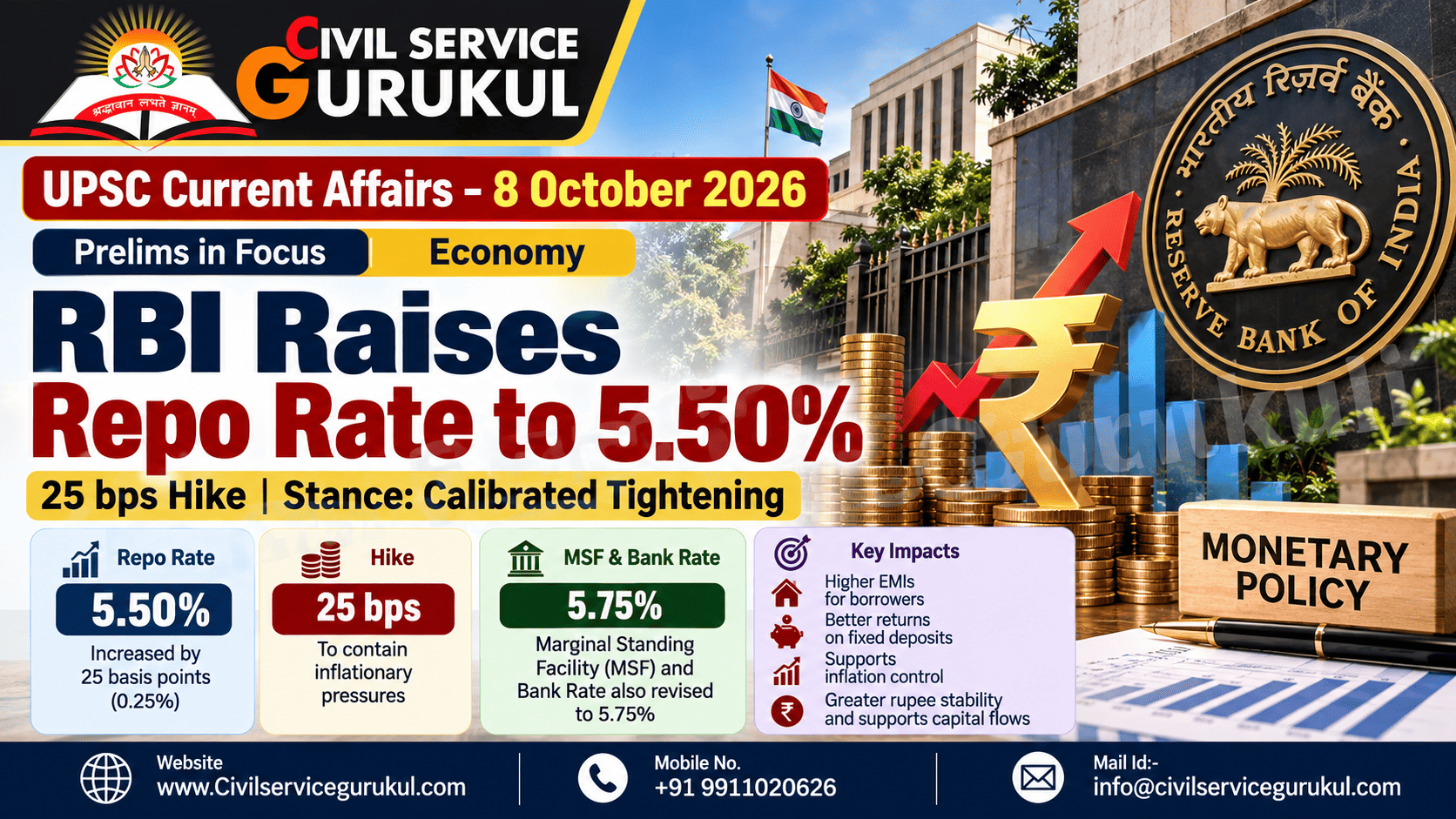
RBI Raises Repo Rate to 5.50%: What It Means for Inflation, Loans and India’s Economy
The Reserve Bank of India’s first repo-rate increase in nearly four years marks an important shift from supporting cheaper credit toward containing inflationary risks while economic growth remains relatively resilient.
Excerpt / Brief Summary
What Did the RBI Announce?
| Policy Instrument | Latest Level |
|---|---|
| Repo Rate | 5.50% |
| Change | Increase of 25 basis points |
| Standing Deposit Facility | 5.25% |
| Marginal Standing Facility | 5.75% |
| Bank Rate | 5.75% |
| Policy Stance | Calibrated Tightening |
The rate increase represented the RBI’s first upward adjustment of the repo rate since February 2023.
What Is the Repo Rate?
The repo rate is the interest rate at which the Reserve Bank of India provides short-term funds to commercial banks against eligible government securities.
It is one of the RBI’s principal instruments for influencing:
- Liquidity;
- Borrowing costs;
- Credit creation;
- Consumption;
- Investment;
- Inflation;
- Overall economic activity.
How Does a Repo Rate Hike Work?
RBI raises repo rate → Banks face higher marginal funding cost → Lending rates may increase → Loans become more expensive → Borrowing and spending may moderate → Aggregate demand slows → Inflationary pressure may ease
This transmission is not necessarily immediate or complete, but the direction of policy generally becomes tighter.
Why Did RBI Raise the Repo Rate?
1. Rising Inflation Risks
The central bank is concerned that higher food, fuel and energy prices could spread into wider consumer prices.
2. Strong Domestic Demand
When demand remains robust, firms may find it easier to pass higher costs on to consumers, making inflation more persistent.
3. Global Energy Uncertainty
India remains sensitive to international crude-oil prices because of its large import dependence. Higher oil prices can affect:
- Transport costs;
- Inflation;
- Current account balance;
- Fiscal pressures;
- Rupee stability.
4. Global Financial Tightening
Higher global bond yields and changing interest-rate expectations can affect foreign capital flows into emerging economies.
What Does “Calibrated Tightening” Mean?
A shift from a neutral stance to calibrated tightening is important because policy stance communicates the central bank’s likely direction.
The central bank retains flexibility to move rates either upward or downward.
Calibrated Tightening:
The policy bias shifts toward controlling inflation, while the timing and magnitude of future action depend on incoming data.
Therefore, the stance does not automatically guarantee another rate hike at the next meeting, but it signals that inflation risks have become a greater policy priority.
What Is the Monetary Policy Committee?
The Monetary Policy Committee, or MPC, determines the policy repo rate under India’s flexible inflation-targeting framework.
- MPC has six members.
- Three members are from the RBI.
- Three are appointed by the Central Government.
- The RBI Governor chairs the MPC.
- Each member has one vote.
- The Governor has a casting vote in case of a tie.
Inflation Targeting in India
India follows a flexible inflation-targeting framework centred on Consumer Price Index inflation.
The medium-term target is:
Tolerance Band: 2% to 6%
Monetary policy attempts to keep inflation near the target while also taking economic growth and financial stability into account.
Impact on Home, Car and Personal Loans
A repo-rate hike can raise borrowing costs, particularly for floating-rate loans linked to external benchmarks.
Borrowers may experience:
- Higher EMI;
- Longer loan tenure;
- Higher total interest outgo;
- Reduced loan affordability;
- More cautious borrowing decisions.
A rise in the repo rate does not mean every loan rate rises immediately. The impact depends on the loan’s benchmark, reset period and the bank’s transmission policy.
Impact on Savers
Higher policy rates may eventually encourage banks to offer better returns on:
- Fixed deposits;
- Term deposits;
- Certain savings products.
Thus, monetary tightening often creates opposite effects for borrowers and savers.
| Stakeholder | Likely Effect |
|---|---|
| Borrowers | Higher borrowing cost |
| Depositors | Potentially better deposit rates |
| Businesses | Higher cost of capital |
| Consumers | Lower discretionary borrowing |
Impact on Businesses and Investment
Higher interest rates can affect corporate investment because businesses face higher financing costs.
Possible consequences include:
- Higher cost of term loans;
- Higher working-capital cost;
- Lower viability of marginal projects;
- Delayed capital expenditure;
- Reduced credit demand.
The challenge for the RBI is therefore to control inflation without unnecessarily weakening productive investment.
Impact on Inflation
A rate hike primarily works through the demand channel.
If credit becomes more expensive:
- Households may spend less;
- Businesses may invest more cautiously;
- Credit expansion may slow;
- Aggregate demand may moderate.
This can reduce demand-driven inflation.
Monetary policy is less effective against pure supply-side inflation, such as crop failure or sudden global crude-oil shortages.
Can a Repo Rate Hike Reduce Food Inflation?
Only indirectly.
A repo-rate hike cannot create more vegetables, cereals or pulses. Therefore, monetary policy cannot directly solve supply shortages.
However, it can prevent a temporary supply shock from turning into broad-based and persistent inflation through higher wages, services prices and inflation expectations.
Impact on the Indian Rupee
Higher domestic interest rates can make rupee-denominated financial assets relatively more attractive to global investors.
This can potentially:
- Support capital inflows;
- Reduce pressure from capital outflows;
- Provide some support to the rupee;
- Help moderate imported inflation.
However, exchange rates depend on many other factors, including the dollar, oil prices and global risk sentiment.
Impact on Financial Markets
Banking
Banks may benefit from loan repricing, but high rates can eventually slow credit growth and increase stress among weaker borrowers.
Real Estate
Higher home-loan rates can reduce housing affordability and weaken demand at the margin.
Automobiles
Vehicle purchases are often credit-financed, making the sector sensitive to loan costs.
Equity Markets
Higher interest rates can reduce the present value of future corporate earnings and may pressure rate-sensitive sectors.
Repo Rate vs Reverse Repo vs SDF vs MSF
| Instrument | Meaning |
|---|---|
| Repo Rate | Rate at which RBI lends short-term funds to banks against eligible securities |
| SDF | Rate at which RBI absorbs liquidity from banks without providing collateral |
| MSF | Emergency overnight borrowing facility available to scheduled commercial banks |
| Bank Rate | Reference rate linked with certain long-term and penal lending provisions |
Understanding the Policy Corridor
The RBI’s liquidity framework uses an interest-rate corridor.
Middle: Repo Rate – 5.50%
Lower Bound: SDF Rate – 5.25%
The corridor helps guide short-term money-market rates around the policy rate.
Growth vs Inflation: RBI’s Policy Dilemma
Central banks often face a trade-off between:
| Lower Interest Rates | Higher Interest Rates |
|---|---|
| Supports borrowing | Restrains credit demand |
| Encourages investment | Helps contain inflation |
| Boosts consumption | Can support currency stability |
| Can accelerate growth | May slow economic activity |
| May increase inflation pressure | Can reduce demand pressure |
The art of monetary policy lies in finding a balance consistent with price stability and sustainable growth.
Why Strong Growth Gives RBI Policy Space
The RBI raised its FY27 growth projection to around 7.1%, while its inflation forecast was revised upward. This combination gives the central bank greater room to focus on inflation without immediately fearing a sharp growth slowdown. :chatgpt-content-reference{index="1"}
In macroeconomic terms, stronger growth provides a buffer against the contractionary impact of moderate monetary tightening.
UPSC Prelims Quick Revision
- Repo rate after the October 2026 policy: 5.50%.
- The hike was 25 basis points.
- 100 basis points = 1 percentage point.
- SDF rate: 5.25%.
- MSF rate: 5.75%.
- Bank Rate: 5.75%.
- MPC consists of six members.
- RBI Governor chairs the MPC.
- India’s CPI inflation target is 4% with a 2%–6% tolerance band.
- Policy stance shifted to calibrated tightening.
UPSC Practice MCQ
1. An increase in the repo rate generally makes borrowing more expensive.
2. The Standing Deposit Facility is normally below the repo rate in the RBI policy corridor.
3. The Marginal Standing Facility normally forms the upper end of the policy corridor.
4. A repo-rate hike directly increases agricultural production and food supply.
Which of the statements given above are correct?
A. 1 and 2 only
B. 1, 2 and 3 only
C. 2, 3 and 4 only
D. 1, 2, 3 and 4
Answer: B
Explanation: Statements 1, 2 and 3 are correct. Statement 4 is incorrect because monetary policy cannot directly expand agricultural supply.
UPSC Mains Relevance
- Monetary policy;
- Inflation;
- Banking;
- Economic growth;
- Investment;
- Rupee and capital flows;
- Macroeconomic stability.
Possible UPSC Mains Question
“Monetary tightening can contain inflation but may also influence credit, investment and growth.” Explain the transmission mechanism of a repo-rate hike and discuss the challenges faced by the Reserve Bank of India in balancing price stability with economic growth.
Suggested Marks: 15
Suggested Word Limit: 250 words
How to Structure the Mains Answer
Introduction:
Define repo rate and mention its role as a key monetary-policy instrument.
Body:
- Explain monetary transmission;
- Discuss impact on loans and EMIs;
- Explain inflation moderation;
- Discuss impact on investment and consumption;
- Explain exchange-rate and capital-flow effects;
- Mention limitations against supply-side inflation;
- Discuss growth-inflation trade-offs.
Conclusion:
Emphasise that effective monetary policy requires calibrated action,
credible communication and complementary supply-side measures.
Key Terms for Answer Enrichment
Conclusion
The RBI’s decision to raise the repo rate to 5.50% represents an important shift in India’s monetary-policy cycle.
With inflation risks increasing while economic growth remains relatively resilient, the central bank has chosen to prioritise price stability through calibrated tightening.
For UPSC aspirants, the development is valuable because it demonstrates the real-world functioning of monetary policy: how an interest-rate decision made by the central bank ultimately influences banks, borrowers, businesses, inflation, investment and the exchange rate.
SEO Tags
Prepare with Mentors Who Cleared the Exam
Get personalized study plans, evaluated answer models, and test series access.