
Rosalind Franklin & Photo 51: 2026 Discovery | UPSC
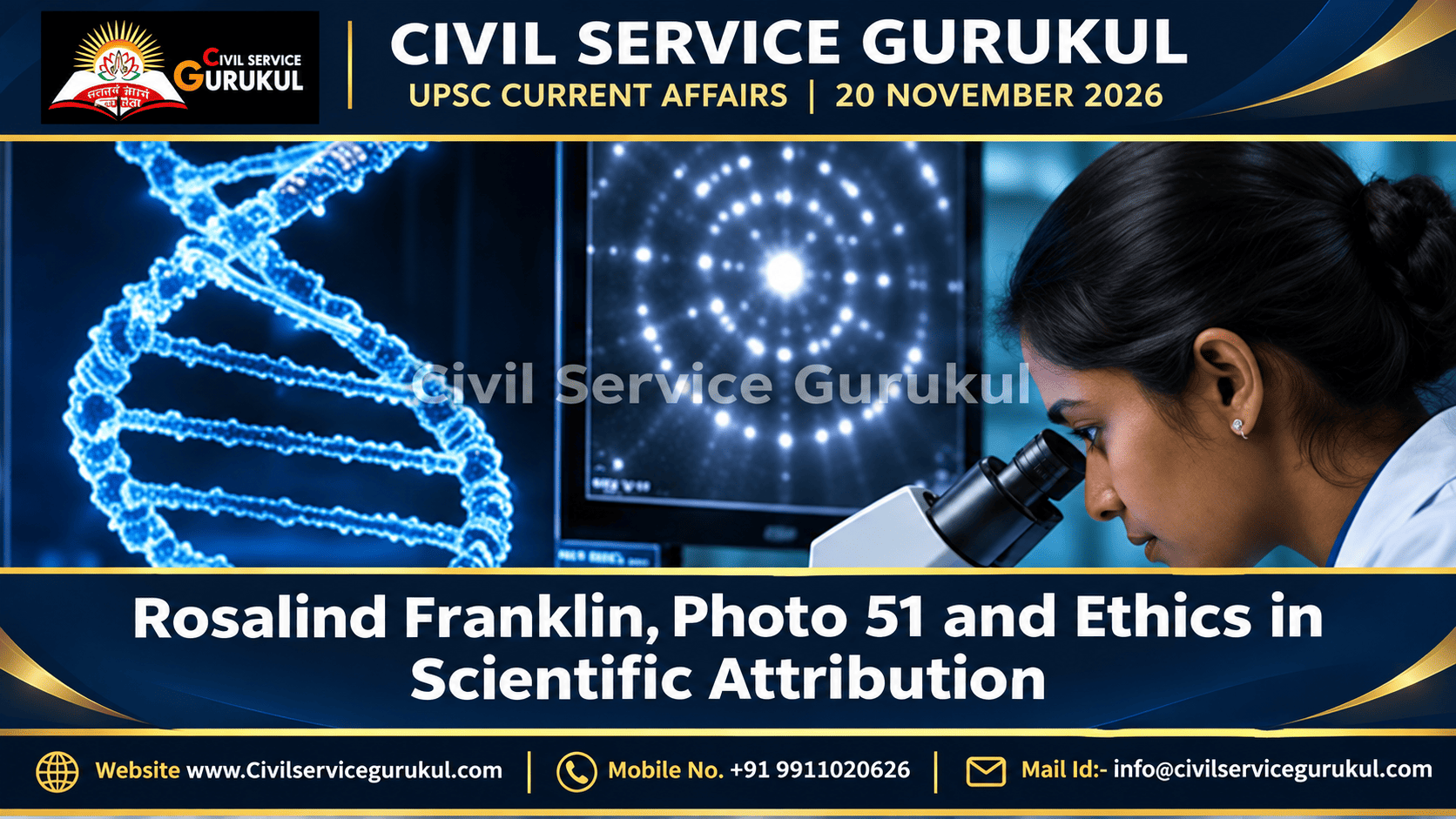
Rosalind Franklin's Photo 51 Mystery Revisited: 2026 Discovery, DNA Double Helix and Ethics in Science
The forgotten significance of Photo 49, the revolutionary history of DNA research, and the ethical importance of scientific attribution, collaboration, research integrity and recognition.
1. Why Is Rosalind Franklin in the News in 2026?
A new historical analysis has renewed discussion about the scientific contributions of Rosalind Franklin to the discovery of DNA's helical structure.
The research paper, "Photograph 49 Is the Key to Understanding the History of Rosalind Franklin's DNA Photograph 51", was published in the Journal of the History of Biology in October 2026.
The authors, Alistair Sponsel, a historian of science, and Brian Sutton, an X-ray crystallographer, examined historical evidence including laboratory notebooks, photographic records, manuscripts and equipment.
Their findings challenge the longstanding portrayal that Franklin did not understand the significance of the famous X-ray diffraction image known as Photo 51.
The researchers argue that Photo 51 was a carefully planned follow-up to Photo 49, which had already provided Franklin with valuable information about DNA's helical structure.
2. Who Was Rosalind Franklin?
Rosalind Elsie Franklin (1920–1958) was a British scientist known for her work in X-ray diffraction and the structural analysis of materials and biological molecules.
At King's College London, she conducted important research on the structure of deoxyribonucleic acid, commonly known as DNA.
Her work involved collecting precise diffraction data and interpreting the molecular arrangement of DNA fibres.
She worked with doctoral student Raymond Gosling, whose experimental contributions were also important.
3. Why Was DNA Structure a Major Scientific Question?
By the middle of the twentieth century, scientists knew that DNA was important to heredity.
However, understanding its three-dimensional molecular structure remained a major scientific challenge.
The correct model had to explain the organisation of the molecule and be consistent with available physical and chemical evidence.
The double-helix model proposed in 1953 became a landmark in molecular biology.
4. Scientists Associated with the Discovery
Developed and analysed important X-ray diffraction evidence relating to DNA structure.
Worked with Franklin on DNA experiments, including the Photo 51 diffraction image.
Worked with Francis Crick to develop the 1953 double-helix model.
Co-developed the DNA structural model with James Watson.
Contributed X-ray research on DNA at King's College London.
5. What Was Photo 51?
Photo 51 was an X-ray diffraction image of the B form of DNA.
It was produced in May 1952 by Rosalind Franklin and Raymond Gosling at King's College London.
The image displayed a distinctive X-shaped diffraction pattern associated with a helical structure.
It provided valuable experimental evidence for understanding DNA's molecular geometry.
6. Why Is the Image Called Photo 51?
Photo 51 was part of a series of diffraction images produced during the laboratory research.
Its number identified its place in that experimental series.
It became particularly famous because of its significance in interpreting the B form of DNA.
7. Was Photo 51 a Direct Photograph of DNA Atoms?
No.
Photo 51 was not a conventional optical photograph showing individual DNA atoms directly.
It was a pattern produced by X-rays interacting with an ordered DNA fibre sample.
Scientists could analyse the diffraction pattern to infer information about molecular arrangement and repeating structural features.
8. What Did the X-Shaped Pattern Indicate?
The X-shaped diffraction pattern provided important evidence for a helical organisation.
Other features of the diffraction data helped researchers estimate dimensions and repeating distances within the DNA structure.
However, the pattern alone was not equivalent to a complete molecular model showing all chemical and structural details.
9. What Did the October 2026 Research Discover?
The 2026 researchers re-examined historical evidence surrounding Photos 49 and 51.
They found that Franklin had already analysed an earlier diffraction image, Photo 49, and extracted important helical parameters.
They concluded that she deliberately obtained Photo 51 to create a clearer and more suitable experimental image.
10. What Was Photo 49?
Photo 49 was an earlier X-ray diffraction image of DNA obtained during Franklin and Gosling's research.
The image was imperfect because part of the diffraction pattern was obscured by a problem in the camera setup.
Despite the imperfection, Franklin was able to extract useful structural information from it.
11. Why Was Photo 51 Taken After Photo 49?
According to the 2026 historical interpretation, Franklin wanted a cleaner version of the earlier diffraction pattern.
Photo 51 therefore represented a deliberate attempt to produce higher-quality evidence suitable for scientific communication.
This challenges the idea that the famous image was merely an accidental experimental result whose significance Franklin failed to recognise.
12. Photo 49 vs Photo 51: Key Differences
| Parameter | Photo 49 | Photo 51 |
|---|---|---|
| Chronology | Earlier diffraction image | Subsequent refined image |
| Image Quality | Partly affected by a camera-related obstruction | Clearer diffraction pattern |
| Scientific Value | Used by Franklin to extract important helical information | Provided high-quality evidence of helical structure |
| 2026 Historical Interpretation | Shows Franklin had recognised important structural features | Interpreted as a deliberately planned refinement |
| Historical Recognition | Less widely known | Internationally famous |
13. Did Franklin Independently Discover the Complete Double Helix?
The 2026 study does not establish that Franklin had completed the full double-helix model at the time of Photo 49 or Photo 51.
The researchers emphasise that she recognised important features of helical DNA before the complete molecular structure was resolved.
This distinction matters because recognising helical geometry and proposing a complete two-stranded molecular model are related but different scientific achievements.
14. Historical Timeline: DNA Discovery and Scientific Recognition
Rosalind Franklin joined the DNA research programme at King's College London.
Franklin and Raymond Gosling produced Photo 51 following earlier experimental work, including Photo 49.
Maurice Wilkins showed Photo 51 to James Watson without Franklin's knowledge.
Nature published the Watson–Crick DNA model paper, Franklin–Gosling's experimental paper, and research from Wilkins and colleagues.
Rosalind Franklin died at the age of 37.
James Watson, Francis Crick and Maurice Wilkins received the Nobel Prize in Physiology or Medicine.
A new historical study re-examined Photo 49 and Photo 51, challenging older interpretations of Franklin's role.
15. Who Received the 1962 Nobel Prize?
The Nobel Prize in Physiology or Medicine for 1962 was awarded to:
- James Watson
- Francis Crick
- Maurice Wilkins
Rosalind Franklin had died in 1958, four years before the award.
The Nobel Prize did not include her name.
Her scientific contributions are now widely recognised in histories of molecular biology.
16. Understanding DNA for UPSC Science and Technology
DNA stands for Deoxyribonucleic Acid.
It is the genetic material in most living organisms and contains information important for heredity and biological functioning.
Key Features of B-DNA
- DNA has a double-helical structure.
- Two polynucleotide strands run antiparallel.
- The sugar-phosphate backbones lie on the outside.
- Nitrogenous bases are located towards the interior.
- Adenine pairs with thymine, and guanine pairs with cytosine.
- Classical B-DNA has approximately 10 base pairs per helical turn.
- The helical pitch is approximately 3.4 nanometres.
- The axial spacing between adjacent base pairs is approximately 0.34 nanometres.
17. What Is X-ray Diffraction?
X-ray diffraction is a scientific technique used to study the arrangement of matter at very small scales.
When X-rays interact with ordered structures, they scatter and generate patterns of constructive and destructive interference.
These patterns contain information about repeating distances and molecular organisation.
18. Why Was X-ray Diffraction Important for DNA?
The technique provided experimental evidence about DNA's helical geometry and repeating structure.
Scientists could combine diffraction measurements with chemical information and molecular modelling to investigate the structure of DNA.
The discovery illustrates how experimental measurements and theoretical interpretation can complement one another.
19. Difference Between DNA Forms A and B
| Feature | A-DNA | B-DNA |
|---|---|---|
| Occurrence in Historical Experiments | Associated with relatively lower hydration conditions | Associated with more highly hydrated DNA fibres |
| Helical Structure | Helical form with different geometry | Classical right-handed double-helical form |
| Diffraction Evidence | More complex historical interpretation | Characteristic Photo 51 diffraction pattern |
| UPSC Importance | Shows DNA structural variation | Central to the famous 1952–53 research |
20. Scientific Attribution: Why Is This an Ethics Issue?
Scientific attribution concerns the fair recognition of individual contributions to research and discoveries.
Major discoveries often result from collaborative efforts, including experimental design, data collection, analysis, modelling and theoretical insight.
Recognition can become ethically contested when the final public narrative does not reflect these different contributions.
The history of Photo 51 offers an important case for examining research integrity and institutional responsibility.
21. Ethical Questions Raised by Photo 51
Were contributions from different researchers recognised in proportion to their scientific work?
How should unpublished research findings be communicated between research groups?
What standards should govern access to and circulation of unpublished material?
How can institutions ensure accurate documentation and acknowledgement?
How can scientific institutions reduce bias in opportunities and recognition?
How should new archival evidence change established accounts of discoveries?
22. Photo 51 and the Ethics of Unpublished Data Sharing
In early 1953, Maurice Wilkins showed Photo 51 to James Watson without Franklin's knowledge.
The episode has generated longstanding debate about research communication, access to data and recognition of scientific work.
An ethical analysis should distinguish documented historical facts from interpretations of individual motives.
It should also consider the institutional working relationships and research norms of the period.
23. Was Rosalind Franklin Merely a Victim of Scientific Misattribution?
That description is too simplistic.
Historical scholarship has increasingly highlighted Franklin as an active, capable researcher who contributed original experimental data and scientific interpretation.
The 2026 research strengthens this understanding by re-examining her earlier calculations and deliberate experimental choices.
A balanced interpretation recognises both her scientific agency and the legitimate questions concerning how credit and information were shared.
24. Ethical Values for UPSC GS Paper IV
| Ethical Value | Application to Scientific Research |
|---|---|
| Integrity | Accurately report research methods, results and contributions |
| Honesty | Avoid misleading claims concerning discovery and ownership |
| Justice | Recognise contributions fairly |
| Transparency | Maintain clear research, authorship and data-sharing records |
| Accountability | Ensure research leaders uphold professional standards |
| Respect | Recognise collaborators, students and technical contributors |
| Objectivity | Evaluate findings using evidence rather than reputation |
25. Lessons for Modern Research Institutions
1. Transparent Authorship Policies
Institutions should define expectations for authorship and contribution at an early stage of research.
2. Proper Recognition of Students
Doctoral researchers and technical staff should receive appropriate recognition for their contributions.
3. Clear Data-Sharing Protocols
Research groups should establish transparent procedures for sharing unpublished results.
4. Reliable Research Documentation
Laboratory notebooks, experimental records and data archives help establish how discoveries actually developed.
5. Fair Evaluation Systems
Institutions should assess research contributions using documented scientific work rather than prestige alone.
6. Inclusive Scientific Culture
Equal opportunities and respectful professional environments can strengthen research quality and institutional trust.
7. Responsible Science Communication
Textbooks, popular media and academic institutions should update historical narratives when credible new evidence emerges.
26. Relevance for India's Science and Technology Governance
For India, the broader ethical lessons are relevant to research universities, public laboratories, science funding agencies and collaborative innovation projects.
Scientific institutions benefit from strong research governance, transparent contribution records and responsible handling of unpublished data.
These measures support public confidence in scientific research and protect the interests of researchers at different career stages.
27. UPSC Prelims 2027: High-Yield Revision Notes
- Rosalind Franklin was a British scientist who specialised in X-ray diffraction.
- Photo 51 was obtained by Franklin and Raymond Gosling in May 1952.
- Photo 51 depicts the diffraction pattern of B-form DNA.
- Photo 49 preceded Photo 51 and features in the 2026 historical reassessment.
- The 2026 paper was written by Alistair Sponsel and Brian Sutton.
- The paper appeared in the Journal of the History of Biology.
- Watson and Crick proposed the famous DNA double-helix model in 1953.
- Franklin and Gosling published their DNA diffraction research in Nature on 25 April 1953.
- The 1962 Nobel Prize in Physiology or Medicine went to Watson, Crick and Wilkins.
- Photo 51 was an X-ray diffraction pattern, not a direct photograph of individual DNA atoms.
- Complementary DNA bases pair as A–T and G–C.
- Research ethics includes fair attribution, integrity, transparency and accountability.
28. Common UPSC Conceptual Traps
| Incorrect Statement | Correct Understanding |
|---|---|
| Photo 51 was a normal optical photograph of DNA atoms. | It was an X-ray diffraction pattern. |
| Rosalind Franklin received the 1962 Nobel Prize. | The prize went to Watson, Crick and Wilkins. |
| The 2026 paper proves Franklin had completed the entire double-helix model in May 1952. | It argues that she recognised important helical features, not that the complete model was established then. |
| Photo 49 was taken after Photo 51. | Photo 49 was the earlier image. |
| Only theoretical model builders contribute to scientific discovery. | Experimental design, data collection and interpretation are also significant contributions. |
29. Original UPSC Prelims MCQs With Detailed Answers
With reference to Rosalind Franklin's DNA research, consider the following statements:
- Photo 51 was an X-ray diffraction image of B-form DNA.
- Raymond Gosling worked with Rosalind Franklin on the image.
- Photo 51 directly photographed individual DNA atoms through an optical microscope.
Which of the statements are correct?
(a) 1 only
(b) 1 and 2 only
(c) 2 and 3 only
(d) 1, 2 and 3
Show Answer and Explanation
Statements 1 and 2 are correct. Photo 51 is an X-ray diffraction image of DNA, obtained by Franklin and Gosling.
Statement 3 is incorrect because X-ray diffraction provides structural information through scattering patterns, not direct optical images of atoms.
Consider the following statements about the October 2026 research:
- It re-examined the relationship between Photo 49 and Photo 51.
- It argued that Franklin had already derived important helical information from Photo 49.
- It conclusively established that Franklin had completed the double-helix model before Watson and Crick.
Which statements are correct?
(a) 1 and 2 only
(b) 2 and 3 only
(c) 1 and 3 only
(d) 1, 2 and 3
Show Answer and Explanation
The researchers re-examined archival records and argued that Franklin had used Photo 49 to extract helical information before taking Photo 51.
They did not establish that she had completed the full double-helix model at that stage.
Which scientists received the 1962 Nobel Prize in Physiology or Medicine for work related to the molecular structure of nucleic acids?
(a) Rosalind Franklin, Raymond Gosling and Maurice Wilkins
(b) James Watson, Francis Crick and Maurice Wilkins
(c) James Watson, Rosalind Franklin and Francis Crick
(d) Raymond Gosling, Linus Pauling and Rosalind Franklin
Show Answer and Explanation
James Watson, Francis Crick and Maurice Wilkins received the 1962 Nobel Prize in Physiology or Medicine.
Rosalind Franklin died in 1958.
With reference to B-form DNA, consider the following statements:
- The two DNA strands run antiparallel.
- Adenine pairs with thymine.
- The classical B-DNA helix contains approximately 10 base pairs per turn.
Which statements are correct?
(a) 1 and 2 only
(b) 2 and 3 only
(c) 1 and 3 only
(d) 1, 2 and 3
Show Answer and Explanation
All three are correct. B-DNA consists of two antiparallel polynucleotide strands, with complementary base pairing.
Its classical helical geometry has approximately 10 base pairs per turn.
Which of the following best reflects ethical scientific attribution?
(a) Giving all credit to the most senior researcher
(b) Recognising documented contributions to research design, experimentation, analysis and interpretation
(c) Treating unpublished data as freely usable without regard to research agreements
(d) Ignoring technical contributors because they do not lead the final publication
Show Answer and Explanation
Fair attribution requires recognition of meaningful scientific contributions.
Research integrity also involves responsible data sharing and transparent authorship practices.
30. GS-IV Ethics Case Study
You are the director of a government-funded research institute.
A junior researcher produces important experimental results, but the senior project leader shares those results with an external collaborator without clearly documenting the junior researcher's contribution.
The external collaborator subsequently publishes a major scientific paper based partly on the findings.
The junior researcher complains that proper credit was not given.
Questions:- Identify the ethical issues involved.
- Which stakeholders should be considered?
- What steps would you take as the institute director?
- How would you prevent such disputes in future?
View Suggested Ethical Approach
Ethical issues: Fair attribution, consent in data sharing, integrity, transparency, professional respect and institutional accountability.
Stakeholders: Junior researcher, senior project leader, external collaborators, research institution, funding agency and the scientific community.
Immediate action: Conduct an impartial documentary review, preserve relevant records, hear all parties and determine the contributions and data-sharing arrangements.
Corrective action: Where warranted, seek appropriate acknowledgement, authorship correction or other remedies through established research processes.
Long-term reform: Introduce transparent authorship agreements, data-management protocols, ethical training and effective grievance redressal.
31. UPSC Mains 2027 Practice Questions
Question: Explain how X-ray diffraction contributed to the discovery of DNA's double-helical structure. Discuss the significance of the 2026 historical reassessment of Rosalind Franklin's work.
Marks: 10 | Word Limit: 150
Suggested Answer Structure
- Introduction: DNA and importance of molecular structure.
- Body: X-ray diffraction, Photo 49, Photo 51 and structural evidence.
- Recent development: 2026 archival reassessment.
- Conclusion: Combined role of experimentation and modelling.
Question: "The progress of science depends not only on discovery but also on integrity, collaboration and fair recognition." Discuss with reference to the history of Rosalind Franklin and Photo 51.
Marks: 15 | Word Limit: 250
Suggested Answer Structure
- Introduction: Meaning of research ethics.
- Historical context: Franklin, Gosling, Photo 51 and the 1953 DNA model.
- Ethical issues: attribution, data sharing, recognition and institutional responsibility.
- Balanced analysis: distinguish historical evidence from assumptions about motives.
- Way forward: transparent authorship, mentoring, archival records and accountability.
- Conclusion: Ethical institutions strengthen scientific credibility.
32. Model UPSC Mains Answer — GS Paper IV
Scientific discoveries often emerge from collective efforts involving experimental design, data collection, analysis and theoretical interpretation. Therefore, integrity and fair attribution are essential to scientific progress.
Rosalind Franklin's contribution to DNA research illustrates this principle. Working with Raymond Gosling, she generated and analysed important X-ray diffraction evidence of DNA. A 2026 historical study highlights her understanding of helical features through Photo 49, before she produced the refined Photo 51.
The history raises ethical questions concerning data sharing, institutional relationships and the fair recognition of scientific contributions.
Research institutions should adopt transparent authorship rules, clear data-sharing procedures, independent dispute resolution and inclusive mentoring.
Scientific excellence must be accompanied by honesty, accountability and respect for all contributors. Fair recognition strengthens trust in research institutions and encourages future innovation.
33. Frequently Asked Questions
What is Photo 51?
Photo 51 is an X-ray diffraction image of B-form DNA, produced by Rosalind Franklin and Raymond Gosling in May 1952.
What was the new discovery about Photo 49 in 2026?
A historical study argued that Franklin had already derived important helical information from Photo 49 and deliberately produced Photo 51 as a refined image.
Who wrote the 2026 historical research paper?
The paper was written by Alistair Sponsel and Brian Sutton.
Was Rosalind Franklin awarded the Nobel Prize?
No. The 1962 Nobel Prize went to James Watson, Francis Crick and Maurice Wilkins. Franklin died in 1958.
Does Photo 51 directly show the DNA double helix?
No. It is an X-ray diffraction pattern providing structural evidence from which molecular geometry can be inferred.
What was Raymond Gosling's role?
Raymond Gosling was Franklin's doctoral student and worked with her in producing the DNA diffraction images, including Photo 51.
Why is this topic relevant to UPSC Ethics?
It illustrates scientific integrity, responsible data sharing, fair attribution, institutional accountability and recognition of research contributions.
Why is this topic relevant to UPSC Science and Technology?
It connects DNA structure, X-ray diffraction, molecular biology, scientific discovery and current historical research.
34. Conclusion: Scientific Progress Requires Both Discovery and Integrity
The 2026 reassessment of Rosalind Franklin's Photo 49 and Photo 51 shows how careful historical research can improve our understanding of major scientific discoveries.
The findings challenge the simplistic belief that Franklin failed to recognise the significance of her own experimental evidence.
At the same time, the research does not establish that she had completed the entire double-helix model in 1952.
For UPSC aspirants, the topic combines science and technology with important ethical principles: honesty, transparency, research integrity, fair recognition and accountability.
The central lesson is that scientific progress depends not only on groundbreaking results, but also on the responsible recognition of everyone who helps produce them.
Prepare UPSC Science, Technology & Ethics with Civil Service Gurukul
Concept-based current affairs, UPSC Prelims practice, GS Paper III analysis, GS Paper IV case studies, Mains answer writing and examination-focused mentoring.
CIVIL SERVICE GURUKUL
Knowledge | Discipline | Success
Visit Our Website Call +91 9911020626 Email Civil Service Gurukulwww.civilservicegurukul.com
Editorial Note: This original educational article was prepared for Civil Service Gurukul on 20 November 2026. The current-affairs discussion is based on the 2026 historical study by Alistair Sponsel and Brian Sutton concerning Photo 49 and Photo 51, together with established historical and scientific information. The research reinterprets existing historical evidence; it does not represent a new discovery of DNA structure in 2026. Historical interpretations should be distinguished from conclusively established experimental findings. The UPSC MCQs, ethics case study and Mains practice material are original educational content.
Prepare with Mentors Who Cleared the Exam
Get personalized study plans, evaluated answer models, and test series access.