
Seventh Nilgiri-Class Frigate: Project 17A & Indian Navy
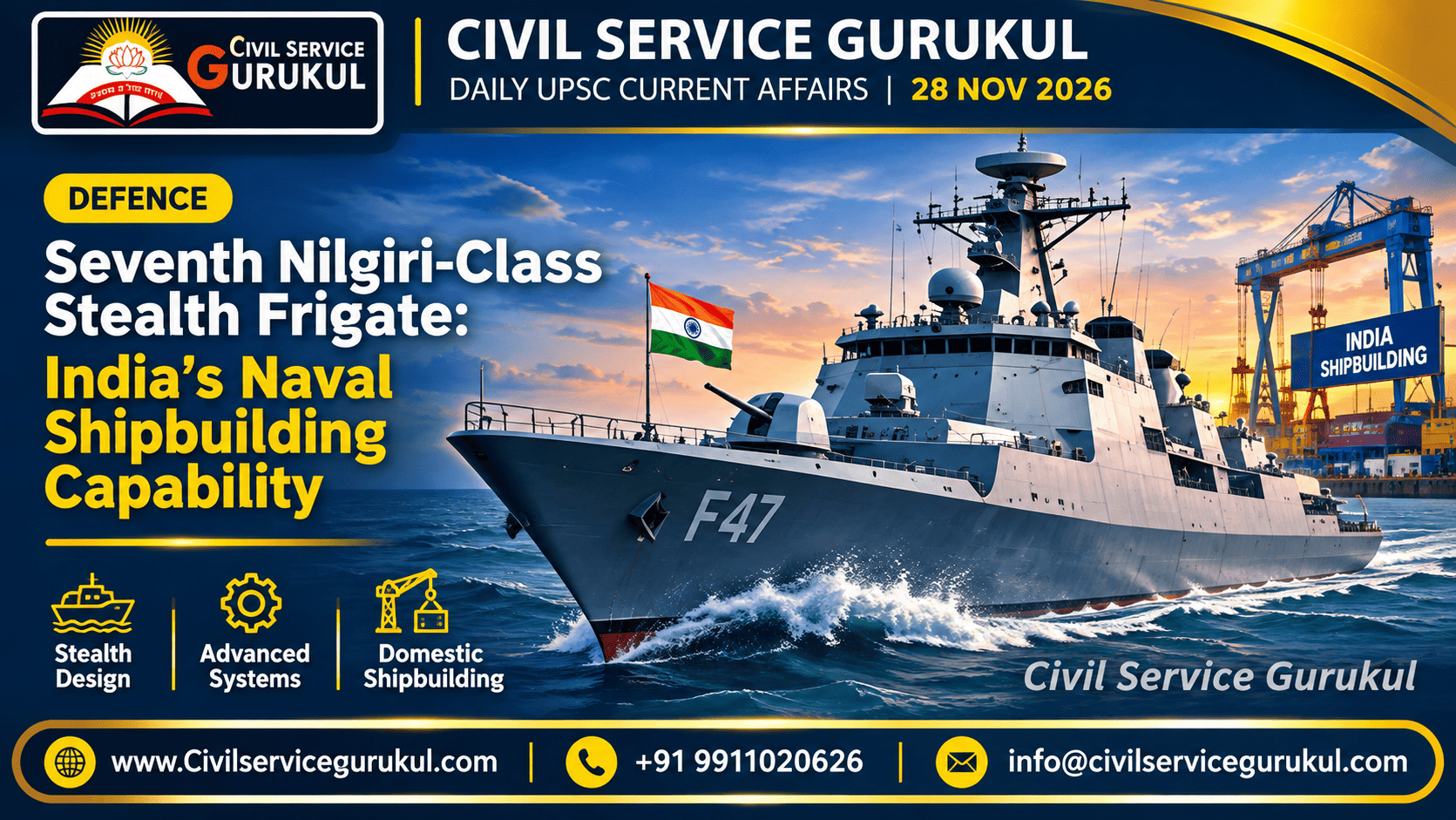
Seventh Nilgiri-Class Stealth Frigate Handed Over to Indian Navy: Project 17A, Indigenous Shipbuilding and India's Maritime Security Explained
28 November 2026 | UPSC CSE 2027 | Civil Service Gurukul Editorial Team
The seventh Nilgiri-class stealth frigate under Project 17A has reportedly been handed over to the Indian Navy, representing an important milestone in India's indigenous naval shipbuilding programme.
Project 17A reflects India's efforts to develop advanced surface combatants through domestic design, manufacturing, systems integration and technological innovation.
The programme has considerable significance for maritime security, defence self-reliance, strategic autonomy and India's ability to protect its economic and security interests across the Indian Ocean Region.
However, the reported handover should not be confused with formal commissioning or confirmation of full operational readiness.
UPSC Syllabus Relevance
| Examination | Relevant Topics |
|---|---|
| UPSC Prelims | Project 17A, Indian Navy, warship classifications, stealth technology and defence manufacturing. |
| GS Paper II | Indian Ocean geopolitics, international cooperation and India's strategic interests. |
| GS Paper III | Defence technology, maritime security, indigenisation of technology and industrial development. |
| Essay Paper | Strategic autonomy, technological self-reliance and national security. |
| UPSC Interview | Indian Navy modernisation, maritime strategy and Atmanirbhar Bharat. |
1. What Is Project 17A?
Project 17A is an important Indian naval shipbuilding programme involving the construction of seven Nilgiri-class guided-missile stealth frigates.
The programme builds upon the experience gained through Project 17, which produced the Shivalik-class frigates.
Project 17A incorporates improvements in ship design, signature management, survivability, automation, sensors and integrated systems.
The programme also demonstrates the development of India's domestic capabilities in naval architecture, advanced engineering and complex systems integration.
Project 17A at a Glance
| Particulars | Details |
|---|---|
| Project Name | Project 17A |
| Warship Class | Nilgiri Class |
| Vessel Category | Guided-Missile Stealth Frigate |
| Total Planned Vessels | Seven |
| Predecessor Programme | Project 17 — Shivalik Class |
| Construction Agencies | Mazagon Dock Shipbuilders Limited and Garden Reach Shipbuilders and Engineers |
| Design Organisation | Indian Navy's Warship Design Bureau |
| Primary Significance | Naval modernisation, indigenous manufacturing and maritime security |
Project 17A is associated with Nilgiri-class frigates, whereas Project 17 is associated with Shivalik-class frigates.
2. Seven Nilgiri-Class Stealth Frigates
The Project 17A programme comprises seven vessels named after Indian mountain ranges and hills.
| Vessel Name | Construction Shipyard |
|---|---|
| Nilgiri | Mazagon Dock Shipbuilders Limited |
| Udaygiri | Mazagon Dock Shipbuilders Limited |
| Taragiri | Mazagon Dock Shipbuilders Limited |
| Mahendragiri | Mazagon Dock Shipbuilders Limited |
| Himgiri | Garden Reach Shipbuilders and Engineers |
| Dunagiri | Garden Reach Shipbuilders and Engineers |
| Vindhyagiri | Garden Reach Shipbuilders and Engineers |
The names above represent the programme's vessels and their associated shipyards. The table does not indicate their individual commissioning dates or current operational status.
The reported handover of the seventh frigate is a programme-level milestone. The specific vessel identity and formal commissioning status should be confirmed through official naval announcements.
3. Important Indian Naval Shipbuilding Institutions
Mazagon Dock Shipbuilders Limited (MDL)
Mazagon Dock Shipbuilders Limited, located in Mumbai, Maharashtra, is a major Indian defence shipbuilding enterprise.
It contributes to the construction of warships and submarines and plays an important role in India's naval manufacturing ecosystem.
Garden Reach Shipbuilders and Engineers (GRSE)
Garden Reach Shipbuilders and Engineers, headquartered in Kolkata, West Bengal, is another important Indian defence shipbuilding organisation.
GRSE contributes to the construction of frigates, corvettes, patrol vessels and other maritime platforms.
Warship Design Bureau
The Indian Navy's Warship Design Bureau contributes to indigenous warship design, naval architecture and the integration of complex engineering systems.
Cochin Shipyard Limited
Cochin Shipyard Limited, located in Kochi, Kerala, is an important Indian shipbuilding and ship-repair enterprise associated with the construction of India's indigenous aircraft carrier, INS Vikrant.
| Shipyard | Location |
|---|---|
| Mazagon Dock Shipbuilders Limited | Mumbai, Maharashtra |
| Garden Reach Shipbuilders and Engineers | Kolkata, West Bengal |
| Cochin Shipyard Limited | Kochi, Kerala |
| Goa Shipyard Limited | Vasco da Gama, Goa |
| Hindustan Shipyard Limited | Visakhapatnam, Andhra Pradesh |
4. Major Features of Nilgiri-Class Frigates
Nilgiri-class frigates are modern multi-role surface combatants intended to strengthen the Indian Navy's capabilities across different maritime environments.
Stealth-Oriented Design
The vessels incorporate design principles intended to reduce detectability and improve survivability.
Multi-Role Capabilities
Modern frigates are designed to support multiple naval responsibilities, including maritime surveillance, fleet protection and anti-submarine operations.
Advanced Sensors
Integrated sensors support maritime awareness, navigation and the detection and classification of potential threats.
Integrated Combat Systems
Modern combat management systems help coordinate information from multiple onboard systems and support decision-making.
Automation and Systems Integration
Automation can improve the efficiency of ship management, machinery monitoring and information processing.
Improved Survivability
Modern naval architecture emphasises reliability, damage control, safety and continued functioning under challenging conditions.
Modular Construction
Modular shipbuilding involves constructing major ship sections separately before integrating them into the complete vessel.
This approach can improve manufacturing coordination, quality assurance and construction efficiency when supported by effective project management.
↓
Modular Construction
↓
Systems Integration
↓
Testing and Quality Assurance
↓
Delivery and Operational Preparation
5. Understanding Stealth Technology in Naval Ships
Stealth technology refers to a combination of design and engineering measures intended to reduce the detectability of a platform.
In naval applications, stealth is not limited to radar visibility. Warships may produce several different types of detectable signatures.
| Signature | Meaning |
|---|---|
| Radar Signature | Characteristics associated with the reflection of radar signals. |
| Acoustic Signature | Sound generated by machinery, propulsion and movement through water. |
| Infrared Signature | Heat emissions associated with engines, machinery and other systems. |
| Electromagnetic Signature | Detectable electromagnetic emissions associated with onboard systems. |
| Visual Signature | Characteristics that influence visual detection of a vessel. |
Why Is Stealth Technology Important?
- Improves platform survivability.
- Reduces detectability in certain operating conditions.
- Supports modern maritime operations.
- Encourages advanced materials and engineering research.
- Promotes technological innovation in naval architecture.
Stealth does not mean complete invisibility. It refers to reducing the probability or effectiveness of detection under particular conditions.
6. Difference Between Frigates, Destroyers, Corvettes and Aircraft Carriers
Naval vessels are classified according to their design, size, capabilities and intended operational roles. Modern classifications may overlap between different navies.
| Warship Type | General Characteristics | Primary Role |
|---|---|---|
| Corvette | Generally smaller surface combatant. | Coastal defence, patrol and specialised missions. |
| Frigate | Versatile surface combatant. | Fleet escort, maritime surveillance and multi-role operations. |
| Destroyer | Generally larger and highly capable surface combatant. | Fleet defence and advanced multi-role operations. |
| Aircraft Carrier | Large naval platform supporting aircraft operations. | Sea-based aviation and maritime power projection. |
| Submarine | Vessel capable of operating underwater. | Underwater surveillance, deterrence and naval operations. |
| Offshore Patrol Vessel | Platform designed primarily for patrol responsibilities. | Maritime monitoring, policing and protection of maritime interests. |
Nilgiri-class vessels are frigates. Visakhapatnam-class vessels are destroyers. INS Vikrant is an aircraft carrier.
7. Important Indian Naval Modernisation Projects
| Project | Associated Class or Programme | Vessel Type |
|---|---|---|
| Project 17 | Shivalik Class | Frigate |
| Project 17A | Nilgiri Class | Stealth Frigate |
| Project 15 | Delhi Class | Destroyer |
| Project 15A | Kolkata Class | Destroyer |
| Project 15B | Visakhapatnam Class | Destroyer |
| Project 28 | Kamorta Class | Anti-Submarine Warfare Corvette |
| Project 75 | Kalvari Class | Conventional Submarine |
| Project 75(I) | Conventional Submarine Acquisition Programme | Submarine |
| IAC-1 | INS Vikrant | Indigenous Aircraft Carrier |
These programmes illustrate India's efforts to develop a diversified naval fleet capable of addressing different maritime security requirements.
8. Difference Between Launch, Delivery and Commissioning
The construction and induction of a naval warship involve multiple engineering, administrative and operational milestones.
| Stage | Meaning |
|---|---|
| Design | Development of the vessel's architecture and engineering requirements. |
| Keel Laying | Traditional milestone marking an important stage in ship construction. |
| Launching | Introduction of the constructed hull into water. |
| Outfitting | Installation and integration of machinery, equipment and onboard systems. |
| Sea Trials | Testing of vessel performance and systems under maritime conditions. |
| Delivery or Handover | Transfer of the vessel from the shipbuilder to the receiving authority. |
| Commissioning | Formal induction of the vessel into naval service. |
| Operational Preparation | Training, integration and readiness activities necessary for assigned responsibilities. |
↓
Launch and Outfitting
↓
Testing and Sea Trials
↓
Delivery or Handover
↓
Commissioning
↓
Operational Integration
The reported handover of the seventh Nilgiri-class frigate does not automatically establish that the vessel has been formally commissioned or has achieved full operational readiness.
9. Defence Indigenisation and Atmanirbhar Bharat
Defence indigenisation refers to the development of domestic capabilities in defence research, design, manufacturing, testing, maintenance and technological innovation.
Project 17A demonstrates how naval procurement can contribute to a broader industrial ecosystem rather than merely increasing the number of warships.
Major Components of Defence Indigenisation
- Domestic naval architecture and engineering.
- Indigenous component manufacturing.
- Advanced materials development.
- Research and development.
- Domestic electronics and sensor capabilities.
- Testing and quality assurance infrastructure.
- Maintenance, repair and overhaul capabilities.
- Development of skilled technical manpower.
- Participation of private enterprises and MSMEs.
Important Government Initiatives
| Initiative | Objective |
|---|---|
| Make in India | Promote domestic manufacturing and industrial investment. |
| Atmanirbhar Bharat | Strengthen domestic capabilities and economic resilience. |
| Defence Acquisition Procedure 2020 | Provide a procurement framework with emphasis on indigenous capabilities. |
| Innovations for Defence Excellence (iDEX) | Encourage innovation by startups, researchers and technology enterprises. |
| Positive Indigenisation Lists | Promote domestic procurement of specified defence items under applicable timelines. |
| Defence Industrial Corridors | Develop defence manufacturing ecosystems in Uttar Pradesh and Tamil Nadu. |
| SRIJAN Portal | Facilitate identification of defence indigenisation opportunities. |
True defence self-reliance requires domestic design ownership, critical technology development, dependable supply chains and lifecycle maintenance capabilities rather than final assembly alone.
10. Significance for India's Maritime Security
India occupies a strategically important position in the Indian Ocean Region. Its maritime environment influences international trade, energy security, economic development and regional stability.
A modern naval fleet helps India protect its legitimate maritime interests and contribute to a stable regional maritime environment.
Protection of Maritime Trade
India depends significantly on maritime transportation for international merchandise trade and energy supplies.
Maritime Domain Awareness
Maritime domain awareness involves developing an effective understanding of activities, developments and potential risks within the maritime environment.
Protection of Economic Interests
India's maritime interests include offshore energy infrastructure, fisheries, ports, shipping and other economic activities.
Regional Stability
Naval cooperation, maritime diplomacy and coordinated security initiatives can support regional confidence and stability.
Humanitarian Assistance and Disaster Relief
Naval forces can support evacuation, disaster relief, medical assistance and emergency logistics during maritime and regional crises.
Counter-Piracy and Maritime Cooperation
Modern naval capabilities contribute to international efforts against piracy and other maritime security challenges, subject to applicable legal frameworks.
11. Sea Lines of Communication and Strategic Chokepoints
Sea Lines of Communication, commonly known as SLOCs, are maritime routes used for commercial transportation, logistics and strategic movement.
Disruptions along major maritime routes can affect shipping costs, energy supplies, international trade and global supply chains.
| Strategic Chokepoint | Geographical Significance |
|---|---|
| Strait of Hormuz | Connects the Persian Gulf with the Gulf of Oman. |
| Strait of Malacca | Connects the Andaman Sea with the Singapore Strait and wider South China Sea routes. |
| Bab-el-Mandeb | Connects the Red Sea with the Gulf of Aden. |
| Suez Canal | Connects the Mediterranean Sea with the Red Sea. |
| Sunda Strait | Separates the Indonesian islands of Java and Sumatra. |
| Lombok Strait | Separates Bali and Lombok in Indonesia. |
Aspirants should revise important maritime chokepoints, neighbouring countries, connecting water bodies and their relevance to international trade.
12. India's Maritime Vision: SAGAR and MAHASAGAR
SAGAR
SAGAR stands for Security and Growth for All in the Region. It was articulated by India in 2015 as a vision for regional maritime cooperation.
It emphasises collective security, economic development, maritime cooperation and capacity building.
MAHASAGAR
MAHASAGAR stands for Mutual and Holistic Advancement for Security and Growth Across Regions.
Articulated in 2025, the vision reflects a broader approach to cooperation, security, development and engagement across regions.
Important Dimensions of Maritime Cooperation
- Regional maritime security.
- Capacity building and training.
- Information sharing.
- Humanitarian assistance.
- Disaster risk reduction.
- Sustainable use of ocean resources.
- Economic and technological cooperation.
Important Maritime Institutions and Initiatives
| Institution or Initiative | Significance |
|---|---|
| Indian Ocean Rim Association (IORA) | Regional cooperation among Indian Ocean countries. |
| Indian Ocean Naval Symposium (IONS) | Promotes dialogue and cooperation among regional navies. |
| Information Fusion Centre – Indian Ocean Region | Supports maritime information sharing and domain awareness. |
| Indo-Pacific Oceans Initiative (IPOI) | Promotes practical maritime cooperation across the Indo-Pacific. |
| QUAD | Cooperation among India, Australia, Japan and the United States across multiple strategic and developmental areas. |
13. Economic and Industrial Significance of Indigenous Shipbuilding
Naval shipbuilding is a technology-intensive industrial activity involving numerous suppliers, engineering disciplines and specialised manufacturing capabilities.
Domestic warship construction can generate economic benefits beyond the defence sector.
Employment Generation
Shipbuilding creates opportunities for engineers, technicians, welders, designers, quality professionals and skilled industrial workers.
Development of MSMEs
Smaller enterprises can participate in the production of components, industrial equipment, electronic systems and specialised services.
Technological Spillovers
Research and engineering capabilities developed for defence shipbuilding may also support civilian maritime manufacturing and other advanced industrial sectors.
Reduction in Import Dependence
Domestic manufacturing and maintenance capabilities can reduce dependence on selected foreign suppliers and improve supply-chain resilience.
Defence Export Potential
Competitive shipbuilding capabilities may create export opportunities, subject to international demand, regulatory approvals, quality standards and commercial competitiveness.
Lifecycle Economic Benefits
Domestic repair, maintenance and upgrade capabilities can improve long-term availability and reduce exposure to external supply disruptions.
↓
Domestic Manufacturing
↓
MSME and Supplier Development
↓
Skilled Employment and Innovation
↓
Industrial Competitiveness
↓
Strategic and Economic Resilience
14. Challenges in India's Naval Modernisation
| Challenge | Potential Implication |
|---|---|
| Critical Technology Dependence | Selected advanced components may remain dependent on foreign suppliers. |
| Project Delays | Construction and integration delays may affect planned fleet development. |
| Cost Escalation | Complex engineering programmes require effective financial management. |
| Skilled Manpower | Advanced shipbuilding requires specialised technical expertise. |
| Research and Development | Continuous investment is necessary to develop critical technologies. |
| Supply-Chain Vulnerability | Dependence on limited suppliers may affect component availability. |
| Lifecycle Maintenance | Warships require reliable spares, upgrades and long-term technical support. |
| Budgetary Trade-Offs | Resources must be balanced across different defence and developmental requirements. |
| Fleet Composition | Surface combatants, submarines, aircraft and unmanned systems require balanced investment. |
| Operational Readiness | Delivery of a vessel must be supported by training, logistics and systems integration. |
The success of naval modernisation should not be assessed solely through the number of vessels constructed. Operational availability, lifecycle costs, training, indigenous technological depth and strategic suitability are equally important indicators.
15. Way Forward
Strengthen Indigenous Research and Development
India should encourage collaboration among defence research institutions, shipyards, universities, startups and private industries.
Develop Critical Component Capabilities
Domestic capabilities in specialised machinery, propulsion-related technologies, electronics and advanced materials should receive sustained attention.
Improve Shipyard Productivity
Modern project management, digital engineering, modular construction and quality assurance can improve construction efficiency.
Promote MSME Participation
Supplier development programmes, technical assistance and predictable procurement opportunities can strengthen domestic industrial participation.
Enhance Lifecycle Maintenance
Maintenance infrastructure, spare-parts availability and technical training should be integrated into procurement planning.
Maintain a Balanced Naval Fleet
Investment decisions should consider surface vessels, submarines, maritime aviation, coastal surveillance and emerging technologies.
Encourage Maritime Cooperation
Regional partnerships, information sharing and humanitarian cooperation can complement domestic naval capabilities.
Improve Transparency and Accountability
Defence programmes should be assessed through appropriate indicators of cost efficiency, delivery performance, technological self-reliance and operational availability.
↓
Domestic Industrial Capability
↓
Reliable Naval Platforms
↓
Operational Readiness
↓
Maritime Security and Strategic Autonomy
16. UPSC Prelims Quick Revision Notes
| Concept | Important Examination Fact |
|---|---|
| Project 17A | Nilgiri-class guided-missile stealth frigates. |
| Project 17 | Shivalik-class frigates. |
| Project 15B | Visakhapatnam-class destroyers. |
| Project 15A | Kolkata-class destroyers. |
| Project 28 | Kamorta-class corvettes. |
| Project 75 | Kalvari-class conventional submarines. |
| INS Vikrant | India's first indigenously built aircraft carrier. |
| Project 17A Fleet Size | Seven planned frigates. |
| MDL | Mazagon Dock Shipbuilders Limited, Mumbai. |
| GRSE | Garden Reach Shipbuilders and Engineers, Kolkata. |
| Warship Design Bureau | Indian Navy's indigenous warship design organisation. |
| Stealth Technology | Reduces detectability; does not ensure invisibility. |
| SLOC | Sea Lines of Communication. |
| SAGAR | Security and Growth for All in the Region. |
| MAHASAGAR | Mutual and Holistic Advancement for Security and Growth Across Regions. |
| IORA | Indian Ocean Rim Association. |
| IONS | Indian Ocean Naval Symposium. |
| iDEX | Innovations for Defence Excellence. |
| Indian Navy Day | 4 December. |
| Commissioning | Formal induction of a vessel into naval service. |
17. UPSC Prelims Practice MCQs
Attempt these original UPSC-oriented practice questions before revealing the answers.
Question 1
With reference to Project 17A, consider the following statements:
- It is associated with Nilgiri-class stealth frigates.
- It builds upon India's experience with Project 17.
- It is exclusively a nuclear-powered submarine construction programme.
Which of the statements given above are correct?
A. 1 only
B. 1 and 2 only
C. 2 and 3 only
D. 1, 2 and 3
Reveal Answer and Explanation
Project 17A involves Nilgiri-class stealth frigates and builds upon the earlier Shivalik-class programme. It is not a nuclear submarine programme.
Question 2
Consider the following pairs:
- Project 17A — Nilgiri Class
- Project 15B — Visakhapatnam Class
- Project 28 — Kamorta Class
- Project 75 — Kalvari Class
How many of the above pairs are correctly matched?
A. Only one
B. Only two
C. Only three
D. All four
Reveal Answer and Explanation
All four projects are correctly matched with their respective naval vessel classes.
Question 3
Which of the following shipyards are associated with Project 17A?
- Mazagon Dock Shipbuilders Limited.
- Garden Reach Shipbuilders and Engineers.
- Cochin Shipyard Limited.
Select the correct answer:
A. 1 and 2 only
B. 2 and 3 only
C. 1 and 3 only
D. 1, 2 and 3
Reveal Answer and Explanation
Project 17A frigates are constructed by Mazagon Dock Shipbuilders Limited and Garden Reach Shipbuilders and Engineers.
Question 4
With reference to stealth technology in naval vessels, consider the following statements:
- It may involve reducing radar detectability.
- It may involve managing acoustic and infrared signatures.
- It guarantees complete invisibility under all operating conditions.
Which of the statements given above are correct?
A. 1 only
B. 3 only
C. 1 and 2 only
D. 1, 2 and 3
Reveal Answer and Explanation
Stealth technology reduces detectability by managing different signatures. It does not guarantee complete invisibility.
Question 5
Which of the following best describes the commissioning of a naval warship?
A. Beginning of its construction.
B. Introduction of its hull into water.
C. Completion of its initial design.
D. Formal induction of the vessel into naval service.
Reveal Answer and Explanation
Commissioning formally introduces a warship into naval service. It is distinct from launching, delivery and other construction milestones.
Question 6
Consider the following pairs:
- Strait of Hormuz — Persian Gulf and Gulf of Oman.
- Bab-el-Mandeb — Red Sea and Gulf of Aden.
- Suez Canal — Mediterranean Sea and Red Sea.
How many of the above pairs are correctly matched?
A. Only one
B. Only two
C. All three
D. None
Reveal Answer and Explanation
All three maritime chokepoints are correctly matched with the water bodies they connect.
Question 7
With reference to defence indigenisation in India, consider the following statements:
- It includes domestic research and design capabilities.
- It includes maintenance and lifecycle support.
- It necessarily requires complete elimination of every foreign component before a platform can be considered indigenous.
Which of the statements given above are correct?
A. 1 and 2 only
B. 2 and 3 only
C. 1 and 3 only
D. 1, 2 and 3
Reveal Answer and Explanation
Defence indigenisation includes domestic design, manufacturing and maintenance capabilities. Indigenous platforms may still contain selected imported components.
Question 8
The term SAGAR, in the context of India's maritime vision, stands for:
A. Strategic Alliance for Global Asian Resources.
B. Security and Growth for All in the Region.
C. Sustainable Agreement for Global Arctic Research.
D. Security and Governance of Asian Rivers.
Reveal Answer and Explanation
SAGAR stands for Security and Growth for All in the Region. It reflects India's approach to maritime cooperation and regional development.
Question 9
Which of the following may be benefits of indigenous naval shipbuilding?
- Development of skilled manpower.
- Expansion of domestic industrial supply chains.
- Improvement in maintenance capabilities.
- Promotion of technological innovation.
Select the correct answer:
A. 1 and 2 only
B. 2 and 3 only
C. 1, 3 and 4 only
D. 1, 2, 3 and 4
Reveal Answer and Explanation
All four are potential benefits of a well-developed indigenous naval shipbuilding ecosystem.
Question 10
With reference to maritime security, consider the following statements:
- Sea Lines of Communication are important for international trade and logistics.
- Maritime domain awareness involves understanding activities and risks within the maritime environment.
- The delivery of a new warship alone guarantees complete maritime security.
Which of the statements given above are correct?
A. 1 only
B. 2 and 3 only
C. 1 and 2 only
D. 1, 2 and 3
Reveal Answer and Explanation
Maritime security requires a combination of platforms, surveillance, trained personnel, logistics, diplomacy and institutional cooperation. Delivery of a single vessel cannot guarantee complete maritime security.
18. UPSC Mains Practice Questions and Model Answer
Mains Question 1 — GS Paper III
Examine the significance of indigenous naval shipbuilding programmes such as Project 17A in strengthening India's maritime security, industrial capabilities and strategic autonomy. Discuss the associated challenges.
15 Marks | 250 Words
Model Answer
Introduction:
India's geographical position in the Indian Ocean and its dependence on maritime trade make naval modernisation an important component of national security. Project 17A, involving indigenous construction of Nilgiri-class stealth frigates, reflects India's efforts to strengthen maritime capabilities and defence self-reliance.
Body:
Indigenous naval shipbuilding contributes to maritime security by supporting fleet modernisation, maritime surveillance, protection of sea lines of communication and sustained naval presence.
Strategically, domestic design and manufacturing capabilities reduce dependence on external suppliers and strengthen India's ability to pursue independent security and foreign policy objectives.
Economically, naval construction promotes advanced engineering, skilled employment, MSME participation, research and development, and domestic industrial supply chains. These capabilities may also generate technological spillovers into civilian maritime industries.
However, several challenges remain. Dependence on imported critical technologies, construction delays, cost escalation, limited specialised manpower and lifecycle maintenance requirements may constrain the effectiveness of naval modernisation.
Moreover, investment in surface combatants must be balanced with submarines, maritime aviation, coastal surveillance and emerging technologies.
India should therefore strengthen indigenous research, promote industry-academia collaboration, develop critical component manufacturing, improve shipyard productivity and ensure reliable maintenance infrastructure.
Conclusion:
Project 17A demonstrates the potential of defence indigenisation to connect national security with industrial development. Its long-term success should be assessed through operational readiness, technological self-reliance, cost efficiency and contribution to a secure and stable maritime environment.
Mains Question 2 — GS Paper III
Defence indigenisation is not merely an import substitution strategy but a foundation for technological and strategic autonomy. Discuss.
15 Marks | 250 Words
Suggested Answer Structure
- Define defence indigenisation.
- Explain the importance of domestic design ownership.
- Discuss national security and supply-chain resilience.
- Analyse employment and industrial benefits.
- Identify critical technology dependencies.
- Suggest research, innovation and procurement reforms.
- Conclude with strategic autonomy and sustainable development.
Mains Question 3 — GS Paper II
Discuss the strategic significance of the Indian Ocean Region for India's foreign policy and economic security.
15 Marks | 250 Words
Mains Question 4 — GS Paper III
Explain the role of maritime domain awareness and regional cooperation in addressing contemporary maritime security challenges.
10 Marks | 150 Words
Mains Question 5 — GS Paper III
Examine how indigenous defence manufacturing can contribute to employment generation, MSME development and technological innovation in India.
15 Marks | 250 Words
19. Civil Service Gurukul: Key Takeaways
- Project 17A involves seven Nilgiri-class stealth frigates.
- Project 17A builds upon the earlier Shivalik-class programme.
- MDL and GRSE are the two principal construction shipyards associated with Project 17A.
- Stealth technology reduces detectability rather than guaranteeing invisibility.
- Frigates and destroyers are distinct categories of naval surface combatants.
- Delivery, commissioning and operational readiness are different milestones.
- Indigenous shipbuilding contributes to industrial development and strategic autonomy.
- Maritime security is essential for protecting trade, energy supplies and economic interests.
- Sea Lines of Communication are important for international maritime connectivity.
- Defence indigenisation requires domestic research, design, manufacturing and maintenance capabilities.
- Naval modernisation must balance multiple platform categories and budgetary requirements.
- Operational effectiveness depends on training, logistics, interoperability and maintenance.
20. Frequently Asked Questions
What is Project 17A?
Project 17A is India's naval shipbuilding programme for seven Nilgiri-class guided-missile stealth frigates.
Which shipyards are associated with Project 17A?
Mazagon Dock Shipbuilders Limited and Garden Reach Shipbuilders and Engineers are associated with the construction of Project 17A frigates.
What is stealth technology in naval ships?
Naval stealth technology reduces the detectability of warships by managing radar, acoustic, infrared and other signatures.
Is handing over a warship the same as commissioning?
No. Handover refers to delivery or transfer of a vessel, whereas commissioning formally introduces the vessel into naval service.
Which naval programme is associated with Visakhapatnam-class destroyers?
Project 15B is associated with Visakhapatnam-class guided-missile destroyers.
What is the difference between Project 17 and Project 17A?
Project 17 is associated with Shivalik-class frigates, while Project 17A involves the more advanced Nilgiri-class frigates.
What is a frigate?
A frigate is a naval surface combatant generally designed for fleet escort, maritime surveillance and multiple naval responsibilities.
What does SAGAR stand for?
SAGAR stands for Security and Growth for All in the Region.
Why is indigenous shipbuilding important for India?
It supports defence self-reliance, skilled employment, domestic technological development, supply-chain resilience and strategic autonomy.
Why is Project 17A important for UPSC 2027?
The programme connects defence technology, maritime security, indigenous manufacturing, strategic autonomy and economic development, particularly under GS Paper III.
21. Conclusion
The reported handover of the seventh Nilgiri-class stealth frigate represents an important milestone in India's continuing efforts to develop indigenous naval shipbuilding capabilities.
Project 17A demonstrates the relationship between national security, advanced engineering, domestic industrial development and technological self-reliance.
A modern and balanced naval fleet can contribute to the protection of India's maritime interests, international trade routes and regional security.
However, the long-term effectiveness of naval modernisation depends on more than the construction and delivery of warships. It requires trained personnel, reliable logistics, technological innovation, lifecycle maintenance and appropriate strategic planning.
India must continue strengthening its indigenous defence ecosystem while promoting responsible maritime cooperation and sustainable industrial development.
For UPSC aspirants, Project 17A provides an important case study connecting defence technology, maritime geopolitics, economic development and strategic autonomy.
Prepare for UPSC CSE 2027 with Civil Service Gurukul
Build conceptual clarity, strengthen your current affairs preparation and improve your answer-writing skills with structured UPSC guidance.
Our UPSC Preparation Programmes
Daily Current Affairs | Indian Polity | International Relations | Indian Economy | History | Geography | Environment | Science and Technology | Defence and Security | Prelims MCQs | Mains Answer Writing | Essay Preparation
35-Test UPSC Prelims Practice Programme 2027
Strengthen your examination preparation through systematic practice, conceptual revision and examination-oriented assessments.
Website: www.civilservicegurukul.com
Mobile: +91 9911020626
Email: info@civilservicegurukul.com
Related UPSC Current Affairs Topics
Educational and Editorial Disclaimer: This article has been prepared for UPSC examination preparation and educational purposes. The reported handover of the seventh Nilgiri-class frigate is based on available news material dated 28 November 2026. The specific vessel identity, official delivery particulars and commissioning status require independent official confirmation. Additional programme information, conceptual explanations and policy analysis are provided as educational background. The article does not claim that delivery automatically establishes full operational readiness.
Prepare with Mentors Who Cleared the Exam
Get personalized study plans, evaluated answer models, and test series access.