
Daily News Analysis
Our daily news analysis consists of two integral parts — Daily News Analysis and Important Editorials curated rigorously from The Hindu, The Indian Express, LiveMint, PIB, and Sansad TV debates. Content is mapped directly to UPSC CSE and State PCS syllabi.

Religious Conversion & Reservation UPSC 2026: Explained
The Supreme Court's October 2026 decision in The Secretary to Government v. Sameer Ahamed N. clarifies the relationship between religious conversion and reservation eligibility in India. Upholding the invalidation of a Tamil Nadu government order, the Court ruled that conversion to Islam does not automatically establish membership of a notified Backward Class Muslim community. These original Civil Service Gurukul notes examine Articles 15, 16, 25, 341 and 342A, distinctions between SC and OBC eligibility, evidence-based social classification, competing social justice considerations, UPSC Prelims questions and a GS Paper II Mains model answer.
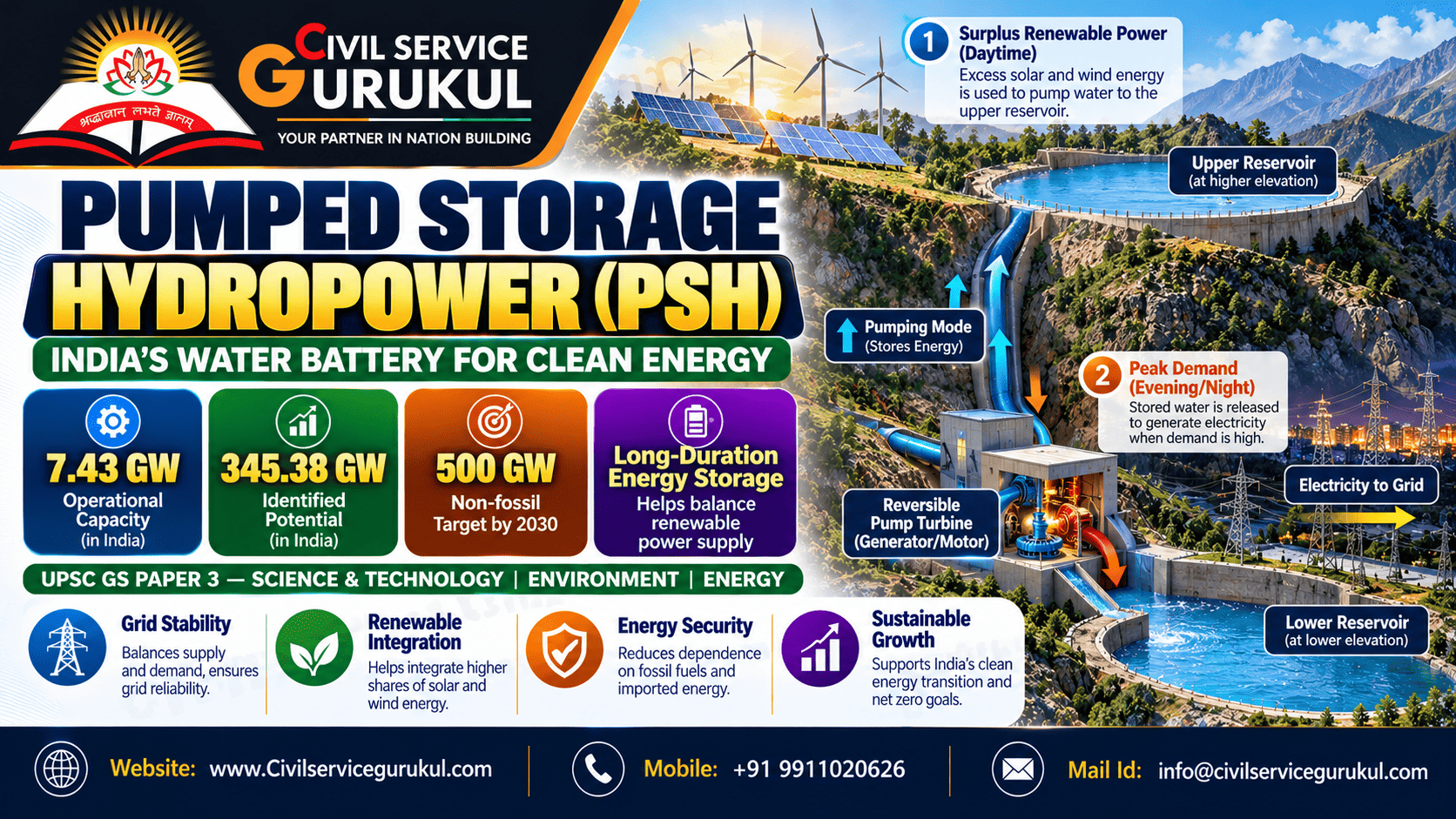
India's Water Batteries: How Pumped Storage Hydropower Can Power a Renewable Energy Future
Pumped Storage Hydropower (PSH) is emerging as an important technology for integrating solar and wind energy into India's electricity grid. This Civil Service Gurukul guide explains its working mechanism, different project types, advantages over battery storage, environmental concerns, Indian policy initiatives and relevance for UPSC Prelims and Mains GS Paper 3.

Green Diwali Campaign 2026 UPSC: Complete Notes
India's Green Diwali Campaign 2026, launched by WWF-India's EIACP Programme Centre with support from the Ministry of Environment, Forest and Climate Change, promotes cracker-free celebrations and sustainable lifestyles from 20 October to 8 November. Focusing on 130 NCAP cities, the initiative encourages citizens to reduce pollution, take environmental pledges, avoid single-use plastics, segregate waste and adopt Mission LiFE principles. These Civil Service Gurukul UPSC notes explain the campaign, air-quality concerns, citizen participation, carbon footprints, governance challenges, Prelims questions and a GS Paper III Mains answer.

India’s Core Sectors: Growth or Warning? UPSC 2026 Explained
Understand India's core industrial sectors for UPSC Prelims and Mains. Learn 2026 output trends, base effects, energy risks, and policy solutions. The analysis uses the official September 2026 release, which reports nine sectors under the 2022–23 base year. September growth was provisionally 7.9%; August growth was revised to 5.9%. Press Information Bureau

Season-Independent Crops: A Climate Solution? UPSC 2026
Explore season-independent crops for UPSC Prelims and Mains. Learn climate adaptation, water productivity, farmer income risks and policy solutions.

PHP2Shell UPSC 2026: Website Shutdowns Explained
Understand PHP2Shell for UPSC Prelims and Mains: learn why websites went offline, how PHP flaws threaten servers, and lessons for India’s cybersecurity.

Indian Agriculture’s Polycrisis UPSC 2026: Explained
Decode Indian agriculture’s polycrisis for UPSC Prelims and Mains. Learn how climate, fertilizer costs, and biofuels interact with policy solutions.
India–Poland Relations 2026: Complete UPSC Notes
India–Poland relations have emerged as an important dimension of India's engagement with Central and Eastern Europe. Following the elevation of bilateral ties to a Strategic Partnership in August 2024, both countries have pursued deeper cooperation in trade, defence manufacturing, critical minerals, technology and connectivity. Recent diplomatic engagement has brought renewed attention to their economic ambitions and geopolitical differences. This comprehensive UPSC 2026 article examines the historical background, strategic significance, challenges, opportunities, relevant international groupings and a practical roadmap for cooperation, with dedicated Prelims facts, Mains analysis and practice questions.
BRICS Parliamentary Forum 2026: Complete UPSC Notes
India is preparing to host the 12th BRICS Parliamentary Forum in New Delhi on 26–27 October 2026, bringing parliamentary cooperation into focus during its BRICS chairship. The forum provides a platform for legislators to exchange views on inclusive growth, global governance reform, climate resilience, digital technologies and the priorities of emerging economies. This article examines the role of parliamentary diplomacy, the evolution of BRICS, India's strategic interests, opportunities for the Global South, institutional challenges and the way forward. It also includes UPSC Prelims facts, original MCQs and a model GS Paper II Mains answer.
World Bank Digital Strategy 2026: Complete UPSC Notes
The World Bank Group's first Digital Strategy aims to accelerate inclusive digital transformation in developing countries by expanding affordable internet access, digital public infrastructure, digital skills and responsible artificial intelligence. Announced at the Global AI and Digital Summit in Seoul, the strategy emphasises practical AI applications, private investment, cybersecurity and shared computing resources. For India, the initiative has important implications for Digital India, financial inclusion, digital public goods, employment, rural connectivity and South–South cooperation. These UPSC notes explain its objectives, major components, development significance, challenges and policy lessons, with Prelims questions and a GS Mains model answer.

Khajuraho Temples 2026: Complete UPSC Notes
The Khajuraho Group of Monuments in Madhya Pradesh represents one of India's finest achievements in medieval temple architecture. Built primarily under the Chandela rulers between the 10th and 11th centuries, these Hindu and Jain temples are celebrated for their soaring Nagara-style shikharas, intricate sandstone sculptures and sophisticated architectural planning. Recent attention to the proposed restoration of a Vishnu idol at Javari Temple highlights the importance of archaeological conservation. This article explores Khajuraho's history, architecture, religious symbolism, UNESCO recognition, heritage management and UPSC examination relevance, including original Prelims questions and a Mains practice answer.

16 Indigenous Animal Breeds 2026: UPSC Complete Notes
India's recognition of 16 indigenous livestock and dog breeds in October 2026 marks an important step towards documenting and conserving the country's animal genetic diversity. The breeds represent cattle, buffalo, goats, sheep, equines, pig, yak and dog populations from different Indian regions. Their identification draws attention to the role of ICAR's National Bureau of Animal Genetic Resources (NBAGR), scientific breed registration, adaptation to local climates, rural livelihoods and conservation of traditional animal husbandry systems. These comprehensive UPSC notes explain the newly recognised breeds, their native states, the registration process, biodiversity significance, major challenges and relevant Prelims questions.
Alberta Referendum 2026: Complete UPSC Notes
Alberta, Canada's energy-rich western province, has attracted international attention following a reported non-binding referendum concerning its continued membership in the Canadian federation. Preliminary results indicated substantial support for remaining in Canada, highlighting the tensions between provincial autonomy and national unity. Alberta's vast oil sands, energy exports, fiscal grievances and political identity make it a significant case study in federalism and regional separatism. This Civil Service Gurukul article explains the referendum, Alberta's geography, Canada's constitutional framework, oil sands economy, secession-related legal issues and key lessons for UPSC Prelims and Mains.
Tibet Earthquake 2026: Complete UPSC Geography Notes
A reported magnitude 7.0 earthquake in Tibet's Nagqu region has renewed attention to the geological instability of the Tibetan Plateau and the Himalayan mountain system. Known as the Roof of the World and the Third Pole, Tibet is a high-altitude region shaped by the continuing collision of the Indian and Eurasian tectonic plates. The plateau influences Asia's climate, major river systems, glaciers and seismic hazards. This Civil Service Gurukul article examines Tibet's location, physical geography, plate tectonics, Himalayan earthquakes, river origins, glacial risks, implications for India and Nepal, and important UPSC Prelims and Mains concepts.
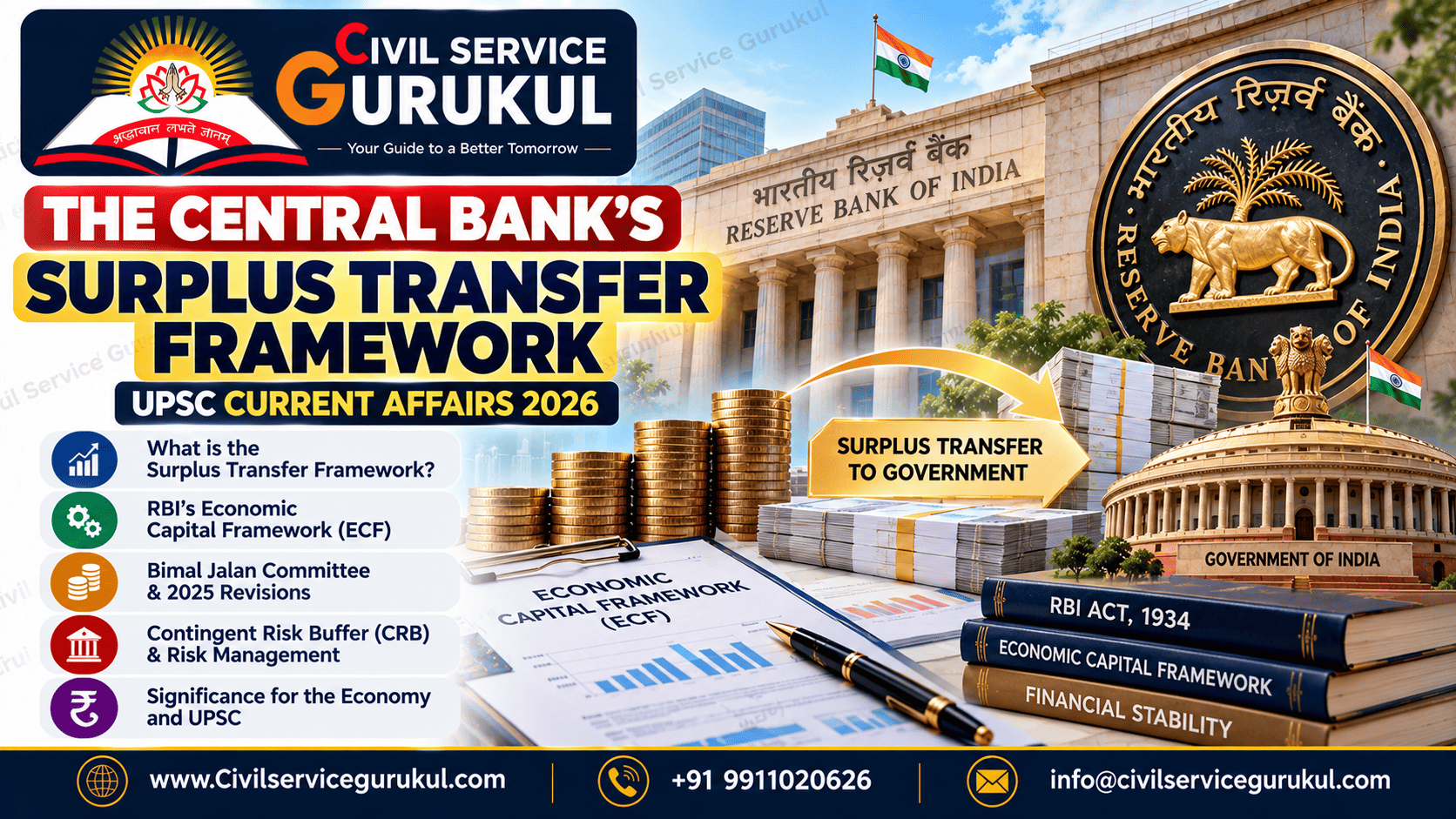
RBI Surplus Transfer Framework 2026: Complete UPSC Notes
The Reserve Bank of India's surplus transfer framework determines how much of its annual net income is retained to safeguard financial stability and how much is transferred to the Central Government. Governed by Section 47 of the RBI Act, 1934, and the revised Economic Capital Framework (ECF), the mechanism balances fiscal support with the central bank's need to maintain adequate financial buffers. In May 2026, the RBI approved a record surplus transfer of ₹2,86,588.46 crore for FY 2025–26 while maintaining its Contingent Risk Buffer at 6.5% of its balance sheet. These comprehensive UPSC notes explain the framework, Bimal Jalan Committee, 2025 revisions, economic implications and examination-oriented questions
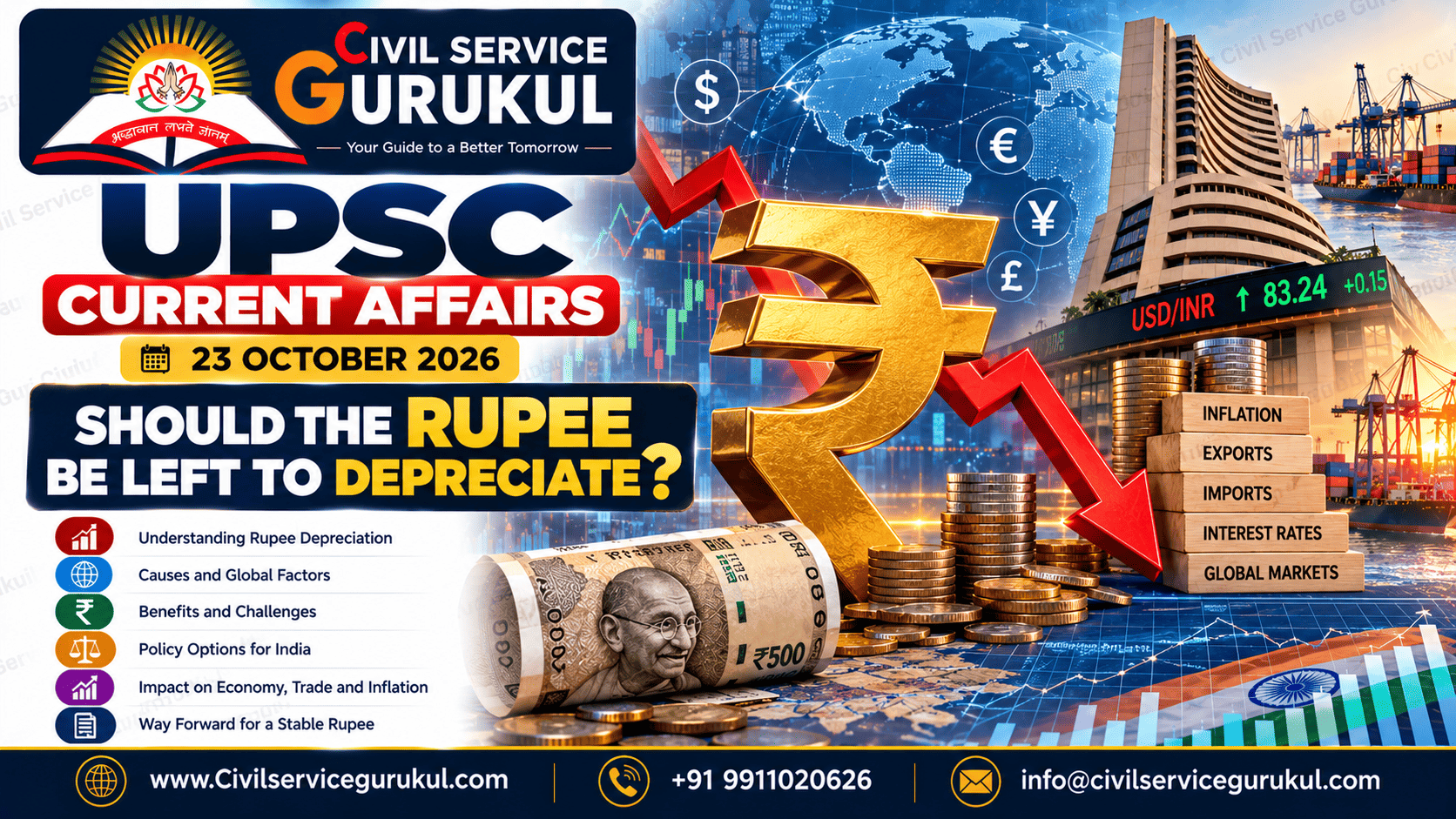
Rupee Depreciation 2026: Complete UPSC Economy Notes
Should India allow the rupee to depreciate freely, or should the Reserve Bank of India intervene to prevent a sharp fall? This question has become increasingly important in 2026 amid geopolitical tensions, elevated crude oil prices, foreign portfolio outflows and volatility in global currency markets. While depreciation can improve export competitiveness and help the economy adjust to external shocks, an uncontrolled decline can increase imported inflation, foreign debt servicing costs and financial instability. This article examines both sides of the debate, the RBI's managed floating exchange rate system, foreign exchange interventions, the impossible trinity and a balanced policy framework for India. The debate gained renewed attention on 22 October 2026 when former RBI Deputy Governor Michael Debabrata Patra cautioned that relying on the exchange rate alone to absorb external shocks could expose the economy to overshooting and financial instability.

India's Payment Revolution 2026: Complete UPSC Notes
India's payment revolution has transformed everyday transactions through the Unified Payments Interface (UPI), interoperable banking infrastructure, QR codes and the JAM Trinity of Jan Dhan, Aadhaar and mobile connectivity. Since UPI's launch in 2016, India has become a global leader in real-time digital payments. During FY 2025–26, UPI processed approximately 24,162 crore transactions worth ₹314.23 lakh crore. By September 2026, monthly UPI transactions reached approximately 2,406.84 crore. This article examines India's digital payment architecture, the roles of RBI and NPCI, financial inclusion, international expansion, cybersecurity, merchant payment economics and future policy challenges for UPSC examinations.
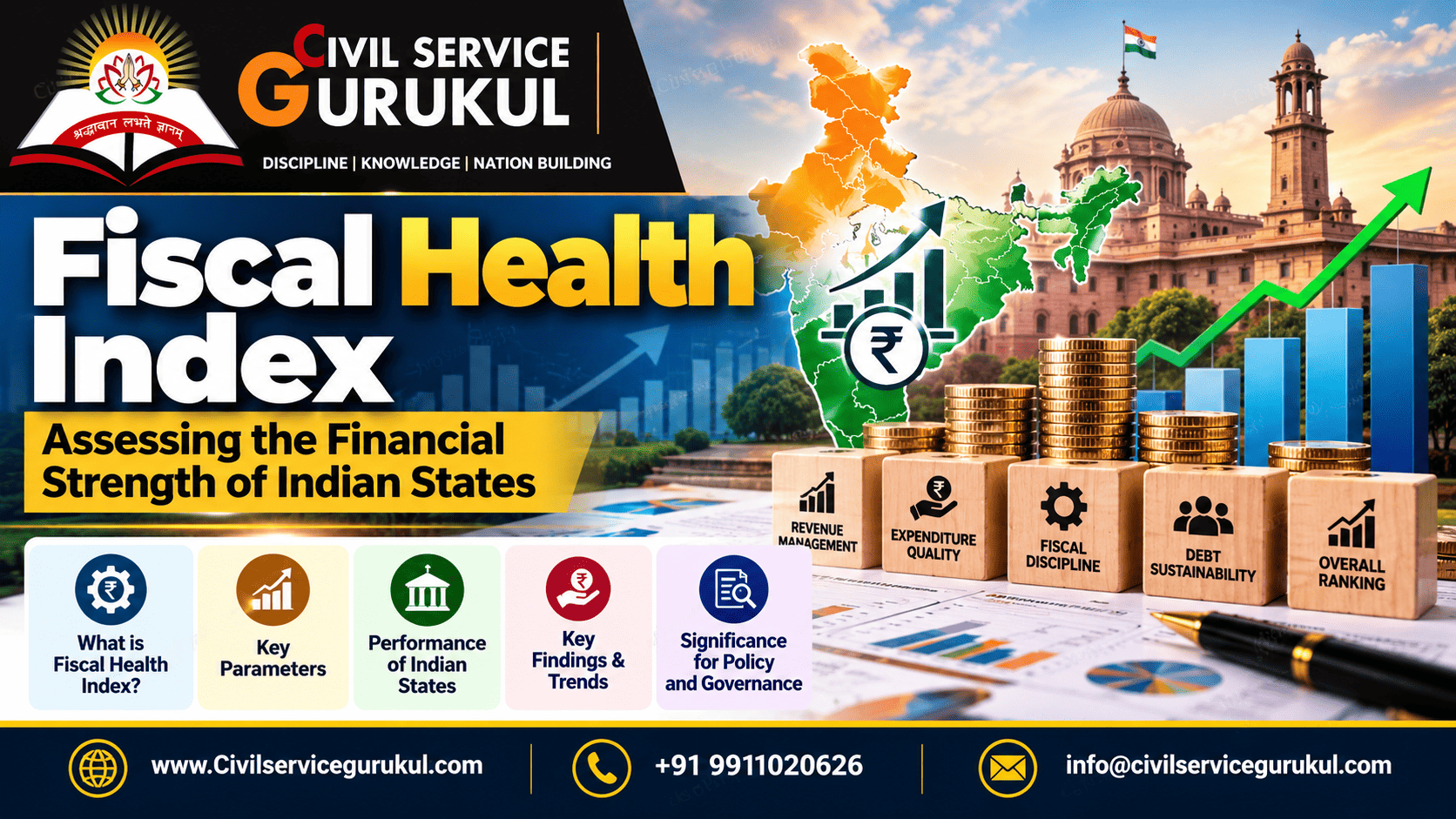
Fiscal Health Index 2026: Complete UPSC Notes
NITI Aayog's Fiscal Health Index 2026 assesses the financial performance of 28 Indian states using five pillars: Quality of Expenditure, Revenue Mobilisation, Fiscal Prudence, Debt Index and Debt Sustainability. Odisha ranked first among 18 major states with a score of 73.1, followed by Goa and Jharkhand, while Arunachal Pradesh led the separately assessed North-Eastern and Himalayan group. This comprehensive UPSC guide explains the index methodology, complete state rankings, fiscal terminology, constitutional provisions, policy implications, Mains analysis and practice questions for UPSC CSE 2026–27.

Infrastructure-Led Nation Building: UPSC Notes 2026
Infrastructure-led nation building has emerged as a central pillar of India's development strategy, connecting public capital expenditure with economic growth, logistics efficiency, job creation and national integration. Initiatives such as PM Gati Shakti, the National Logistics Policy, Bharatmala, Sagarmala, railway modernisation, renewable energy expansion and Digital Public Infrastructure aim to strengthen India's productive capacity. This comprehensive Civil Service Gurukul article explains the economic rationale, major government initiatives, infrastructure financing, challenges, environmental sustainability and policy reforms, with UPSC Prelims questions and GS Paper III Mains model answers.
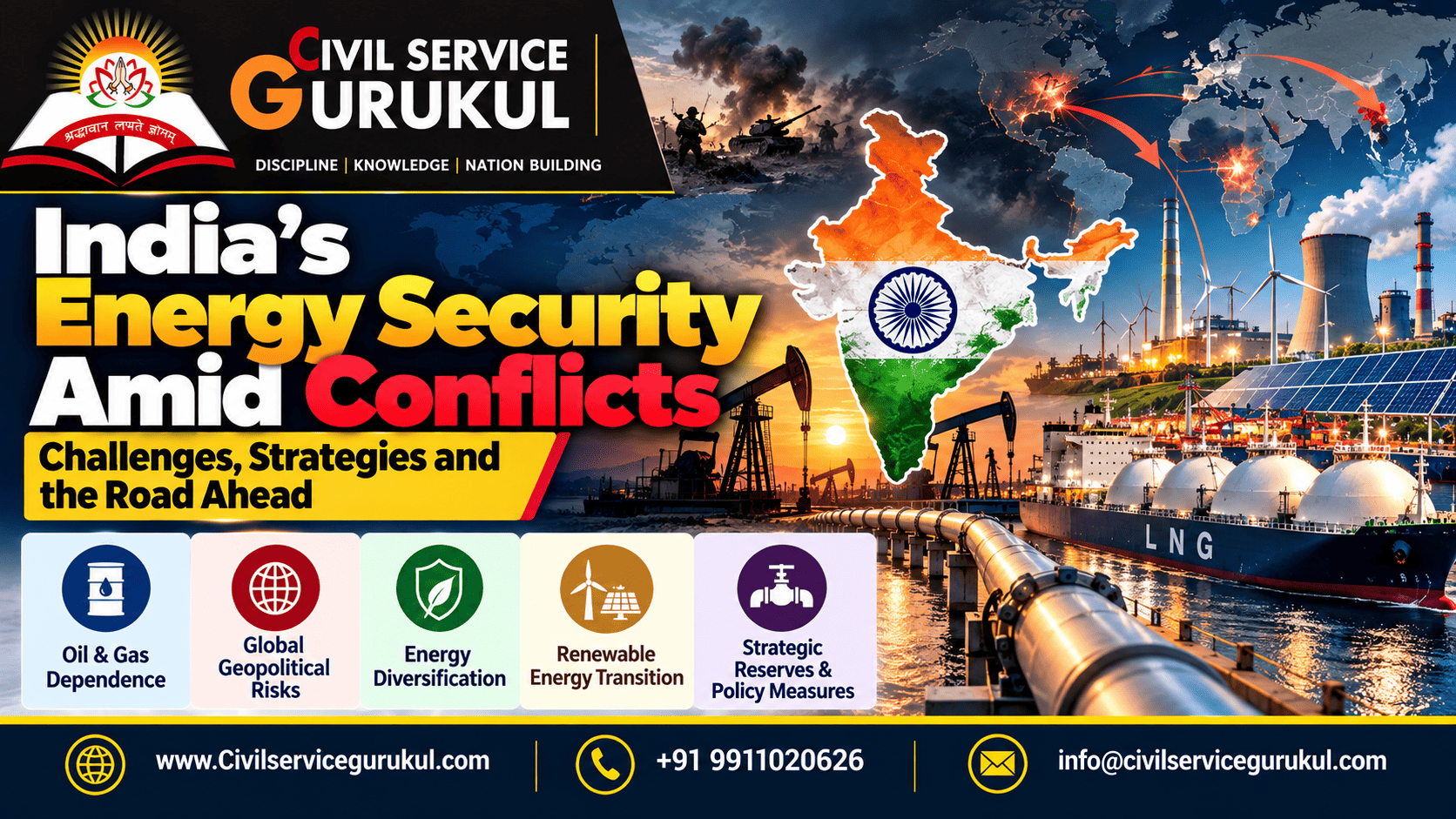
India's Energy Security Amid Conflicts: UPSC 2026
India's growing energy requirements and dependence on imported crude oil make the country vulnerable to geopolitical conflicts, maritime disruptions, price shocks and supply-chain uncertainty. Tensions in West Asia, the Russia–Ukraine conflict and risks around the Strait of Hormuz highlight the strategic importance of diversified energy imports, strategic petroleum reserves, maritime security and domestic energy production. This Civil Service Gurukul UPSC guide examines India's energy import dependence, oil diplomacy, LNG supplies, renewable energy transition, critical minerals, government initiatives, economic implications and the way forward, with Prelims MCQs and a GS Paper III Mains model answer.