
Agniveer Service Extension 2026 | UPSC Notes
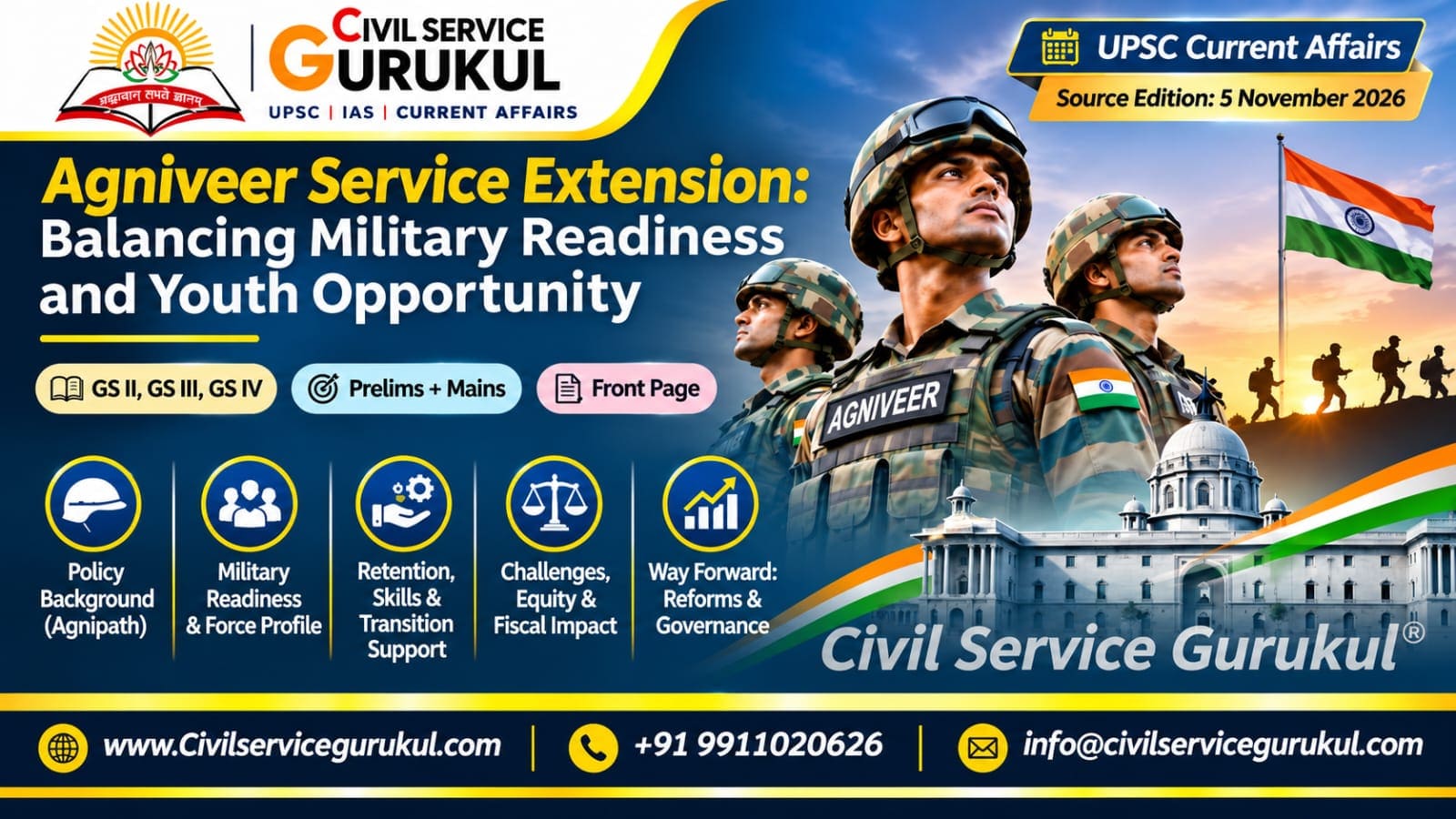
UPSC CIVIL SERVICES EXAMINATION | CURRENT AFFAIRS | DEFENCE & NATIONAL SECURITY
Agniveer Service Extension 2026: Impact on India's Defence Preparedness, Military Reforms and Youth Employment
A comprehensive UPSC analysis of the Agnipath recruitment framework, reported service-extension developments, operational readiness, personnel management, youth aspirations and governance reforms.
Published: 6 November 2026 | Source Topic: 5 November 2026
UPSC Syllabus Relevance
| UPSC Paper | Relevant Areas |
|---|---|
| GS Paper II | Government policies, governance, policy implementation and accountability. |
| GS Paper III | Security challenges, defence preparedness, human resources and fiscal considerations. |
| GS Paper IV | Ethics in public policy, fairness, transparency, responsibility and accountability. |
| Essay | National security, youth development, public institutions and reform. |
Quick Revision: Important Facts
1. Why Is Agniveer Service Extension in the News?
A source index dated 5 November 2026 reported a Union Cabinet decision concerning an option to extend service for Agniveers.
The reported development has brought renewed attention to the relationship between military recruitment, operational readiness and the career aspirations of young recruits.
However, a reported policy decision must be distinguished from a legally operative government order. The final provisions, eligibility criteria and implementation arrangements require confirmation through official records.
Why the Issue Matters
- It concerns the personnel structure of India's armed forces.
- It affects long-term defence workforce planning.
- It raises questions about military training and experience.
- It influences the career expectations of young recruits.
- It involves fiscal and administrative considerations.
- It creates important UPSC questions on governance and national security.
2. What Is the Agnipath Scheme?
Agnipath is a recruitment framework for the Indian armed forces. Individuals recruited through the framework are known as Agniveers.
The framework seeks to address personnel requirements while maintaining an appropriate balance between youthful recruitment and institutional military capability.
Military recruitment policy is distinct from constitutional civil-service recruitment. The service conditions, institutional objectives and operational requirements differ substantially.
Major Policy Dimensions
- Military recruitment and workforce planning.
- Training and operational deployment.
- Retention and service continuity.
- Defence personnel expenditure.
- Post-service transition opportunities.
- Skill development and certification.
3. What Does Agniveer Service Extension Mean?
Service extension generally refers to a policy mechanism through which eligible personnel may continue serving beyond an initially defined period, subject to applicable rules.
In military personnel management, extension and retention arrangements must account for operational requirements, eligibility, performance and workforce planning.
Important Questions
- Who would be eligible for an extension?
- What selection criteria would apply?
- Would extension be automatic or selective?
- How would operational performance be assessed?
- What would be the financial implications?
- How would the rules affect existing recruits?
4. Potential Benefits of a Revised Retention Policy
A. Improved Continuity of Experience
Longer service for selected trained personnel may help retain valuable operational experience.
B. Better Returns on Training Investment
Retention may allow institutions to benefit for longer from investments in training and skill development.
C. Greater Workforce Stability
Predictable retention arrangements may support long-term manpower planning.
D. Enhanced Career Predictability
Clearly communicated opportunities for continued service may help recruits understand their career pathways.
E. Stronger Institutional Capability
Experienced personnel can contribute to operational continuity, mentoring and specialized military functions.
These are potential policy benefits, not verified outcomes of the reported 2026 development.
5. Challenges and Concerns
Training Turnover
Frequent replacement of trained personnel may increase the burden of repeated training, particularly in technically demanding roles.
Fiscal Sustainability
Changes in retention arrangements may affect salary commitments, long-term liabilities and personnel budgets.
Selection Fairness
Unclear selection criteria may create uncertainty and perceptions of unfairness.
Workforce Planning
Changes in retention rates can influence recruitment requirements and the future composition of the force.
Post-Service Employment
Personnel who do not continue in military service require credible opportunities for civilian employment and further training.
Policy Communication
Ambiguity about eligibility, timelines or benefits can affect the expectations of serving personnel and prospective recruits.
6. Military Readiness vs Youth Opportunity
The central policy challenge is balancing operational effectiveness with fair and meaningful opportunities for young recruits.
| Military Readiness | Youth Opportunity |
|---|---|
| Retention of trained personnel | Access to military employment |
| Operational experience | Skill development |
| Personnel continuity | Career mobility |
| Training efficiency | Civilian employment transition |
| Long-term defence capability | Transparent career pathways |
A sustainable policy should avoid treating these objectives as mutually exclusive.
7. Governance and Institutional Considerations
Defence personnel policy requires clear administrative responsibility, transparent implementation and measurable outcomes.
Important Governance Principles
- Transparent eligibility rules.
- Objective selection procedures.
- Clearly defined institutional responsibilities.
- Accessible grievance mechanisms.
- Periodic performance reviews.
- Reliable workforce data.
- Accountability in implementation.
UPSC answers should distinguish military recruitment rules from constitutional provisions governing civil services.
8. Ethical Dimensions: GS Paper IV
Fairness
Selection and retention criteria should be applied consistently and without arbitrary discrimination.
Transparency
Recruits should have access to clear information about service conditions and opportunities.
Accountability
Institutions should evaluate policy outcomes and provide appropriate grievance-redress mechanisms.
Empathy
Personnel policy should recognize the career expectations and economic circumstances of young recruits.
Public Interest
The ultimate objective should remain national security, institutional effectiveness and responsible public expenditure.
9. Post-Service Rehabilitation and Employment
Post-service transition is an important part of any short-tenure military recruitment framework.
Skill certification, career counselling and links with civilian employment opportunities may improve the transition experience.
Potential Support Measures
- Recognized skill certifications.
- Career counselling.
- Employment information systems.
- State-level job linkages.
- Further education pathways.
- Entrepreneurship guidance.
- Industry partnerships.
These measures should be assessed through measurable employment and training outcomes rather than policy announcements alone.
10. Way Forward: Policy Recommendations
- Publish clear rules: Communicate eligibility, retention criteria and service conditions through official instruments.
- Ensure objective assessment: Use transparent and operationally relevant selection standards.
- Strengthen training: Align training duration and specialization with military requirements.
- Support career transitions: Expand credible skill certification and employment pathways.
- Establish grievance channels: Provide accessible mechanisms for reviewing procedural concerns.
- Monitor readiness: Conduct periodic assessments of training effectiveness and operational capability.
- Evaluate fiscal implications: Examine both immediate costs and long-term personnel commitments.
- Improve policy feedback: Use evidence from implementation to refine recruitment and retention arrangements.
11. UPSC Prelims Practice MCQs
Question 1
Agnipath primarily concerns recruitment into which of the following?
- Indian Armed Forces
- Election Commission of India
- Reserve Bank of India
- State Legislatures
Correct Answer: A
Explanation: Agnipath is a military recruitment framework associated with the Indian armed forces.
Question 2
Consider the following statements:
- Military personnel policy can affect operational readiness.
- Retention arrangements may influence long-term personnel expenditure.
- A newspaper headline alone always establishes a legally enforceable service entitlement.
Which of the statements given above are correct?
- 1 only
- 1 and 2 only
- 2 and 3 only
- 1, 2 and 3
Correct Answer: B
Explanation: Statements 1 and 2 are correct. Statement 3 is incorrect because legal entitlements depend on applicable official rules and instruments.
Question 3
Which of the following is most directly relevant to assessing a military retention policy?
- Training effectiveness
- Operational continuity
- Fiscal sustainability
- All of the above
Correct Answer: D
Explanation: Training, operational effectiveness and financial sustainability are all relevant to personnel policy evaluation.
Question 4
Which principle is most relevant to fair selection for continued service?
- Arbitrary discretion
- Opaque procedures
- Objective and transparent criteria
- Unpublished eligibility rules
Correct Answer: C
Explanation: Objective and transparent criteria promote procedural fairness and accountability.
12. UPSC Mains Practice Questions
Question 1 — GS Paper III | 150 Words | 10 Marks
"Military recruitment reforms must balance operational efficiency with long-term personnel sustainability." Discuss in the context of the Agnipath framework.
Question 2 — GS Paper II / III | 250 Words | 15 Marks
Assess how a revised Agniveer retention policy could reconcile operational effectiveness, fiscal sustainability and youth aspirations.
Question 3 — GS Paper IV | 150 Words | 10 Marks
Explain the importance of transparency, fairness and accountability in military recruitment and retention policies.
13. UPSC Mains Model Answer
Question: Assess how a revised Agniveer retention policy could reconcile operational effectiveness, fiscal sustainability and youth aspirations. (250 words)
Introduction
The Agnipath framework represents an approach to military recruitment that must balance the armed forces' personnel requirements with the opportunities and expectations of young recruits. Any revision to retention arrangements should be assessed against operational, financial and social objectives.
Operational Effectiveness
Retaining trained personnel may strengthen institutional experience, reduce repeated training requirements and support continuity in technically demanding roles. However, workforce planning must also maintain recruitment flexibility and appropriate age profiles.
Fiscal Sustainability
Retention decisions influence personnel expenditure and long-term financial commitments. Policymakers must compare the benefits of experience with the costs of additional service and the requirements of defence modernization.
Youth Aspirations
Transparent selection criteria, recognized skills and credible civilian employment pathways are essential. Clear communication can reduce uncertainty and strengthen confidence in recruitment institutions.
Way Forward
- Publish objective retention criteria.
- Introduce periodic readiness assessments.
- Strengthen skill certification and employment linkages.
- Provide accessible grievance mechanisms.
- Review fiscal and operational outcomes regularly.
Conclusion
A balanced retention policy should prioritize national security while ensuring fairness, fiscal responsibility and meaningful career pathways for young personnel. Evidence-based implementation is essential for lasting institutional credibility.
14. UPSC Answer-Writing Strategy
For a strong UPSC Mains answer, candidates should distinguish the reported policy development from the established recruitment framework.
Recommended Structure
- Introduction: Define the Agnipath framework and identify the policy issue.
- Background: Explain the institutional context of military recruitment.
- Benefits: Discuss readiness, training efficiency and personnel continuity.
- Challenges: Examine fiscal sustainability, fairness and transition support.
- Way Forward: Recommend measurable reforms and transparent implementation.
- Conclusion: Link national security with responsible governance and youth opportunity.
15. Key Takeaways for UPSC Revision
- Agnipath is a recruitment framework for the Indian armed forces.
- Service extension and retention should be assessed through official rules.
- Military readiness depends on training, experience and effective workforce planning.
- Personnel policies have fiscal and administrative consequences.
- Transparent selection criteria promote procedural fairness.
- Post-service transition pathways are important for youth opportunity.
- Policy evaluation should rely on measurable outcomes.
- The exact terms of the reported November 2026 development require official verification.
16. Frequently Asked Questions
What is the Agnipath Scheme?
Agnipath is a recruitment framework for the Indian armed forces.
Who are Agniveers?
Agniveers are personnel recruited through the Agnipath framework.
What is Agniveer service extension?
It refers to a possible mechanism for eligible personnel to continue service beyond an initially defined period, subject to applicable rules.
Has a new extension period been officially confirmed?
The supplied source refers to a reported November 2026 development, but the exact operative provisions have not been verified against an official notification.
Why is this topic important for UPSC?
It connects military recruitment, defence preparedness, governance, public expenditure, youth employment and ethics.
What are the potential benefits of retention?
Potential benefits include retaining experience, improving continuity and increasing returns on training investment.
What are the major challenges?
Challenges include training turnover, fiscal sustainability, selection fairness, workforce planning and post-service employment.
What should UPSC aspirants remember?
Distinguish verified policy provisions from reported developments and use a balanced, evidence-based approach in Mains answers.
17. Important Keywords for UPSC Revision
Agnipath Scheme, Agniveer Service Extension, Defence Preparedness, Military Readiness, Personnel Management, National Security, Retention Policy, Youth Employment, Training Efficiency, Fiscal Sustainability, Governance, Transparency, Accountability, UPSC Current Affairs 2026.
Prepare UPSC Current Affairs with Civil Service Gurukul
Civil Service Gurukul provides exam-oriented current affairs analysis, Prelims practice questions, Mains answer-writing guidance and syllabus-based study resources for UPSC Civil Services Examination aspirants.
Visit Civil Service GurukulWebsite: www.civilservicegurukul.com
Mobile: +91 9911020626
Email: info@civilservicegurukul.com
Prepare with Mentors Who Cleared the Exam
Get personalized study plans, evaluated answer models, and test series access.