
Andhra Pradesh Cyclone 2026 | UPSC Disaster Management Notes
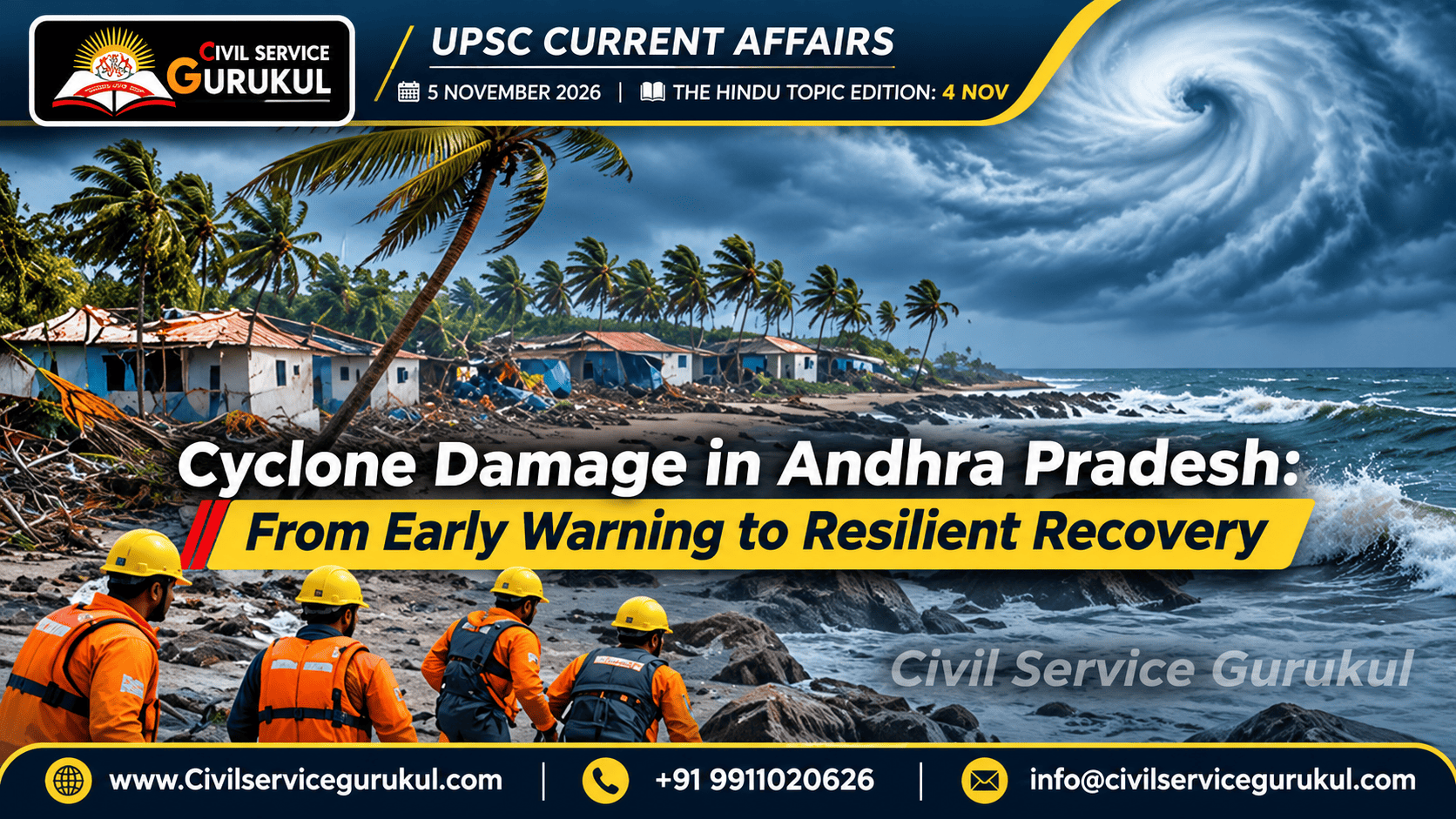
UPSC CURRENT AFFAIRS | GEOGRAPHY | DISASTER MANAGEMENT
Andhra Pradesh Cyclone 2026: Causes, Impact, Early Warning Systems and Disaster Management Lessons for UPSC
Comprehensive UPSC Prelims and Mains analysis of tropical cyclones, coastal vulnerability, disaster governance and climate-resilient recovery.
Published: 5 November 2026
1. Why Is the Andhra Pradesh Cyclone in News?
A newspaper-topic index dated 4 November 2026 highlighted a report concerning cyclone damage in three districts of Andhra Pradesh.
The headline referred to at least two deaths, but this figure should be treated as provisional until confirmed through subsequent official reports.
The development highlights the vulnerability of coastal settlements, fishing communities, agriculture and essential infrastructure to tropical cyclones.
2. What Is a Tropical Cyclone?
A tropical cyclone is an organized rotating low-pressure weather system that develops over warm tropical or subtropical ocean waters.
It is associated with strong winds, heavy rainfall, thunderstorms and, in some cases, dangerous storm surge.
Major Characteristics
- Low atmospheric pressure near the centre.
- Rotating circulation around the low-pressure centre.
- Moist convection and organized thunderstorms.
- Energy derived primarily from warm ocean waters and latent heat release.
- Potential for strong winds, flooding and coastal inundation.
3. Conditions Necessary for Tropical Cyclone Formation
Several environmental conditions favour tropical cyclone formation and intensification.
- Warm ocean surface temperatures, commonly around 26.5°C or higher over sufficient depth.
- Atmospheric moisture supporting deep convection.
- Low vertical wind shear.
- A pre-existing atmospheric disturbance or low-pressure circulation.
- Sufficient Coriolis effect away from the Equator.
- Favourable upper-level atmospheric outflow.
4. Why Is the Bay of Bengal Vulnerable to Cyclones?
The Bay of Bengal is an important region for tropical cyclone development in the North Indian Ocean.
Warm Ocean Conditions
Favourable sea surface temperatures can support cyclone formation and intensification.
Moist Atmospheric Environment
Atmospheric moisture can support strong convection and heavy rainfall.
Coastal Exposure
The surrounding coastlines contain densely populated settlements, agricultural land and important economic infrastructure.
Storm Surge Vulnerability
Low-lying coastal areas can experience dangerous inundation when storm surge coincides with unfavourable tidal conditions.
Actual cyclone risk depends on storm track, intensity, coastal topography and local preparedness.
5. Why Is Andhra Pradesh Vulnerable?
Andhra Pradesh has a long coastline along the Bay of Bengal.
Its coastal economy includes fishing, agriculture, transport, industry and port-related activities.
Potential vulnerabilities include:
- Exposure of coastal villages to high winds.
- Flooding in low-lying settlements.
- Damage to fishing boats and coastal livelihoods.
- Crop losses from rainfall, flooding or saline water.
- Disruption of electricity and communications.
- Road blockages and reduced emergency access.
6. Major Hazards Associated with Cyclones
| Hazard | Meaning | Potential Impact |
|---|---|---|
| Strong Winds | High-speed cyclonic circulation | Damage to buildings, trees and power infrastructure |
| Heavy Rainfall | Intense precipitation | Urban and rural flooding |
| Storm Surge | Abnormal rise in sea level associated with a storm | Coastal inundation and saline water intrusion |
| Inland Flooding | Accumulation or overflow of water inland | Damage to settlements, roads and crops |
| Infrastructure Failure | Damage to critical services | Disruption of power, water and communications |
7. Role of the India Meteorological Department
The India Meteorological Department is the principal national agency responsible for weather forecasting, including tropical cyclone monitoring and warnings.
Cyclone forecasting may involve:
- Satellite observations.
- Weather radar data.
- Ocean and atmospheric observations.
- Numerical weather prediction models.
- Forecasts of cyclone track and intensity.
- Warnings concerning associated hazards.
Forecast accuracy is important, but effective public safety also depends on timely warning communication and local action.
8. Disaster Management Institutions in India
| Institution | Major Role |
|---|---|
| IMD | Cyclone forecasting and meteorological warnings |
| NDMA | National disaster management policy and guidance |
| State Disaster Management Authorities | State-level disaster management coordination |
| District Administration | Local preparedness, evacuation, relief and coordination |
| NDRF | Specialized disaster response and rescue operations |
| Local Bodies | Community-level preparedness and essential service support |
9. Why Early Warning Alone Is Not Enough
A scientifically accurate forecast does not automatically guarantee that all vulnerable households will be protected.
Effective disaster preparedness requires warnings to reach communities in an understandable and actionable form.
Last-Mile Communication
Warnings must reach vulnerable communities, including people with limited digital access.
Evacuation Access
Safe evacuation requires accessible routes and adequate shelters.
Community Trust
Residents must understand the risk and have confidence in official instructions.
Special Assistance
Older persons, children and persons with disabilities may require additional support.
10. Cyclone Preparedness: Before, During and After
| Stage | Priority Actions |
|---|---|
| Before | Risk mapping, warnings, evacuation planning, shelter preparation and emergency supplies |
| During | Safe sheltering, emergency communication, rescue coordination and protection of essential services |
| After | Damage assessment, restoration of water and electricity, livelihood assistance and resilient reconstruction |
11. Climate Change and Cyclone Risk
Climate change can influence the environmental conditions associated with tropical cyclone hazards.
Warmer oceans can provide additional energy for intense storms, while rising sea levels can increase coastal inundation risk.
However, changes in cyclone frequency, intensity and regional distribution require careful scientific analysis.
A single cyclone cannot automatically be attributed to climate change without an appropriate attribution study.
12. Disaster Risk Reduction and Resilient Recovery
Disaster risk reduction aims to limit the potential harm from hazardous events by addressing exposure and vulnerability.
Resilient recovery seeks to restore essential services while reducing future disaster risk.
Important Measures
- Village-level hazard and exposure mapping.
- Accessible cyclone shelters.
- Reliable evacuation routes.
- Resilient electricity and water systems.
- Protection of coastal ecosystems.
- Livelihood recovery support.
- Transparent damage assessment.
- Public grievance and correction mechanisms.
13. Governance and Ethical Dimensions
Cyclone management is not only a scientific or administrative challenge.
It also raises important ethical questions concerning fairness, accountability and the protection of vulnerable communities.
Equity
Relief and rehabilitation should account for differences in vulnerability.
Transparency
Damage assessments and assistance processes should be clear and subject to review.
Accountability
Public institutions should monitor whether promised services actually reach affected communities.
Human Dignity
Emergency response should respect the needs and rights of affected people.
14. Way Forward: Building Cyclone-Resilient Coastal Communities
- Improve local risk mapping and vulnerability assessments.
- Strengthen multilingual and accessible warning systems.
- Maintain safe evacuation routes and shelters.
- Improve resilience of electricity, water and communications infrastructure.
- Support fishing and agricultural livelihood recovery.
- Publish transparent damage and relief assessments.
- Conduct community drills and preparedness training.
- Coordinate forecasting, administration and emergency response.
Success should be evaluated through measurable outcomes such as warning reach, evacuation accessibility, service restoration and reduced future losses.
15. UPSC Prelims Quick Revision
- Tropical cyclones are rotating low-pressure weather systems.
- Warm ocean conditions and low vertical wind shear favour cyclone development.
- The Coriolis effect is weak near the Equator.
- The Bay of Bengal is an important tropical cyclone region.
- Storm surge is an abnormal rise in sea level associated with a storm.
- IMD is responsible for cyclone forecasting and meteorological warnings in India.
- NDMA provides national disaster management guidance.
- District administrations coordinate local preparedness and relief.
- Early warning must be linked with effective last-mile response.
16. UPSC Prelims Practice MCQs
Question 1
Which agency is primarily responsible for cyclone forecasting in India?
- NDMA
- India Meteorological Department
- Election Commission
- Finance Commission
IMD is responsible for cyclone forecasting and meteorological warnings.
Question 2
Which condition generally favours tropical cyclone formation?
- Strong vertical wind shear
- Very cold ocean surface
- Warm ocean water and low vertical wind shear
- Absence of atmospheric moisture
Warm water and low vertical wind shear are favourable conditions for cyclone development.
Question 3
Why do tropical cyclones generally not form directly over the Equator?
- There is no ocean water.
- The Coriolis effect is too weak.
- Atmospheric pressure is always high.
- Ocean temperatures are always low.
The weak Coriolis effect near the Equator makes organized cyclonic rotation difficult.
Question 4
Storm surge refers to:
- A rise in sea level associated with a storm.
- Only the rainfall produced by a cyclone.
- The seasonal movement of ocean currents.
- A permanent increase in ocean salinity.
Storm surge is an abnormal rise in sea level associated with storm conditions.
Question 5
Which statement best reflects effective cyclone preparedness?
- Forecasting alone eliminates disaster risk.
- Only coastal infrastructure matters.
- Warnings, evacuation, shelters and community preparedness must work together.
- Relief planning begins only after landfall.
Effective preparedness requires an integrated warning-to-action system.
17. UPSC Mains Practice Questions
GS Paper I — Geography
Question: Explain the geographical and atmospheric conditions responsible for tropical cyclone formation in the Bay of Bengal. (150 words)
GS Paper III — Disaster Management
Question: Accurate cyclone forecasting is necessary but insufficient for effective disaster risk reduction. Discuss with reference to coastal India. (250 words)
GS Paper III — Climate Resilience
Question: Examine the importance of resilient infrastructure and community participation in reducing cyclone disaster losses. (250 words)
18. Model UPSC Mains Answer
Question: Why does last-mile preparedness matter as much as cyclone forecasting?
Introduction:
Cyclone forecasting provides essential information about potential storm tracks and hazards. However, disaster risk reduction depends on converting forecasts into timely protective action.
Body:
- Warning reach: Information must reach vulnerable households.
- Evacuation: Accessible routes and shelters are necessary.
- Community participation: Local awareness improves response.
- Infrastructure: Reliable communications and essential services support safety.
- Inclusion: Additional assistance may be required for vulnerable groups.
- Institutional coordination: Forecasting agencies and local administrations must act together.
Conclusion:
Effective cyclone management requires an integrated system connecting scientific forecasting, community preparedness, inclusive evacuation and resilient recovery.
19. Key Takeaways for UPSC Aspirants
- Connect cyclone formation with Bay of Bengal geography.
- Differentiate forecasting from last-mile preparedness.
- Understand the respective roles of IMD, NDMA and district administration.
- Explain storm surge, inland flooding and infrastructure disruption separately.
- Discuss disaster management through preparedness, response and recovery.
- Use the Andhra Pradesh report as a case-study trigger without assuming unverified casualty figures.
- Conclude Mains answers with practical, measurable reforms.
Frequently Asked Questions
Why is the Andhra Pradesh cyclone relevant for UPSC?
It connects climatology, coastal geography, disaster preparedness, governance and climate resilience under GS Papers I and III.
Which agency forecasts cyclones in India?
The India Meteorological Department issues cyclone forecasts and related meteorological warnings.
What is the difference between cyclone forecasting and disaster preparedness?
Forecasting estimates future weather hazards, while preparedness involves warnings, evacuation, shelters, coordination and protective action.
What is storm surge?
Storm surge is an abnormal rise in sea level associated with storm conditions and can cause coastal inundation.
Which UPSC Mains papers cover tropical cyclones?
GS Paper I covers relevant physical geography, while GS Paper III covers disaster management and related resilience issues.
Are the reported Andhra Pradesh casualty figures final?
No final casualty figures have been independently established in this article. The dated headline should be checked against official updates.
Prepare for UPSC with Civil Service Gurukul
Strengthen your preparation for UPSC Prelims and Mains with structured current affairs, geography, disaster management, practice questions and analytical notes.
Visit Civil Service GurukulWebsite: www.civilservicegurukul.com
Mobile: +91 9911020626
Email: info@civilservicegurukul.com
Prepare with Mentors Who Cleared the Exam
Get personalized study plans, evaluated answer models, and test series access.