August 2026 UPSC Current Affairs: GS-Wise Monthly Revision of the Most Important Issues
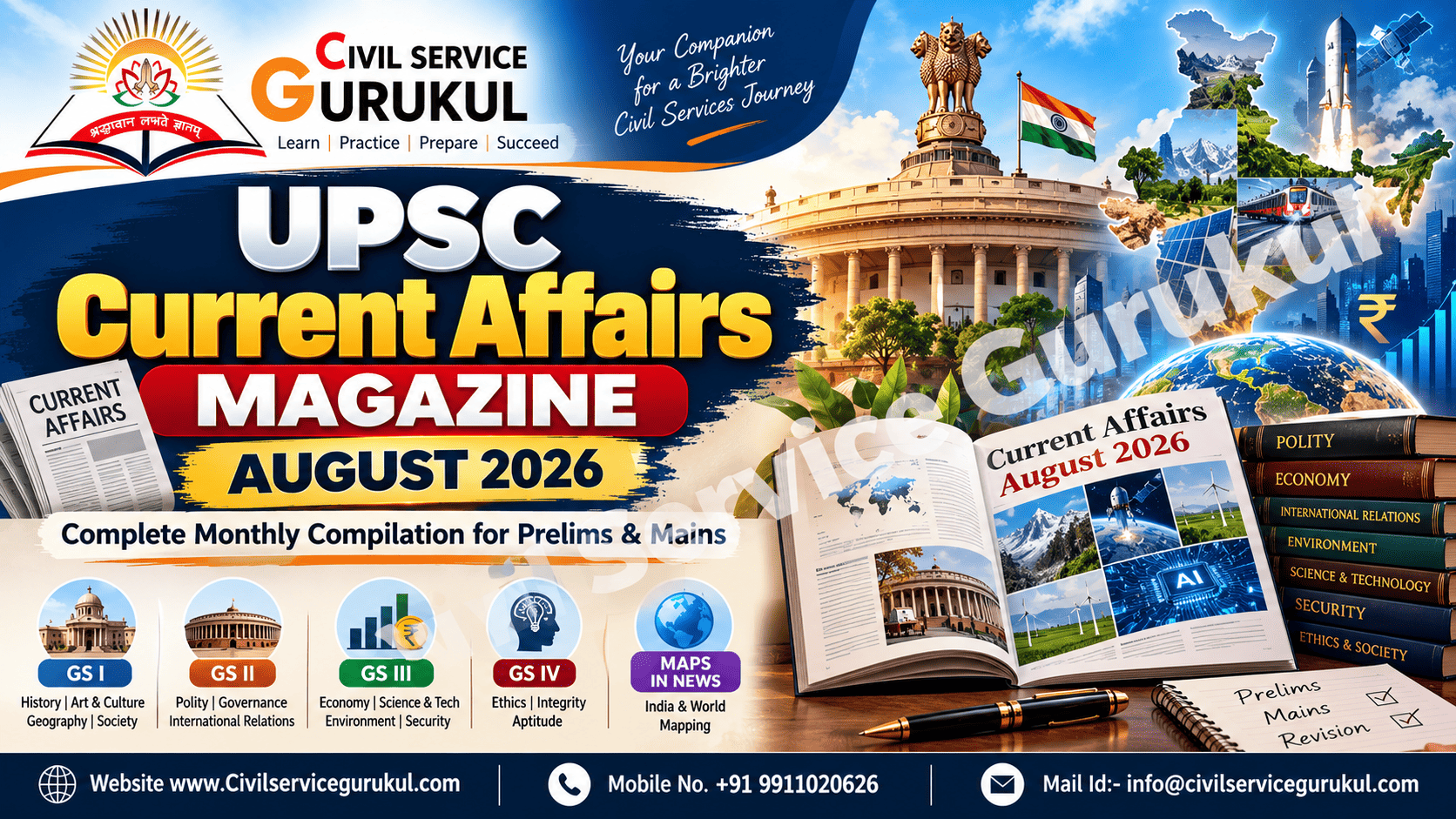
August 2026 UPSC Current Affairs: GS-Wise Monthly Revision of the Most Important Issues
A high-yield Civil Service Gurukul revision guide connecting the month’s major developments with the UPSC syllabus, Prelims facts, Mains dimensions and answer-writing themes.
Revise the most important UPSC current affairs themes from August 2026 through a GS-wise approach. Key areas include fiscal federalism and the 16th Finance Commission, delimitation, critical minerals, UPI’s decade-long journey, Himalayan cloudbursts, carbon-border measures, Ramsar wetlands, labour standards, Sarnath heritage and important places in news.
UPSC Prelims – General Studies Paper I
UPSC Mains – GS Paper I, GS Paper II, GS Paper III & GS Paper IV
Preparation Use: Prelims Revision • Mains Answer Writing • Essay • Interview
Why Monthly Current Affairs Revision Matters
Daily current affairs build awareness, but monthly consolidation converts information into exam-ready knowledge.
For UPSC preparation, every important issue should ideally be organised around three questions:
- What happened? – the current development.
- Why does it matter? – its constitutional, economic, social, environmental or strategic significance.
- Where does it fit in the syllabus? – Prelims facts and Mains analytical dimensions.
August 2026 offered several themes that cut across polity, economy, environment, technology, culture and governance.
GS-Wise High-Yield Themes
GS Paper I
- Himalayan cloudbursts and physical geography
- Sarnath and India's cultural heritage
- Important places in news
- Wetlands and geographical mapping
GS Paper II
- Delimitation and representative democracy
- Fiscal federalism
- Centre-State relations
- 16th Finance Commission
- Labour standards and international institutions
GS Paper III
- Critical Minerals Mission
- UPI and digital public infrastructure
- Carbon Border Adjustment Mechanism
- Climate resilience and cloudbursts
- Wetland conservation
GS Paper IV
- Intergenerational equity
- Environmental responsibility
- Ethics of fiscal allocation
- Technology and inclusion
- Public accountability
1. 16th Finance Commission and Fiscal Federalism
The Finance Commission remains central to India's federal financial architecture because it deals with the distribution of financial resources between the Union and the States.
For UPSC, the topic should not be studied merely as a constitutional body. It connects directly with:
- Vertical and horizontal tax devolution
- Grants-in-aid
- Regional inequalities
- State fiscal capacity
- Local government finances
- Cooperative and competitive federalism
A strong answer should examine how fiscal federalism can balance national priorities with the diverse developmental needs of States while maintaining macroeconomic discipline.
2. Delimitation and the Future of Indian Representation
Delimitation has become an increasingly important constitutional and political issue because it concerns how parliamentary and assembly constituencies are redrawn to reflect demographic changes.
For UPSC preparation, aspirants should connect delimitation with:
- Representation and population
- Federal balance
- Regional demographic differences
- Women's political representation
- Constitutional provisions governing constituencies
- Principle of equal representation
3. Critical Minerals and India's Strategic Autonomy
Critical minerals have become central to economic security because modern technologies depend on minerals required for batteries, renewable energy, electronics, defence systems and advanced manufacturing.
India's strategy in this area must address:
- Domestic exploration
- Overseas mineral partnerships
- Recycling and circular economy
- Supply-chain diversification
- Processing and refining capabilities
- Research into substitutes
The issue connects directly with energy transition, electric mobility, semiconductor ambitions and strategic autonomy.
4. Ten Years of UPI: India's Digital Public Infrastructure Story
UPI represents one of India's most important digital public-infrastructure innovations.
Its wider significance goes beyond digital payments. It demonstrates how interoperable public digital infrastructure can support:
- Financial inclusion
- Low-cost payments
- Digital entrepreneurship
- Formalisation of economic activity
- Fintech innovation
- Cross-border digital cooperation
UPSC Link: Digital Public Infrastructure
UPI should be revised together with Aadhaar, digital identity, account aggregation, direct-benefit transfers and India's broader digital-governance architecture.
For Mains, discuss both the transformative potential and concerns relating to cybersecurity, digital exclusion, privacy and concentration risks.
5. Himalayan Cloudbursts and Climate Vulnerability
Cloudbursts in Himalayan regions are high-intensity rainfall events capable of producing flash floods, landslides and severe infrastructure damage.
For UPSC, the topic should be linked with:
- Orographic rainfall
- Extreme precipitation
- Fragile Himalayan geology
- Unplanned urbanisation
- Tourism pressure
- Climate change
- Early-warning systems
- Disaster-resilient infrastructure
Revise cloudburst definition, Himalayan states, western disturbances, monsoon systems, flash floods and landslide-prone regions.
6. EU Carbon Border Measures and India
Carbon-border measures illustrate how climate policy is increasingly intersecting with international trade.
For India, such measures can affect carbon-intensive exports and create pressure on industries to improve their environmental performance.
UPSC dimensions include:
- Climate-trade linkage
- Protectionism versus climate action
- Common but Differentiated Responsibilities
- Industrial decarbonisation
- Export competitiveness
- Green technology transition
7. Wetlands and Ramsar Sites
Wetlands remain one of the most important environment topics for UPSC because they combine ecology, biodiversity, disaster mitigation and international environmental conventions.
A Ramsar-site-based current-affairs item should trigger revision of:
- Ramsar Convention
- Wetland ecosystem services
- Migratory birds
- Flood buffering
- Groundwater recharge
- Carbon storage
- Important Indian wetlands and their locations
8. Sarnath and India's Cultural Heritage
Sarnath has exceptional importance in India's Buddhist and archaeological heritage.
For UPSC, connect the location with:
- Life of Gautama Buddha
- Dharmachakra Pravartana
- Ashokan heritage
- Buddhist architecture
- Archaeological conservation
- Cultural diplomacy
- Heritage tourism
Heritage topics become particularly valuable when current affairs create an opportunity to revise ancient history, art and culture, and UNESCO-related processes together.
9. ILO and Emerging Labour Standards
International labour developments should be studied within the broader framework of worker rights, social security and changing employment patterns.
Relevant dimensions include:
- Occupational safety
- Gig and platform workers
- Formalisation
- Universal social security
- Labour codes
- International Labour Organization conventions
Prelims Quick Revision Matrix
| Topic | What to Revise |
|---|---|
| Finance Commission | Constitutional basis, appointment, functions and tax devolution |
| Delimitation | Constitutional provisions, Delimitation Commission and representation |
| Critical Minerals | Uses, strategic importance, supply chains and major minerals |
| UPI | Digital payments, interoperability and financial inclusion |
| Cloudbursts | Mechanism, Himalayan vulnerability and disaster management |
| CBAM | Climate policy, international trade and carbon-intensive sectors |
| Ramsar Sites | Convention, wetlands and mapping |
| Sarnath | Buddhism, Ashokan heritage and archaeology |
Important Mains Practice Questions
Q1. Examine the role of the Finance Commission in strengthening fiscal federalism in India.
Q2. Delimitation involves a complex balance between democratic representation and federal equity. Discuss.
Q3. Why are critical minerals becoming central to India's energy security and strategic autonomy?
Q4. India's digital public infrastructure has transformed financial inclusion, but new governance challenges have emerged. Analyse.
Q5. Himalayan disasters are increasingly a product of both natural vulnerability and development choices. Discuss with reference to extreme rainfall events.
How to Revise August 2026 Current Affairs
- First Reading: Understand what happened and why it was in news.
- Second Reading: Attach each issue to a specific UPSC syllabus heading.
- Prelims Layer: Extract institutions, locations, reports, conventions and factual details.
- Mains Layer: Prepare causes, challenges, significance, reforms and way forward.
- Map Layer: Locate wetlands, heritage sites, countries, seas and strategic regions appearing in news.
- Revision Layer: Convert long notes into one-page subject-wise summaries.
Frequently Asked Questions
Which GS papers are covered by August 2026 current affairs?
The month's developments cut across GS-I, GS-II, GS-III and GS-IV, while many topics are also directly relevant for UPSC Prelims.
What were some important August 2026 themes for UPSC?
Important areas include the 16th Finance Commission, fiscal federalism, delimitation, critical minerals, digital payments, Himalayan extreme-weather risks, carbon-border measures, wetlands and cultural heritage.
How should monthly current affairs be revised?
Revise current affairs GS-wise and integrate every issue with static syllabus topics, Prelims facts, Mains arguments and relevant maps.
Should aspirants make separate notes for Prelims and Mains?
A single integrated note can work effectively when it clearly separates factual Prelims points from analytical Mains dimensions.
Why are places in news important?
UPSC frequently tests geographical locations associated with environmental events, conflicts, cultural sites, international organisations and biodiversity developments.
Final Takeaway
August 2026 illustrates the interdisciplinary nature of UPSC current affairs.
A Finance Commission issue becomes a question of federalism. A digital-payment milestone becomes a case study in financial inclusion. A cloudburst becomes a discussion on climate resilience. A critical-mineral policy becomes a question of strategic autonomy.
The objective of current-affairs preparation should therefore not be to memorise more news, but to connect developments with the Constitution, economy, geography, environment, technology, ethics and India's long-term developmental challenges.
SEO Tags
August 2026 Current Affairs UPSC, UPSC Monthly Current Affairs August 2026, UPSC Current Affairs 2026, 16th Finance Commission UPSC, Fiscal Federalism UPSC, Delimitation UPSC, Critical Minerals Mission UPSC, UPI at 10 UPSC, Cloudburst UPSC, Himalayan Disasters UPSC, CBAM UPSC, Ramsar Sites UPSC, Sarnath UPSC, ILO UPSC, UPSC Prelims 2027, UPSC Mains 2027, GS Paper 1, GS Paper 2, GS Paper 3, GS Paper 4, Civil Service Gurukul
Prepare with Mentors Who Cleared the Exam
Get personalized study plans, evaluated answer models, and test series access.