
When Healthcare Stops at the Road: India’s Last-Mile Rural Healthcare Challenge
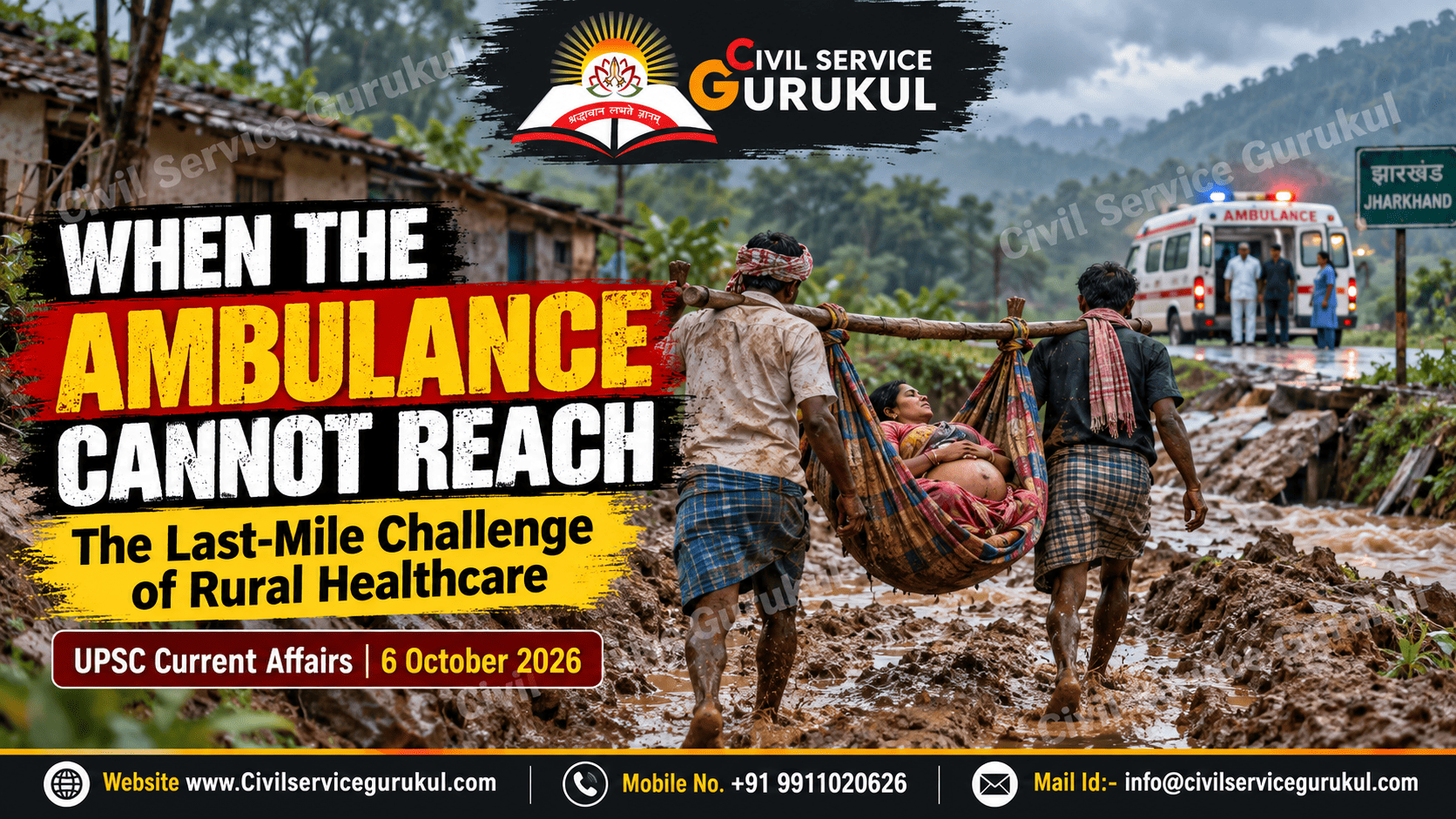
When Healthcare Stops at the Road: India’s Last-Mile Rural Healthcare Challenge
A hospital may exist, an ambulance may be available and a healthcare scheme may be operational—but governance fails if a citizen cannot physically reach the service when it matters most.
Excerpt / Brief Summary
Why Is This Issue Important?
Healthcare delivery is normally discussed in terms of hospitals, doctors, medicines, insurance, primary health centres and government schemes. However, there is another equally important dimension: Can citizens actually reach these facilities?
In difficult terrain, remote villages and areas with weak road connectivity, even a relatively short distance can become a serious obstacle during a medical emergency.
The problem becomes particularly acute for:
- Pregnant women requiring institutional delivery;
- Newborns and infants needing emergency intervention;
- Elderly persons;
- Persons with disabilities;
- Victims of accidents and medical emergencies;
- People living in tribal, hilly, forested and remote regions.
The Governance Paradox: Service Exists, Access Does Not
A government may provide an ambulance service and build a healthcare centre. Yet if the connecting road becomes unusable during the monsoon, the effective benefit of these services declines dramatically.
This creates a distinction between:
| Dimension | Meaning |
|---|---|
| Availability | A healthcare facility, ambulance or government programme formally exists. |
| Accessibility | Citizens are physically and economically capable of reaching the service. |
| Affordability | The service can be used without imposing excessive financial hardship. |
| Quality | The service delivers appropriate and effective healthcare. |
| Accountability | Institutions responsible for delivery can be held answerable for failures. |
Good governance requires all these dimensions to work together.
Why Last-Mile Infrastructure Matters for Healthcare
1. The Golden Hour in Medical Emergencies
Emergency treatment often depends on how quickly a patient can reach an appropriate healthcare facility. Poor roads increase response time and can convert a treatable condition into a life-threatening emergency.
2. Maternal and Child Health
Institutional delivery and timely obstetric care require dependable transport. For a woman in labour, an inaccessible road is not simply an infrastructure inconvenience—it may become a direct health risk.
3. Continuity of Healthcare
Poor connectivity can also affect vaccination, antenatal check-ups, medicine distribution, diagnostic services and follow-up consultations.
4. Rural–Urban Inequality
Weak connectivity reinforces geographical inequality. Citizens in remote areas may formally enjoy the same rights and schemes as urban residents but experience significantly lower effective access.
5. Emergency Response Capacity
Ambulances, mobile medical units and emergency personnel can function efficiently only when the supporting transport infrastructure is reliable throughout the year.
Public Health Is an Ecosystem, Not a Standalone Department
An important lesson for public administration is that health outcomes do not depend solely on the Health Department.
They are influenced by:
- Rural roads and transport;
- Drinking water and sanitation;
- Electricity;
- Digital and mobile connectivity;
- Nutrition;
- Local government capacity;
- Education and health awareness;
- Emergency transport networks;
- Administrative coordination.
Therefore, rural healthcare requires a whole-of-government approach rather than isolated departmental functioning.
Key Governance Challenges
1. Infrastructure Quality vs Infrastructure Creation
Administrative success is sometimes measured through kilometres of roads constructed, number of hospitals built or amount of money sanctioned. Such indicators measure outputs but not necessarily outcomes.
A road that deteriorates quickly or becomes unusable during rainfall may satisfy a construction target without delivering meaningful connectivity.
2. Weak Maintenance Culture
Public policy often gives greater visibility to creation of new infrastructure than to maintenance of existing assets. Rural roads require drainage, timely repairs and periodic quality assessment.
3. Fragmented Responsibility
Healthcare, roads, Panchayati Raj institutions, district administration and emergency transport systems may operate under different authorities. Poor coordination can create accountability gaps.
4. Difficult Terrain
Tribal, forested, mountainous and flood-prone regions require locally appropriate infrastructure solutions. A uniform approach may not work across India's diverse geography.
5. Monitoring and Accountability Deficit
Infrastructure expenditure must be accompanied by transparent quality checks, citizen feedback, social audits and responsibility for defective execution.
Ethical Dimensions: GS Paper IV
- Empathy: Administration must understand public services from the citizen's lived experience.
- Compassion: Vulnerable citizens require responsive and humane governance.
- Accountability: Officials and implementing agencies must answer for poor-quality public works.
- Responsibility: Public money carries a fiduciary obligation to create durable social value.
- Integrity: Infrastructure quality must not be compromised merely to complete administrative targets.
- Public Service Orientation: Administrative processes should ultimately improve human welfare.
- Dignity: Citizens should not have to endure avoidable hardship to obtain basic healthcare.
Constitutional and Governance Perspective
Access to healthcare is connected with the broader constitutional commitment to life, dignity, social justice and welfare-oriented governance.
The Directive Principles also encourage the State to improve public health and promote conditions that enable citizens to live with dignity.
From a constitutional-governance perspective, therefore, healthcare cannot be viewed merely as a hospital-based service. Accessibility itself forms an essential element of meaningful delivery.
Role of Panchayati Raj Institutions
Local governments are often closest to the infrastructure problems faced by rural citizens. Strengthening Panchayats can improve:
- Identification of roads requiring urgent repair;
- Local monitoring of construction quality;
- Community participation;
- Coordination with district administration;
- Social audit of public expenditure;
- Mapping of vulnerable households;
- Preparation for monsoon and emergency conditions.
Decentralisation becomes meaningful when local bodies have adequate funds, functions and functionaries, along with effective accountability mechanisms.
From Infrastructure Spending to Infrastructure Outcomes
A fundamental shift is needed in the way development programmes are evaluated.
| Traditional Indicator | Outcome-Oriented Indicator |
|---|---|
| Road constructed | Road remains usable throughout the year |
| Ambulance sanctioned | Emergency patient receives timely transport |
| Health centre opened | Citizens can reach and receive quality treatment |
| Funds utilised | Public expenditure produces measurable social benefits |
| Scheme coverage | Beneficiaries experience actual improvement in welfare |
This represents the transition from outlay → output → outcome → impact.
Way Forward
1. All-Weather Rural Connectivity
Critical routes connecting villages with hospitals, primary health centres and major roads should receive priority for all-weather construction and maintenance.
2. Healthcare Accessibility Mapping
District administrations can map settlements according to actual travel time to emergency healthcare rather than measuring only straight-line distance.
3. Integrated Emergency Planning
Ambulance networks should be planned together with road accessibility, disaster vulnerability, terrain and seasonal conditions.
4. Stronger Quality Audits
Road and infrastructure projects should undergo technical inspection and independent quality assessment, particularly where public safety depends on them.
5. Social Audits and Community Monitoring
Citizens should have accessible mechanisms to report defective infrastructure and track corrective action.
6. Technology-Based Monitoring
Geo-tagging, digital dashboards, photographs, mobile reporting and remote monitoring can improve transparency in public works.
7. Strengthening Primary Healthcare
Better local healthcare facilities can reduce the distance patients must travel for basic treatment and preventive services.
8. Context-Specific Transport Solutions
Remote regions may require innovative combinations of mobile medical units, specialised vehicles, community emergency transport and telemedicine.
9. Convergence Between Departments
Health, rural development, roads, Panchayati Raj institutions and district administration should jointly identify infrastructure bottlenecks affecting healthcare.
10. Outcome-Based Accountability
Administrative evaluation should focus not only on how much infrastructure was created but on whether that infrastructure remains functional and accessible.
UPSC Mains Relevance
- Issues relating to development and management of health services
- Governance and public service delivery
- Vulnerable sections
- Local governance and decentralisation
- Accountability and implementation gaps
- Infrastructure
- Inclusive development
- Disaster and emergency preparedness
- Empathy and compassion
- Accountability
- Public service values
- Ethical use of public funds
- Citizen-centric administration
- Inclusive development
- Rural transformation
- Healthcare accessibility
- Development with dignity
- Good governance and the last citizen
How to Use This Example in a UPSC Mains Answer
Introduction:
Begin with the idea that the effectiveness of public services depends not merely on their formal
availability but on their actual accessibility to citizens.
Body:
- Explain the relationship between road connectivity and healthcare.
- Discuss maternal health and emergency transport.
- Highlight infrastructure quality and maintenance.
- Examine coordination and accountability failures.
- Add ethical dimensions such as dignity and empathy.
- Suggest institutional and technology-driven reforms.
Conclusion:
Argue that citizen-centric governance must measure development by the ability of the most vulnerable
citizen to access essential services safely, reliably and with dignity.
UPSC Practice Question
“Last-mile connectivity is not merely an infrastructure issue; it is an essential component of effective healthcare delivery and social justice.” Discuss in the context of rural India.
Suggested Marks: 15
Suggested Word Limit: 250 words
Potential Ethics Case Study Angle
Imagine you are the District Magistrate of a remote district where recently constructed rural roads repeatedly become unusable during the monsoon. Ambulances are unable to reach several villages. A pregnant woman has recently faced a serious emergency because of poor connectivity.
As District Magistrate, identify:
- The ethical issues involved;
- The stakeholders concerned;
- Your immediate response;
- Measures for fixing institutional accountability;
- Long-term reforms to prevent recurrence.
Key Terms for Answer Enrichment
Conclusion
The real test of governance is not whether an ambulance exists on an official dashboard, whether a road has been marked as completed or whether funds have been fully utilised.
The real test is whether a pregnant woman, an elderly citizen or a critically ill patient in the remotest village can receive timely medical care without avoidable hardship.
India's journey towards universal and equitable healthcare therefore requires us to look beyond hospitals and insurance coverage. It requires dependable roads, functional local institutions, responsible public expenditure, administrative convergence and a culture of accountability.
Development becomes meaningful only when the last citizen can actually access the services created in his or her name.
SEO Tags
Rural Healthcare India, Last Mile Healthcare, UPSC Current Affairs 2026, UPSC GS 2, UPSC GS 4 Ethics, Healthcare Accessibility, Rural Infrastructure India, Public Service Delivery, Citizen Centric Governance, Inclusive Development, Maternal Healthcare India, Panchayati Raj, Accountability in Governance, Healthcare Governance, UPSC Mains Enrichment, Civil Service Gurukul
Prepare with Mentors Who Cleared the Exam
Get personalized study plans, evaluated answer models, and test series access.