
Battery Energy Storage VGF 2026: UPSC Notes
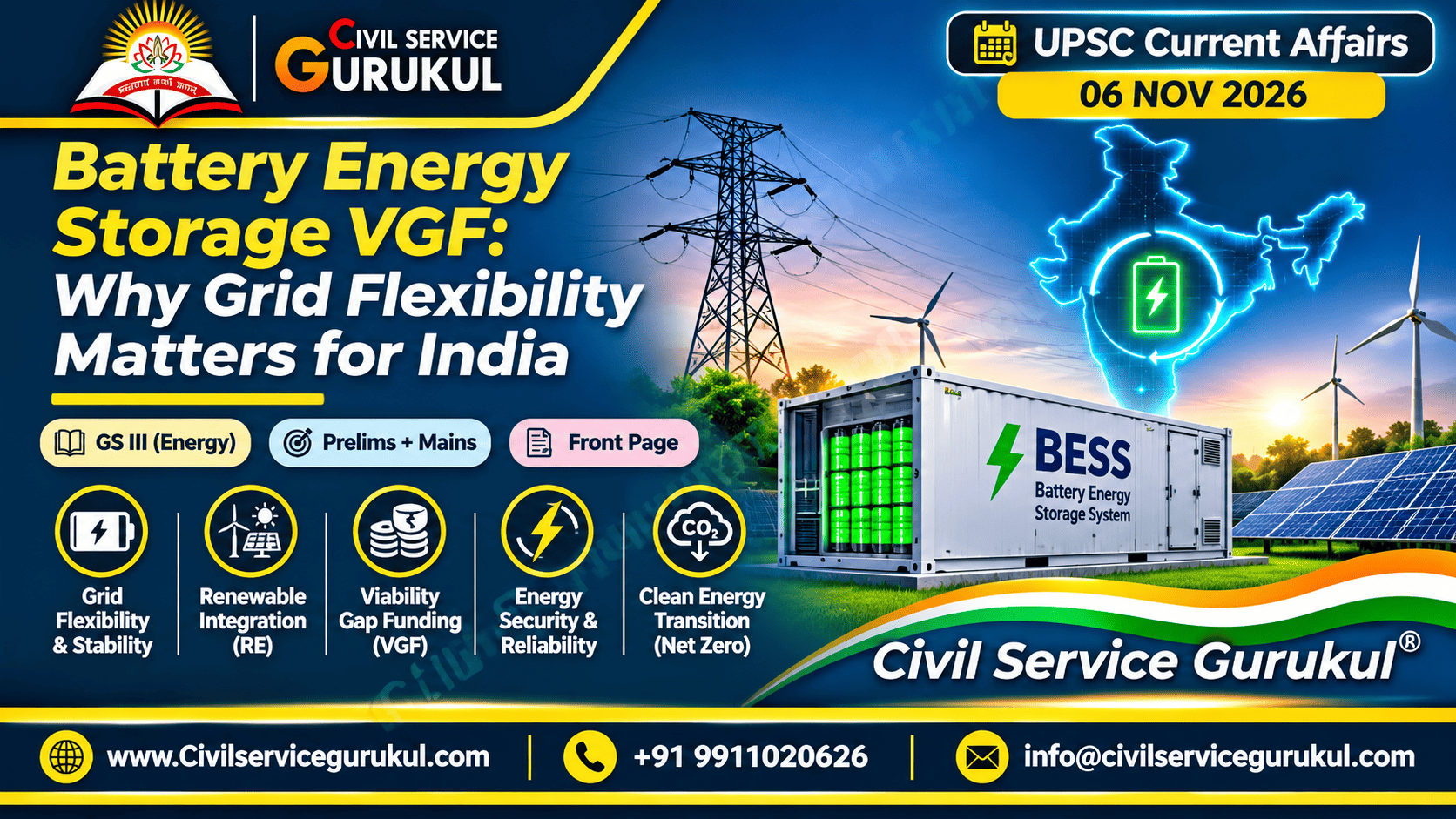
UPSC CIVIL SERVICES EXAMINATION | ENERGY SECURITY | SCIENCE & TECHNOLOGY
Battery Energy Storage in India 2026: How VGF Can Power Renewable Energy and a Flexible Electricity Grid
A comprehensive UPSC analysis of Battery Energy Storage Systems, Viability Gap Funding, renewable integration, electricity markets, grid reliability and sustainable energy infrastructure.
Published: 6 November 2026 | Source Edition: 5 November 2026
UPSC Syllabus Relevance
| UPSC Paper | Relevant Areas |
|---|---|
| GS Paper III | Energy, infrastructure, science and technology, environment, sustainable development and investment. |
| GS Paper II | Government policy, institutional coordination, implementation and public accountability. |
| Prelims | BESS, VGF, MW, MWh, grid frequency, energy storage and renewable integration. |
| Essay | Energy transition, green infrastructure, sustainable development and energy security. |
Quick Revision: Important Terms
1. Why Is Battery Energy Storage in the News?
The supplied current-affairs material dated 5 November 2026 discusses a reported Cabinet approval of viability-gap funding for large-scale energy storage.
The policy debate is significant because India is expanding renewable electricity generation, particularly from solar and wind energy.
Solar and wind generation vary with time of day and weather conditions. Electricity systems therefore need flexible resources that can balance generation and consumption.
Battery Energy Storage Systems can help manage this challenge by storing electricity when it is available and releasing it when required.
Why It Matters for UPSC
- It connects energy policy with climate and infrastructure planning.
- It explains the technical need for grid flexibility.
- It highlights the role of public financial support.
- It raises questions about electricity-market design.
- It involves environmental and recycling challenges.
- It is directly relevant to GS Paper III.
2. What Is a Battery Energy Storage System?
A Battery Energy Storage System, or BESS, is an arrangement that stores electrical energy in rechargeable batteries and supplies electricity when required.
BESS typically combines battery modules, power-conversion equipment, control systems, thermal management and safety arrangements.
Basic Working Mechanism
↓
↓
↓
In practical operation, charging and discharging are managed according to electricity prices, grid conditions, battery limits and system requirements.
3. What Is Viability Gap Funding?
Viability Gap Funding is a form of financial assistance intended to support projects that provide public or economic benefits but may not initially be commercially viable on acceptable terms.
Energy-storage projects can involve substantial upfront capital costs. Financial support may reduce the initial investment burden and improve project feasibility.
How VGF Can Support BESS
- A project is identified as strategically useful.
- Expected project costs and revenue streams are assessed.
- The financial viability gap is evaluated.
- Eligible support may be provided under applicable scheme conditions.
- The project is procured, developed and monitored.
- Performance and public benefits are assessed.
The precise eligibility conditions, funding percentage, procurement process and disbursement schedule depend on the notified scheme.
4. Why Does India Need Grid Flexibility?
Electricity generation and consumption must remain balanced continuously for reliable grid operation.
Renewable energy sources such as solar and wind are variable. Their output depends on environmental conditions rather than electricity demand alone.
Major Grid Challenges
- High solar generation during daylight hours.
- Evening electricity-demand peaks.
- Changes in wind availability.
- Transmission congestion.
- Frequency-management requirements.
- Renewable-energy curtailment.
- Unexpected changes in generation or demand.
Grid flexibility refers to the electricity system's ability to respond effectively to these changing conditions.
5. How Battery Storage Supports Renewable Integration
Solar Energy Shifting
BESS can store some electricity generated during periods of high solar output and discharge it during evening demand peaks.
Frequency Response
Battery systems can respond rapidly to grid-control signals and help support frequency management, subject to technical configuration and applicable market arrangements.
Reduced Renewable Curtailment
When renewable electricity cannot be immediately used or transmitted, storage may absorb part of the surplus generation.
Peak-Load Management
Storage can discharge during high-demand periods and potentially reduce dependence on expensive peak-period generation.
Grid Reliability
Properly integrated battery systems can provide selected ancillary services and improve operational flexibility.
6. MW vs MWh: Important UPSC Prelims Concept
Power and energy are related but different concepts.
| Term | Meaning | Example |
|---|---|---|
| MW | Megawatt: unit of power. | Maximum discharge rate. |
| MWh | Megawatt-hour: unit of energy. | Stored energy capacity. |
Aspirants should avoid confusing the rate of electricity delivery with the total amount of energy available.
7. Economic Viability of Battery Storage Projects
The economics of BESS depend on several technical and commercial factors.
Important Cost and Revenue Factors
- Initial capital expenditure.
- Battery replacement and maintenance.
- Charging electricity costs.
- Round-trip efficiency.
- Battery cycle life.
- Electricity tariffs.
- Ancillary-service revenue opportunities.
- Grid congestion and location.
- Availability and performance requirements.
A financially viable project requires realistic assumptions about utilization, electricity prices, degradation and contractual payments.
8. Benefits of VGF for Energy Storage
Lower Initial Financial Burden
Targeted financial support can reduce the upfront funding gap for eligible projects.
Investment Mobilization
Well-designed schemes may attract private participation in infrastructure that delivers broader system benefits.
Renewable Integration
Additional storage capacity can help electricity systems accommodate variable renewable generation.
Potential Consumer Benefits
Efficient procurement and operation may help reduce selected system costs over time, although outcomes depend on market conditions and project performance.
Energy Security
Greater operational flexibility can improve the resilience of electricity systems.
9. Challenges and Limitations of BESS
High Capital Costs
Large-scale battery installations can require significant initial investment.
Battery Degradation
Battery performance and usable capacity may decline with age, cycling and operating conditions.
Market Uncertainty
Revenue may depend on tariffs, dispatch requirements and ancillary-service arrangements.
Safety Requirements
Thermal management, fire protection and appropriate operating standards are important.
Environmental Concerns
Battery manufacturing, material sourcing, end-of-life management and recycling require environmental safeguards.
Risk of Stranded Assets
Poor location selection, inadequate demand assessment or weak procurement design may result in underutilized infrastructure.
10. Why Subsidies Alone Are Not Enough
Public financial support can help bridge initial viability gaps, but it cannot replace sound project design.
If procurement is non-competitive or performance standards are weak, subsidies may support projects that do not deliver adequate public value.
Essential Governance Safeguards
- Transparent and competitive procurement.
- Clear eligibility criteria.
- Performance-linked payments.
- Independent technical evaluation.
- Battery safety requirements.
- Recycling and end-of-life obligations.
- Public reporting of project outcomes.
- Periodic scheme review.
11. BESS Is Not the Only Grid Flexibility Solution
Battery storage is one important component of grid flexibility, but electricity systems require a portfolio of complementary solutions.
| Solution | Primary Role |
|---|---|
| Battery Storage | Fast response and time-shifting of electricity. |
| Pumped Hydro Storage | Bulk energy storage where suitable conditions exist. |
| Transmission Expansion | Moves electricity between regions. |
| Demand Response | Adjusts electricity consumption in response to system conditions. |
| Flexible Generation | Adjusts electricity output to support balancing. |
The appropriate combination depends on local electricity demand, renewable generation, network conditions and project economics.
12. Environmental and Sustainability Dimensions
Battery storage can facilitate renewable energy integration, but its lifecycle impacts must be considered.
Major Sustainability Issues
- Responsible mineral sourcing.
- Energy use during battery manufacturing.
- Battery chemistry and material selection.
- Thermal and fire safety.
- Collection of end-of-life batteries.
- Material recovery and recycling.
- Safe handling of hazardous components.
A lifecycle approach evaluates environmental impacts from manufacturing and operation through reuse, recycling and final disposal.
13. Institutional and Federal Governance
Energy-storage development involves multiple stakeholders, including public authorities, electricity regulators, grid operators, distribution utilities, developers and consumers.
Coordination is essential because the benefits of a storage project may extend beyond the entity directly purchasing its services.
Important Governance Questions
- Who finances the project?
- Who owns and operates the battery system?
- Who determines dispatch schedules?
- How are electricity charges and service payments structured?
- Which institution monitors performance?
- Who is responsible for safety and recycling?
- How are consumer interests protected?
Clear contractual responsibilities and institutional coordination can reduce implementation risks.
14. Ethical Dimensions of Public Funding
Transparency
Public financial support should follow clearly published rules and procedures.
Accountability
Project outcomes should be monitored against stated objectives.
Efficiency
Public resources should generate measurable electricity-system benefits.
Environmental Responsibility
Project design should include safety and recycling safeguards.
Intergenerational Equity
Energy infrastructure should consider both present reliability needs and long-term environmental consequences.
15. Way Forward for India's Energy Storage Ecosystem
- Competitive procurement: Use transparent auctions and clear evaluation criteria.
- Performance-linked funding: Connect payments to measurable delivery and availability.
- Integrated grid planning: Select storage locations based on system needs.
- Safety standards: Strengthen thermal management, testing and emergency procedures.
- Recycling obligations: Include lifecycle responsibility in project design.
- Market development: Improve frameworks for valuing flexibility and ancillary services.
- Technology neutrality: Compare batteries with other storage and flexibility options.
- Periodic review: Evaluate scheme performance and adapt to changing costs.
16. UPSC Prelims Practice MCQs
Question 1
In a Battery Energy Storage System, MWh primarily measures:
- Energy capacity
- Instantaneous power
- Voltage
- Frequency
Correct Answer: A
Explanation: MWh is a unit of energy. MW is a unit of power.
Question 2
Viability Gap Funding is primarily intended to:
- Eliminate the need for project evaluation.
- Support socially or economically useful projects facing financial viability constraints.
- Replace all private investment.
- Remove all operating risks.
Correct Answer: B
Explanation: VGF is designed to address viability constraints in eligible projects under specified conditions.
Question 3
Consider the following statements:
- Battery storage can shift electricity from one time period to another.
- Battery systems may support frequency response.
- Battery storage makes transmission infrastructure unnecessary.
Which statements are correct?
- 1 only
- 1 and 2 only
- 2 and 3 only
- 1, 2 and 3
Correct Answer: B
Explanation: Statements 1 and 2 are correct. Storage complements but does not eliminate the need for transmission infrastructure.
Question 4
Which of the following is a relevant concern in battery storage deployment?
- Battery degradation
- End-of-life recycling
- Safety management
- All of the above
Correct Answer: D
Explanation: Battery degradation, recycling and safety are important technical and environmental considerations.
Question 5
Which combination best supports grid flexibility?
- Battery storage alone in every situation
- Transmission expansion alone in every situation
- Battery storage, demand response, transmission and other flexible resources
- Only increasing installed renewable capacity
Correct Answer: C
Explanation: A flexible electricity system generally requires complementary technologies and operational measures.
17. UPSC Mains Practice Questions
Question 1 — GS Paper III | 150 Words | 10 Marks
Explain the role of Battery Energy Storage Systems in improving grid flexibility and renewable energy integration in India.
Question 2 — GS Paper III | 250 Words | 15 Marks
Critically examine how Viability Gap Funding can accelerate large-scale battery storage deployment while creating fiscal, regulatory and environmental challenges.
Question 3 — GS Paper II / III | 150 Words | 10 Marks
Discuss the importance of transparent procurement and performance monitoring in publicly supported energy infrastructure projects.
18. UPSC Mains Model Answer
Question: Critically examine how Viability Gap Funding can accelerate large-scale battery storage deployment while creating fiscal, regulatory and environmental challenges. (250 words)
Introduction
Battery Energy Storage Systems can support renewable integration by storing electricity and releasing it when required. Viability Gap Funding seeks to improve the financial feasibility of projects that provide broader public benefits but face initial commercial constraints.
Potential Benefits
- Reduces the initial funding gap for eligible storage projects.
- May encourage investment in grid-flexibility infrastructure.
- Supports solar energy shifting and peak-load management.
- Can contribute to frequency response and reduced renewable curtailment.
- May improve the reliability of electricity supply.
Major Challenges
- Public subsidies create fiscal obligations.
- Weak procurement may lead to inefficient investment.
- Project revenue depends on tariffs, utilization and market design.
- Battery degradation and replacement affect lifecycle economics.
- Manufacturing, safety and recycling create environmental responsibilities.
Way Forward
India should prioritize transparent competitive procurement, performance-linked funding, appropriate electricity-market frameworks, lifecycle safety and recycling obligations, and integrated grid planning. Battery storage should be evaluated alongside pumped hydro, transmission expansion and demand response.
Conclusion
VGF can help unlock strategically important storage capacity, but lasting success depends on strong project economics, regulatory clarity, environmental safeguards and measurable grid benefits.
19. UPSC Answer-Writing Strategy
- Define BESS: Explain electricity storage and controlled discharge.
- Explain VGF: Describe the financial viability gap.
- Establish Need: Discuss variable renewable generation and grid flexibility.
- Highlight Benefits: Solar shifting, frequency response and peak management.
- Discuss Risks: Costs, tariffs, battery degradation and environmental concerns.
- Suggest Reforms: Competitive procurement, recycling and performance-linked payments.
- Conclude: Link storage deployment with a reliable and sustainable energy transition.
20. Key Takeaways for UPSC Revision
- BESS stores electricity and supplies it when needed.
- VGF can support projects facing initial financial viability constraints.
- Solar and wind generation are variable.
- Grid flexibility helps balance changing electricity supply and demand.
- MW measures power; MWh measures energy.
- Battery storage can support peak-load management and frequency response.
- Project economics depend on costs, utilization, tariffs and battery life.
- Safety, recycling and environmental safeguards are essential.
- Batteries complement transmission, pumped hydro and demand response.
- Transparent procurement and measurable outcomes improve policy effectiveness.
21. Frequently Asked Questions
What is BESS?
BESS stands for Battery Energy Storage System. It stores electrical energy in rechargeable batteries for later use.
What is Viability Gap Funding?
VGF is financial assistance intended to improve the feasibility of eligible projects that provide public benefits but face commercial viability constraints.
Why does India need battery storage?
Battery storage can help balance variable renewable generation, shift electricity to peak-demand periods and support grid flexibility.
What is the difference between MW and MWh?
MW measures power, while MWh measures energy.
Can battery storage reduce renewable curtailment?
Yes. Storage may absorb surplus renewable generation that would otherwise be curtailed, subject to system conditions and capacity.
Can batteries replace transmission infrastructure?
No. Battery storage complements transmission and other grid-flexibility resources.
What are the main risks of BESS?
Important risks include high initial costs, degradation, uncertain revenue, safety requirements and recycling challenges.
Why is BESS relevant to UPSC?
It connects energy infrastructure, science and technology, environment, sustainable development, government policy and governance.
22. Important Keywords for UPSC Revision
Battery Energy Storage System, BESS, Viability Gap Funding, VGF, Grid Flexibility, Renewable Energy Integration, MW, MWh, Frequency Response, Renewable Curtailment, Peak-Load Management, Ancillary Services, Pumped Hydro Storage, Battery Recycling, Energy Security, UPSC Current Affairs 2026.
Prepare UPSC Science, Technology and Current Affairs with Civil Service Gurukul
Civil Service Gurukul provides syllabus-based UPSC current affairs, science and technology analysis, Prelims practice questions, Mains answer-writing guidance and comprehensive civil services preparation resources.
Visit Civil Service GurukulWebsite: www.civilservicegurukul.com
Mobile: +91 9911020626
Email: info@civilservicegurukul.com
Prepare with Mentors Who Cleared the Exam
Get personalized study plans, evaluated answer models, and test series access.