
Break the PDS Ration-Shop Monopoly: UPSC 2026 Explained
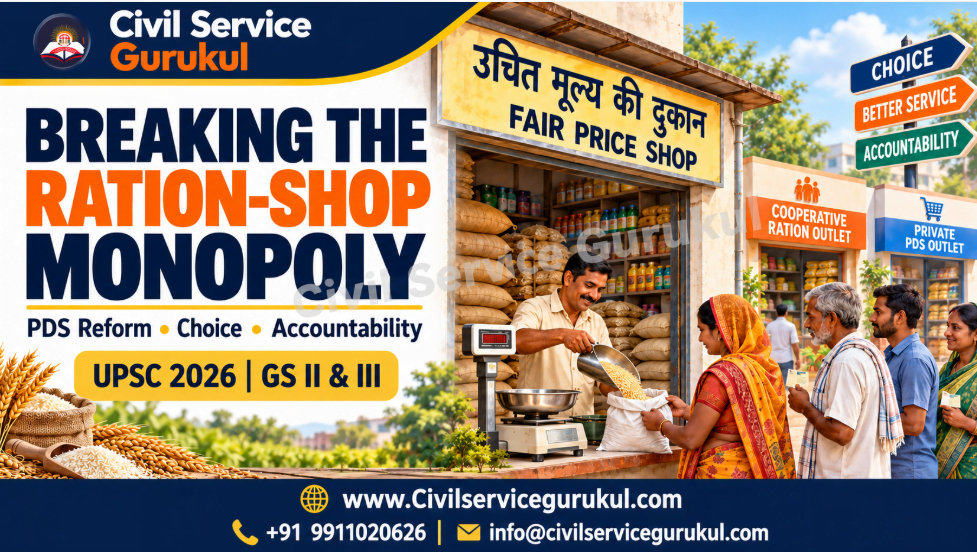
Break the PDS Ration-Shop Monopoly: UPSC 2026 Explained
How to break the ration-shop monopoly in PDS is a question of beneficiary choice and accountable welfare delivery. For UPSC, it connects GS Paper 2 welfare schemes, governance and vulnerable groups with GS Paper 3 food security and PDS functioning. Understanding how to break the ration-shop monopoly in PDS also strengthens Prelims preparation on the National Food Security Act and ration portability.
Introduction: When an Entitlement Depends on One Dealer
Imagine reaching a ration shop after losing half a day’s wages, only to find it closed. Returning tomorrow means another journey and more lost income. If alternative outlets are inaccessible, a household’s legal entitlement depends heavily on one dealer’s conduct. Breaking this dependence requires usable alternatives, reliable supplies and enforceable remedies.
Background: Understanding the Monopoly Problem
India’s Public Distribution System supplies foodgrains through licensed fair price shops. Historically, attachment to a designated outlet restricted household choice. One Nation One Ration Card has weakened that restriction, but practical dependence can persist where another shop is distant, unavailable or unwilling to serve incoming beneficiaries.
Here, “monopoly” describes local bargaining power rather than a finding under competition law. Dealers may face weak pressure to improve opening hours, weighing accuracy or behaviour when dissatisfied users cannot realistically switch. This is a service-delivery problem within a publicly financed entitlement system.
Key Provisions and Existing Reform Features
- NFSA entitlements: Priority Household beneficiaries receive 5 kg per person monthly; Antyodaya Anna Yojana households receive 35 kg per household monthly.
- Reform mandate: Section 12 of the NFSA envisages measures including doorstep delivery, computerisation, transparency and preference for specified public or community institutions in FPS licensing.
- Accountability: The Act provides for grievance mechanisms, disclosure of records, social audits and vigilance committees.
- Portability: ONORC enables eligible beneficiaries to draw their entitlement, wholly or partly, from participating ePoS-enabled shops using their existing ration card.
ONORC achieved coverage across all 36 States and Union Territories in June 2022. The five-year free-foodgrain arrangement beginning January 2024 covers NFSA entitlements under PMGKAY. Free grain removes the beneficiary’s grain price, but travel expenses, waiting time and discriminatory treatment can still obstruct access.
How to Break the Ration-Shop Monopoly
1. Turn Portability into Effective Choice
Beneficiaries need clear information about alternative shops, opening hours and available stocks. Panchayats, urban local bodies and helpdesks should explain switching procedures in local languages. Portability must work for nearby households as well as migrants; otherwise, its potential to discipline poor service remains underused.
2. Make Stocks and Incentives Follow Demand
A popular shop cannot accommodate additional users without sufficient grain. States should adjust replenishment to actual demand, maintain contingency stocks and settle dealer commissions promptly. These are recommended improvements: portability alone does not guarantee that every outlet automatically receives timely additional supplies.
3. Expand Accountable Providers Where Feasible
Transparent licensing can create alternatives through cooperatives, panchayats and women’s self-help groups, consistent with the NFSA’s reform direction. Selection should assess capacity and integrity. Several licences controlled by related interests can reproduce local dominance, so ownership transparency and independent inspections matter.
4. Combine Technology with Human Remedies
Electronic records should support accurate weighing, receipts and stock reconciliation. Alongside these tools, authorities should provide workable exception procedures for authentication or connectivity failures. A failed digital transaction should trigger assistance and investigation rather than leave a household without a practical route to food.
Significance: Why Beneficiary Choice Matters
- Bargaining power: A credible switching option can reduce dependence on an unresponsive dealer.
- Migrant protection: Portable access helps separate food entitlement from a fixed residential location.
- Service incentives: Demand-responsive supplies and commissions can reward reliable outlets.
- Dignity: Accessible information and complaint channels help beneficiaries exercise rights confidently.
Challenges and Policy Trade-offs
Geographical constraints: Sparse settlements may support only one viable outlet. Creating additional shops without adequate demand can undermine viability. Mobile distribution, transport assistance or closely monitored service obligations may offer better alternatives in such locations.
Collusion and exclusion: Nearby dealers may coordinate poor practices, while older persons, persons with disabilities and digitally excluded households face higher switching costs. Choice cannot replace inspections, accessible grievance redress or assistance for people who cannot travel easily.
Cash-transfer risks: Cash or vouchers may widen purchasing options where markets function well. However, delayed payments, inflation, banking barriers and weak local markets can erode food access. Portability should therefore not be confused with a universal case for replacing grain distribution.
Way Forward: Measure Successful Access
District administrations should map underserved areas, publish shop-level service information and use portability demand to improve stock planning. Dealer remuneration should be adequate and timely. Persistent misconduct should attract proportionate action, with continuity arrangements ensuring that suspension of a licence does not interrupt household supplies.
Evaluation must track full entitlement received, waiting time, stock-outs, failed transactions and complaint resolution. Portability counts alone cannot establish welfare gains. Household surveys and social audits should test whether women, migrants and remote communities experience meaningful improvements, while public dashboards protect personal information.
Prelims Pointers: Facts for Revision
- Legal framework: NFSA, 2013 provides the statutory foundation for covered food-security entitlements.
- Coverage ceilings: The Act provides coverage up to 75% of the rural and 50% of the urban population.
- ONORC milestones: Rollout began in August 2019; nationwide coverage followed in June 2022.
- Policy decision: The November 2023 Cabinet announcement provided free foodgrains for about 81.35 crore beneficiaries for five years from January 2024.
- Exam distinction: PHH entitlement is person-based; AAY entitlement is household-based.
Mains Value Addition
Use the framework choice, capacity and accountability. Choice enables switching; capacity supplies the preferred outlet; accountability addresses collusion and protects people unable to switch. This analytical framework explains why digital interoperability is necessary but insufficient for improving welfare delivery.
For example, a migrant household may divide its entitlement between the destination and home locations. Yet portability delivers little benefit if the destination shop lacks grain. Linking beneficiary mobility with responsive logistics illustrates cooperative federalism and the difference between formal eligibility and effective access.
UPSC PYQs and Practice Questions
Previous-Year Connection
UPSC Mains 2022, GS Paper 3 — paraphrased theme: Challenges confronting India’s PDS and measures for improving effectiveness and transparency. Connect your answer to leakage, exclusion, portability, supply reliability and social accountability.
Prelims Practice Question 1
Consider two statements: 1. ONORC supports portability using an existing ration card. 2. ONORC requires every beneficiary to surrender the home-state ration card before accessing grain elsewhere. Which is correct? (a) 1 only (b) 2 only (c) Both (d) Neither.
Answer: (a). ONORC enables portable access through the existing card; surrendering it is not a prerequisite for using portability.
Prelims Practice Question 2
Which entitlement pairing is correct under NFSA? (a) PHH: 35 kg per person monthly (b) AAY: 5 kg per household monthly (c) PHH: 5 kg per person monthly (d) AAY: 35 kg per person monthly.
Answer: (c). PHH beneficiaries receive 5 kg per person monthly, whereas AAY households receive 35 kg per household monthly.
Mains Practice Question
“Ration portability can weaken dealer dominance only when supported by reliable supplies and enforceable accountability.” Discuss. (150 words)
Conclusion
Breaking local dealer dominance requires more than permission to change shops. Effective reform combines accessible alternatives, viable outlets, responsive stocks and dependable remedies. Success means every eligible household receives its full entitlement conveniently and with dignity.
Key Takeaways for Revision
- Portability creates an alternative to dependence on one dealer.
- Stocks and remuneration must respond to beneficiary demand.
- Technology needs accessible exception procedures and oversight.
- Evaluate food access and service quality alongside transaction numbers.
Prepare with Mentors Who Cleared the Exam
Get personalized study plans, evaluated answer models, and test series access.