
Camels of Kutch in Crisis: Why Gujarat's Swimming Camels Need Protection
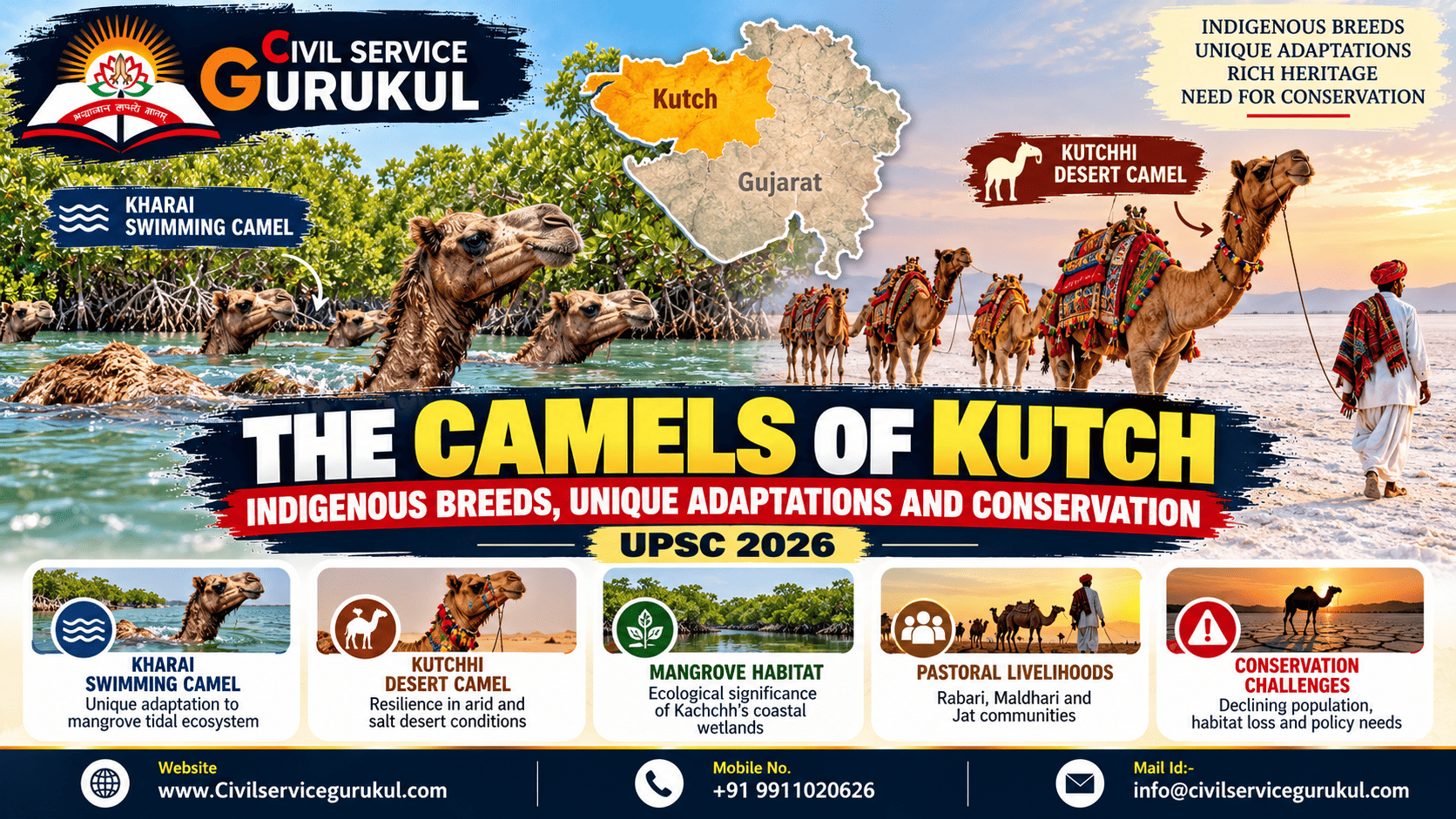
Camels of Kutch in Crisis: Why Gujarat's Swimming Camels Need Protection
Understand Kharai and Kutchhi camel breeds, their extraordinary adaptations, the role of mangroves and the future of pastoral livelihoods in Gujarat.
26 October 2026 | UPSC Prelims & Mains
The indigenous camel populations of Kutch, Gujarat, are facing serious conservation challenges. The October 2026 current-affairs report highlights a decline from more than 17,600 camels in 1992 and reduced participation at the traditional Bhed Mata Camel Fair.
The region has two important indigenous camel breeds: the coastal Kharai camel, famous for swimming to mangrove grazing areas, and the inland Kutchhi camel, adapted to dry scrubland and grassland ecosystems.
Protecting these animals also means protecting pastoral communities, mangrove habitats and traditional ecological knowledge.
1. Why Are the Camels of Kutch in the News?
The camel population of Gujarat's Kutch district has declined substantially over recent decades. The traditional Bhed Mata Camel Fair, once attended by thousands of animals, reportedly saw fewer than 200 camels in the period highlighted by the October 2026 report.
This trend has raised concerns about the long-term survival of indigenous breeds, the economic difficulties faced by camel herders and the degradation of traditional grazing landscapes.
However, camel-fair attendance is not the same as an official district-wide livestock census. It is an indicator of changing participation and pastoral conditions, not a complete population estimate.
2. Where Is Kutch Located?
Kutch is a district in western Gujarat. Its landscape includes salt marshes, coastal mangroves, arid grasslands and thorn-scrub vegetation.
The Great Rann of Kutch and the Little Rann of Kutch are prominent geographical features of the wider region.
These dry and saline environments have shaped the development of specialised livestock breeds and pastoral systems.
3. What Are the Indigenous Camel Breeds of Kutch?
| Feature | Kharai Camel | Kutchhi Camel |
|---|---|---|
| Common Description | Swimming camel | Traditional inland camel |
| Primary Habitat | Coastal and mangrove ecosystems | Dry grasslands and thorn-scrub landscapes |
| Important Adaptation | Ability to swim across tidal waters | Ability to tolerate dry and arid conditions |
| Food Resources | Mangrove foliage and other coastal vegetation | Dryland browse and vegetation |
| Conservation Concern | Loss of mangrove access and coastal habitat pressures | Reduction of grazing areas and changing pastoral livelihoods |
4. What Makes the Kharai Camel Special?
The Kharai camel is an indigenous dromedary breed associated with the coastal ecosystems of Kutch.
It is popularly called the swimming camel because it can cross tidal creeks and seawater channels to reach island grazing areas.
Important Characteristics
- Adapted to saline coastal conditions.
- Capable of swimming between coastal grazing locations.
- Uses mangrove foliage as an important food resource.
- Associated with traditional pastoral management systems.
- Ecologically connected to the health of coastal vegetation.
The Kharai camel is known for its swimming ability and association with the mangroves of Kutch. It should not be confused with the inland Kutchhi camel.
5. Why Are Mangroves Important for Kharai Camels?
Mangroves are salt-tolerant trees and shrubs that grow in coastal intertidal environments.
They provide important ecological services, including shoreline protection, carbon storage and habitats for fish, birds and other organisms.
For Kharai camels, mangrove vegetation also provides a source of browse.
The loss or inaccessibility of mangrove grazing areas can therefore directly affect camel nutrition and traditional herd management.
6. What Is the Role of Pastoral Communities?
Pastoralism is a livelihood system based on raising livestock and managing access to grazing resources.
In Kutch, communities such as Rabaris, Maldharis and Jaths have longstanding connections with camel herding.
Pastoralists possess practical knowledge of seasonal grazing patterns, water availability, animal health and local vegetation.
The conservation of indigenous camels is closely linked to the continuation of this knowledge.
7. Why Are Camel Populations Declining?
The source highlights a sharp historical decline in Kutch's camel population. Several broader factors can help explain why pastoral camel-rearing systems face pressure.
A. Loss of Grazing Land
Land-use changes, infrastructure development and restrictions on access can reduce the availability of traditional grazing areas.
B. Changes in Mangrove Habitats
Habitat degradation and altered access to coastal vegetation can create challenges for Kharai herds.
C. Economic Pressures
Maintaining camel herds may become less attractive when costs increase or traditional sources of income decline.
D. Changing Rural Livelihoods
Younger generations may move towards other occupations, reducing the number of people engaged in traditional herding.
E. Animal Health and Veterinary Access
Remote grazing landscapes can make regular veterinary services and disease monitoring more difficult.
8. Ecological Importance of Camels
Indigenous camels form part of the ecological and livelihood systems of arid and coastal landscapes.
Through browsing and movement, they can influence vegetation patterns and contribute to seed dispersal.
However, the ecological effects of grazing depend on herd density, season, vegetation condition and management practices. Excessive grazing can also harm fragile habitats.
9. Kutch Camels and Climate Resilience
Arid and semi-arid regions face growing risks from temperature extremes, irregular rainfall and water scarcity.
Camels possess adaptations that help them tolerate harsh environmental conditions.
Indigenous breeds can therefore be important components of climate-resilient livestock systems, particularly where other forms of animal husbandry are less suited to local conditions.
Protecting breed diversity also helps preserve useful genetic characteristics for future generations.
10. Conservation of Indigenous Livestock Breeds
Livestock conservation is not limited to protecting wild animals. Indigenous domesticated breeds also represent valuable biological and cultural resources.
Effective conservation requires attention to breeding populations, genetic diversity, animal health and the economic sustainability of herding.
| Conservation Priority | Possible Action |
|---|---|
| Breed Preservation | Maintain breeding records and protect genetic diversity. |
| Habitat Access | Develop sustainable arrangements for traditional grazing. |
| Veterinary Care | Improve mobile veterinary services and disease monitoring. |
| Pastoral Livelihoods | Support viable markets and community enterprises. |
| Scientific Monitoring | Conduct reliable livestock surveys and ecological assessments. |
| Community Participation | Involve herders in conservation planning and implementation. |
11. Government and Institutional Approaches
India's broader livestock development framework includes measures related to indigenous breed conservation, animal health and livestock-based livelihoods.
Relevant approaches include the National Livestock Mission, breed documentation and animal husbandry extension services.
For Kutch camels, conservation efforts must be adapted to local coastal and arid ecosystems rather than applying a single model to every livestock breed.
12. What Is the Way Forward?
- Protect Breed Diversity: Support scientifically managed breeding and accurate population records.
- Maintain Ecological Connectivity: Assess traditional access routes to grazing habitats.
- Promote Sustainable Mangrove Management: Balance ecosystem protection with carefully managed pastoral use.
- Strengthen Pastoral Livelihoods: Improve access to veterinary services, markets and suitable livelihood support.
- Use Community Knowledge: Include experienced herders in conservation decisions.
- Improve Data Collection: Distinguish official population trends from estimates based on fair attendance or local observations.
13. UPSC Prelims Quick Revision
- Kutch is located in Gujarat.
- The Kharai camel is popularly called the swimming camel.
- Kharai camels are associated with coastal mangrove habitats.
- Kutchhi camels are associated with inland arid and thorn-scrub landscapes.
- Both belong to the dromedary camel species, Camelus dromedarius.
- Rabaris, Maldharis and Jaths are among the pastoral communities associated with camel herding in Kutch.
- Mangroves are salt-tolerant coastal vegetation.
- The Bhed Mata Camel Fair is associated with the region's camel-rearing traditions.
- Conservation involves both biodiversity and pastoral livelihoods.
14. UPSC Prelims Practice MCQs
Which Indian camel breed is popularly known as the swimming camel?
(A) Bikaneri
(B) Kharai
(C) Mewari
(D) Jaisalmeri
Consider the following statements:
- Kharai camels are associated with mangrove ecosystems.
- Kutchhi camels are adapted to arid inland environments.
- Kutch is located in Rajasthan.
Which statements are correct?
(A) 1 only
(B) 1 and 2 only
(C) 2 and 3 only
(D) 1, 2 and 3
Which of the following best describes pastoralism?
(A) Cultivation of crops using hydroponics
(B) Livelihood systems based on livestock herding and grazing management
(C) Commercial deep-sea fishing
(D) Extraction of mineral resources
Why are mangroves important for the Kharai camel?
(A) They provide important coastal browse and grazing resources.
(B) They create permanent freshwater glaciers.
(C) They eliminate the need for animal drinking water.
(D) They occur only in deserts.
15. UPSC Mains Practice Question
"The conservation of indigenous livestock breeds requires the protection of both ecosystems and traditional livelihoods."
Discuss with reference to the Kharai camels of Gujarat's Kutch region.
Word Limit: 250 words
Suggested Answer Framework
- Introduce the Kharai and Kutchhi camel breeds.
- Explain the ecological importance of mangroves and dryland grazing systems.
- Discuss pastoral communities and traditional knowledge.
- Identify habitat and economic pressures.
- Suggest community-led and science-based conservation measures.
- Conclude with integrated biodiversity and livelihood protection.
16. Frequently Asked Questions
Where are the Kharai camels found?
Kharai camels are associated with the coastal areas and mangrove ecosystems of Gujarat's Kutch region.
Why are Kharai camels called swimming camels?
They are capable of crossing tidal creeks and seawater channels to reach coastal grazing areas.
What is the difference between Kharai and Kutchhi camels?
Kharai camels are associated with coastal and mangrove habitats, while Kutchhi camels are primarily adapted to inland arid environments.
Which communities are associated with camel herding in Kutch?
Rabaris, Maldharis and Jaths are among the pastoral communities associated with camel management in the region.
Why is this topic important for UPSC?
It connects species in news, indigenous livestock breeds, mangrove ecology, biodiversity conservation, geography and traditional livelihoods.
17. Conclusion: Protecting a Unique Coastal Heritage
The decline of camels in Kutch raises concerns that go beyond livestock numbers. It affects indigenous genetic resources, pastoral knowledge, coastal habitats and the cultural identity of herding communities.
The Kharai camel demonstrates how animal breeds can develop remarkable adaptations to local environments. Protecting this heritage requires reliable population monitoring, sustainable habitat management and meaningful participation by pastoral communities.
Final UPSC Takeaway: Conservation becomes more effective when biodiversity protection and livelihood security are treated as connected goals rather than separate issues.
Prepare for UPSC with Civil Service Gurukul
Strengthen your preparation in Environment, Geography, Indian Society, Economy and Current Affairs through structured UPSC learning resources.
Website: www.civilservicegurukul.com
Mobile: +91 9911020626
Email: info@civilservicegurukul.com
Editorial Note: This original educational article uses the 26 October 2026 current-affairs report as its news basis. The discussion of conservation strategies and livelihood measures is explanatory analysis. Camel-fair attendance figures should not be treated as a substitute for official livestock census data.
Prepare with Mentors Who Cleared the Exam
Get personalized study plans, evaluated answer models, and test series access.