
Census 2027: India's First Digital Census, Caste Enumeration & UPSC PYQs
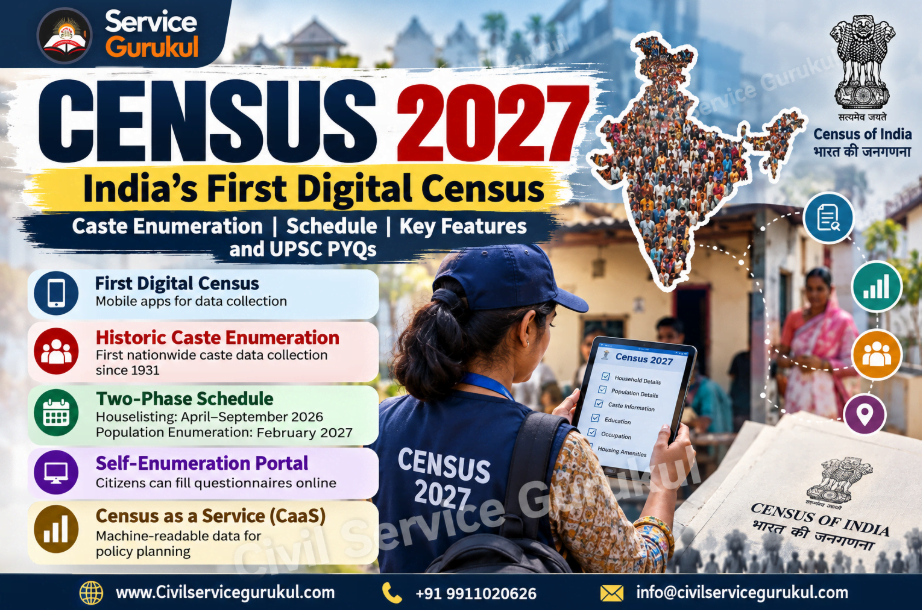
UPSC CURRENT AFFAIRS GS PAPER I & II CENSUS 2027
Census 2027 Explained: India's First Digital Census, Caste Enumeration and the Future of Data-Driven Governance
Complete examination-oriented notes on India's 16th Census, its schedule, digital technologies, constitutional significance and important State PCS previous year questions.
1. Why Is Census 2027 Important?
Census 2027 represents a major transformation in India's system of population data collection.
It will be the 16th Census of India and the eighth Census after Independence.
The exercise will introduce India's first digital Census, using mobile applications, digital monitoring and online self-enumeration facilities.
Another important feature is nationwide caste enumeration, extending beyond the Scheduled Caste and Scheduled Tribe categories.
2. Background of the Indian Census
The Census is a nationwide statistical exercise designed to collect information about the population and households.
India's first non-synchronous population enumeration was undertaken in 1872.
The first synchronous Census was conducted in 1881.
The last completed decennial Census was conducted in 2011. The planned 2021 Census was postponed.
Legal and Administrative Framework
- Census Act, 1948: Provides the statutory framework for Census operations.
- Census Rules, 1990: Provide procedural provisions for conducting Census operations.
- Administrative Authority: Office of the Registrar General and Census Commissioner, India.
- Nodal Ministry: Ministry of Home Affairs.
- Constitutional Position: Census falls under Entry 69 of the Union List in the Seventh Schedule.
3. Census 2027 Schedule: Two Major Phases
Census 2027 is organised into two principal phases.
Houselisting and Housing Census
April–September 2026
A 30-day houselisting operation is scheduled in each State or Union Territory within the notified period.
Population Enumeration
February 2027
Collection of individual demographic and socio-economic information, including caste enumeration.
Phase I: Houselisting and Housing Census
The first phase focuses on information relating to houses and households.
Key areas include:
- Housing conditions.
- Availability of household amenities.
- Household assets.
- Preparation of the enumeration framework.
A 15-day self-enumeration window is provided before the 30-day house-to-house operation.
Phase II: Population Enumeration
The second phase focuses on individual-level information relating to demographic, socio-economic and other population characteristics.
Major areas include:
- Age and sex.
- Education and literacy.
- Migration.
- Fertility-related information.
- Social and cultural characteristics.
- Caste enumeration.
Special Arrangements for Snow-Bound Regions
Population enumeration is scheduled for September 2026 in:
- Union Territory of Ladakh.
- Designated snow-bound areas of Jammu and Kashmir.
- Designated snow-bound areas of Himachal Pradesh.
- Designated snow-bound areas of Uttarakhand.
4. Key Features of Census 2027
First Digital Census
Enumerators will use mobile applications for collecting and submitting data.
Self-Enumeration
Citizens can enter their information using a secure online platform.
Caste Enumeration
The second phase will include nationwide caste enumeration beyond SC and ST categories.
Digital Monitoring
Supervisors and officials can track Census operations using digital management systems.
Digital Mapping
Technology will assist in preparing and managing enumeration blocks.
Machine-Readable Data
Census-as-a-Service will support structured data access for government planning.
5. Digital Technologies Used in Census 2027
A. Mobile-Based Data Collection
Enumerators will use digital applications to record Census information instead of relying primarily on paper schedules.
Potential advantages include faster data processing, reduced manual entry and improved operational monitoring.
B. Self-Enumeration Portal
A secure online facility allows citizens to provide their information independently.
The information can then be linked with the field enumeration process.
C. Census Management and Monitoring System
CMMS stands for Census Management and Monitoring System.
It enables authorised officials to manage and monitor enumeration activities.
D. Houselisting Block Creator
The HLB Creator is a satellite-based web mapping application used for creating digital enumeration blocks.
It can support better geographical planning and fieldwork management.
E. Census-as-a-Service
CaaS refers to Census-as-a-Service.
It aims to provide ministries with clean, machine-readable and queryable Census data for evidence-based policy planning.
| Digital Tool | Function |
|---|---|
| Mobile Application | Field data collection |
| Self-Enumeration Portal | Citizen-led online submission |
| CMMS | Operational monitoring |
| HLB Creator | Digital enumeration-block mapping |
| CaaS | Machine-readable data for planning |
6. Caste Enumeration: Historical Significance
Census 2027 will include nationwide caste enumeration covering communities beyond Scheduled Castes and Scheduled Tribes.
The 1931 Census is an important historical reference for comprehensive caste enumeration in India.
Why Is Caste Enumeration Important?
- Can improve understanding of social and demographic patterns.
- May assist in identifying disparities among communities.
- Can support evidence-based social justice policies.
- May help evaluate welfare programme coverage.
- Can contribute to academic and policy research.
Potential Challenges
- Classification of caste groups.
- Differences in local nomenclature.
- Data consistency and standardisation.
- Privacy and confidentiality.
- Risk of politicisation or misinterpretation.
7. Constitutional and Governance Significance
Constitutional Dimension
- Census is a Union List subject under Entry 69.
- The Census Act, 1948 provides its legal framework.
- Population data supports governance and public planning.
- Relevant constitutional themes include equality, social justice and representation.
Policy and Development Dimension
- Public health planning.
- Education infrastructure.
- Urban and rural development.
- Social welfare programme design.
- Migration and labour-market analysis.
- Demographic and regional planning.
Why Updated Census Data Matters
Reliable population data helps governments understand changing demographic patterns and design public services more effectively.
It can also support analysis of ageing, urbanisation, migration, housing conditions and access to basic amenities.
8. International Perspective and Best Practices
Digital Census systems can benefit from international statistical best practices.
Important Principles
- Clear statistical definitions.
- Confidentiality of individual responses.
- Secure data collection and transmission.
- Inclusive access for digitally excluded groups.
- Strong quality-assurance procedures.
- Transparent publication of aggregated results.
India's digital Census creates opportunities for more efficient data processing, provided technology is supported by training, security and robust verification.
9. Challenges and Way Forward
Major Challenges
- Digital literacy gaps.
- Connectivity in remote regions.
- Training of field enumerators.
- Data security and confidentiality.
- Accuracy of self-reported information.
- Consistent caste classification.
- Inclusion of vulnerable populations.
Way Forward
- Provide comprehensive enumerator training.
- Ensure secure and reliable digital systems.
- Maintain assistance for digitally excluded households.
- Strengthen field verification.
- Adopt clear data-classification standards.
- Conduct rigorous quality checks.
- Publish accessible and useful aggregate statistics.
10. UPSC Prelims Quick Revision
| Topic | Important Fact |
|---|---|
| Census 2027 | 16th Census of India |
| First Digital Census | Census 2027 |
| Phase I | Houselisting, April–September 2026 |
| Phase II | Population Enumeration, February 2027 |
| Snow-Bound Areas | Special September 2026 enumeration |
| Caste Enumeration | During Population Enumeration |
| CMMS | Census Management and Monitoring System |
| HLB Creator | Digital mapping of houselisting blocks |
| CaaS | Census-as-a-Service |
| Legal Framework | Census Act, 1948 |
| Union List | Entry 69 |
| First Synchronous Census | 1881 |
11. UPSC Mains Answer-Writing Strategy
GS Paper I
Discuss demographic change, population distribution, urbanisation, migration and social characteristics.
GS Paper II
Explain digital governance, data-driven policymaking, social justice and administrative accountability.
GS Paper III
Discuss the importance of demographic data for economic planning, human capital and infrastructure development.
12. Conclusion
Census 2027 represents an important modernisation of India's population data-collection system.
Its digital tools, self-enumeration facility, nationwide caste enumeration and machine-readable outputs can strengthen evidence-based governance and public planning.
However, successful implementation will require data accuracy, digital inclusion, confidentiality and effective administrative capacity.
13. Previous Year Questions: 10 Important State PCS PYQs with Correct Answers and Explanations
The following questions are based on UPPSC Prelims papers from 2019 to 2024.
PYQ 1: Population Ranking
Arrange these States in descending order of population according to Census 2011: Uttar Pradesh, West Bengal, Bihar and Andhra Pradesh.
(A) Uttar Pradesh, West Bengal, Bihar, Andhra Pradesh
(B) Uttar Pradesh, Bihar, West Bengal, Andhra Pradesh
(C) Bihar, Uttar Pradesh, West Bengal, Andhra Pradesh
(D) West Bengal, Uttar Pradesh, Bihar, Andhra Pradesh
View Correct Answer and Explanation
According to Census 2011, Uttar Pradesh had the largest population among these States.
The descending order is: Uttar Pradesh, Bihar, West Bengal and Andhra Pradesh.
The question uses the 2011 State boundaries, including undivided Andhra Pradesh.
PYQ 2: Malthusian Population Theory
According to Thomas Malthus, population and food supply increase in which progression?
(A) Both in arithmetic progression
(B) Both in geometric progression
(C) Population arithmetic, food geometric
(D) Population geometric, food arithmetic
View Correct Answer and Explanation
Malthus argued that population tends to grow in geometric progression, such as 1, 2, 4, 8 and 16.
Food supply was assumed to grow in arithmetic progression, such as 1, 2, 3, 4 and 5.
This difference formed the basis of his argument about population pressure on resources.
PYQ 3: Population Stabilisation Target
Under India's National Population Policy, 2000, the long-term population stabilisation target was set for which year?
(A) 2030
(B) 2045
(C) 2060
(D) 2075
View Correct Answer and Explanation
The National Population Policy, 2000 envisaged achieving a stable population by 2045, consistent with sustainable economic growth and development.
This is a historical policy target, not a statement that population stabilisation has already been achieved.
PYQ 4: Demographic Dividend
Which population group was identified as the working-age population in the question on demographic dividend?
(A) Above 60 years
(B) 15–59 years
(C) 0–6 years
(D) 14–50 years
View Correct Answer and Explanation
The answer key uses the 15–59 years working-age classification.
The demographic dividend refers to the potential economic benefit arising when the working-age share of the population increases relative to dependants.
International demographic statistics may use 15–64 years as the working-age range.
The important concept is the relationship between working-age and dependent populations, not simply the number of workers.
PYQ 5: Population Theory
Thomas Malthus is associated with which population theory?
(A) Malthusian Theory of Population
(B) Optimum Population Theory
(C) Social Maladjustment Theory
(D) Demographic Transition Theory
View Correct Answer and Explanation
Thomas Robert Malthus developed the Malthusian Theory of Population.
It emphasised the possibility that population growth could exceed the growth of food resources.
This theory is important in population geography and demographic studies.
PYQ 6: Lowest Population Density
Which of the following States had the lowest population density according to Census 2011?
(A) Himachal Pradesh
(B) Arunachal Pradesh
(C) West Bengal
(D) Mizoram
View Correct Answer and Explanation
Arunachal Pradesh had the lowest population density among Indian States according to Census 2011, at approximately 17 persons per square kilometre.
Population density is calculated as:
Population ÷ Geographical Area
PYQ 7: Birth Rate and Social Development
Consider the following statements:
- Urbanisation tends to reduce birth rates.
- Higher literacy is generally associated with lower birth rates.
Which statements are correct?
(A) 1 only
(B) 2 only
(C) Both 1 and 2
(D) Neither 1 nor 2
View Correct Answer and Explanation
Urbanisation is often associated with smaller family size, higher living costs and changes in employment patterns.
Higher literacy, particularly female education, is generally associated with increased reproductive awareness and lower fertility.
These are broad demographic relationships rather than universal rules for every population.
PYQ 8: Most Populous Indian State
According to Census 2011, which of the following was India's most populous State?
(A) Bihar
(B) Madhya Pradesh
(C) Maharashtra
(D) Uttar Pradesh
View Correct Answer and Explanation
Uttar Pradesh was India's most populous State according to Census 2011.
Its population was approximately 19.98 crore.
Always remember that this answer is based on Census 2011 figures.
PYQ 9: Replacement-Level Fertility
What is the approximate Total Fertility Rate associated with replacement-level fertility?
(A) 1.0
(B) 1.5
(C) 2.1
(D) 3.5
View Correct Answer and Explanation
Replacement-level fertility is commonly approximated at 2.1 births per woman in populations with relatively low mortality.
It is the fertility level at which a population replaces itself across generations in the absence of migration.
The exact replacement level can vary depending on mortality conditions.
PYQ 10: Dependency Ratio
Why can the dependency ratio decline during a demographic transition?
(A) The share of dependent children always increases
(B) All elderly people leave the labour force
(C) The working-age population rises relative to dependants
(D) Total population necessarily declines
View Correct Answer and Explanation
The dependency ratio compares the dependent-age population with the working-age population.
A rising share of working-age people relative to dependants can reduce the ratio.
This may create conditions for a demographic dividend, provided adequate employment, education and healthcare opportunities are available.
- Census Data: State population rankings and density.
- Population Theories: Malthusian Theory.
- Fertility: Birth rate and replacement level.
- Demographic Dividend: Working-age population.
- Population Policy: Stabilisation targets.
- Demographic Transition: Dependency ratio.
These themes recur across different State PCS examination years, although the exact questions differ.
Prepare UPSC and State PCS with Civil Service Gurukul
Build strong foundations in Geography, Polity, Economy, Governance and Current Affairs through concept-based learning, previous year questions and structured exam preparation.
Explore NCERT Foundation Course Enquire on WhatsAppPrepare with Mentors Who Cleared the Exam
Get personalized study plans, evaluated answer models, and test series access.