
PANKHUDI Portal 2026: Transforming CSR Partnerships for Women and Child Development in India
UPSC CURRENT AFFAIRS 2026 GS PAPER II SOCIAL JUSTICE
PANKHUDI Portal: How India's New CSR Partnership Platform Can Transform Women and Child Welfare
A complete UPSC guide to PANKHUDI, CSR, Mission Shakti, Mission Vatsalya, Poshan 2.0, digital governance and previous year questions.
1. Why Is PANKHUDI Portal in the News?
The Ministry of Women and Child Development launched the PANKHUDI Portal on 8 January 2026.
The portal was launched by Union Minister for Women and Child Development Smt. Annpurna Devi.
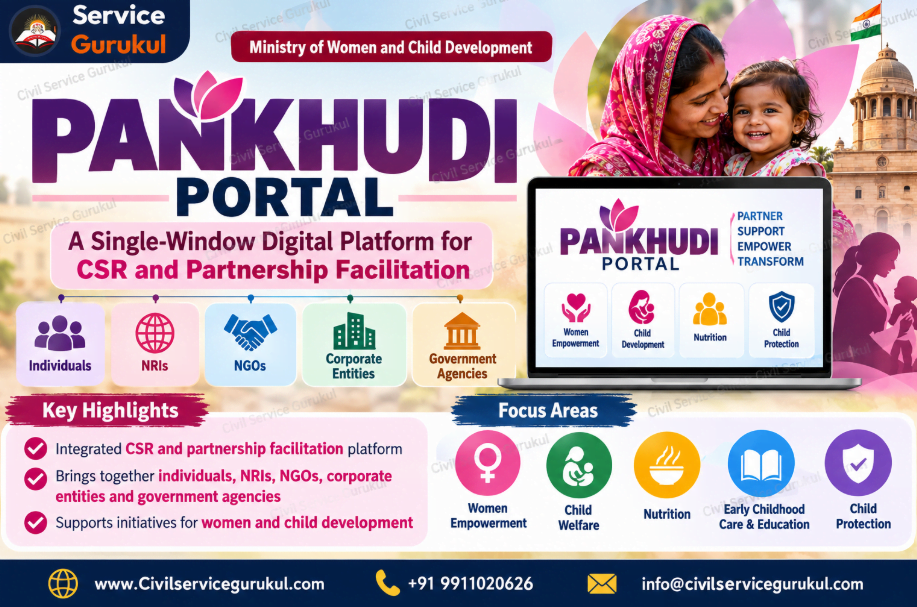
PANKHUDI is an integrated Corporate Social Responsibility (CSR) and partnership facilitation single-window digital platform.
It brings together individuals, Non-Resident Indians (NRIs), Non-Governmental Organisations (NGOs), corporate entities and government agencies.
2. What Is PANKHUDI Portal?
PANKHUDI is a single-window digital platform developed to facilitate structured and transparent partnerships for women and child development.
It connects potential contributors with development initiatives and requirements identified through government systems.
Core Objectives
- Promote transparent CSR partnerships.
- Connect contributors with development needs.
- Improve coordination among stakeholders.
- Support women and child welfare initiatives.
- Enable monitoring of contributions and proposals.
- Encourage public participation in social development.
3. Who Can Participate?
Individuals
Citizens interested in supporting development initiatives.
NRIs
Non-Resident Indians wishing to contribute to welfare initiatives.
NGOs
Civil society organisations working in relevant development areas.
Corporates
Businesses and CSR contributors supporting eligible initiatives.
Government Agencies
Central and State departments coordinating development activities.
Implementing Institutions
Grassroots institutions identifying requirements and implementing programmes.
4. Key Features of PANKHUDI Portal
A. Single-Window Digital Interface
The portal offers a common platform for CSR and voluntary partnerships.
B. Transparent Workflows
Contributors can register, identify initiatives, submit proposals and track their status.
C. Need-Based Participation
Institutions can indicate their requirements, helping contributors identify relevant areas of support.
D. Monitoring and Accountability
Digital workflows can improve transparency, traceability and administrative coordination.
E. Non-Cash Contributions
Contributions through the portal are accepted only through non-cash modes.
5. How Does PANKHUDI Work?
This structured process helps connect contributions with identified welfare requirements while supporting transparency and accountability.
6. Priority Areas of PANKHUDI
| Priority Area | Development Focus |
|---|---|
| Nutrition | Supporting nutritional well-being of women and children. |
| Health | Improving health-related services and support. |
| Early Childhood Care and Education | Supporting early learning and child development. |
| Child Protection | Supporting welfare, protection and rehabilitation. |
| Women's Safety | Strengthening services for women's protection. |
| Women's Empowerment | Supporting opportunities and services for women. |
7. Three Flagship Missions Linked with PANKHUDI
A. Mission Saksham Anganwadi and Poshan 2.0
Focuses on nutrition, early childhood care, Anganwadi services and related support for eligible beneficiaries.
B. Mission Vatsalya
Focuses on child protection, child welfare and care-related institutional and non-institutional services.
C. Mission Shakti
Focuses on women's safety, security and empowerment.
| Mission | Main Focus |
|---|---|
| Saksham Anganwadi & Poshan 2.0 | Nutrition and early childhood development |
| Mission Vatsalya | Child protection and welfare |
| Mission Shakti | Women's safety and empowerment |
8. Connection with Corporate Social Responsibility
CSR refers to Corporate Social Responsibility.
In India, Section 135 of the Companies Act, 2013 provides the principal statutory framework for CSR obligations of qualifying companies.
CSR Applicability Thresholds
A company may fall within Section 135 if it meets at least one of the following criteria in the immediately preceding financial year:
- Net worth of ₹500 crore or more.
- Turnover of ₹1,000 crore or more.
- Net profit of ₹5 crore or more.
The statutory spending framework generally refers to at least 2% of the average net profits of the three immediately preceding financial years, subject to applicable rules.
9. Governance and Constitutional Significance
A. Participatory Governance
PANKHUDI supports Jan Bhagidari by encouraging participation from citizens, institutions and organisations.
B. Collaborative Development
It can strengthen coordination among government bodies, civil society and corporate contributors.
C. Digital Governance
The portal illustrates the use of technology to simplify administrative processes and improve monitoring.
D. Constitutional Linkages
| Provision | Relevance |
|---|---|
| Article 14 | Equality before law |
| Article 15(3) | Special provisions for women and children |
| Article 21 | Life and dignity |
| Article 39(e) and (f) | Protection and development of children |
| Article 47 | Nutrition and public health |
10. Potential Benefits
- Better coordination of voluntary and institutional contributions.
- Greater transparency in partnership processes.
- Improved alignment between local needs and available support.
- Support for women and child welfare institutions.
- More accountable monitoring of proposals.
- Potential reduction in duplication of efforts.
11. Challenges and Way Forward
Challenges
- Digital access and literacy gaps.
- Uneven institutional capacity.
- Verification of contributors and proposals.
- Coordination across government departments.
- Measuring outcomes rather than inputs alone.
- Protecting sensitive beneficiary information.
Way Forward
- Strengthen training and handholding.
- Improve access for smaller organisations.
- Adopt clear proposal evaluation standards.
- Ensure transparent monitoring and reporting.
- Develop measurable welfare indicators.
- Protect privacy and maintain accountability.
12. UPSC Prelims Quick Revision
| Topic | Important Fact |
|---|---|
| Portal | PANKHUDI |
| Launch Date | 8 January 2026 |
| Ministry | Women and Child Development |
| Launched By | Union Minister Annpurna Devi |
| Nature | CSR and partnership facilitation platform |
| Interface | Single-window digital portal |
| Stakeholders | Individuals, NRIs, NGOs, corporates and government agencies |
| Contributions | Non-cash modes only |
| Mission 1 | Saksham Anganwadi & Poshan 2.0 |
| Mission 2 | Mission Vatsalya |
| Mission 3 | Mission Shakti |
| CSR Framework | Section 135, Companies Act 2013 |
13. UPSC Mains Answer-Writing Strategy
GS Paper II
Discuss civil society, NGOs, public-private collaboration, women empowerment and child welfare.
GS Paper III
Explain CSR, inclusive development, resource mobilisation and social infrastructure.
GS Paper IV
Connect the portal with transparency, accountability, public service values and responsible corporate citizenship.
14. Conclusion
PANKHUDI represents a digital approach to strengthening collaboration for women and child development.
By bringing government institutions, civil society, individuals and corporate contributors onto a common platform, it can support more transparent and coordinated welfare initiatives.
Its effectiveness will depend on inclusion, implementation capacity, financial accountability and measurable improvements in welfare outcomes.
15. Ten Relevant UPSC Mains PYQs with Suggested Answers
PYQ 1: Civil Society and the State
Do you agree that civil society organisations are often viewed as anti-State rather than non-State actors? Justify.
Suggested Answer and Explanation
- CSOs support service delivery.
- They raise awareness and represent communities.
- They may question government policies.
- Constructive criticism is part of democratic accountability.
- Transparent partnerships can improve cooperation.
PANKHUDI Link: The portal provides a framework for collaboration between government and non-State development partners.
PYQ 2: Public Charitable Trusts
Explain how public charitable trusts can contribute to more inclusive development in India.
Suggested Answer and Explanation
- Support vulnerable communities.
- Provide health and education services.
- Mobilise voluntary resources.
- Address local development gaps.
- Promote community participation.
PANKHUDI Link: Digital partnerships can help align institutional contributions with identified welfare needs.
PYQ 3: Civil Society and Women's Representation
Discuss the contribution of civil society groups to women's meaningful participation and representation in State legislatures.
Suggested Answer and Explanation
- Leadership training.
- Awareness of political rights.
- Mobilisation of women voters.
- Advocacy for inclusive institutions.
- Support for participation in public life.
PANKHUDI Link: Although the portal is not an electoral programme, its women-empowerment partnership model relates to broader social inclusion.
PYQ 4: Donor Dependence and Community Participation
Can excessive dependence on donor agencies reduce community participation in development? Justify.
Suggested Answer and Explanation
- Donors can mobilise additional resources.
- Overdependence may distort local priorities.
- Community participation improves relevance.
- Transparency strengthens accountability.
- Local institutions should help identify needs.
PANKHUDI Link: Its need-based approach can help connect contributors with grassroots requirements.
PYQ 5: NGOs as Public Service Providers
Can civil society and NGOs offer an alternative model of public service delivery? Discuss the challenges.
Suggested Answer and Explanation
- Grassroots outreach.
- Community trust.
- Flexible service delivery.
- Innovation in social programmes.
- Challenges: funding, scale and monitoring.
PANKHUDI Link: The portal offers a digital mechanism to coordinate government and NGO contributions.
PYQ 6: Women's SHGs and Malnutrition
Can microfinance through women's Self-Help Groups help break the cycle of gender inequality, poverty and malnutrition? Explain.
Suggested Answer and Explanation
- Access to financial resources.
- Greater economic independence.
- Improved household decision-making.
- Potential improvements in nutrition.
- Need for education and healthcare support.
PANKHUDI Link: Its focus on women's empowerment and nutrition addresses related development priorities.
PYQ 7: Microfinance and SHGs
Evaluate the role of Self-Help Groups in asset creation, income security and empowerment of rural women.
Suggested Answer and Explanation
- Small savings and credit.
- Support for microenterprises.
- Asset creation.
- Improved income security.
- Collective bargaining and social participation.
PANKHUDI Link: CSR partnerships can complement community-based empowerment programmes.
PYQ 8: SHGs and Development
Examine the role of Self-Help Groups in development and the measures taken by government to promote them.
Suggested Answer and Explanation
- Financial inclusion.
- Women's collective participation.
- Livelihood development.
- Social mobilisation.
- Government support through livelihood missions.
PANKHUDI Link: The portal similarly emphasises partnerships and participation, although it is not itself an SHG financing scheme.
PYQ 9: Role of Non-State Actors
Critically examine the view that non-State actors play only a marginal role in Indian governance.
Suggested Answer and Explanation
- NGOs deliver social services.
- Community organisations support participation.
- Private institutions mobilise resources.
- CSOs promote accountability.
- Challenges include uneven capacity and oversight.
PANKHUDI Link: The portal formally facilitates participation of non-State actors in development initiatives.
PYQ 10: E-Governance and Service Delivery
Examine the importance of the interactive service model of e-governance in promoting transparency and accountability.
Suggested Answer and Explanation
- Online registration and applications.
- Digital proposal processing.
- Status tracking.
- Reduced information gaps.
- Improved transparency and accountability.
PANKHUDI Link: Its registration, proposal submission and tracking workflows illustrate interactive digital governance.
- Role of NGOs and civil society.
- Women empowerment and SHGs.
- Donor participation and development.
- Public service delivery.
- Inclusive development.
- Digital governance and accountability.
Prepare UPSC & State PCS with Civil Service Gurukul
Master Polity, Governance, Social Justice and Current Affairs through conceptual notes, previous year questions and answer-writing practice.
Explore Civil Service Gurukul Enquire on WhatsAppPrepare with Mentors Who Cleared the Exam
Get personalized study plans, evaluated answer models, and test series access.