
Coronary Stents & Angioplasty: Medical Ethics UPSC 2026
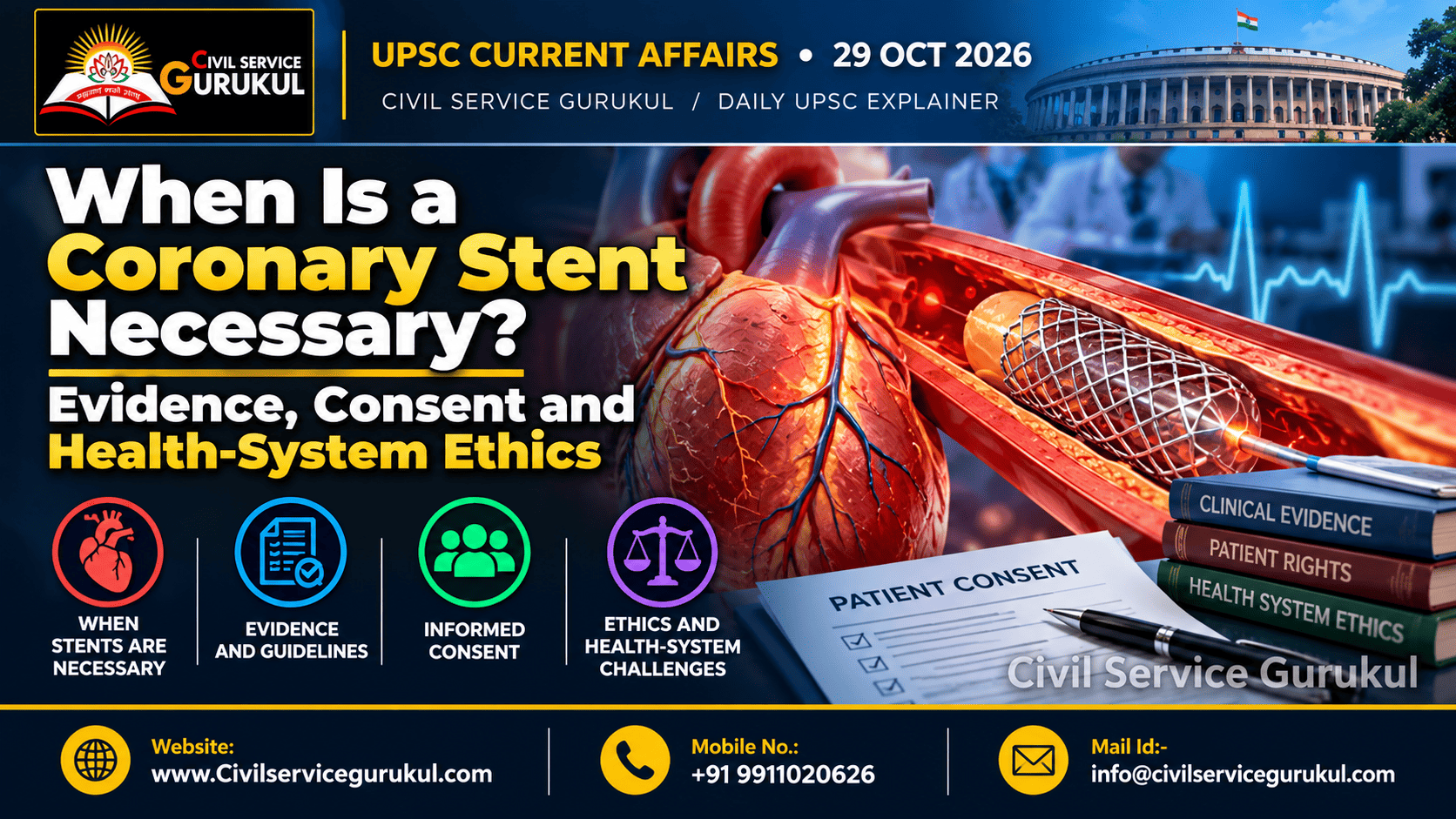
Coronary Stents and Unnecessary Angioplasty in India: Patient Rights, Medical Ethics and Healthcare Accountability
An in-depth UPSC analysis of coronary stents, angioplasty, informed consent, patient safety and responsible healthcare governance.
Public discussion in October 2026 about potentially unnecessary coronary stenting has highlighted the importance of distinguishing emergency cardiac interventions from elective treatment decisions in stable coronary disease.
This article examines medical ethics, informed consent, evidence-based care, financial incentives and healthcare accountability from a UPSC perspective.
GS Paper II: Public Health, Healthcare Governance, Social Sector Services and Accountability.
GS Paper IV: Medical Ethics, Informed Consent, Patient Autonomy, Professional Integrity and Transparency.
Prelims: Coronary Arteries, Atherosclerosis, Angioplasty, Stents and Acute Coronary Syndrome.
Why Are Coronary Stents and Angioplasty in the News?
Public debate in October 2026 over potentially unnecessary coronary stenting renewed attention to appropriate medical decision-making.
A crucial distinction exists between urgent intervention during certain heart attacks and elective treatment of stable coronary disease.
Emergency treatment may be life-saving, while stable disease often allows a more detailed comparison of medicines, lifestyle measures and revascularisation.
Sudden or severe chest pain may indicate a medical emergency. Immediate professional medical evaluation is essential. This article is educational and is not individual medical advice.
What Is Coronary Artery Disease?
Coronary arteries supply oxygenated blood to the heart muscle.
Atherosclerotic plaques may narrow these arteries and reduce blood flow.
This can cause angina, or chest discomfort associated with reduced blood supply to the heart.
Sudden plaque rupture and blood clot formation can lead to acute coronary syndrome, including myocardial infarction, commonly called a heart attack.
What Is Angioplasty or Percutaneous Coronary Intervention?
Percutaneous coronary intervention, or PCI, is a catheter-based procedure used to improve blood flow through affected coronary arteries.
It may involve a balloon and often the placement of a coronary stent.
The urgency and expected benefit of PCI depend on the patient's clinical condition.
What Is a Coronary Stent?
A coronary stent is a small mesh scaffold placed inside a coronary artery during PCI.
It helps support the treated vessel and maintain blood flow.
However, a stent does not eliminate the underlying need for risk-factor management and prescribed medical treatment.
Emergency Heart Attack vs Stable Coronary Disease
| Aspect | Acute Coronary Syndrome | Stable Coronary Disease |
|---|---|---|
| Clinical Context | May involve sudden plaque rupture and clot formation. | Often involves chronic narrowing and symptoms. |
| Urgency | May require immediate intervention. | Often permits detailed clinical evaluation. |
| Treatment Decision | Urgent reperfusion may be necessary. | Medication, symptoms, anatomy and patient preferences are considered. |
| Role of PCI | Can be life-saving in appropriate emergencies. | May be considered according to clinical evidence and expected benefit. |
It is incorrect to assume that every coronary narrowing requires a stent.
It is equally incorrect to suggest that angioplasty is never necessary during a heart attack.
Informed Consent and Patient Autonomy
Informed consent is a central principle of medical ethics.
Patients should receive understandable information about the proposed treatment, its expected benefits, material risks and reasonable alternatives.
In elective settings, shared decision-making helps align treatment with clinical evidence and patient preferences.
However, the process of obtaining a second opinion should not create dangerous delays in emergency care.
Medical Ethics: Preventing Overtreatment Without Delaying Necessary Care
Patient Autonomy
Patients should participate in decisions about their treatment where clinically appropriate.
Beneficence
Healthcare professionals should recommend interventions that are expected to benefit the patient.
Non-Maleficence
Avoidable procedural risks and unnecessary treatment should be minimised.
Justice
Healthcare resources should be used fairly and responsibly.
Ethical practice requires both protection against overtreatment and timely access to life-saving interventions.
Healthcare Accountability and Financial Incentives
Healthcare systems must address information asymmetry between patients and medical professionals.
Patients may find it difficult to distinguish an urgent coronary blockage from a stable narrowing.
Financial incentives, hospital package pricing and incomplete consent processes may create concerns about inappropriate interventions.
Documented clinical indications, quality audits and transparent communication can strengthen public trust.
However, oversight systems must avoid discouraging clinically justified care for high-risk patients.
Way Forward: Strengthening Ethical Cardiac Care
- Document clinical indications for elective PCI.
- Promote shared decision-making and meaningful informed consent.
- Audit treatment appropriateness using risk-adjusted clinical criteria.
- Improve access to preventive medicines and cardiac rehabilitation.
- Strengthen transparency in healthcare pricing and patient communication.
- Ensure suspected heart attacks receive urgent medical evaluation.
UPSC Prelims Quick Revision Capsule
| Term | Meaning |
|---|---|
| PCI | Percutaneous Coronary Intervention. |
| Coronary Stent | Mesh scaffold used to support a treated coronary artery. |
| Atherosclerosis | Build-up of plaque in arterial walls. |
| ACS | Acute Coronary Syndrome. |
| Angina | Chest discomfort associated with reduced blood supply to heart muscle. |
| Informed Consent | Understanding relevant benefits, risks and alternatives before agreeing to treatment. |
| Shared Decision-Making | Clinical decisions informed by evidence and patient preferences. |
UPSC Prelims Practice MCQs
With reference to coronary stents, consider the following statements:
- A coronary stent is a mesh scaffold.
- PCI may be urgently required in certain heart attacks.
- Stent placement eliminates the need for all future preventive care.
Which statements are correct?
(A) 1 and 2 only
(B) 1 and 3 only
(C) 2 and 3 only
(D) 1, 2 and 3
Statements 1 and 2 are correct. Stent placement does not replace risk-factor management or prescribed medicines.
Which statement about stable coronary disease is most accurate?
(A) Every narrowing requires immediate stenting.
(B) Treatment decisions should consider symptoms, clinical evidence and patient preferences.
(C) Preventive medicines have no role.
(D) Angiography alone always determines the need for PCI.
Stable coronary disease requires individualised clinical assessment.
Which principle is most closely associated with explaining treatment risks, benefits and alternatives to patients?
(A) Fiscal deficit
(B) Informed consent
(C) Monetary policy
(D) Legislative privilege
Informed consent supports patient autonomy and ethical medical decision-making.
UPSC Mains Answer Writing Practice
Discuss how clinical guidelines, informed consent and financial accountability can reduce unnecessary medical procedures without undermining emergency care.
Suggested Answer Structure- Differentiate emergency and elective care.
- Explain evidence-based treatment.
- Discuss patient autonomy and informed consent.
- Analyse financial incentives and information asymmetry.
- Recommend quality audits and patient-safety safeguards.
Model Answer Framework
Medical ethics requires healthcare decisions to be guided by clinical evidence, patient welfare and informed consent.
Unnecessary procedures may expose patients to avoidable costs and medical risks.
At the same time, delays in essential emergency treatment can have serious consequences.
Healthcare institutions should therefore promote transparent consent processes, documented clinical indications, independent audits and appropriate financial oversight.
The objective should be to provide the right treatment at the right time, based on the patient's condition.
Frequently Asked Questions
What is a coronary stent?
A small mesh scaffold placed inside a coronary artery during PCI.
Is angioplasty always necessary?
No. Its appropriateness depends on the clinical condition and evidence.
Can angioplasty be life-saving?
Yes. Timely reperfusion may be life-saving during certain heart attacks.
Should patients with severe chest pain wait for a second opinion?
No. Sudden or severe chest pain may require immediate emergency medical evaluation.
Why is this topic important for UPSC?
It connects public health, medical ethics, patient autonomy, healthcare governance and institutional accountability.
Key Takeaway for UPSC Aspirants
Appropriate medical care means providing the intervention supported by clinical evidence and the patient's condition.
Healthcare accountability must prevent avoidable overtreatment while ensuring rapid access to essential emergency care.
Prepare Public Health and Ethics with Civil Service Gurukul
Strengthen your UPSC preparation with health governance analysis, medical ethics, current affairs, Prelims practice and Mains answer-writing guidance.
Website: www.civilservicegurukul.com
Mobile: +91 9911020626
Email: info@civilservicegurukul.com
Medical disclaimer: This article is for educational and UPSC examination preparation purposes. It does not provide personalised medical advice. People experiencing possible heart attack symptoms should seek immediate emergency medical evaluation.
Prepare with Mentors Who Cleared the Exam
Get personalized study plans, evaluated answer models, and test series access.