
Creative Industries in India – UPSC Mains 2027
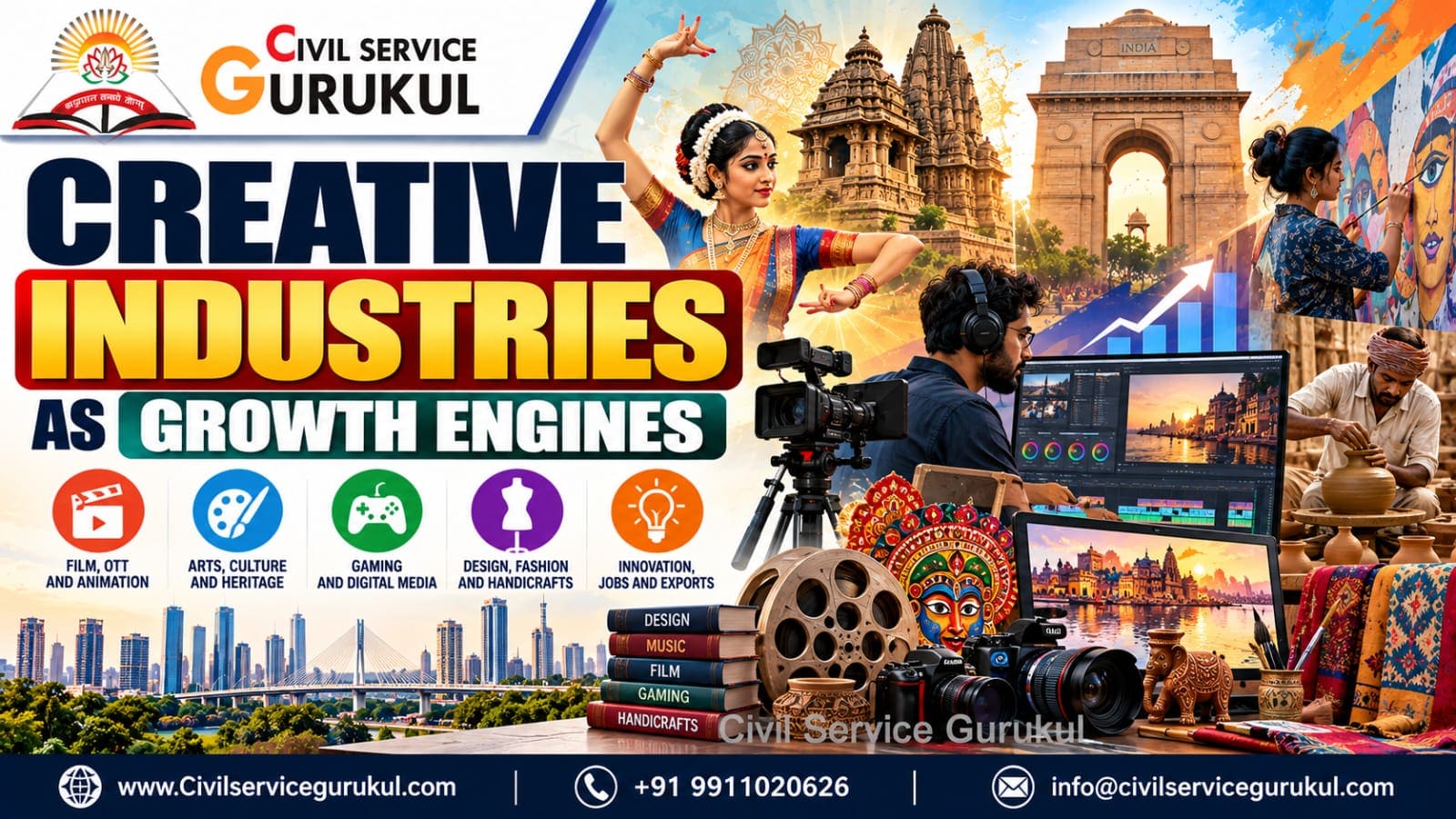
India's Orange Economy: Creative Industries as Engines of Growth
From cultural heritage and storytelling to animation, gaming, design and digital entrepreneurship: building India's next generation of innovation-led industries.
Executive Summary
Creative industries are increasingly important contributors to modern economic development.
These sectors generate economic value through artistic expression, knowledge, technology, cultural heritage and intellectual property.
India's creative economy includes cinema, television, music, animation, visual effects, gaming, comics, digital content, design, advertising and live entertainment.
The Economic Survey 2025–26 recognises the Orange Economy as an emerging driver of media, tourism and urban services.
Union Budget 2026–27 proposed AVGC Content Creator Labs in 15,000 secondary schools and 500 colleges, with an allocation of ₹250 crore.
For UPSC Mains, the topic connects economic growth, employment, entrepreneurship, exports, technology, intellectual property and India's cultural influence.
1. Introduction: Creativity as Economic Capital
Traditionally, economic development has been associated with agriculture, manufacturing, capital investment and physical infrastructure.
However, modern economies also generate substantial value from knowledge, storytelling, digital platforms, cultural expression and intellectual property.
A film, video game, design concept or digital animation asset can be distributed across international markets without requiring physical production in every country.
This gives creative industries a distinctive economic model: high initial investment in content and creativity, followed by opportunities for repeated licensing and distribution.
2. What Is the Orange Economy?
The Orange Economy refers to activities where economic value originates primarily from creativity, artistic expression, cultural knowledge and intellectual property.
Its boundaries vary according to statistical and policy definitions.
Core Characteristics
- Ideas and creativity are important inputs.
- Intellectual property can be a central asset.
- Content may be distributed digitally across borders.
- Technology and artistic skills often interact.
- Industries create linkages with tourism and services.
- Small creators can potentially reach global audiences.
Orange Economy versus Traditional Manufacturing
| Dimension | Traditional Manufacturing | Creative Industries |
|---|---|---|
| Major value driver | Physical inputs, engineering and production | Creativity, skills, technology and IP |
| Typical output | Machinery, textiles, automobiles | Films, games, design, media assets |
| Distribution | Often depends on physical logistics | Can be physical, digital or experiential |
| Scalability | Requires expansion of productive capacity | Some digital content can scale at relatively low marginal distribution cost |
| Risks | Input costs, supply chains, demand | IP theft, uncertain demand, platform dependence |
3. Major Components of India's Creative Economy
Cinema and Television
Film production, broadcasting, distribution, editing, post-production and licensing.
Animation and VFX
Digital animation, visual effects, virtual production and computer-generated imagery.
Gaming
Video-game design, software development, artwork, gameplay, interactive storytelling and publishing.
Music and Audio
Music production, sound engineering, recording, distribution and live performance.
Design and Advertising
Graphic design, branding, product design, marketing and visual communication.
Digital Content
Educational videos, podcasts, online media, social-media content and creator-led businesses.
Handicrafts and Heritage
Traditional arts, crafts, textiles, cultural products and heritage-based design.
Live Entertainment
Concerts, cultural festivals, theatre, exhibitions and experience-based events.
4. Why Creative Industries Can Become Growth Engines
4.1 High-Value Services
Creative products can generate significant revenue from knowledge-intensive activities.
Digital production also enables cross-border service exports, subject to international market conditions.
4.2 Intellectual Property Monetisation
A successful film, character, game franchise or music catalogue can create revenue through licensing, distribution, merchandising and adaptation.
4.3 Employment Multiplier
Creative production supports artists, programmers, editors, designers, technicians, marketers and administrative personnel.
Events and media production may also support hospitality, travel, catering, transport and other local services.
4.4 Export Diversification
Creative services can help diversify exports beyond traditional goods and services.
4.5 Entrepreneurship
Digital distribution and creative technologies can reduce certain market-entry barriers, enabling independent creators and startups.
4.6 Innovation Spillovers
Virtual production, 3D modelling, immersive technologies and AI-assisted design can generate capabilities useful in education, healthcare, manufacturing and architecture.
5. Creative Industries and India's Demographic Dividend
India has a large youth population and a growing base of digitally skilled professionals.
Creative sectors can offer employment to individuals with diverse talents in art, technology, writing, production and business.
Employment Opportunities
- Animation artists and illustrators.
- Game developers and designers.
- Visual effects and production professionals.
- Content writers and editors.
- Music and sound engineers.
- UI/UX and graphic designers.
- Digital marketing professionals.
- Media entrepreneurs and freelancers.
Opportunities for Smaller Cities
Digital infrastructure can enable some creative services to be delivered outside large metropolitan production centres.
Regional-language media, local tourism and cultural entrepreneurship can also support district-level employment.
Major Employment Challenges
Project-based contracts, irregular earnings, limited health insurance and weak bargaining power can affect some creative workers.
Therefore, growth in the creative economy must be accompanied by improvements in employment quality.
6. AVGC-XR: India's Emerging Creative Technology Sector
AVGC-XR stands for Animation, Visual Effects, Gaming, Comics and Extended Reality.
Extended Reality
Extended Reality is an umbrella term for immersive technologies, including Virtual Reality and Augmented Reality.
Strategic Importance
- Supports digital content exports.
- Enables new storytelling formats.
- Develops high-value technical skills.
- Creates cross-sector applications.
- Encourages ownership of Indian creative IP.
Potential Applications
| Technology | Possible Application |
|---|---|
| Animation | Entertainment, education and advertising. |
| Visual Effects | Film, television and virtual production. |
| Gaming | Interactive entertainment and learning. |
| Comics | Storytelling, publishing and character IP. |
| AR / VR | Training, heritage, simulation and immersive experiences. |
7. Government Initiatives Supporting Creative Industries
7.1 WAVES 2025
The World Audio Visual and Entertainment Summit was held in Mumbai from 1–4 May 2025.
It brought together creators, businesses, investors and policymakers across media and entertainment activities.
7.2 WAVES Bazaar
WAVES Bazaar provides a marketplace framework for business networking, co-production opportunities and international content discovery.
7.3 WAVEX
WAVEX supports emerging startups in creative technologies through acceleration and industry connections.
7.4 Indian Institute of Creative Technologies
IICT, Mumbai, was established as a National Centre of Excellence for AVGC-XR.
It brings together industry, academia and public institutions to support skills, research and innovation.
7.5 India Cine Hub
India Cine Hub supports film facilitation, including relevant permissions and production-related services.
7.6 Startup and Intellectual Property Ecosystems
Innovation support, IP registration, industry partnerships and access to finance can help creative enterprises scale.
8. Union Budget 2026–27: Creative Economy Focus
Union Budget 2026–27 recognised the importance of developing creative skills and training in the AVGC sector.
Content Creator Labs
Purpose of the Initiative
- Improve early exposure to creative technologies.
- Build practical digital production skills.
- Expand the future talent pipeline.
- Support innovation in schools and colleges.
- Improve links between education and industry.
Implementation Challenges
Success will depend on trained instructors, equipment maintenance, updated curricula, student accessibility and links with industry opportunities.
9. Intellectual Property: The Economic Foundation of Creativity
Intellectual property provides legal mechanisms for protecting and commercialising eligible creative works, inventions, brands and designs.
Copyright
Copyright protects eligible original literary, artistic, musical, dramatic and audiovisual works, subject to applicable law.
Trademarks
Trademarks protect distinctive brand identifiers for goods or services.
Design Rights
Registered designs may protect qualifying visual features of industrial articles.
Patents
Patents may protect eligible inventions meeting applicable statutory requirements.
Why IP Ownership Matters
Creative firms that retain valuable IP can potentially earn repeated licensing and royalty income from their creations.
However, IP creation does not guarantee commercial success. Market demand and effective enforcement remain essential.
Risks to Creative Enterprises
- Digital piracy.
- Unauthorised distribution.
- Unfair contracts.
- Ownership disputes.
- Expensive cross-border enforcement.
- Unclear AI-generated content rights.
10. Creative Industries and India's Global Soft Power
Soft power refers to the ability to influence preferences through attraction, culture and values, rather than coercion.
India's films, music, literature, regional languages, crafts and digital storytelling can strengthen international cultural connections.
Economic Benefits
- International demand for cultural products.
- Tourism linked to films and heritage.
- Global brand recognition.
- Cross-border creative collaborations.
- Expanded markets for regional creators.
Regional Diversity
India's linguistic and cultural diversity creates opportunities for unique content and distinct creative industries across States.
Support for local languages and cultural heritage may broaden participation in the creative economy.
11. Challenges Facing India's Creative Economy
| Challenge | Economic Consequence | Possible Response |
|---|---|---|
| Limited formal training | Mismatch between talent and industry needs | Industry-linked courses and apprenticeships. |
| Weak IP protection | Revenue losses and uncertainty | Better enforcement and contract support. |
| Access to finance | Difficulty funding original projects | Creative-sector financing and IP valuation capacity. |
| Platform concentration | Dependence on few digital intermediaries | Fair competition and distribution diversity. |
| Freelance income insecurity | Limited livelihood stability | Social protection and fair contracting. |
| Digital divide | Unequal opportunity across regions | Connectivity and affordable infrastructure. |
| AI disruption | Changing demand for creative tasks | Reskilling and clear governance. |
| Market concentration | Barriers for smaller creators | Independent production and market-access support. |
Financing Creative Projects
Creative projects often have uncertain demand and limited conventional collateral.
This can make traditional bank lending difficult, especially for early-stage studios and independent creative professionals.
Data Measurement
Creative activities span multiple industries and employment categories.
Reliable measurement of GDP contribution, exports and employment requires clear definitions and consistent methodology.
12. Way Forward: A Roadmap for Viksit Bharat 2047
1. Build Regional Creative Clusters
Support animation, film, design, heritage and digital media clusters beyond major metropolitan areas.
2. Strengthen Creative Education
Expand practical training, industry partnerships and updated curricula.
3. Improve Access to Finance
Develop financing approaches appropriate for project-based creative enterprises.
4. Support Indian IP Ownership
Encourage original characters, franchises, software, content and design assets.
5. Improve Export Readiness
Support international standards, language adaptation and market connections.
6. Protect Creative Workers
Improve contracts, payment practices, skills and appropriate social protection.
7. Encourage Responsible AI
Use AI to enhance creative capabilities while addressing copyright and employment challenges.
8. Promote Regional Languages
Strengthen opportunities for cultural and linguistic diversity.
9. Develop Better Sector Statistics
Measure jobs, value addition, exports and business survival consistently.
10. Link Creativity with Tourism
Encourage responsible heritage experiences, cultural festivals and creative destinations.
13. Relevance for UPSC General Studies
| Paper | Relevant Theme |
|---|---|
| GS I | Indian culture, art forms and cultural heritage. |
| GS II | Government policies and cultural diplomacy. |
| GS III | Economic growth, employment and entrepreneurship. |
| GS III | Science, technology, innovation and intellectual property. |
| GS III | Services exports and inclusive development. |
| Essay | Culture, creativity, technology and national development. |
14. UPSC Mains 2027 Practice Questions
Define the Orange Economy and explain the major components of India's creative industries.
"Creative industries can become new engines of economic growth and employment in India." Critically examine.
Discuss the role of AVGC-XR technologies and intellectual property in India's transition towards a knowledge economy.
Explain the significance of the Indian Institute of Creative Technologies and WAVES for India's creative economy.
Analyse the challenges faced by India's creative entrepreneurs and suggest a roadmap for sustainable creative-sector development.
15. UPSC Mains Model Answer
Question
"India's Orange Economy has the potential to transform creativity into a major source of economic growth, employment and global influence." Discuss. (250 Words)
Introduction
The Orange Economy consists of activities where value arises from creativity, culture and intellectual property. India's growing media, AVGC-XR, gaming and digital content sectors present opportunities for economic diversification.
Economic Significance
- Creative services can support high-value employment and exports.
- Original intellectual property can generate licensing and royalty revenue.
- Digital platforms expand market access for creators.
- Live events and cultural activities support tourism, hospitality and services.
- Creative technologies generate innovation spillovers into other sectors.
Policy Initiatives
The Government has promoted WAVES, the Indian Institute of Creative Technologies and AVGC-XR skills.
Budget 2026–27 proposed Content Creator Labs in 15,000 schools and 500 colleges.
Challenges
- Limited financing for original projects.
- Digital piracy and weak IP enforcement.
- Uneven skills and infrastructure.
- Income insecurity among freelancers.
- Competition and platform dependence.
Way Forward
India should strengthen creative education, original IP ownership, regional clusters, worker protection, export readiness and responsible technology adoption.
Conclusion
The Orange Economy can complement manufacturing and traditional services by transforming India's talent and cultural diversity into globally competitive economic capabilities.
16. Quick Revision Notes for UPSC
| Topic | Essential Fact |
|---|---|
| Orange Economy | Economic activities driven by creativity, culture and IP. |
| AVGC-XR | Animation, Visual Effects, Gaming, Comics and Extended Reality. |
| M&E Sector Size | Approximately ₹2.5 trillion in 2024. |
| Economic Survey | 2025–26 highlights the Orange Economy. |
| WAVES 2025 | Held in Mumbai, 1–4 May 2025. |
| WAVES Full Form | World Audio Visual and Entertainment Summit. |
| IICT | Indian Institute of Creative Technologies, Mumbai. |
| IICT Role | National Centre of Excellence for AVGC-XR. |
| Budget 2026–27 | Creator Labs proposed in 15,000 schools and 500 colleges. |
| Creator Labs Allocation | ₹250 crore. |
| WAVES Bazaar | Marketplace and collaboration platform. |
| WAVEX | Startup support initiative. |
| IPR | Intellectual Property Rights. |
| Soft Power | Influence through culture, attraction and values. |
17. Frequently Asked Questions
What is the Orange Economy?
The Orange Economy comprises activities where value is generated through creativity, culture, ideas and IP.
What is AVGC-XR?
Animation, Visual Effects, Gaming, Comics and Extended Reality.
How do creative industries contribute to GDP?
They generate value added through production, licensing, sales, services and related economic activities.
What is IICT?
The Indian Institute of Creative Technologies is a national centre supporting AVGC-XR skills, research and industry links.
What did Budget 2026–27 propose for AVGC?
Content Creator Labs in 15,000 secondary schools and 500 colleges, with an allocation of ₹250 crore.
Why is intellectual property important?
IP rights can enable creators to protect eligible work and earn income through commercialisation and licensing.
18. Conclusion: From Cultural Richness to Creative Prosperity
India possesses a diverse cultural heritage, a large base of creative talent and growing digital capabilities.
The creative economy can bring these strengths into productive economic activity through content creation, technology, tourism, exports and intellectual property.
However, sustained development requires skilled workers, competitive enterprises, fair contracts, stronger IP systems and effective access to finance.
The objective should be to build an economy in which creative talent can translate into sustainable livelihoods and globally competitive enterprises.
SEO Topic Tags
CIVIL SERVICE GURUKUL PUBLICATION
Master Indian Economy for UPSC Civil Services
These comprehensive notes form part of the book Indian Economy, written by CA Dhananjay Ojha.
The book is intended to help aspirants develop conceptual clarity, economic reasoning, policy understanding and UPSC answer-writing skills.
Purchase the Book – Indian Economy
If you want to purchase the Indian Economy book, contact Civil Service Gurukul for book availability and purchase details.
UPSC INTEGRATED LEARNING PROGRAMME
Integrated Guidance Program on Indian Economy
Prepare for UPSC CSE 2027
If you want structured guidance in Indian Economy, explore the Integrated Guidance Program on Indian Economy by Civil Service Gurukul.
The programme is intended for aspirants seeking conceptual clarity, structured syllabus preparation, current-affairs integration and analytical answer-writing guidance.
Join Soon – Enquire About Admission
Academic and Copyright Notice
This article is an original educational synthesis prepared for Civil Service Gurukul as part of Indian Economy study material authored by CA Dhananjay Ojha.
Sector estimates, policy announcements and institutional developments should be checked for subsequent official updates before examination use.
Prepare with Mentors Who Cleared the Exam
Get personalized study plans, evaluated answer models, and test series access.