
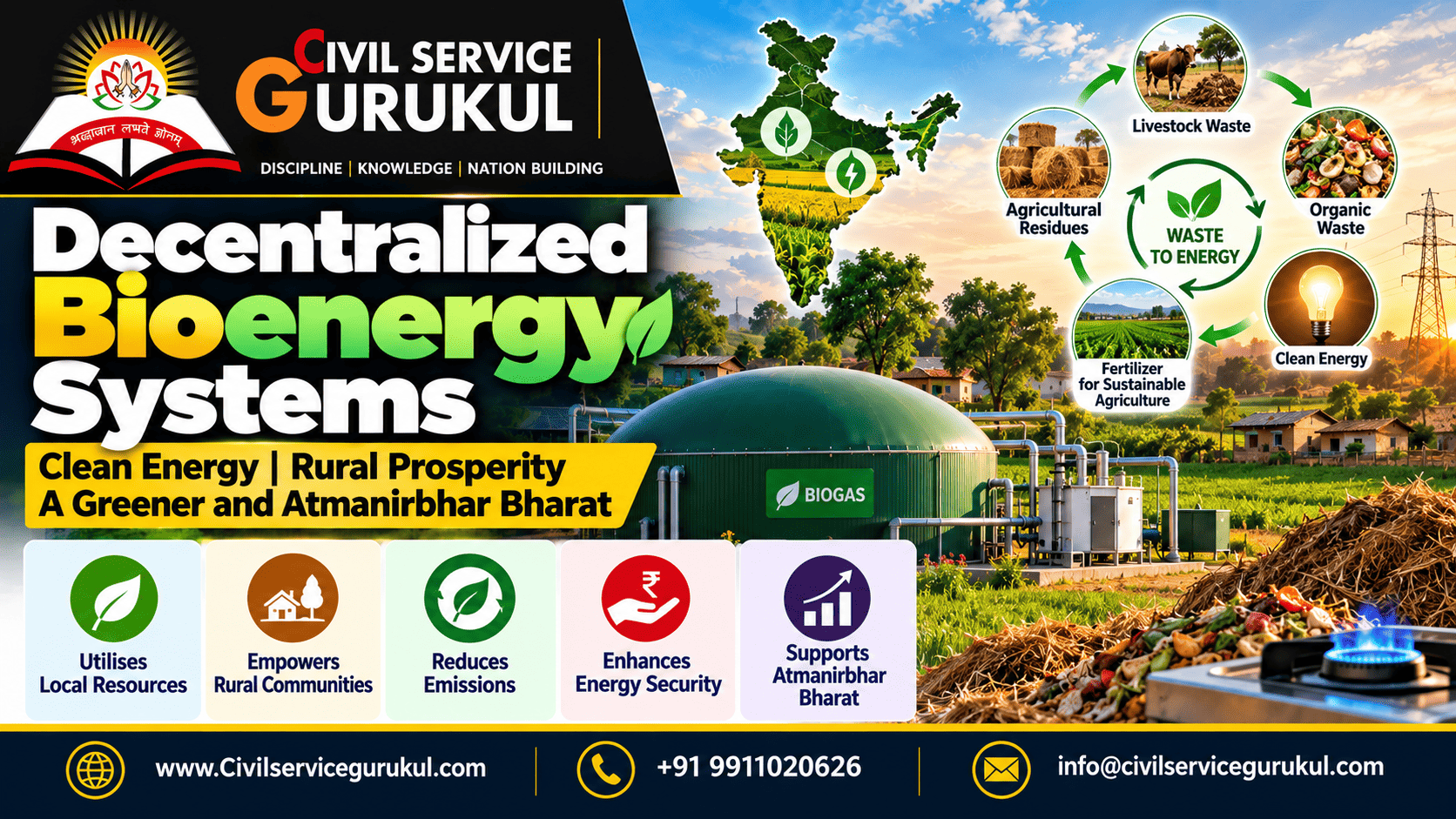
India generates large quantities of agricultural residues, cattle dung, food waste and other organic materials. When managed scientifically, these resources can provide renewable energy, organic manure and new rural livelihoods.
Decentralized bioenergy systems convert locally available organic resources into biogas, compressed biogas, electricity, heat and other useful products.
Unlike highly centralised energy systems, these facilities can operate near farms, dairy clusters, villages and agro-processing units.
India's GOBARdhan, SATAT and National Bioenergy Programme provide policy support for the bioenergy ecosystem.
The GOBARdhan National Circular Bioenergy Scheme approved in August 2026 has an outlay of ₹23,731 crore for FY 2026–27 to FY 2035–36.
The success of decentralized bioenergy depends on reliable feedstock, sound technology, environmental safeguards and financially sustainable operations.
1. What Are Decentralized Bioenergy Systems?
Decentralized bioenergy systems are relatively localised facilities that convert biomass and biodegradable waste into usable energy products.
They can operate at household, community, cooperative, industrial-cluster or commercial scales.
Their defining feature is the close connection between local feedstock availability, energy production and nearby consumption or distribution.
2. Why Does India Need Decentralized Bioenergy?
- Large availability of agricultural and livestock residues.
- Need for cleaner rural cooking and thermal energy.
- Air pollution caused by open biomass burning.
- Dependence on imported natural gas and petroleum.
- Rising organic waste management requirements.
- Need for additional farmer income opportunities.
- Demand for sustainable organic soil inputs.
Bioenergy can complement solar, wind and other renewable sources, particularly where locally available biomass can provide dispatchable heat or energy.
3. Major Types of Decentralized Bioenergy
Small digesters use cattle dung and biodegradable waste to produce gas for cooking and other local energy needs.
Village-level facilities process organic waste collected from multiple households, farms or institutions.
Larger facilities upgrade and compress biogas for use as a gaseous fuel in suitable applications.
Controlled thermochemical conversion produces combustible producer gas from suitable dry biomass.
Agricultural residues are densified into solid fuels for appropriate industrial or thermal applications.
Facilities generate useful electricity and heat, often using agro-industrial residues.
4. How Does a Biogas Plant Work?
Biogas is produced through anaerobic digestion, in which microorganisms break down biodegradable organic matter in the absence of oxygen.
↓
Feedstock Preparation↓
Anaerobic Digester↓
Biogas + Digestate↓
Clean Energy + Organic ManureBiogas commonly contains methane and carbon dioxide, along with smaller quantities of other gases.
Its exact composition depends on feedstock, plant design and operating conditions.
5. Anaerobic Digestion: Four Biological Stages
| Stage | Biological Process |
|---|---|
| Hydrolysis | Complex organic substances are broken into simpler compounds. |
| Acidogenesis | Microorganisms convert simpler compounds into organic acids and other products. |
| Acetogenesis | Intermediate products are converted into compounds used by methanogens. |
| Methanogenesis | Methanogenic microorganisms produce methane. |
Methanogenesis is carried out by methanogenic archaea. Anaerobic digestion occurs without molecular oxygen.
6. Biogas Versus Compressed Biogas
| Feature | Biogas | Compressed Biogas |
|---|---|---|
| Production | Anaerobic digestion | Upgrading and compression of biogas |
| Composition | Methane, carbon dioxide and trace gases | High-methane gas meeting applicable quality standards |
| Typical Use | Cooking, heating, local power | Transport fuel, industrial or gas-network applications |
| Infrastructure | Digester and local gas utilisation | Purification, compression, storage and distribution |
| Investment Scale | Often small to medium | Generally higher commercial investment |
CBG can substitute for conventional natural gas in suitable applications when it meets required fuel quality specifications.
7. Agricultural Residues as an Energy Resource
India produces diverse agricultural residues, including paddy straw, wheat straw, sugarcane residues and other biomass.
Some residues can be used in bioenergy facilities, subject to technical suitability.
However, not all crop residues should be removed from fields. A portion is needed to maintain soil organic matter, prevent erosion and support agricultural sustainability.
8. Bioenergy and Crop Residue Burning
Open burning of crop residues contributes to particulate pollution, greenhouse gas emissions and deterioration of air quality.
Bioenergy can provide an alternative use for a suitable share of these residues.
Farmers may benefit where reliable collection, transport and purchasing arrangements exist.
Yet biomass collection costs and seasonal availability remain major constraints.
9. GOBARdhan: National Circular Bioenergy Scheme 2026
The Union Cabinet approved the GOBARdhan National Circular Bioenergy Scheme on 6 August 2026.
The scheme has a total outlay of ₹23,731 crore and covers FY 2026–27 to FY 2035–36.
It is administered by the Ministry of Petroleum and Natural Gas.
Six Major Interventions
- CBG Offtake Assurance.
- CBG Pricing Framework.
- Capital Assistance for CBG Projects.
- Development of Pipeline Infrastructure.
- Credit Guarantee Support.
- CBG Ecosystem Challenge Fund.
The objective is to strengthen investment certainty, improve commercial viability and develop a more integrated CBG value chain.
10. Important GOBARdhan Statistics
| Indicator | Status |
|---|---|
| Scheme Outlay | ₹23,731 crore |
| Implementation Period | FY 2026–27 to FY 2035–36 |
| CBG/Bio-CNG Plants Registered | 1,929 as of 13 August 2026 |
| Plants Commissioned | 217 as of 13 August 2026 |
| Plants Under Construction | 357 as of 13 August 2026 |
| Policy Objective | Nearly tenfold expansion in domestic CBG production |
Registration indicates project participation or intent; it does not establish operational production capacity.
11. SATAT Initiative
SATAT stands for Sustainable Alternative Towards Affordable Transportation.
Launched in 2018, it seeks to promote compressed biogas production and its procurement through participating oil marketing companies.
The initiative supports the development of a domestic renewable gaseous-fuel ecosystem.
12. National Bioenergy Programme
The Ministry of New and Renewable Energy notified the National Bioenergy Programme in 2022.
Its Phase-I originally covered FY 2021–22 to FY 2025–26, with an approved outlay of ₹858 crore.
The programme covered three broad components.
Supports eligible projects using organic waste for energy generation.
Supports eligible briquette, pellet and biomass cogeneration projects.
Supports small and medium biogas facilities for energy and organic manure production.
Phase-I was subsequently extended to 30 September 2026. The July 2026 parliamentary response stated that Phase-II had not then been approved.
The National Bioenergy Programme should not be confused with the separate GOBARdhan National Circular Bioenergy Scheme approved in August 2026.
13. Biomass Gasification
Biomass gasification is a thermochemical process that converts suitable solid biomass into a combustible gas under controlled conditions.
The resulting producer gas may be used for thermal applications or compatible power generation systems.
Potential Applications
- Rice mills.
- Food-processing industries.
- Small industrial clusters.
- Local heat generation.
- Suitable distributed power systems.
Gasification differs from anaerobic digestion: one is thermochemical, while the other is biological.
14. Role of Dairy Cooperatives and Gaushalas
Dairy cooperatives, livestock clusters and gaushalas can supply cattle dung for community biogas and CBG projects.
They may also benefit from digestate-based manure production.
Long-term success requires regular feedstock collection, transparent payment systems, proper storage and professional plant management.
15. Bioenergy and the Circular Economy
A circular economy aims to keep materials and resources in productive use while reducing waste.
↓
Organic Residues↓
Biogas / CBG Production↓
Energy + Processed Digestate↓
Local Economic Value + Soil Nutrient RecyclingThis model can support waste-to-wealth initiatives and rural economic diversification.
16. Benefits of Decentralized Bioenergy
Locally produced renewable fuels can reduce dependence on external energy supplies.
Collection, transport, plant operations and maintenance create potential local livelihoods.
Scientific treatment can reduce uncontrolled disposal of biodegradable waste.
Suitable residues and livestock waste may create additional revenue opportunities.
Properly processed digestate can supplement soil nutrient management.
Capturing methane and displacing fossil fuels can reduce emissions when systems are well managed.
17. Environmental Limitations and Safeguards
Bioenergy is not automatically carbon-neutral or environmentally harmless.
Environmental outcomes depend on feedstock sourcing, methane leakage, transport distances, processing efficiency and waste management.
Essential Safeguards
- Prevent methane leakage from digesters and equipment.
- Ensure proper digestate treatment and storage.
- Protect soil health when collecting crop residues.
- Control air pollution from combustion and gasification.
- Avoid unsustainable land-use changes.
- Monitor water use and local environmental impacts.
18. Challenges in Scaling Bioenergy
| Challenge | Policy Concern |
|---|---|
| Feedstock Availability | Organic material supply may be seasonal and geographically dispersed. |
| Transport Costs | Bulky residues can be expensive to collect and move. |
| Capital Requirements | Commercial CBG plants require substantial investment. |
| Technical Reliability | Plant performance depends on maintenance and process control. |
| Offtake Risk | Revenue depends on reliable fuel buyers and contracts. |
| Manure Marketing | Digestate processing, quality and distribution affect value. |
| Environmental Risk | Methane leakage and poor waste handling can undermine benefits. |
| Institutional Capacity | Local bodies may lack technical and financial expertise. |
19. Decentralized Bioenergy and Rural Development
Village-level bioenergy systems can support local energy access, waste management and rural entrepreneurship.
Potential institutional models include:
- Gram Panchayat-managed community plants.
- Farmer Producer Organisations.
- Dairy cooperatives.
- Self-help group enterprises.
- Private rural energy developers.
- Public-private partnerships.
Each model requires clear ownership, accountable management and a viable operating revenue stream.
20. Illustrative Village Bioenergy Model
Consider a hypothetical rural cluster with a regular supply of cattle dung and segregated biodegradable waste.
| Component | Proposed Arrangement |
|---|---|
| Feedstock | Cattle dung and suitable organic waste |
| Ownership | Village cooperative or local enterprise |
| Technology | Appropriately sized anaerobic digester |
| Energy Use | Local cooking or thermal applications |
| By-product | Processed digestate for agricultural use |
| Revenue Sources | Energy sales, service fees and manure sales, where viable |
| Monitoring | Feedstock quantity, gas output, maintenance and emissions |
Actual plant size, cost, output and profitability must be determined through a technical feasibility study and detailed project report.
21. Way Forward for India
- Map district-wise biomass and organic waste availability.
- Develop reliable feedstock collection and aggregation systems.
- Encourage cooperative and community ownership where commercially appropriate.
- Strengthen technical training for plant operators.
- Improve access to long-term project finance.
- Develop predictable fuel offtake arrangements.
- Support quality standards for digestate-based manure.
- Monitor methane emissions and environmental performance.
- Integrate bioenergy with rural development and waste management planning.
- Evaluate projects through life-cycle environmental and economic analysis.
22. UPSC Prelims Practice Questions
Q1. Which process is mainly responsible for conventional biogas production?
Answer: Anaerobic digestion. Microorganisms break down biodegradable material without oxygen.
Q2. What is the principal combustible component of biogas?
Answer: Methane.
Q3. SATAT is associated with which sector?
Answer: Compressed biogas and alternative transport fuel.
Q4. Which ministry administers the new GOBARdhan National Circular Bioenergy Scheme?
Answer: Ministry of Petroleum and Natural Gas.
Q5. What is the approved outlay of the GOBARdhan National Circular Bioenergy Scheme?
Answer: ₹23,731 crore.
Q6. What is digestate?
Answer: The residual material remaining after anaerobic digestion, which may be processed for agricultural use.
Q7. Which technology converts dry biomass into producer gas?
Answer: Biomass gasification.
Q8. Is bioenergy always carbon-neutral?
Answer: No. Its emissions depend on feedstock, land use, processing, transport and methane leakage.
23. UPSC Mains Practice Question
"Decentralized bioenergy systems can simultaneously address India's rural energy needs, agricultural waste management and climate commitments." Discuss their potential, limitations and the policy measures required for sustainable expansion.
Model Answer
Introduction: Decentralized bioenergy systems convert locally available organic waste into usable energy and valuable by-products. They support India's circular economy and rural development goals.
Potential Benefits:
- Reduce dependence on conventional fuels through local energy production.
- Create economic value from agricultural and livestock residues.
- Offer alternatives to open burning of suitable biomass.
- Generate rural employment in collection, processing and plant management.
- Produce digestate that can support soil nutrient recycling.
Major Challenges: Feedstock seasonality, high logistics costs, financing constraints, technical failures, uncertain fuel offtake and methane leakage can undermine project viability.
Government Initiatives: GOBARdhan, SATAT and the National Bioenergy Programme have supported the bioenergy ecosystem. The new GOBARdhan scheme provides a long-term framework for CBG development.
Way Forward: India should strengthen local feedstock mapping, cooperative participation, project finance, technical training, fuel procurement arrangements and environmental monitoring.
Conclusion: Decentralized bioenergy can become an important instrument of rural transformation when commercial viability is combined with environmental safeguards and effective local governance.
24. Quick Revision for UPSC 2027
- Bioenergy: Energy derived from biological materials.
- Biogas: Produced through anaerobic digestion.
- Main Biogas Fuel: Methane.
- CBG: Upgraded and compressed biogas.
- SATAT: Sustainable Alternative Towards Affordable Transportation.
- GOBARdhan 2026: ₹23,731 crore scheme outlay.
- Nodal Ministry: Ministry of Petroleum and Natural Gas for the new CBG scheme.
- National Bioenergy Programme: Ministry of New and Renewable Energy.
- Major By-product: Digestate.
- Major Challenge: Reliable feedstock and financial viability.
- UPSC Papers: GS II, GS III and Essay.
25. Conclusion: From Waste to Rural Wealth
Decentralized bioenergy offers India an opportunity to connect clean energy, agricultural development and local entrepreneurship.
Biogas, compressed biogas and other biomass technologies can create useful value from suitable organic residues.
However, the future of the sector will depend on reliable raw materials, efficient plant operation, stable revenues and responsible environmental management.
With appropriate policies and community participation, decentralized bioenergy can contribute to energy security, circular rural economies and the broader vision of Viksit Bharat 2047.
Prepare UPSC Environment and Economy with Civil Service Gurukul
Strengthen your preparation through comprehensive current affairs notes, conceptual explanations, Prelims practice and Mains answer writing.
Explore Civil Service Gurukul
Website:
www.civilservicegurukul.com
Mobile:
+91 9911020626
Email:
info@civilservicegurukul.com
This article is prepared for UPSC educational purposes using public policy information available up to 24 October 2026.
Government outlays are not equivalent to actual expenditure. Registered projects are not necessarily operational facilities.