
DNA and Personality Genetics 2026: UPSC Notes
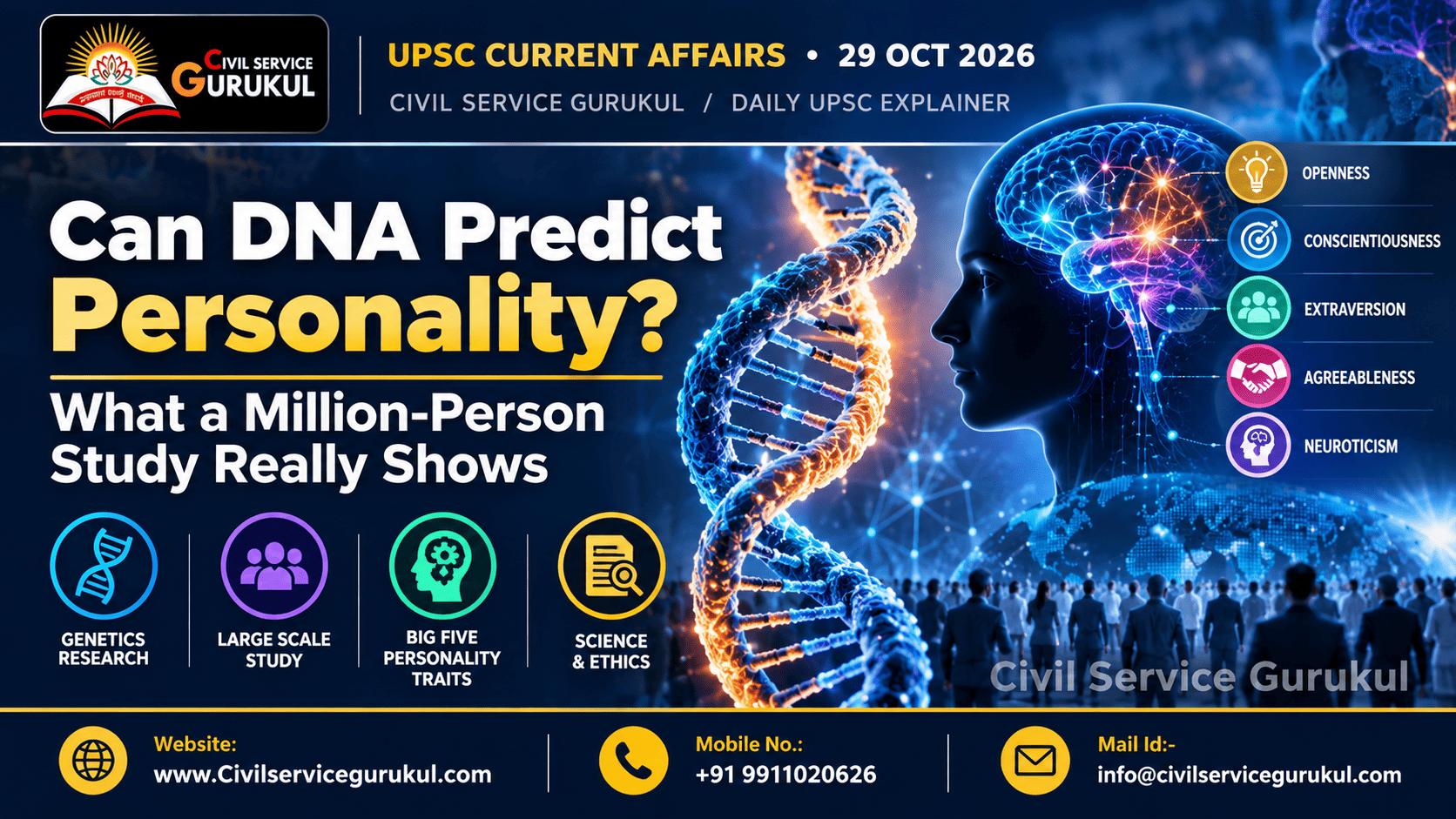
Can Your DNA Predict Your Personality? New 2026 Genetic Study Explained for UPSC
A large-scale genetic study identifies associations between DNA variants and personality traits, while raising questions about prediction, privacy, fairness and human behaviour.
Research published in Nature in September 2026 combined genome-wide association data from cohorts including up to approximately 1.14 million participants.
The analysis identified 1,260 genetic variants associated with the Big Five personality traits.
However, these findings do not establish a DNA test capable of reliably predicting an individual's personality.
GS Paper III: Science and Technology, Biotechnology, Applications of Genetics.
GS Paper IV: Ethics, Human Dignity, Privacy, Consent, Non-Discrimination and Responsible Innovation.
Prelims: DNA, Genetic Variants, GWAS, Polygenic Traits, Heritability and Research Methods.
Why Is DNA and Personality Research in the News?
A large genome-wide association study published in Nature in September 2026 examined genetic associations with personality traits.
The research combined data from cohorts including up to approximately 1.14 million participants.
Researchers identified 1,260 variants associated with the Big Five personality dimensions.
The findings received renewed attention in October 2026, alongside warnings against genetic determinism.
Key Findings of the 2026 Genetic Personality Study
- The study identified 1,260 personality- associated genetic variants.
- 824 associations were reported as previously unreported.
- Measured common variants explained approximately 7.4% to 10.6% of variation in individual personality dimensions in the study.
- The Big Five framework remains a psychological measurement model, not a genetic classification system.
- The findings do not establish reliable DNA-based personality diagnosis for individuals.
A large sample can improve the ability to detect small statistical associations.
It does not, by itself, prove that genetic variants directly cause specific behaviour.
Understanding the Big Five Personality Traits
The Big Five personality model describes broad patterns in human personality.
The five dimensions are commonly remembered using the acronym OCEAN.
| Trait | Broad Meaning |
|---|---|
| Openness | Interest in ideas, imagination and new experiences. |
| Conscientiousness | Organisation, discipline and goal-directed behaviour. |
| Extraversion | Sociability, assertiveness and energetic engagement. |
| Agreeableness | Cooperation, compassion and interpersonal trust. |
| Neuroticism | Tendency toward negative emotional experiences. |
These dimensions describe tendencies rather than unchangeable individual destinies.
What Is a Genome-Wide Association Study (GWAS)?
A genome-wide association study, or GWAS, examines statistical relationships between genetic variants and measured traits across many individuals.
Researchers compare genetic information with observed or reported characteristics.
The aim is to identify variants that occur more frequently alongside particular traits.
Important limitation
A genetic association does not automatically demonstrate a direct causal mechanism.
Other genetic, environmental or methodological factors may contribute to the observed relationship.
Polygenic Traits and Polygenic Scores Explained
A polygenic trait is influenced by many genetic variants rather than one single gene.
A polygenic score combines estimated effects across multiple genetic variants.
Such scores can be used in research to examine statistical patterns.
However, their predictive value depends on the population, study design, measurement methods and other factors.
A polygenic score is not a complete measure of an individual's personality.
Can DNA Reliably Predict an Individual's Personality?
The 2026 study supports the existence of genetic associations with personality variation.
It does not establish that DNA can accurately determine the character of a particular individual.
Measured common variants explained only a limited share of variation in each personality dimension.
Therefore, genetic findings should not be converted into fixed labels about individual ability, character or merit.
Role of Environment, Education and Experience in Personality
Human behaviour emerges from complex interactions among inherited biology, family, education, social conditions, personal experiences and chance.
Genetic influences do not eliminate the importance of environmental factors.
Likewise, environmental influences do not mean genetic associations are irrelevant.
A balanced scientific approach recognises that both inherited and environmental factors contribute to behavioural variation.
Significance for India: Biotechnology, Governance and Public Policy
Genetic research can improve scientific understanding of biological pathways associated with behaviour.
However, the application of such findings in India raises important questions about fairness, population diversity and data governance.
Important concerns
- Population differences in genetic datasets.
- Reliability of genetic predictions.
- Informed consent for genomic research.
- Protection of sensitive genetic information.
- Potential discrimination in high-stakes decisions.
- Misleading commercial personality claims.
Genetic prediction models require careful validation before their results can be interpreted across different populations.
Ethical Concerns: Privacy, Consent and Genetic Discrimination
Using genomic information to evaluate personality could create serious ethical risks.
Genetic personality screening in employment, education, insurance or policing could lead to unfair judgements based on uncertain predictions.
| Ethical Principle | Application |
|---|---|
| Human dignity | Individuals should not be reduced to genetic scores. |
| Informed consent | People should understand how genomic data will be used. |
| Privacy | Sensitive genetic information requires protection. |
| Non-discrimination | Weak predictions should not determine opportunities. |
| Transparency | Uncertainty and model limitations must be communicated. |
| Accountability | Institutions should provide oversight and redress. |
Policy Challenges in Genetic Personality Prediction
- Distinguishing correlation from causation.
- Preventing misuse of genetic information.
- Ensuring meaningful informed consent.
- Addressing ancestry-related prediction bias.
- Protecting sensitive genomic records.
- Preventing exaggerated commercial claims.
- Maintaining public trust in biotechnology research.
Open scientific research can support knowledge development, but uncontrolled access to genomic information can undermine privacy and trust.
Way Forward: Responsible Genetic Research and Governance
- Require informed consent for genomic research and data use.
- Establish clear rules for secondary use of genetic information.
- Assess predictive validity across Indian populations.
- Prevent discriminatory use of weak genetic personality predictions.
- Strengthen secure data storage and access controls.
- Promote scientific communication distinguishing association from causation.
- Provide independent oversight and effective redress mechanisms.
UPSC Prelims Revision Capsule
| Concept | Key Point |
|---|---|
| GWAS | Identifies statistical links between genetic variants and traits. |
| Polygenic trait | A trait influenced by many genetic variants. |
| Polygenic score | Combines estimated effects of multiple variants. |
| Big Five | Openness, Conscientiousness, Extraversion, Agreeableness and Neuroticism. |
| Heritability | A population-level statistic, not an individual's destiny percentage. |
| Genetic determinism | The mistaken assumption that genes completely decide complex traits. |
| Genetic association | A statistical relationship that does not by itself prove causation. |
UPSC Prelims Practice MCQs
With reference to genome-wide association studies, consider the following statements:
- GWAS examines statistical relationships between genetic variants and traits.
- A genetic association always establishes direct causation.
- Large sample sizes can help detect small genetic associations.
Which of the statements given above are correct?
(A) 1 and 2 only
(B) 1 and 3 only
(C) 2 and 3 only
(D) 1, 2 and 3
Statements 1 and 3 are correct. Statement 2 is incorrect because statistical association does not automatically prove causation.
Which of the following is NOT included in the Big Five personality model?
(A) Openness
(B) Agreeableness
(C) Intelligence
(D) Neuroticism
The Big Five model includes Openness, Conscientiousness, Extraversion, Agreeableness and Neuroticism.
Which statement best reflects the scientific meaning of heritability?
(A) It determines an individual's destiny.
(B) It is a population-level statistic.
(C) It proves environment is irrelevant.
(D) It means one gene controls a trait.
Heritability describes variation at the population level under specified conditions. It does not represent a fixed destiny for an individual.
UPSC Mains Answer Writing Practice
"Advances in genomic research offer new scientific insights but also create risks of discrimination and loss of privacy."
Examine the ethical challenges of using genetic information to assess behavioural traits in public and private decision-making.
Suggested Approach:
- Define GWAS and polygenic traits.
- Explain scientific limits of genetic prediction.
- Discuss consent, privacy and discrimination.
- Address population bias and data governance.
- Recommend safeguards and independent oversight.
Model Answer Framework
Genomic research can improve understanding of biological factors associated with human behaviour.
However, complex personality traits are influenced by multiple genetic and environmental factors.
The 2026 personality genetics study identified many genetic associations, but did not establish reliable individual-level personality prediction.
Using uncertain genetic scores in employment, education or insurance could undermine dignity, privacy and equal opportunity.
A responsible policy approach should prioritise informed consent, secure data governance, non-discrimination, scientific validation and public accountability.
Frequently Asked Questions
Can DNA accurately predict personality?
The study identified genetic associations, but did not establish a reliable DNA test for individual personality prediction.
What is the Big Five personality model?
It is a psychological framework describing Openness, Conscientiousness, Extraversion, Agreeableness and Neuroticism.
What is GWAS?
GWAS is a research method used to identify statistical relationships between genetic variants and measured traits.
What is a polygenic score?
A polygenic score combines estimated effects from multiple genetic variants. Its predictive value depends on context and validation.
Why is this topic important for UPSC ethics?
It connects scientific innovation with human dignity, informed consent, privacy, non-discrimination and responsible governance.
Civil Service Gurukul — Key Takeaway
Genetic research can identify statistical tendencies, but DNA does not provide a complete description of human personality.
For UPSC, connect biotechnology with research methods, ethical governance, privacy and human dignity.
Prepare UPSC Science, Technology and Ethics with Civil Service Gurukul
Civil Service Gurukul provides UPSC-focused current affairs analysis, Prelims revision, Mains answer-writing practice and syllabus-based study material.
Website: www.civilservicegurukul.com
Mobile: +91 9911020626
Email: info@civilservicegurukul.com
Educational note: This article is prepared for UPSC Civil Services Examination study using the supplied 2026 genetics research summary. Genetic associations should not be interpreted as deterministic predictions of individual personality.
Prepare with Mentors Who Cleared the Exam
Get personalized study plans, evaluated answer models, and test series access.