
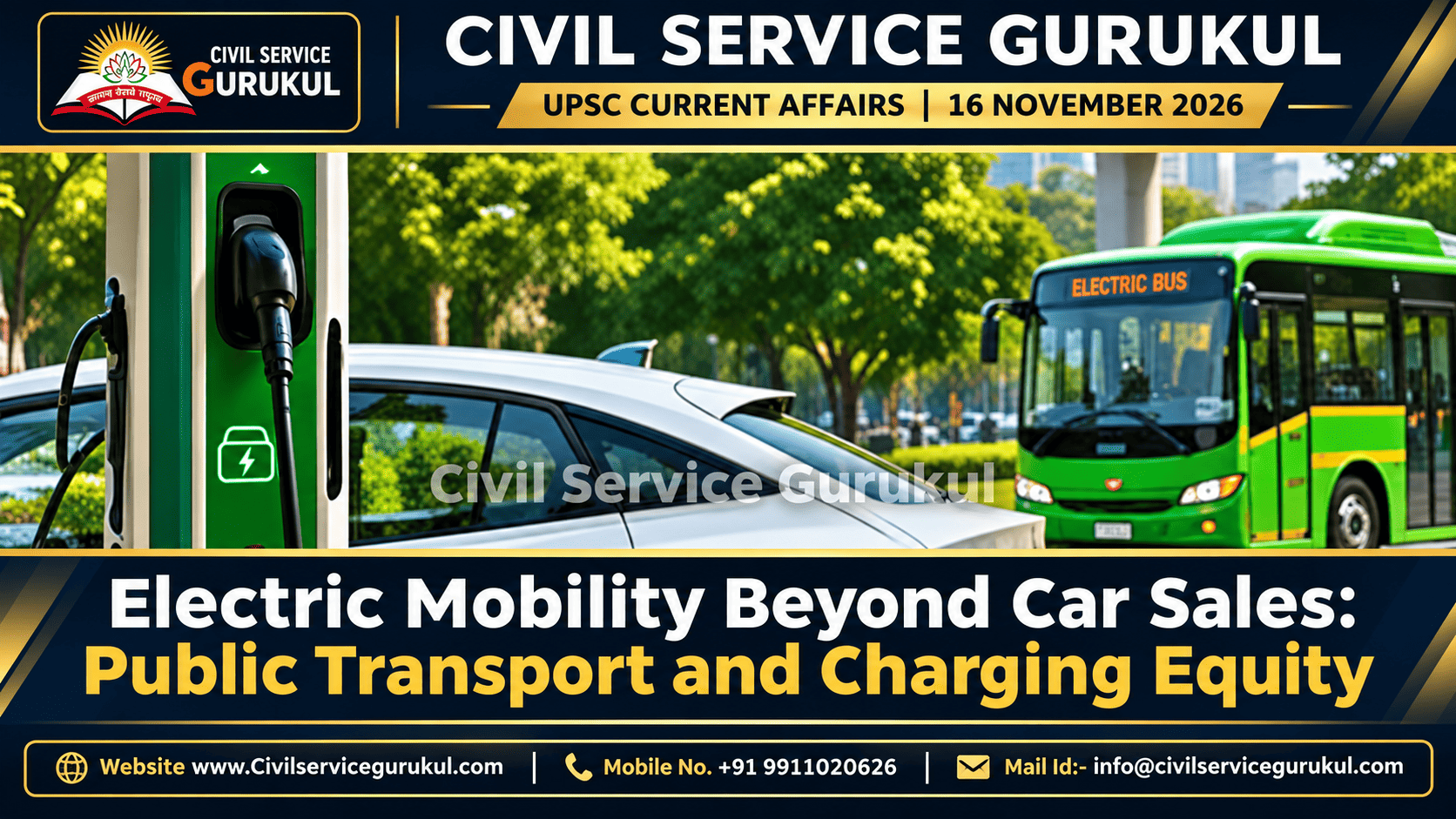
Why Is Electric Mobility in the News?
India's automobile sector continues to attract attention because of changing vehicle demand, electric mobility and urban transport needs.
The supplied editorial refers to a 14 November 2026 news index discussing rising passenger-vehicle wholesale dispatches.
However, vehicle sales statistics alone cannot determine whether urban transportation has become cleaner, more efficient or equitable.
A sustainable transport system must also consider congestion, public transport quality, land use, walking accessibility, charging infrastructure and electricity generation.
The uploaded material mentions rising passenger-vehicle wholesales. Specific numerical figures were not verified against official industry data.
Wholesale dispatches should not be confused with consumer registrations or actual vehicle use.
UPSC Syllabus Relevance
| UPSC Paper | Relevant Topics |
|---|---|
| GS Paper II | Urban governance, public services, social justice, accessibility and inclusive development |
| GS Paper III | Environment, climate change, infrastructure, energy transition and sustainable development |
| GS Paper IV | Environmental ethics, intergenerational equity, public accountability and distributive justice |
| Prelims | Electric vehicles, charging systems, emissions, vehicle sales statistics and environmental concepts |
What Is Electric Mobility?
Electric mobility refers to the use of electrically powered transport systems, including electric cars, buses, two-wheelers, three-wheelers and other transport modes.
Electric vehicles use electric motors and energy storage or other electricity supply arrangements to provide propulsion.
Potential Benefits
- Reduced direct tailpipe emissions.
- Lower dependence on petrol and diesel for some journeys.
- Potential improvements in urban air quality.
- Energy efficiency advantages in many applications.
- Opportunities for technological innovation and industrial development.
The actual environmental benefits depend on vehicle type, electricity generation, manufacturing, usage patterns and end-of-life management.
Why Higher Car Sales Do Not Guarantee Sustainable Mobility
An increase in vehicle sales may indicate greater market demand, but it does not automatically mean that cities are becoming more sustainable.
1. Traffic Congestion
More private cars may increase pressure on limited urban road capacity and parking space.
2. Land Use
Car-dependent urban development may require substantial road and parking infrastructure.
3. Unequal Access
Private vehicle ownership does not ensure affordable transport for people who cannot purchase cars.
4. Public Transport Quality
Poor bus frequency, unreliable services and weak last-mile connectivity may reduce accessibility.
5. Environmental Impact
Electric cars avoid exhaust emissions during operation but still require energy, materials and road infrastructure.
Sustainable urban mobility should be evaluated through accessibility, affordability, emissions, congestion and transport efficiency, not merely vehicle sales.
Wholesale Dispatches vs Vehicle Registrations
Understanding vehicle statistics is important for UPSC Prelims and economic analysis.
Wholesale Dispatches
Wholesale figures generally represent vehicles supplied by manufacturers to dealers or distribution channels.
Retail Registrations
Vehicle registrations reflect vehicles recorded through the relevant registration process.
The two measures can differ because of dealer inventories, timing differences and other factors.
| Parameter | Wholesale Dispatches | Retail Registrations |
|---|---|---|
| What is measured? | Manufacturer-to-dealer or distribution dispatches | Vehicles recorded through registration systems |
| Possible influence | Dealer inventory and production schedules | Retail demand and registration timing |
| Economic interpretation | Supply-side market indicator | Closer indicator of vehicles entering registered use |
Electric Vehicles and Lifecycle Emissions
Electric vehicles produce no exhaust emissions when operating solely on electric power.
However, their environmental impact must be examined across the entire vehicle lifecycle.
Major Lifecycle Stages
- Raw material extraction.
- Battery and vehicle manufacturing.
- Electricity generation and charging.
- Vehicle operation and maintenance.
- Battery reuse, recycling or disposal.
Electricity generated from fossil fuels can contribute to indirect emissions.
Battery manufacturing also involves material and energy requirements.
Zero tailpipe emissions do not mean zero lifecycle environmental impact.
The magnitude of lifecycle benefits depends on the electricity mix, vehicle efficiency, manufacturing practices and usage.
Why Public Transport Must Be Central to India's EV Transition
A sustainable mobility strategy should focus on moving people efficiently rather than merely increasing the number of privately owned vehicles.
Benefits of Strong Public Transport
- Improved mobility for people without private vehicles.
- Potential reduction in road congestion.
- More efficient use of road space.
- Greater access to jobs, education and healthcare.
- Lower transport costs for many households.
- Potential environmental benefits when services are well utilised.
Electric buses can combine the benefits of electrification with the high passenger capacity of public transport.
However, bus services also require reliable scheduling, adequate coverage, maintenance and appropriate charging arrangements.
Electric Buses vs Private Electric Cars
| Dimension | Electric Buses | Private Electric Cars |
|---|---|---|
| Passenger capacity | High per vehicle | Relatively low per vehicle |
| Public accessibility | Potentially broad when affordable and well connected | Primarily benefits users with vehicle access |
| Road space efficiency | Can be high at good occupancy | Depends on occupancy and travel patterns |
| Charging needs | Often involves depot or route-based planning | May rely on home, workplace or public charging |
| Policy priority | Mass mobility and service quality | Private mobility electrification |
The relative benefits depend on occupancy, service quality, electricity sources and local transport conditions.
What Is EV Charging Equity?
Charging equity refers to fair and practical access to electric vehicle charging opportunities across different communities, locations and user groups.
Charging infrastructure should not be concentrated only in affluent neighbourhoods or locations serving private car owners.
Groups That May Face Charging Barriers
- Residents without dedicated private parking.
- People living in rented accommodation.
- Low-income urban households.
- Commercial drivers and delivery workers.
- Residents of underserved neighbourhoods.
- Users in smaller towns and peripheral areas.
Charging equity also depends on pricing, reliability, safety and accessibility.
Charging equity is a question of distributive justice because public infrastructure decisions affect who can participate in the transition to cleaner transport.
Major Challenges in EV Charging Infrastructure
1. Unequal Geographical Distribution
Charging stations may be concentrated in commercially attractive urban locations.
2. Electricity Distribution Capacity
Charging demand may require local network upgrades and load management.
3. Land and Parking Constraints
Dense cities may have limited space for charging facilities.
4. Affordability
Charging prices and associated access costs can influence adoption.
5. Reliability
Non-functioning chargers or incompatible payment arrangements can reduce usability.
6. Accessibility
Infrastructure design should consider different vehicle types and user needs.
Urban Mobility, Walking and Last-Mile Connectivity
Electric mobility cannot replace the need for safe pedestrian infrastructure.
Walking, cycling and public transport are essential parts of an integrated urban transport system.
Important Urban Planning Measures
- Safe and continuous footpaths.
- Accessible pedestrian crossings.
- Reliable bus stops and service information.
- Better connections between transport modes.
- Appropriate cycling infrastructure.
- Land-use planning that reduces unnecessary travel distances.
Urban mobility policy should prioritise accessibility and safety for all road users.
Vehicle Scrappage and Environmental Sustainability
Vehicle scrappage policies seek to address older or unsuitable vehicles through defined assessment and replacement arrangements.
However, environmental benefits should not be assumed solely from replacing one vehicle with another.
An evidence-based approach should consider actual vehicle emissions, roadworthiness, replacement impacts and lifecycle costs.
Vehicle replacement should be guided by measurable environmental and safety outcomes, not simply vehicle age or sales growth.
Electric Mobility and Climate Governance
Transport electrification can contribute to climate mitigation when supported by cleaner electricity and efficient transport systems.
However, policy effectiveness depends on coordination between transport, energy, urban planning and environmental institutions.
Important Governance Priorities
- Integrated urban mobility planning.
- Clean electricity and grid preparedness.
- Accessible charging infrastructure.
- Efficient public transport systems.
- Battery recycling and responsible material management.
- Transparent environmental performance indicators.
Ethical Dimensions: GS Paper IV Perspective
1. Environmental Responsibility
Public policy should reduce avoidable environmental harm.
2. Intergenerational Equity
Present mobility decisions affect future generations through emissions and resource use.
3. Distributive Justice
Charging and transport investments should consider underserved communities.
4. Public Accountability
Government initiatives should be evaluated through transparent and measurable outcomes.
5. Evidence-Based Policymaking
Policy claims should distinguish verified results from announcements, forecasts and assumptions.
Way Forward: Building Inclusive Electric Mobility
- Prioritise public transport: Improve bus services, frequency and passenger accessibility.
- Expand electric buses: Integrate fleet planning with charging and maintenance capacity.
- Improve charging equity: Identify underserved neighbourhoods and user groups.
- Strengthen walking infrastructure: Provide safe pedestrian access and last-mile connections.
- Plan electricity demand: Coordinate charging deployment with distribution network readiness.
- Adopt lifecycle assessment: Evaluate manufacturing, electricity use and end-of-life impacts.
- Use evidence-based scrappage: Assess environmental and safety outcomes.
- Improve transparency: Publish reliable transport performance and accessibility indicators.
- Strengthen public participation: Include commuters, commercial drivers and vulnerable communities in planning.
India should pursue a people-centred electric mobility transition that combines public transport reform, cleaner energy, accessible charging and sustainable urban planning.
UPSC Prelims Quick Revision
- Wholesale vehicle dispatches differ from retail registrations.
- Electric vehicles produce no direct exhaust emissions when operating on electric power.
- EVs still have manufacturing and electricity-related environmental impacts.
- Lifecycle assessment considers multiple stages of a product's existence.
- Electric buses can support high-capacity public transport.
- Charging equity concerns fair access to charging infrastructure.
- Vehicle electrification alone does not eliminate traffic congestion.
- Walking and public transport remain central to sustainable urban mobility.
Original UPSC Prelims Practice MCQs
Question 1: Electric Vehicle Emissions
Consider the following statements:
1. Battery electric vehicles
produce no direct
tailpipe emissions.
2. Electric vehicles
have zero environmental
impact throughout
their lifecycle.
3. Electricity generation
can influence the
environmental performance
of electric vehicles.
Which statements are correct?
(a) 1 and 2 only
(b) 1 and 3 only
(c) 2 and 3 only
(d) 1, 2 and 3
View Answer and Explanation
Correct Answer: (b) 1 and 3 only.
Statement 1 is correct for battery electric vehicles operating on electric power.
Statement 2 is incorrect because manufacturing, battery production and electricity generation have environmental impacts.
Statement 3 is correct.
Question 2: Vehicle Statistics
Consider the following statements:
1. Wholesale dispatches
and retail registrations
always represent
identical quantities.
2. Dealer inventory
changes may influence
wholesale dispatches.
3. Retail registrations
can provide information
about vehicles entering
registered use.
Which statements are correct?
(a) 1 only
(b) 2 and 3 only
(c) 1 and 3 only
(d) 1, 2 and 3
View Answer and Explanation
Correct Answer: (b) 2 and 3 only.
Wholesale dispatches may differ from registrations because of inventory and timing differences.
Question 3: Sustainable Urban Mobility
Which of the following best represents a sustainable urban mobility strategy?
(a) Increasing private car ownership alone
(b) Expanding roads without improving public transport
(c) Integrating reliable buses, safe walking, accessible charging and cleaner electricity
(d) Ignoring congestion when vehicles are electric
View Answer and Explanation
Correct Answer: (c).
Sustainable mobility requires integrated transport planning, not merely vehicle electrification.
Question 4: Charging Equity
Consider the following statements:
1. Charging equity
concerns fair access
to charging opportunities.
2. Residents without
private parking may
face charging barriers.
3. Charging equity
is unrelated to
public infrastructure
planning.
Which statements are correct?
(a) 1 and 2 only
(b) 2 and 3 only
(c) 1 and 3 only
(d) 1, 2 and 3
View Answer and Explanation
Correct Answer: (a) 1 and 2 only.
Charging equity is directly relevant to infrastructure planning, affordability and accessibility.
UPSC Mains Practice Question
"India's electric mobility transition must move beyond private car sales towards equitable and sustainable urban transport." Critically examine with reference to public transport, charging infrastructure and lifecycle emissions.
Suggested Answer-Writing Framework
Introduction: Explain electric mobility and its relevance to urban sustainability.
Opportunities: Discuss tailpipe emissions, energy efficiency and technological innovation.
Limitations: Examine congestion, unequal access, charging barriers and lifecycle impacts.
Public Transport: Explain the importance of buses, walking and last-mile connectivity.
Way Forward: Recommend charging equity, integrated planning, cleaner electricity and transparent monitoring.
Conclusion: Emphasise people-centred, inclusive and environmentally responsible urban mobility.
Key Takeaways for UPSC Aspirants
- Higher vehicle sales do not automatically indicate sustainable mobility.
- Wholesale dispatches and registrations are different indicators.
- Electric vehicles reduce tailpipe emissions but not all lifecycle impacts.
- Electric buses can support inclusive mass transport.
- Charging equity is an important infrastructure and social justice issue.
- Walking, cycling and public transport should complement electrification.
- Urban mobility requires coordination across transport, energy and planning institutions.
Frequently Asked Questions
1. What is electric mobility?
Electric mobility refers to transport systems powered by electricity, including electric cars, buses, two-wheelers and three-wheelers.
2. Are electric vehicles completely pollution-free?
Battery electric vehicles have no direct tailpipe emissions, but manufacturing and electricity generation can have environmental impacts.
3. Why are electric buses important?
Electric buses can combine vehicle electrification with high-capacity public transport.
4. What is charging equity?
Charging equity concerns fair and practical access to charging infrastructure across different communities and users.
5. What is the difference between wholesale dispatches and retail registrations?
Wholesale dispatches generally measure manufacturer-to-dealer supplies, while registrations record vehicles through registration systems.
6. Why is this topic important for UPSC?
It connects urban governance, climate change, infrastructure, energy transition and environmental ethics.
Conclusion: Sustainable Mobility Must Be People-Centred
Electric vehicles can contribute to cleaner urban transport, but vehicle electrification alone cannot resolve congestion, accessibility and infrastructure inequality.
India's transition must therefore prioritise reliable public transport, safe walking, equitable charging and cleaner electricity.
The ultimate measure of sustainable mobility should be whether people can travel safely, affordably and efficiently with lower environmental impacts.
Prepare for UPSC Prelims & Mains with Civil Service Gurukul
Strengthen your understanding of Environment, Indian Economy, Urban Governance and Current Affairs through conceptual learning, original MCQs and structured Mains answer-writing practice.
Visit Civil Service Gurukul Contact Our TeamEditorial Note
This is an original educational analysis based on the topic and context supplied in the uploaded editorial.
The supplied material refers to rising passenger-vehicle wholesale dispatches in a 14 November 2026 source index.
No specific sales figures are asserted without verification against relevant industry data.