
Exercise Keen Sword 27: Why the US–Japan Military Drill Matters for Indo-Pacific Security
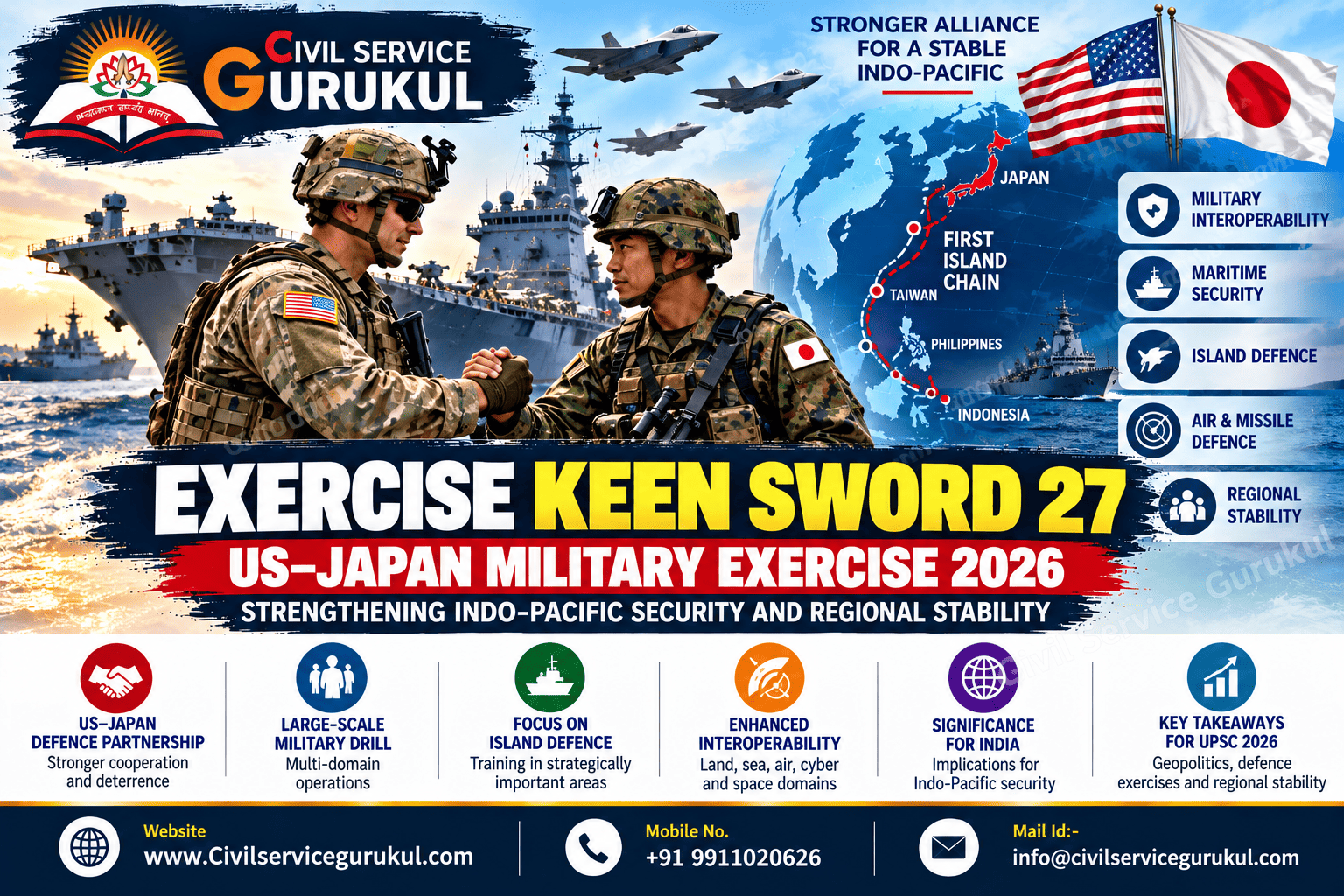
Exercise Keen Sword 27: Why the US–Japan Military Drill Matters for Indo-Pacific Security
Understand the military exercise, US–Japan defence cooperation, the First Island Chain, Taiwan Strait tensions and strategic developments in the Indo-Pacific.
26 October 2026 | UPSC Prelims & Mains
Exercise Keen Sword 27 is a major bilateral military field-training exercise involving the United States Armed Forces and the Japan Self-Defense Forces.
The October 2026 current-affairs report describes the exercise as the largest joint field-training exercise in the two countries' shared history, involving approximately 56,000 personnel.
Conducted in Japan and surrounding waters, the exercise focuses on military interoperability, island defence, maritime security, missile defence and coordination across multiple operational domains.
For UPSC, this topic connects international military exercises, the Indo-Pacific region, the First Island Chain, the Taiwan Strait and regional security architecture.
1. Why Is Exercise Keen Sword 27 in the News?
The United States and Japan launched Exercise Keen Sword 27 across Japan's southwestern islands and surrounding maritime areas.
The exercise involves substantial military participation, including personnel from both countries, aircraft, warships and other defence assets.
Its activities focus on strengthening the ability of the two countries' armed forces to operate together during complex security situations.
The exercise has attracted attention because it takes place in a strategically important region near the East China Sea and Taiwan.
2. What Is Exercise Keen Sword?
Keen Sword is a recurring bilateral military exercise between Japan and the United States.
It is designed to improve joint operational readiness, coordination and interoperability between the Japan Self-Defense Forces and the United States Armed Forces.
The exercise includes field-training activities in multiple operational environments.
Exercise Keen Sword is conducted by Japan and the United States. India is not a participating country in this bilateral exercise.
3. Key Facts About Exercise Keen Sword 27
| Feature | Details |
|---|---|
| Exercise Name | Keen Sword 27 |
| Participating Countries | Japan and the United States |
| Host Country | Japan |
| Frequency | Biennial |
| Exercise Type | Joint field-training military exercise |
| Participating Forces | Japan Self-Defense Forces and US Armed Forces |
| Reported Scale | Approximately 56,000 personnel |
| Major Operational Areas | Southwestern Japanese islands and surrounding waters |
| Primary Focus | Interoperability, island defence, maritime operations and multi-domain coordination |
4. What Are the Main Objectives of the Exercise?
A. Improve Military Interoperability
Interoperability refers to the ability of different military forces to communicate, coordinate and conduct operations together.
B. Strengthen Island Defence
The exercise includes activities relevant to protecting islands and responding to security challenges in maritime environments.
C. Enhance Maritime Security
Naval coordination, maritime surveillance and the protection of important sea routes are significant components of regional security planning.
D. Improve Air and Missile Defence
Joint exercises can improve coordination in detecting, tracking and responding to aerial and missile threats.
E. Strengthen Crisis Preparedness
Training activities can also address logistics, communication and civilian evacuation during emergencies.
5. What Is the First Island Chain?
The First Island Chain is a strategic geographical concept used to describe an arc of islands along the western Pacific Ocean.
It broadly extends from the Japanese archipelago through the Ryukyu Islands and Taiwan towards the Philippines.
The concept is important because these islands are located near major maritime routes connecting the East China Sea, South China Sea and the wider Pacific Ocean.
Why Is It Strategically Important?
- It includes important maritime passages.
- It is relevant to naval movement between regional seas and the Pacific Ocean.
- Several islands host or support military infrastructure.
- It plays a role in regional surveillance and defence planning.
- Its geography is relevant to discussions about access, deterrence and maritime security.
The First Island Chain is a strategic geographical concept, not an international organisation or a formal military alliance.
6. Why Are Yonaguni and Ishigaki Islands Important?
Yonaguni and Ishigaki are Japanese islands located in the southwestern part of the country.
The October 2026 report identifies these islands as important locations for mobile anti-ship missile deployments and coastal defence activities associated with the exercise.
Their geographical position makes them relevant to maritime surveillance and the defence of Japan's southwestern island territories.
Yonaguni Island
Yonaguni lies close to Taiwan and is among Japan's westernmost inhabited islands.
Its location makes it strategically significant in discussions of East Asian maritime security.
Ishigaki Island
Ishigaki is part of Japan's southwestern island region and occupies an important position near maritime routes in the East China Sea.
7. What Is the Taiwan Strait?
The Taiwan Strait is a body of water separating Taiwan from mainland China.
It connects the East China Sea with the South China Sea and is an important passage for international shipping.
The region has strategic importance because of cross-strait tensions and the involvement of major regional and global powers.
Exercise Keen Sword 27 is relevant to this broader security environment because some training areas lie near the southwestern Japanese islands.
However, the exercise should not automatically be interpreted as evidence that an armed conflict is imminent.
8. What Is the Miyako Strait?
The Miyako Strait is a maritime passage between Okinawa Island and Miyako Island in Japan's Ryukyu island region.
It provides a route between the East China Sea and the western Pacific Ocean.
The strait is frequently discussed in relation to naval movements, maritime surveillance and regional security.
| Location | UPSC Importance |
|---|---|
| Yonaguni | Japanese island located close to Taiwan |
| Ishigaki | Southwestern Japanese island with strategic maritime relevance |
| Miyako Strait | Maritime passage connecting the East China Sea and western Pacific |
| Taiwan Strait | Waterway separating Taiwan and mainland China |
| Ryukyu Islands | Island chain extending southwest from Japan's main islands |
9. What Is Multi-Domain Military Operations?
Modern military operations increasingly involve coordination across several domains rather than relying on land, naval or air forces separately.
Exercise Keen Sword 27 includes training related to multiple operational domains.
| Domain | Examples of Activities |
|---|---|
| Land | Ground-force coordination and island defence |
| Sea | Naval operations and maritime surveillance |
| Air | Aircraft coordination and air defence |
| Cyber | Protection and coordination of digital military systems |
| Space | Use of space-based information and communications |
| Electromagnetic Spectrum | Electronic warfare and communications-related activities |
Integrating these domains can improve information sharing, decision-making and coordination during complex operations.
10. What Is the US–Japan Security Alliance?
Japan and the United States maintain a longstanding security relationship under the Treaty of Mutual Cooperation and Security between Japan and the United States of America, signed in 1960.
The alliance provides an institutional foundation for bilateral defence cooperation.
Joint military exercises are one method through which the two countries maintain operational familiarity and test coordination arrangements.
Important Dimensions
- Defence cooperation and consultation.
- Joint training and preparedness.
- Regional maritime security.
- Military logistics and communication.
- Deterrence and crisis-response planning.
11. Why Is the Indo-Pacific Region Important?
The Indo-Pacific refers to the interconnected strategic and economic space spanning the Indian and Pacific Oceans.
It includes major shipping routes, important trading economies and regions of geopolitical competition.
For countries such as India, Japan and the United States, the Indo-Pacific is important for maritime commerce, connectivity, energy security and regional stability.
Different countries use somewhat different geographical and strategic definitions of the Indo-Pacific.
12. What Is the Strategic Significance of Keen Sword 27?
A. Joint Operational Readiness
The exercise allows participating forces to test procedures, communication and coordination.
B. Maritime Security
Training near strategically important sea routes highlights the significance of maritime surveillance and access.
C. Alliance Coordination
Regular exercises provide opportunities to improve practical cooperation between Japan and the United States.
D. Regional Deterrence
Military planners may view credible readiness and coordinated defence capabilities as contributing to deterrence.
E. Regional Security Concerns
Large exercises may also attract scrutiny from neighbouring countries, which can interpret military activity differently.
13. How Is Keen Sword Different from Other Exercises?
| Exercise | Participating Countries | Primary Character |
|---|---|---|
| Keen Sword | United States and Japan | Bilateral field-training exercise |
| Yudh Abhyas | India and United States | Bilateral army exercise |
| Dharma Guardian | India and Japan | Bilateral army exercise |
| Malabar | India, United States, Japan and Australia | Multilateral naval exercise |
| Veer Guardian | India and Japan | Bilateral air exercise |
Questions often test the correct matching of military exercises with participating countries. Keen Sword should not be confused with the India–Japan exercise Dharma Guardian or the multilateral naval exercise Malabar.
14. Why Does This Matter for India?
India is not a participant in Exercise Keen Sword 27. However, developments in the western Pacific are relevant to India's wider Indo-Pacific interests.
India maintains important bilateral relationships with both Japan and the United States and participates with them in other defence and diplomatic frameworks.
Regional security developments may affect maritime connectivity, supply chains, international trade and strategic cooperation.
India's Key Interests
- Freedom of navigation and lawful maritime commerce.
- Peaceful resolution of disputes.
- Regional stability and secure sea routes.
- International cooperation consistent with international law.
- Maintaining strategic autonomy while expanding partnerships.
15. Challenges in Indo-Pacific Security
The region faces several interconnected challenges.
- Strategic Competition: Major powers differ over security arrangements and regional influence.
- Maritime Disputes: Competing territorial and maritime claims create diplomatic tensions.
- Military Miscalculation: Close encounters between armed forces may create risks of unintended escalation.
- Supply Chain Vulnerability: Disruptions to important shipping routes can affect trade and production.
- Cybersecurity: Military and civilian infrastructure increasingly depend on interconnected digital systems.
- Humanitarian Risks: Regional crises can affect civilian populations and essential services.
16. Way Forward: Regional Security and Cooperation
Military preparedness is one part of regional security. Diplomatic communication and crisis-management arrangements are also important.
- Maintain communication channels between defence establishments.
- Encourage transparency about military activities where feasible.
- Strengthen maritime safety procedures.
- Support peaceful dispute resolution under international law.
- Improve humanitarian assistance and disaster-response cooperation.
- Reduce the risk of accidental escalation.
17. UPSC Prelims Quick Revision
- Exercise Keen Sword 27 is a US–Japan bilateral military exercise.
- Host country: Japan.
- Participating forces: Japan Self-Defense Forces and US Armed Forces.
- Exercise series: Biennial.
- Reported participation: Approximately 56,000 personnel.
- Major geographical focus: Southwestern Japan and surrounding waters.
- Key islands: Yonaguni and Ishigaki.
- Miyako Strait connects the East China Sea and western Pacific.
- First Island Chain is a strategic geographical concept.
- Major operational domains: Land, sea, air, cyber, space and electromagnetic operations.
- India is not a participant in Keen Sword 27.
- The exercise is relevant to the wider Indo-Pacific security environment.
18. UPSC Prelims Practice MCQs
Exercise Keen Sword 27 is conducted between which countries?
(A) India and Japan
(B) United States and Japan
(C) Australia and India
(D) China and Russia
Consider the following statements:
- Exercise Keen Sword is hosted by Japan.
- It is a multilateral exercise involving all four Quad countries.
- It includes training across multiple operational domains.
Which statements are correct?
(A) 1 only
(B) 1 and 3 only
(C) 2 and 3 only
(D) 1, 2 and 3
The Miyako Strait is strategically important because it connects:
(A) Arabian Sea and Bay of Bengal
(B) Red Sea and Mediterranean Sea
(C) East China Sea and western Pacific Ocean
(D) Black Sea and Caspian Sea
Which of the following best describes the First Island Chain?
(A) A global trade organisation
(B) A strategic arc of islands in the western Pacific
(C) A United Nations peacekeeping mission
(D) A group of islands in the Arabian Sea
Match the following military exercises with their participants:
- Keen Sword — United States and Japan
- Dharma Guardian — India and Japan
- Yudh Abhyas — India and United States
How many pairs are correctly matched?
(A) Only one
(B) Only two
(C) All three
(D) None
19. UPSC Mains Practice Questions
"Military alliances and joint exercises are important features of the emerging Indo-Pacific security architecture."
Discuss the strategic significance of Exercise Keen Sword 27 in this context.
Word Limit: 250 words
Suggested Answer Framework
- Introduce the Indo-Pacific security environment.
- Explain the US–Japan alliance.
- Describe the objectives of Keen Sword 27.
- Discuss the First Island Chain and maritime geography.
- Consider deterrence, readiness and regional security concerns.
- Conclude with the importance of diplomacy and stability.
Explain the concept of multi-domain military operations. How can interoperability between armed forces contribute to joint operational readiness?
Word Limit: 150 words
20. Frequently Asked Questions
What is Exercise Keen Sword 27?
It is a major bilateral military field-training exercise between Japan and the United States.
Which country hosts Exercise Keen Sword?
Japan hosts the exercise.
How many military personnel are involved in Keen Sword 27?
The October 2026 current-affairs report describes participation by approximately 56,000 Japanese and American personnel.
Is India participating in Exercise Keen Sword 27?
No. Keen Sword is a bilateral US–Japan military exercise.
What is the First Island Chain?
It is a strategic arc of islands along the western Pacific, broadly including the Japanese island region, Taiwan and the Philippines.
Why is Yonaguni Island strategically important?
Yonaguni is a Japanese island located close to Taiwan and is relevant to maritime surveillance and security planning.
Why is Exercise Keen Sword 27 important for UPSC?
It connects military exercises, international relations, Indo-Pacific geography, the US–Japan alliance and regional security.
21. Conclusion
Exercise Keen Sword 27 highlights the importance of joint military readiness and defence coordination between the United States and Japan.
Its focus on southwestern Japanese islands, maritime security and multi-domain operations reflects the strategic importance of the western Pacific.
For UPSC aspirants, the exercise is particularly useful for understanding the relationship between geography, military cooperation and international security.
Final UPSC Takeaway: Exercise Keen Sword 27 is a US–Japan bilateral military exercise that illustrates how defence interoperability, island geography and regional security concerns intersect in the Indo-Pacific.
Prepare for UPSC with Civil Service Gurukul
Build conceptual clarity in International Relations, Geography, Defence, Security and Current Affairs with structured UPSC learning resources.
Website: www.civilservicegurukul.com
Mobile: +91 9911020626
Email: info@civilservicegurukul.com
Editorial Note: This original article is prepared for UPSC examination purposes. Details about the exercise reflect information reported on 26 October 2026. Broader explanations of military geography, international relations and security concepts are provided for educational understanding.
Prepare with Mentors Who Cleared the Exam
Get personalized study plans, evaluated answer models, and test series access.