Exercise SURYAKIRAN XX 2026: India–Nepal Defence UPSC
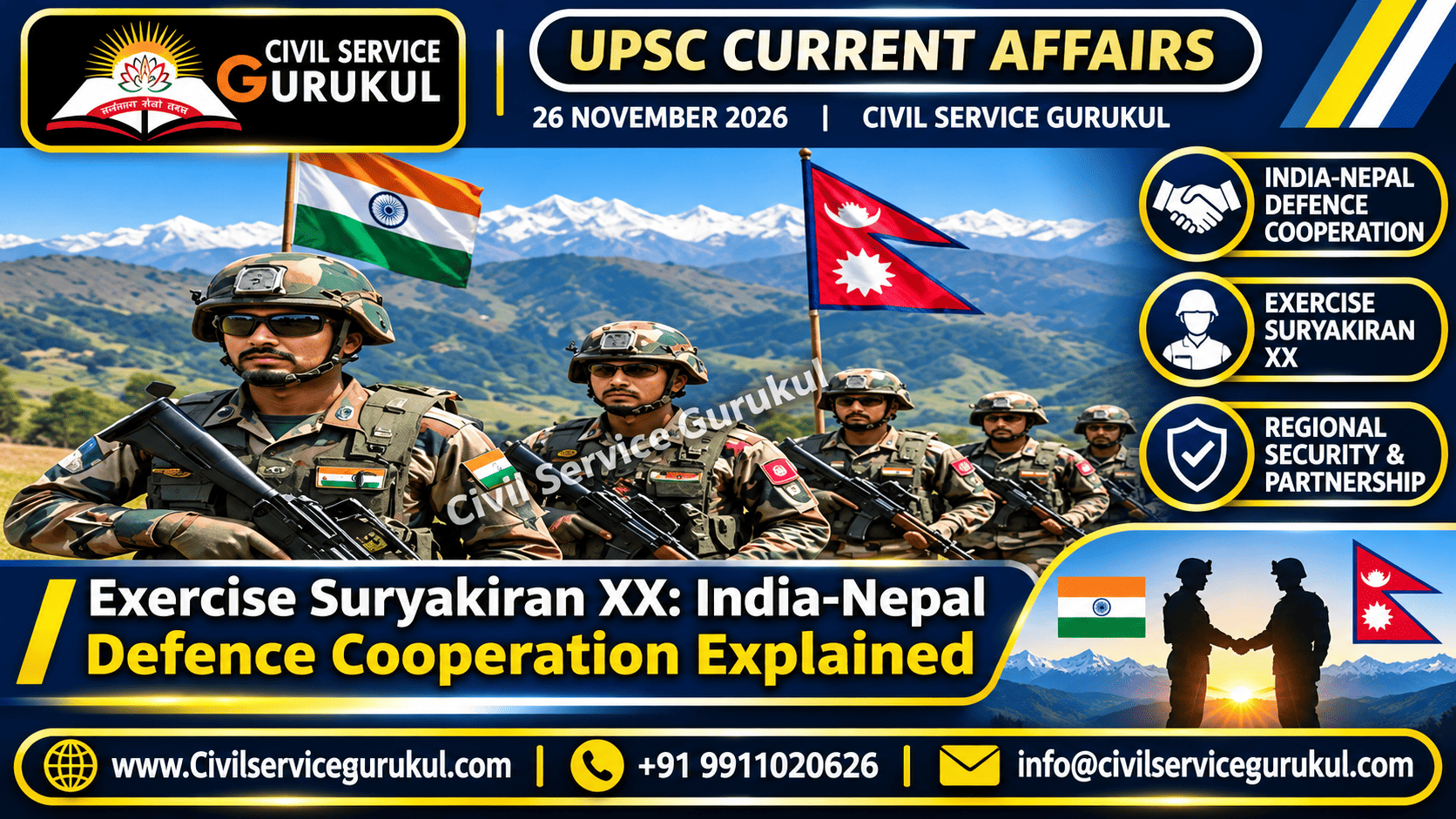
Exercise SURYAKIRAN XX 2026: Strengthening India–Nepal Defence Cooperation, Himalayan Security and Strategic Neighbourhood Partnership – UPSC 2027
India and Nepal commenced the twentieth edition of their bilateral military exercise SURYAKIRAN on 25 November 2026 at Saljhandi, Nepal.
The exercise seeks to strengthen cooperation between the two armies through professional exchanges, joint training, humanitarian assistance and disaster-response preparedness.
Beyond military cooperation, SURYAKIRAN reflects the importance of mutual confidence, Himalayan security, regional stability and India's neighbourhood diplomacy.
For UPSC aspirants, the development connects international relations with defence diplomacy, disaster management, border security and regional cooperation.
UPSC Syllabus Relevance
| Examination Stage | Relevant Topics |
|---|---|
| Prelims | Defence exercises, neighbouring countries, military institutions and Himalayan geography. |
| GS Paper I | Himalayan geography, earthquakes, floods and regional geographical linkages. |
| GS Paper II | India and its neighbourhood, bilateral relations, international cooperation and defence diplomacy. |
| GS Paper III | National security, border management, disaster management and defence cooperation. |
| GS Paper IV | International cooperation, humanitarian responsibility, mutual respect and ethical diplomacy. |
| Essay | Regional peace, international friendship, collective security and sustainable development. |
1. Why in the News?
The twentieth edition of Exercise SURYAKIRAN began on 25 November 2026 in Nepal, marking another important development in the long-standing military partnership between India and Nepal.
The scheduled two-week engagement brings together personnel from both countries for professional training and institutional cooperation.
The programme combines military preparedness with disaster-response and medical cooperation, reflecting the diverse security and humanitarian requirements of the Himalayan region.
The exercise is expected to contribute to mutual understanding between the participating armies. Its actual outcomes can be assessed after completion.
Joint military exercises are instruments of defence diplomacy. They create opportunities for professional cooperation without necessarily establishing a formal military alliance.
2. Important Facts About Exercise SURYAKIRAN XX
| Particulars | Details |
|---|---|
| Exercise Name | Exercise SURYAKIRAN XX |
| Edition | 20th Edition |
| Participating Countries | India and Nepal |
| Participating Forces | Indian Army and Nepali Army |
| Nature | Bilateral joint military exercise |
| Frequency | Annual |
| Joint Training Initiated | 2011 |
| Host Country | Nepal |
| Venue | Saljhandi, Rupandehi district |
| Commencement Date | 25 November 2026 |
| Scheduled Completion | 8 December 2026 |
| Indian Representation | Kumaon Regiment |
| Nepali Representation | Shri Jawla Dal Battalion |
| Indian Personnel | 334 |
| Nepali Personnel | 334 |
| Total Participating Personnel | 668 |
| Broad Focus | Military cooperation, interoperability, counterterrorism, counter-insurgency, disaster response and medical training. |
SURYAKIRAN — India and Nepal — Bilateral Army Exercise — Conducted alternately in the two countries.
3. Major Objectives of Exercise SURYAKIRAN XX
A. Military Interoperability
Develop the capacity of the participating armies to cooperate effectively when undertaking mutually agreed activities.
B. Professional Knowledge Exchange
Encourage learning from the institutional experience, training practices and professional capabilities of both armies.
C. Counterterrorism Cooperation
Improve shared understanding of security challenges and strengthen cooperation within the agreed exercise framework.
D. Disaster Management
Support preparedness for natural disasters and improve coordination during humanitarian emergencies.
E. Medical Cooperation
Promote professional exchange concerning emergency medical assistance and humanitarian support.
F. Confidence-Building
Strengthen mutual understanding, professional relationships and institutional trust.
4. Historical Background of India–Nepal Defence Relations
India and Nepal share historical, cultural and geographical connections that extend into their contemporary defence partnership.
The relationship includes military training, institutional visits, professional exchanges and humanitarian cooperation.
Important Historical Developments
| Year | Development |
|---|---|
| 1947 | Tripartite arrangement involving India, Nepal and the United Kingdom concerning Gorkha military recruitment. |
| 1950 | Signing of the India–Nepal Treaty of Peace and Friendship. |
| 1950 onwards | Tradition of conferring honorary General ranks upon the respective Army Chiefs. |
| 2011 | Commencement of the combined military training programme associated with SURYAKIRAN. |
| 2015 | India launched Operation Maitri following the Nepal earthquake. |
| 2019 | Fourteenth edition of SURYAKIRAN conducted in Nepal. |
| 2023 | Seventeenth edition conducted at Pithoragarh, Uttarakhand. |
| 2025 | Nineteenth edition of Exercise SURYAKIRAN. |
| 2026 | Twentieth edition commenced in Saljhandi, Nepal. |
Historical Gorkha Military Connection
The service of Nepali Gorkhas in the Indian Army has historically represented an important people-to-people dimension of defence relations.
Contemporary recruitment arrangements involve policy discussions between the two countries and should not be assumed to remain unchanged merely because of their historical significance.
5. Geographical Significance of Nepal
Nepal is a landlocked South Asian country situated between India and China. Its geographical position within the Himalayan region influences trade, connectivity, environmental cooperation and security relationships.
| Geographical Feature | Details |
|---|---|
| Capital | Kathmandu |
| Region | South Asia |
| Geographical Nature | Landlocked country |
| Neighbouring Countries | India and China |
| Major Mountain System | Himalayas |
| Highest Peak | Mount Everest, situated on the Nepal–China boundary. |
| Major River Systems | Koshi, Gandaki and Karnali. |
| Southern Geographical Region | Terai plains |
| Exercise Host District | Rupandehi |
| Province | Lumbini Province |
Five Indian States Sharing a Border with Nepal
- Uttarakhand.
- Uttar Pradesh.
- Bihar.
- West Bengal.
- Sikkim.
6. India–Nepal Treaty of Peace and Friendship, 1950
The Treaty of Peace and Friendship, signed on 31 July 1950, constitutes an important foundation of modern India–Nepal bilateral relations.
The agreement establishes principles of peaceful relations and includes reciprocal provisions concerning citizens and economic activities.
Major Features
- Recognition of mutual sovereignty and territorial integrity.
- Commitment to peaceful and friendly bilateral relations.
- Consultation concerning relevant regional security issues.
- Reciprocal arrangements relating to residence, movement and economic participation.
- Foundation for continued bilateral cooperation.
Contemporary Relevance
India and Nepal have periodically discussed the relevance and operation of historical bilateral arrangements in changing political and strategic circumstances.
While the treaty remains an important historical framework, discussions concerning its interpretation or possible revision should be conducted through respectful bilateral engagement.
7. What Is Military Interoperability?
Military interoperability refers to the ability of different armed forces to work together effectively in agreed circumstances.
It includes compatibility in communication, coordination, institutional procedures and professional understanding.
Interoperability and Defence Diplomacy
Military Exercise vs Defence Treaty vs Military Alliance
| Concept | Meaning |
|---|---|
| Military Exercise | Organised training activity intended to improve professional capabilities and cooperation. |
| Defence Treaty | Formal international agreement establishing specified defence-related commitments. |
| Military Alliance | Cooperative security arrangement that may contain collective defence commitments. |
| Defence Diplomacy | Use of defence-related engagement to support peaceful foreign policy objectives. |
8. Humanitarian Assistance and Disaster Relief (HADR)
Humanitarian Assistance and Disaster Relief refers to coordinated efforts to protect lives, provide emergency support and assist communities affected by natural or human-induced disasters.
The Himalayan region is exposed to earthquakes, landslides, floods, avalanches and glacial lake outburst floods.
India–Nepal cooperation can strengthen disaster preparedness and improve the effectiveness of humanitarian assistance when requested by affected authorities.
Major Areas of HADR Cooperation
- Search and rescue preparedness.
- Emergency medical assistance.
- Humanitarian logistics.
- Disaster-related communication.
- Relief material coordination.
- Emergency evacuation support.
- Post-disaster recovery and rehabilitation.
Why Are the Himalayas Vulnerable to Earthquakes?
The Himalayas developed through the convergence and collision of the Indian and Eurasian tectonic plates.
Continuing tectonic movement creates seismic stress, contributing to earthquake hazards across the Himalayan region.
9. Operation Maitri and the Nepal Earthquake of 2015
Following the devastating earthquake that struck Nepal in April 2015, India launched Operation Maitri to provide emergency humanitarian assistance.
The operation demonstrated the significance of regional solidarity, emergency preparedness and international disaster cooperation.
Major Contributions
- Search and rescue assistance.
- Emergency medical support.
- Transportation of essential relief supplies.
- Assistance in evacuation activities.
- Support for affected communities.
Operation Maitri vs Exercise SURYAKIRAN
| Parameter | Operation Maitri | Exercise SURYAKIRAN |
|---|---|---|
| Nature | Disaster relief operation | Bilateral military exercise |
| Context | Nepal earthquake, 2015 | Regular joint military cooperation |
| Primary Objective | Humanitarian assistance and emergency response | Professional training and military interoperability |
| Frequency | Event-specific operation | Recurring exercise |
10. India–Nepal Open Border and Border Management
India and Nepal share a distinctive open-border arrangement that facilitates movement, family relationships, employment, trade and cultural interaction.
The arrangement represents an important asset for bilateral relations while creating responsibilities concerning legitimate security management.
Border Management Institutions
| Institution | Country | Broad Responsibility |
|---|---|---|
| Sashastra Seema Bal (SSB) | India | Border guarding responsibilities along India's borders with Nepal and Bhutan. |
| Armed Police Force (APF) | Nepal | Security and border-related responsibilities within Nepal. |
| Indian Army | India | Military defence and agreed bilateral military cooperation. |
| Nepali Army | Nepal | National defence and agreed bilateral military cooperation. |
Effective border governance requires coordination against illicit activities while preserving lawful movement and the welfare of border communities.
11. Exercise SURYAKIRAN and India's Neighbourhood First Policy
India's Neighbourhood First Policy emphasises constructive engagement with neighbouring countries through connectivity, development partnerships, trade, security cooperation and people-to-people exchanges.
Nepal occupies an important position in this approach because of its geographical proximity, historical relationships and shared developmental opportunities.
Major Pillars of Neighbourhood Cooperation
- Mutual respect and sovereign equality.
- Regional peace and stability.
- Economic and infrastructure connectivity.
- Humanitarian cooperation.
- Trade and investment partnerships.
- Energy and water-resource cooperation.
- Cultural and educational exchanges.
Exercise SURYAKIRAN contributes to the defence dimension of neighbourhood engagement. It should be understood alongside economic, diplomatic and social cooperation rather than as a substitute for them.
12. Broader Dimensions of India–Nepal Relations
| Area of Cooperation | Strategic Significance |
|---|---|
| Defence Cooperation | Professional exchanges, institutional trust and joint military training. |
| Trade and Transit | Facilitates commercial connectivity and access to international markets. |
| Hydropower | Creates opportunities for electricity generation and cross-border energy trade. |
| Water Resources | Supports cooperation concerning rivers, irrigation and flood management. |
| Rail and Road Connectivity | Improves transportation, commerce and people-to-people engagement. |
| Disaster Management | Strengthens preparedness and humanitarian response. |
| Tourism | Promotes religious, cultural and economic exchanges. |
| Education | Supports academic collaboration and human-resource development. |
| Environmental Cooperation | Addresses shared Himalayan ecological and climate-related challenges. |
13. Major Challenges in India–Nepal Relations
Despite longstanding cooperation, bilateral relations face several issues requiring sensitive and constructive diplomatic engagement.
| Challenge | Implication |
|---|---|
| Boundary Disagreements | Differences concerning areas such as Kalapani, Lipulekh, Limpiyadhura and Susta require diplomatic resolution. |
| Treaty-Related Concerns | Differing views about historical bilateral arrangements may require continued consultation. |
| Economic Asymmetry | Differences in economic size and capabilities may create concerns regarding dependence and reciprocity. |
| Water-Resource Management | River-sharing, flooding and infrastructure development require equitable coordination. |
| Geopolitical Competition | Changing regional relationships may influence the strategic choices of both countries. |
| Border Security | Authorities must address illicit activities without unnecessarily restricting legitimate movement. |
| Military Recruitment Issues | Changing recruitment policies may require bilateral discussion. |
| Disaster Vulnerability | Shared exposure to Himalayan disasters requires stronger regional preparedness. |
| Public Perceptions | Misinformation and political disagreements may undermine mutual trust. |
14. Important Indian Bilateral Military Exercises for UPSC
UPSC frequently tests the association between military exercises and participating countries.
| Military Exercise | Partner Country |
|---|---|
| Surya Kiran | Nepal |
| Yudh Abhyas | United States |
| Vajra Prahar | United States |
| Shakti | France |
| Dharma Guardian | Japan |
| Mitra Shakti | Sri Lanka |
| Sampriti | Bangladesh |
| Nomadic Elephant | Mongolia |
| Garuda Shakti | Indonesia |
| Maitree | Thailand |
| Austra Hind | Australia |
| Ekuverin | Maldives |
| Ajeya Warrior | United Kingdom |
| Khanjar | Kyrgyzstan |
| Dustlik | Uzbekistan |
Exercise SURYAKIRAN is conducted with Nepal, while Exercise Dharma Guardian is conducted with Japan. Operation Maitri was India's humanitarian response to the 2015 Nepal earthquake, whereas Exercise Maitree is associated with Thailand.
15. Way Forward: Strengthening India–Nepal Strategic Partnership
A. Institutionalise Professional Defence Exchanges
Continue mutually agreed training programmes, professional visits and institutional dialogue.
B. Strengthen Disaster Management Cooperation
Expand collaboration in humanitarian preparedness, mountain rescue, emergency medical assistance and disaster recovery.
C. Improve Border Governance
Promote effective coordination between authorised institutions while protecting legitimate cross-border movement.
D. Resolve Disagreements Through Dialogue
Address outstanding boundary and treaty-related issues through peaceful diplomatic mechanisms.
E. Expand Economic Connectivity
Strengthen mutually beneficial trade, transport, energy and investment partnerships.
F. Promote Environmental Cooperation
Develop coordinated approaches to Himalayan conservation, flood management, climate adaptation and natural disaster risks.
G. Respect Sovereignty and National Priorities
Ensure that bilateral partnerships reflect mutual consent and respect for each country's independent policy choices.
H. Evaluate Cooperation Outcomes
Assess joint programmes through professional learning, institutional coordination, disaster preparedness and implementation of mutually agreed objectives.
Defence Cooperation + Diplomatic Trust + Economic Connectivity + Humanitarian Assistance + Sovereign Equality = Sustainable Neighbourhood Partnership.
16. UPSC Prelims 2027 – Quick Revision
- SURYAKIRAN is an India–Nepal bilateral Army exercise.
- The combined training programme began in 2011.
- The exercise is conducted alternately in India and Nepal.
- The twentieth edition began on 25 November 2026.
- The host location is Saljhandi in Nepal.
- The Indian Army is represented by the Kumaon Regiment.
- The Nepali Army is represented by Shri Jawla Dal Battalion.
- HADR stands for Humanitarian Assistance and Disaster Relief.
- Operation Maitri was launched after the Nepal earthquake in 2015.
- The India–Nepal Treaty of Peace and Friendship was signed in 1950.
- Nepal is a landlocked Himalayan country.
- Five Indian States share a border with Nepal.
- SSB guards India's borders with Nepal and Bhutan.
- Koshi, Gandaki and Karnali are major river systems of Nepal.
- Rupandehi district lies in Lumbini Province.
- A joint military exercise is not equivalent to a defence treaty or military alliance.
17. UPSC Prelims Practice MCQs
Question 1
With reference to Exercise SURYAKIRAN, consider the following statements:
- It is a bilateral military exercise between India and Nepal.
- It is conducted alternately in India and Nepal.
- It is exclusively a naval exercise.
Which of the statements given above are correct?
- 1 only
- 1 and 2 only
- 2 and 3 only
- 1, 2 and 3
Reveal Correct Answer and Explanation
Statements 1 and 2 are correct. SURYAKIRAN is a recurring bilateral exercise involving the Indian and Nepali armies.
Statement 3 is incorrect because it is an Army exercise rather than an exclusively naval exercise.
Question 2
Consider the following pairs:
| Exercise | Partner Country |
|---|---|
| 1. Surya Kiran | Nepal |
| 2. Dharma Guardian | Japan |
| 3. Mitra Shakti | France |
| 4. Nomadic Elephant | Mongolia |
How many of the above pairs are correctly matched?
- Only one
- Only two
- Only three
- All four
Reveal Correct Answer and Explanation
Pairs 1, 2 and 4 are correctly matched.
Pair 3 is incorrect because Mitra Shakti is conducted with Sri Lanka. Exercise Shakti is associated with France.
Question 3
Which of the following Indian States share an international boundary with Nepal?
- Uttarakhand
- Himachal Pradesh
- Uttar Pradesh
- Bihar
- West Bengal
- Sikkim
Select the correct answer using the code given below:
- 1, 2, 3 and 4 only
- 1, 3, 4 and 5 only
- 1, 3, 4, 5 and 6 only
- 1, 2, 3, 4, 5 and 6
Reveal Correct Answer and Explanation
Nepal shares an international boundary with Uttarakhand, Uttar Pradesh, Bihar, West Bengal and Sikkim.
Himachal Pradesh does not share a border with Nepal.
Question 4
Operation Maitri, sometimes mentioned in the context of India–Nepal relations, was associated with:
- A bilateral naval exercise.
- Humanitarian assistance following the 2015 Nepal earthquake.
- Establishment of the South Asian Association for Regional Cooperation.
- Construction of a joint space research station.
Reveal Correct Answer and Explanation
Operation Maitri was India's humanitarian assistance and disaster relief operation following the devastating earthquake in Nepal in April 2015.
Question 5
Consider the following statements regarding India–Nepal relations:
- The Treaty of Peace and Friendship was signed in 1950.
- Sashastra Seema Bal has border guarding responsibilities along the India–Nepal border.
- Participation in a joint military exercise automatically creates a collective defence treaty.
Which of the statements given above are correct?
- 1 and 2 only
- 2 and 3 only
- 1 and 3 only
- 1, 2 and 3
Reveal Correct Answer and Explanation
The India–Nepal Treaty of Peace and Friendship was signed in 1950, and SSB performs border guarding responsibilities along the India–Nepal border.
A joint military exercise does not automatically establish a legally binding collective defence treaty.
18. UPSC Mains Answer Writing Practice
Question: Discuss the strategic and developmental significance of India–Nepal defence cooperation in the context of Exercise SURYAKIRAN XX and India's Neighbourhood First Policy.
Marks: 15 | Word Limit: 250 Words
Reveal Model Answer
Introduction
India and Nepal share historical, geographical, cultural and institutional relationships supported by longstanding defence cooperation. Exercise SURYAKIRAN XX represents an important instrument of military diplomacy aimed at enhancing mutual confidence and professional coordination.
Body
India–Nepal defence cooperation has several dimensions of strategic and developmental significance:
- Military interoperability: Joint training supports institutional understanding and professional cooperation.
- Border management: Coordinated engagement can contribute to addressing shared security challenges.
- Disaster preparedness: Humanitarian cooperation is particularly important in the earthquake-prone Himalayan region.
- Defence diplomacy: Regular professional exchanges can strengthen confidence and reduce misunderstandings.
- Neighbourhood stability: Constructive bilateral relations contribute to regional peace and development.
- Human security: Disaster-response cooperation and sustainable border development support community welfare.
However, bilateral relations also face challenges concerning boundary disagreements, historical treaty arrangements, economic asymmetry and changing geopolitical relationships.
India must pursue defence cooperation alongside mutually beneficial trade, energy partnerships, infrastructure connectivity and respectful diplomatic engagement.
Nepal's sovereignty and independent policy choices should remain central considerations in the relationship.
Conclusion
Exercise SURYAKIRAN demonstrates the potential of defence diplomacy to support broader neighbourhood cooperation. A sustainable India–Nepal partnership must integrate military confidence-building with economic development, humanitarian assistance, sovereign equality and shared commitments to regional peace.
Question: Examine the role of bilateral military cooperation in strengthening disaster preparedness in the Himalayan region.
Marks: 10 | Word Limit: 150 Words
Reveal Suggested Answer
The Himalayan region is highly vulnerable to earthquakes, landslides, floods and other natural hazards. Cross-border cooperation is essential because disasters may affect communities and infrastructure across national boundaries.
Bilateral military training can strengthen humanitarian logistics, communication, emergency medical coordination and search-and-rescue preparedness.
Exercise SURYAKIRAN provides a platform for India and Nepal to develop professional cooperation in disaster-response activities. Operation Maitri following the 2015 Nepal earthquake illustrates the practical importance of humanitarian assistance.
However, military support must complement civilian disaster-management authorities and respect the sovereignty of affected countries.
India and Nepal should strengthen disaster-related information sharing, community preparedness, institutional training and coordinated humanitarian planning.
Such cooperation can improve regional resilience, protect vulnerable communities and reinforce mutual trust.
19. Important Essay Topics for UPSC
- Peaceful neighbourhoods are the foundation of national security.
- International cooperation is essential for disaster resilience.
- Defence diplomacy as an instrument of regional peace.
- Geographical proximity must translate into mutual prosperity.
- National security extends beyond military strength.
- Mutual respect is the foundation of sustainable international partnerships.
20. Frequently Asked Questions
What is Exercise SURYAKIRAN?
It is a bilateral joint military exercise involving the Indian Army and Nepali Army.
Which edition of Exercise SURYAKIRAN is being conducted in November 2026?
The twentieth edition, known as SURYAKIRAN XX.
Where is Exercise SURYAKIRAN XX being conducted?
At the Nepal Army Battle School in Saljhandi, Rupandehi district, Nepal.
What are the dates of Exercise SURYAKIRAN XX?
It commenced on 25 November 2026 and is scheduled to conclude on 8 December 2026.
When did the India–Nepal combined military training programme begin?
The programme began in 2011.
Which Indian Army regiment is participating in SURYAKIRAN XX?
The Kumaon Regiment.
How many Indian and Nepali personnel are participating?
The announced contingent strength is 334 personnel from each country.
What is military interoperability?
It is the ability of different armed forces to cooperate effectively in agreed activities through professional coordination and compatible institutional practices.
What is HADR?
HADR stands for Humanitarian Assistance and Disaster Relief.
What was Operation Maitri?
It was India's humanitarian assistance operation following the Nepal earthquake in 2015.
When was the India–Nepal Treaty of Peace and Friendship signed?
31 July 1950.
Which Indian force guards the India–Nepal border?
Sashastra Seema Bal performs border guarding responsibilities on the Indian side.
How many Indian States share a border with Nepal?
Five: Uttarakhand, Uttar Pradesh, Bihar, West Bengal and Sikkim.
Does Exercise SURYAKIRAN establish a military alliance?
No. A bilateral military exercise does not itself create a collective defence treaty or military alliance.
Why is Exercise SURYAKIRAN important for UPSC 2027?
It connects defence exercises, international relations, Himalayan geography, disaster management, border security and India's Neighbourhood First Policy.
21. Conclusion
Exercise SURYAKIRAN XX represents the continuing importance of India–Nepal defence cooperation within the wider framework of bilateral relations.
Joint professional training, humanitarian cooperation and disaster preparedness can contribute to mutual confidence and institutional resilience.
However, sustainable neighbourhood diplomacy requires more than military engagement. India and Nepal must continue to strengthen economic connectivity, environmental cooperation, cultural exchanges and peaceful diplomatic mechanisms.
The future of the partnership should be guided by sovereign equality, mutual benefit, regional stability and the shared welfare of citizens.
Exercise SURYAKIRAN illustrates how defence diplomacy can connect national security with humanitarian responsibility, mutual trust and sustainable neighbourhood development.
Prepare for UPSC CSE 2027 with Civil Service Gurukul
Develop conceptual clarity, analytical thinking and examination-oriented preparation through structured learning.
Daily Current Affairs | Prelims Test Series | Mains Answer Writing | NCERT Foundation | International Relations | Defence and Security | Disaster Management | UPSC Mentorship
Visit Our Website Connect on WhatsAppWebsite: www.Civilservicegurukul.com
Mobile No.: +91 9911020626
Email: info@civilservicegurukul.com
Prepare with Mentors Who Cleared the Exam
Get personalized study plans, evaluated answer models, and test series access.