
India–China LAC Talks 2026: Border Peace & UPSC Analysis
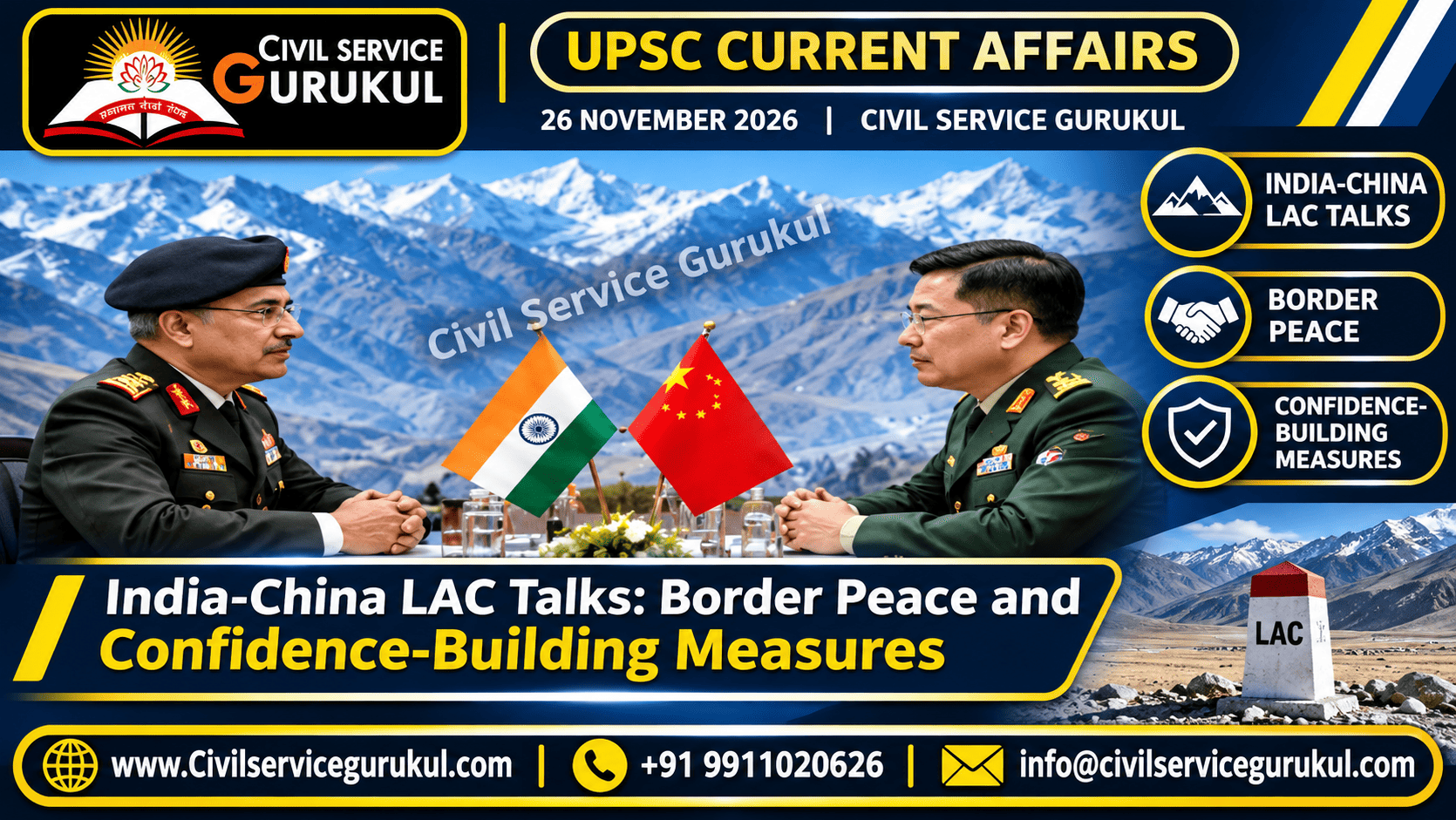
India–China LAC Talks 2026: Arunachal Pradesh Border Peace, Military Diplomacy and Confidence-Building Measures – UPSC 2027 Special
India and China have held senior military-level discussions in the Arunachal Pradesh sector to improve management of the Line of Actual Control and prevent escalation of border tensions.
The development underscores the importance of military dialogue, diplomatic negotiations, confidence-building measures and strategic stability in the Himalayan border region.
While diplomatic engagement can reduce the possibility of confrontation, it cannot automatically resolve competing territorial claims or establish a mutually demarcated international boundary.
For UPSC aspirants, the issue connects international relations, Himalayan geography, national security, border infrastructure, strategic autonomy and peaceful conflict resolution.
UPSC Syllabus Relevance
| Examination Stage | Relevant Topics |
|---|---|
| Prelims | Line of Actual Control, Himalayan geography, international boundaries, mountain passes and bilateral institutions. |
| GS Paper I | Physical geography of the Himalayas and geographical significance of border regions. |
| GS Paper II | India and its neighbourhood, bilateral relations, international agreements and diplomatic engagement. |
| GS Paper III | Border management, security challenges, infrastructure and national security. |
| GS Paper IV | Peaceful conflict resolution, diplomatic responsibility and ethical decision-making. |
| Essay | Peace, national security, strategic autonomy and international cooperation. |
1. Why in the News?
During November 2026, Indian and Chinese senior military commanders held discussions concerning outstanding border management issues in the Arunachal Pradesh sector.
The Ministry of External Affairs confirmed the engagements on 25 November 2026, according to contemporary reporting.
The discussions focused on maintaining stability, preventing further tensions and addressing unresolved issues through established communication mechanisms.
The meetings followed earlier military and diplomatic engagements between the two countries during 2026.
Major Objectives of Border Dialogue
- Reduce the possibility of unintended military confrontation.
- Improve communication between military authorities.
- Address outstanding border management concerns.
- Strengthen implementation of mutually agreed arrangements.
- Maintain conditions favourable to broader bilateral cooperation.
2. What Is the Line of Actual Control?
The Line of Actual Control, commonly known as the LAC, is the de facto line separating areas under Indian and Chinese control in their disputed border regions.
Unlike a fully negotiated international boundary, the LAC does not have a mutually accepted alignment throughout its entire extent.
Differences in perceptions regarding its alignment can create overlapping claims and difficulties in managing patrols and other border activities.
Important Characteristics of the LAC
- It has practical significance for border management.
- Its alignment is disputed in several areas.
- It is not a mutually demarcated international boundary.
- Its management depends on military and diplomatic arrangements.
- Agreement on border management does not necessarily settle territorial sovereignty.
3. Three Sectors of the India–China Boundary
The India–China boundary is generally discussed in three geographical sectors: Western, Middle and Eastern.
| Sector | Indian Region | Important Geographical Areas |
|---|---|---|
| Western Sector | Ladakh | Aksai Chin, Pangong Tso, Galwan Valley, Depsang and Demchok. |
| Middle Sector | Himachal Pradesh and Uttarakhand | Himalayan boundary areas, including the Barahoti region. |
| Eastern Sector | Sikkim and Arunachal Pradesh | Tawang, McMahon Line and other Himalayan frontier areas. |
Arunachal Pradesh is the principal area of the eastern-sector territorial dispute. The boundary in Sikkim has a distinct historical and legal background and should not be treated as identical to the dispute over Arunachal Pradesh.
Indian States and Union Territory Along the China Border
- Ladakh (Union Territory).
- Himachal Pradesh.
- Uttarakhand.
- Sikkim.
- Arunachal Pradesh.
4. Difference Between LAC, LOC and International Boundary
| Parameter | LAC | LOC | International Boundary |
|---|---|---|---|
| Full Form | Line of Actual Control | Line of Control | International Boundary |
| Countries Involved | India and China | India and Pakistan | Relevant neighbouring countries |
| Nature | De facto line with differing perceptions in places | Military control line in the Jammu and Kashmir region | Boundary recognised under applicable legal arrangements |
| Alignment | Not jointly clarified throughout | Generally delineated under bilateral arrangements | Generally established through legal instruments |
| Major Historical Context | India–China boundary dispute and subsequent agreements | Simla Agreement, 1972 | Treaties, agreements and international law |
5. Historical Background of the India–China Border Dispute
| Year | Historical Development |
|---|---|
| 1914 | Simla Conference and formulation of the McMahon Line between British India and Tibet. China did not accept the resulting boundary arrangement. |
| 1950 | Establishment of diplomatic relations between India and the People's Republic of China. |
| 1954 | Agreement incorporating the Five Principles of Peaceful Coexistence, popularly known as Panchsheel. |
| 1962 | India–China border war. |
| 1988 | Renewed high-level political engagement following Prime Minister Rajiv Gandhi's China visit. |
| 1993 | Agreement on maintaining peace and tranquillity along the LAC. |
| 1996 | Agreement on military confidence-building measures. |
| 2003 | Establishment of the Special Representatives mechanism. |
| 2005 | Agreement on Political Parameters and Guiding Principles for boundary settlement and a protocol on implementing military confidence-building measures. |
| 2012 | Establishment of the WMCC. |
| 2013 | Border Defence Cooperation Agreement. |
| 2017 | Doklam standoff involving concerns around the Bhutan–China–India tri-junction region. |
| 2020 | Eastern Ladakh border standoff and Galwan Valley confrontation. |
| 21 October 2024 | Agreement on patrolling arrangements in Depsang and Demchok. |
| November 2026 | Military discussions concerning border management in the Arunachal Pradesh sector. |
The historical evolution demonstrates that India and China have developed multiple mechanisms for managing tensions even though the larger boundary dispute remains unresolved.
6. What Is the McMahon Line?
The McMahon Line is associated with the boundary arrangement negotiated between British India and Tibet during the Simla Conference of 1914.
It is named after Sir Henry McMahon, the then Foreign Secretary of British India.
India recognises the McMahon Line as the basis of its boundary in the relevant eastern-sector region, while China disputes its legitimacy.
McMahon Line vs LAC
| McMahon Line | Line of Actual Control |
|---|---|
| Associated with the 1914 Simla Conference. | Represents the practical separation of areas under Indian and Chinese control. |
| Relevant primarily to the eastern sector. | Relevant to the broader India–China border regions. |
| Historical boundary arrangement. | De facto line used in contemporary border management. |
7. Strategic Significance of Arunachal Pradesh
Arunachal Pradesh occupies an important geographical position in the eastern Himalayan region and shares international boundaries with Bhutan, China and Myanmar.
It is an integral part of India and is administered as an Indian State. China maintains territorial claims over much of the State, which India rejects.
Reasons for Its Strategic Importance
- Location along the eastern Himalayan frontier.
- Importance for national security and territorial integrity.
- Presence of major river systems and water resources.
- Significance for border connectivity and regional development.
- Rich tribal, linguistic and cultural diversity.
- Ecologically sensitive mountain and forest ecosystems.
Important Mountain Passes for UPSC
| Mountain Pass | State or Union Territory |
|---|---|
| Karakoram Pass | Ladakh |
| Shipki La | Himachal Pradesh |
| Lipulekh Pass | Uttarakhand |
| Nathu La | Sikkim |
| Bum La | Arunachal Pradesh |
| Sela Pass | Arunachal Pradesh |
Not every mountain pass listed above lies directly on the international boundary. Sela Pass, for example, is an important internal mountain pass in Arunachal Pradesh.
8. Important India–China Border Agreements
India and China have negotiated several agreements aimed at reducing confrontation and facilitating peaceful management of their disputed boundary.
| Year | Agreement or Mechanism | Primary Objective |
|---|---|---|
| 1993 | Border Peace and Tranquillity Agreement | Maintain peaceful conditions along the LAC pending boundary settlement. |
| 1996 | Military Confidence-Building Measures Agreement | Reduce military risks and establish restraints in border areas. |
| 2005 | Political Parameters and Guiding Principles Agreement | Establish principles for negotiating a boundary settlement. |
| 2005 | Protocol on Implementation of Military Confidence-Building Measures | Strengthen practical implementation of agreed measures. |
| 2012 | Working Mechanism for Consultation and Coordination | Facilitate consultation on border affairs. |
| 2013 | Border Defence Cooperation Agreement | Improve communication and military cooperation for border stability. |
| 2024 | Depsang and Demchok Patrolling Arrangements | Address outstanding friction points associated with the 2020 eastern Ladakh standoff. |
9. Special Representatives, WMCC and Military-Level Talks
India and China use multiple diplomatic and military mechanisms to address different dimensions of their boundary dispute.
A. Special Representatives Mechanism
Established in 2003, the Special Representatives mechanism provides a high-level political channel for exploring a mutually acceptable framework for boundary settlement.
B. Working Mechanism for Consultation and Coordination
The Working Mechanism for Consultation and Coordination on India–China Border Affairs, commonly known as WMCC, was established in 2012.
It facilitates consultations on border affairs and supports the management of situations affecting peace and stability. It is not primarily responsible for negotiating the final boundary settlement.
C. Senior Military Commander-Level Talks
Military-level discussions address practical border management, implementation of agreed arrangements and prevention of confrontation.
D. Local Communication Mechanisms
Established communication channels and meetings between authorised local commanders can help clarify incidents and reduce misunderstandings.
| Mechanism | Primary Responsibility |
|---|---|
| Special Representatives | Political framework for boundary settlement. |
| WMCC | Diplomatic consultation and coordination on border affairs. |
| Senior Military Commanders | Operational border management and implementation of agreed arrangements. |
| Local Military Communication | Incident clarification and immediate conflict prevention. |
10. What Are Confidence-Building Measures?
Confidence-Building Measures, or CBMs, are arrangements intended to improve mutual understanding, reduce uncertainty and prevent unintended escalation between countries.
They are particularly relevant in border regions where competing territorial perceptions and military activities may create recurring tensions.
Important Examples of Confidence-Building Measures
- Regular military and diplomatic communication.
- Agreed incident-management procedures.
- Military hotlines and commander-level meetings.
- Appropriate information-sharing arrangements.
- Mutually agreed military restraints.
- Verification of agreed commitments.
- Peaceful resolution of local disagreements.
Conceptual Framework for Border Stability
This framework illustrates the intended role of CBMs rather than confirming implementation of any specific new arrangement during the November 2026 talks.
11. Disengagement vs De-escalation vs Boundary Settlement
| Concept | Meaning |
|---|---|
| Disengagement | Separation of opposing forces from immediate confrontation areas under agreed arrangements. |
| De-escalation | Broader reduction of military tensions and elevated military posture. |
| De-induction | Withdrawal of additional personnel or military equipment from designated operational areas. |
| Boundary Delimitation | Legal or cartographic definition of an agreed boundary alignment. |
| Boundary Demarcation | Physical marking of an agreed boundary on the ground. |
| Boundary Settlement | Mutually accepted resolution of the territorial boundary question. |
Significance of the October 2024 Agreement
India and China agreed on patrolling arrangements concerning Depsang and Demchok on 21 October 2024.
According to India's subsequent official statements, the agreement led to disengagement from the remaining friction points associated with the 2020 standoff.
However, broader military stability, mutual trust and resolution of the boundary dispute remained separate policy objectives.
12. Importance of Border Infrastructure and Development
Border infrastructure is important not only for national security but also for the economic development and welfare of frontier communities.
Role of Border Roads Organisation
The Border Roads Organisation, established in 1960, develops and maintains important transport infrastructure in border areas and other designated regions.
Role of Indo-Tibetan Border Police
The Indo-Tibetan Border Police, raised in 1962, is a Central Armed Police Force under the Ministry of Home Affairs with responsibilities including guarding the India–China frontier.
| Institution | Administrative Ministry | Broad Role |
|---|---|---|
| Indian Army | Ministry of Defence | Military defence and national security. |
| Border Roads Organisation | Ministry of Defence | Border transport infrastructure. |
| Indo-Tibetan Border Police | Ministry of Home Affairs | Border guarding and related security responsibilities. |
| Ministry of External Affairs | Government of India | Diplomatic engagement and international negotiations. |
| State Governments | Respective States | Local administration, public services and community development. |
Development Priorities for Frontier Communities
- Road and communication connectivity.
- Reliable electricity and digital services.
- Healthcare and educational infrastructure.
- Local employment and sustainable livelihoods.
- Disaster preparedness and environmental protection.
- Preservation of local cultures and community participation.
13. Vibrant Villages Programme and Border Security
The Vibrant Villages Programme seeks to improve living conditions, public infrastructure and economic opportunities in selected border villages.
Vibrant Villages Programme-I
Approved in February 2023, VVP-I focuses on selected villages along India's northern border.
| Particulars | Details |
|---|---|
| Administrative Ministry | Ministry of Home Affairs |
| Scheme Type | Centrally Sponsored Scheme |
| Approved Outlay | ₹4,800 crore |
| Original Scheme Period | FY 2022–23 to FY 2025–26 |
| Geographical Coverage | Selected northern border villages in Arunachal Pradesh, Sikkim, Uttarakhand, Himachal Pradesh and Ladakh. |
| Primary Objective | Comprehensive village development and improved livelihood opportunities. |
Vibrant Villages Programme-II
VVP-II was approved in April 2025 as a Central Sector Scheme with an outlay of ₹6,839 crore up to FY 2028–29.
It extends comprehensive development support to identified villages along other international land borders, excluding northern border areas already covered by VVP-I.
14. Major Challenges in India–China Border Relations
| Challenge | Strategic Implication |
|---|---|
| Different LAC Perceptions | Can contribute to overlapping claims and local tensions. |
| Unresolved Territorial Disputes | Prevent a comprehensive and permanent boundary settlement. |
| Strategic Trust Deficit | Reduces confidence in bilateral commitments. |
| Military Modernisation | May intensify mutual security concerns. |
| Infrastructure Competition | Creates strategic concerns while also supporting legitimate development objectives. |
| Harsh Himalayan Geography | Complicates connectivity, logistics and administration. |
| Economic Interdependence | Requires balancing trade benefits with strategic vulnerabilities. |
| Geopolitical Competition | Influences bilateral relations and regional partnerships. |
| Misinformation | Unverified claims can intensify public anxiety and diplomatic tensions. |
| Environmental Vulnerability | Unplanned infrastructure may increase risks to fragile Himalayan ecosystems. |
15. Why Is Border Peace Important for India–China Relations?
National Security
Stable border conditions reduce the likelihood of confrontation and support long-term security planning.
Economic Development
Reduced geopolitical uncertainty may improve conditions for commercial engagement, investment and regional economic stability.
Regional Stability
Peaceful relations between two major Asian powers can contribute to stability across the wider region.
Multilateral Cooperation
India and China participate in platforms such as BRICS, the Shanghai Cooperation Organisation and the G20. Stable bilateral relations may facilitate cooperation where their interests converge.
Frontier Community Welfare
Peaceful conditions can support education, healthcare, connectivity, tourism and sustainable livelihood opportunities in border regions.
Strategic Autonomy
India's ability to maintain independent foreign policy choices can be strengthened through a combination of credible security capabilities and constructive diplomatic engagement.
16. Military Diplomacy: Opportunities and Limitations
| Opportunities | Limitations |
|---|---|
| Improves communication between military authorities. | Does not automatically resolve competing territorial claims. |
| Reduces risks of misunderstanding. | Depends on mutual adherence to commitments. |
| Supports implementation of agreed arrangements. | May not eliminate broader geopolitical competition. |
| Creates opportunities for peaceful conflict management. | Requires political support and effective verification. |
| Can contribute to strategic stability. | Meetings alone do not establish tangible changes on the ground. |
17. India's Strategic Response and Way Forward
A. Strengthen Military Communication
Maintain reliable communication channels and institutional procedures for clarifying border incidents and preventing escalation.
B. Continue Political Dialogue
Use high-level diplomatic engagement and the Special Representatives mechanism to pursue an acceptable framework for resolving the boundary dispute.
C. Improve Implementation of Agreements
Develop mutually acceptable procedures for monitoring and implementing existing border commitments.
D. Maintain Credible Security Capabilities
Strengthen national preparedness while ensuring that security policies remain consistent with the objective of maintaining peace.
E. Promote Border Community Development
Expand access to infrastructure, education, healthcare, digital connectivity and sustainable economic opportunities.
F. Protect Himalayan Ecosystems
Integrate environmental assessments, disaster resilience and ecological safeguards into infrastructure development.
G. Strengthen Economic Resilience
Reduce excessive dependence in strategically important supply chains through domestic capabilities and diversified international partnerships.
H. Maintain Responsible Public Communication
Distinguish confirmed military developments from speculation, unverified reports and political claims.
Diplomatic Engagement + Credible Deterrence + Border Development + Economic Resilience + Environmental Sustainability = Comprehensive Border Management.
18. UPSC Prelims 2027 – Quick Revision
- LAC stands for Line of Actual Control.
- India's official estimate of its boundary with China is 3,488 kilometres.
- The LAC is not mutually demarcated throughout.
- The India–China boundary is generally divided into three sectors.
- Aksai Chin is associated with the Western Sector.
- Arunachal Pradesh is associated with the Eastern Sector.
- The McMahon Line is associated with the Simla Conference of 1914.
- Panchsheel principles were incorporated into the 1954 agreement.
- The Border Peace and Tranquillity Agreement was signed in 1993.
- The military confidence-building agreement was signed in 1996.
- The Special Representatives mechanism was established in 2003.
- The WMCC was established in 2012.
- The Border Defence Cooperation Agreement was signed in 2013.
- Depsang and Demchok patrolling arrangements were agreed in October 2024.
- The Indo-Tibetan Border Police functions under the Ministry of Home Affairs.
- The Border Roads Organisation functions under the Ministry of Defence.
- Vibrant Villages Programme-I was approved in February 2023.
- Vibrant Villages Programme-II is a Central Sector Scheme.
- Disengagement and final boundary settlement are distinct concepts.
19. UPSC Prelims Practice MCQs
Question 1
With reference to the Line of Actual Control, consider the following statements:
- It separates areas under Indian and Chinese control in disputed border regions.
- Its alignment is mutually accepted and fully demarcated throughout.
- Arunachal Pradesh is associated with the eastern sector of the boundary dispute.
Which of the statements given above are correct?
- 1 and 2 only
- 1 and 3 only
- 2 and 3 only
- 1, 2 and 3
Reveal Correct Answer and Explanation
Statement 1 is correct because the LAC represents a de facto line separating areas under Indian and Chinese control.
Statement 2 is incorrect because its alignment is not mutually accepted throughout.
Statement 3 is correct because Arunachal Pradesh forms part of the eastern sector of the dispute.
Question 2
Consider the following pairs:
| Agreement or Mechanism | Year |
|---|---|
| 1. Border Peace and Tranquillity Agreement | 1993 |
| 2. Working Mechanism for Consultation and Coordination | 2012 |
| 3. Border Defence Cooperation Agreement | 2013 |
How many of the pairs given above are correctly matched?
- Only one
- Only two
- All three
- None
Reveal Correct Answer and Explanation
The peace agreement was signed in 1993, WMCC was established in 2012 and the Border Defence Cooperation Agreement was signed in 2013.
Question 3
With reference to India's border management institutions, consider the following statements:
- The Indo-Tibetan Border Police functions under the Ministry of Home Affairs.
- The Border Roads Organisation functions under the Ministry of Defence.
- The WMCC is primarily responsible for negotiating the final India–China boundary settlement.
Which of the statements given above are correct?
- 1 and 2 only
- 2 and 3 only
- 1 and 3 only
- 1, 2 and 3
Reveal Correct Answer and Explanation
Statements 1 and 2 correctly identify the administrative ministries. Statement 3 is incorrect because the WMCC focuses on consultation and coordination concerning border affairs rather than negotiation of the final boundary settlement.
Question 4
Consider the following pairs:
| Mountain Pass | State |
|---|---|
| 1. Nathu La | Sikkim |
| 2. Shipki La | Himachal Pradesh |
| 3. Bum La | Uttarakhand |
How many of the above pairs are correctly matched?
- Only one
- Only two
- All three
- None
Reveal Correct Answer and Explanation
Nathu La is located in Sikkim and Shipki La is located in Himachal Pradesh. Bum La is associated with Arunachal Pradesh, not Uttarakhand.
Question 5
With reference to confidence-building measures in India–China relations, consider the following statements:
- Military hotlines can help reduce misunderstandings.
- Disengagement at a friction point automatically resolves the entire boundary dispute.
- Diplomatic and military communication may reduce the risk of unintended escalation.
Which of the statements given above are correct?
- 1 only
- 1 and 2 only
- 1 and 3 only
- 1, 2 and 3
Reveal Correct Answer and Explanation
Communication mechanisms and confidence-building measures seek to prevent misunderstandings and escalation. However, disengagement at a particular location does not settle the entire boundary question.
20. UPSC Mains Answer Writing Practice
Question: Assess the role and limitations of military confidence-building measures in India–China relations. Discuss in the context of recent military-level talks along the Line of Actual Control in Arunachal Pradesh.
Marks: 15 | Word Limit: 250 Words
Reveal Model Answer
Introduction
The recent India–China military discussions in Arunachal Pradesh highlight the importance of confidence-building measures in managing tensions along the disputed Line of Actual Control. These mechanisms seek to prevent confrontation while maintaining conditions favourable to diplomatic engagement.
Body
Confidence-building measures contribute to border stability through:
- Regular communication between military commanders.
- Reduction of misunderstandings and escalation risks.
- Implementation of mutually agreed border management arrangements.
- Creation of institutional channels for resolving local disagreements.
- Improvement of conditions for broader diplomatic engagement.
India and China have established several relevant mechanisms, including the 1993 and 1996 agreements, WMCC, Special Representatives talks and Border Defence Cooperation Agreement.
However, these arrangements face limitations arising from different LAC perceptions, unresolved territorial claims, strategic mistrust and implementation difficulties. Disengagement at individual friction points does not automatically establish complete de-escalation or final boundary settlement.
India should pursue a multidimensional approach combining credible security capabilities, political dialogue, reliable communication, effective verification and sustainable border development. Economic resilience and responsible public communication can further strengthen strategic stability.
Conclusion
Military confidence-building measures are necessary but insufficient for a permanent resolution of the India–China boundary dispute. Durable peace requires mutual adherence to agreements, sustained political engagement and respect for each country's legitimate security concerns.
Question: Examine the relationship between border infrastructure, frontier community development and national security in India's Himalayan border regions.
Marks: 10 | Word Limit: 150 Words
Reveal Suggested Answer
Border infrastructure plays an important role in strengthening national security and improving the living conditions of communities in Himalayan regions.
Transport networks, communication facilities and essential public services support effective administration, disaster response and economic development.
Initiatives such as the Vibrant Villages Programme recognise the importance of sustainable livelihoods and community welfare in comprehensive border management.
However, infrastructure development in fragile mountain ecosystems creates environmental challenges, including landslide risks, habitat degradation and pressure on natural resources.
India must therefore combine strategic infrastructure development with environmental safeguards, local participation, disaster resilience and improved public services.
Comprehensive border security requires more than military preparedness. It also depends on resilient infrastructure, prosperous communities, effective governance and sustainable development.
21. Important Essay Topics for UPSC
- Peace through strength and dialogue.
- Geography shapes the strategic choices of nations.
- National security begins with secure and prosperous communities.
- Strategic autonomy in a changing global order.
- Diplomacy is an instrument of national security.
- Development and environmental sustainability in frontier regions.
22. Frequently Asked Questions
What is the Line of Actual Control?
The LAC is the de facto line separating areas under Indian and Chinese control in disputed border regions. Its alignment is not mutually accepted throughout.
Why are India–China border talks in the news in November 2026?
Senior military commanders held discussions concerning border management and outstanding issues in the Arunachal Pradesh sector, with the objective of reducing escalation risks.
How long is the India–China boundary?
According to India's official estimate, the boundary is approximately 3,488 kilometres long.
What are the three sectors of the India–China boundary?
The Western, Middle and Eastern sectors.
What is the McMahon Line?
It is associated with the boundary arrangement negotiated between British India and Tibet during the Simla Conference of 1914.
What is WMCC?
WMCC stands for Working Mechanism for Consultation and Coordination on India–China Border Affairs. It was established in 2012.
When was the Special Representatives mechanism established?
It was established in 2003 to explore a political framework for boundary settlement.
What are confidence-building measures?
They are arrangements intended to improve mutual understanding, reduce military uncertainty and prevent unintended escalation.
What is the difference between disengagement and de-escalation?
Disengagement generally refers to separation from immediate confrontation areas, while de-escalation involves a broader reduction of military tensions.
When was the Depsang and Demchok agreement reached?
India and China reached an agreement on patrolling arrangements in these areas on 21 October 2024.
Which ministry administers the ITBP?
The Ministry of Home Affairs.
What is the Vibrant Villages Programme?
It is a government initiative intended to improve infrastructure, livelihoods and living conditions in identified border villages.
Have the November 2026 talks resolved the India–China boundary dispute?
No final boundary settlement has been established by the reported military discussions.
Why is the India–China LAC issue important for UPSC?
It connects international relations, national security, Himalayan geography, strategic autonomy, diplomatic negotiations and border development.
23. Conclusion
The November 2026 military discussions between India and China demonstrate the continuing importance of institutional engagement in managing border-related tensions.
Confidence-building measures can reduce misunderstandings and help prevent local incidents from escalating into larger confrontations. However, their effectiveness depends on mutual implementation, political commitment and appropriate verification.
India's long-term approach should combine credible national security capabilities, diplomatic engagement, economic resilience, sustainable border infrastructure and the welfare of frontier communities.
Peaceful border management and final boundary settlement remain distinct objectives. Both require sustained engagement and responsible strategic decision-making.
India's approach to border security must combine strategic preparedness with constructive diplomacy, recognising that durable peace depends on reliable agreements, responsible governance and mutual respect.
Prepare for UPSC CSE 2027 with Civil Service Gurukul
Develop conceptual clarity, analytical thinking and examination-oriented preparation through structured learning.
Daily Current Affairs | Prelims Test Series | Mains Answer Writing | NCERT Foundation | International Relations | Internal Security | Indian Geography | UPSC Mentorship
Visit Our Website Connect on WhatsAppWebsite: www.Civilservicegurukul.com
Mobile No.: +91 9911020626
Email: info@civilservicegurukul.com
Prepare with Mentors Who Cleared the Exam
Get personalized study plans, evaluated answer models, and test series access.