
Free Bus Travel for Women 2026: Shakti Scheme & UPSC
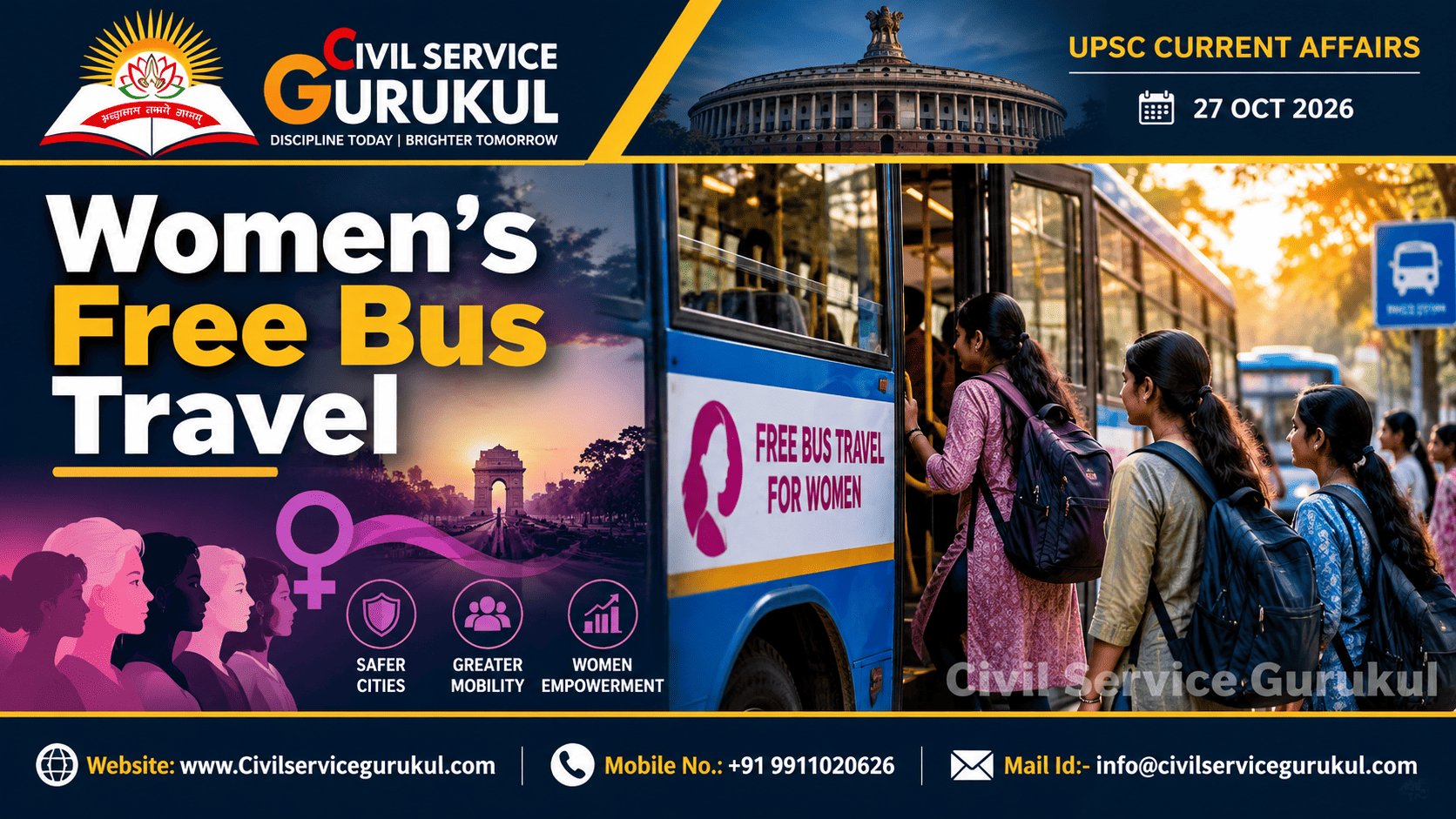
Free Bus Travel for Women in India 2026: Shakti Scheme, Employment, Gender Equality and UPSC Analysis
An in-depth UPSC analysis of women’s mobility, public transport subsidies, employment opportunities, gender-responsive budgeting and inclusive development.
Published: 27 October 2026
Prepared by: Civil Service Gurukul Research Desk
Free bus travel schemes for women are increasingly being discussed as tools of economic empowerment rather than merely transport subsidies.
The October 2026 discussion highlighted research suggesting improvements in women’s mobility and participation in paid work after the introduction of fare-free travel schemes.
However, sustainable outcomes depend on adequate bus capacity, safety, reliable service, transparent funding and access to employment opportunities.
GS Paper I: Women and society, gender inequality and social empowerment.
GS Paper II: Welfare schemes, social justice and inclusive governance.
GS Paper III: Employment, urban transport, public expenditure and economic development.
GS Paper IV: Equity, fairness and ethical public-policy design.
1. Why Is Free Bus Travel for Women in the News?
An October 2026 policy discussion examined whether fare-free bus travel schemes can improve women’s economic participation and social mobility.
The discussion highlighted research suggesting that reducing transport costs may help women access employment, education, healthcare and public services.
For many women, daily commuting expenses can influence whether travelling for work or study is financially practical.
The issue therefore extends beyond transport policy to gender equality and economic opportunity.
2. Background: Free Bus Travel Schemes in India
Several Indian states have introduced fare concessions or free bus travel arrangements for eligible women.
Karnataka Shakti Scheme
Karnataka’s Shakti programme provides free travel to eligible women under the scheme’s applicable conditions.
The programme is an example of using public transport policy to improve accessibility and reduce household commuting costs.
Tamil Nadu Vidiyal Payanam
Tamil Nadu’s Vidiyal Payanam provides fare-free travel for women in specified ordinary bus services.
It illustrates how public transport concessions can be integrated into wider social welfare policy.
Delhi's Fare-Concession Arrangements
Delhi has also used fare-concession arrangements for women in public bus transport.
These examples show that states can adopt different administrative and funding models to support women’s mobility.
3. How Can Free Bus Travel Improve Women's Employment?
Transport expenses are part of the cost of accepting and retaining employment.
Reducing these expenses may expand the range of workplaces that women can realistically access.
Lower commuting costs
Women in lower-paid or informal employment may benefit when daily travel expenses account for a meaningful share of their earnings.
Greater job-search opportunities
Affordable transport can make it easier to search for employment across a wider geographical area.
Improved access to shifts
Reduced commuting expenses may make additional working hours more financially viable.
Education and skill development
Affordable transport can support travel to colleges, training centres and other educational institutions.
4. What Does Research Suggest?
The supplied October 2026 article refers to a working paper using Time Use Survey data that reported improvements in women’s paid-work participation and duration following free-bus schemes.
It also refers to an assessment of Karnataka’s Shakti programme indicating increased ridership.
These findings suggest that public transport affordability may contribute to women’s economic participation.
However, research outcomes depend on study design, local conditions and the availability of reliable transport and employment.
Why results may differ across states
- Differences in bus-route coverage.
- Availability of jobs and educational institutions.
- Safety of travel and last-mile connections.
- Social norms affecting women's mobility.
- Frequency and reliability of public transport.
A scheme that improves mobility in one region may not produce the same employment effects elsewhere.
5. Wider Social and Economic Benefits
Greater access to healthcare
Affordable public transport may help women travel to hospitals, clinics and other essential services.
Educational participation
Reduced travel costs may support regular attendance at colleges and training institutions.
Household financial relief
Lower transport expenses can free household resources for other needs.
Local economic activity
Improved mobility may help connect consumers and workers with local markets.
Social inclusion
Reliable public transport can improve access to public spaces and institutions for women who do not own private vehicles.
6. Challenges and Policy Trade-offs
| Challenge | Policy Implication |
|---|---|
| Fiscal Cost | Governments must provide transparent and adequate funding |
| Bus Crowding | Fleet capacity should expand with demand |
| Service Reliability | Timetables and frequency must remain dependable |
| Safety | Bus stops and last-mile connections require improvement |
| Digital Eligibility | Documentation requirements should not exclude eligible passengers |
| Employment Outcomes | Job availability and social norms affect economic benefits |
Why free travel is not cost-free
Transport operators continue to incur expenses for fuel, wages, maintenance and fleet expansion.
If government reimbursements are delayed or inadequate, service quality may deteriorate.
Financial sustainability is therefore essential to the success of a fare-free transport policy.
7. Gender-Responsive Budgeting and Public Transport
Gender-responsive budgeting examines how government expenditure and revenue policies affect women and men differently.
Free bus travel can be evaluated through this approach by examining both direct expenditure and wider social outcomes.
Important evaluation indicators
- Women’s ridership and frequency of travel.
- Participation in paid employment.
- Travel time and commuting expenses.
- Access to education and healthcare.
- Passenger safety and satisfaction.
- Operating costs and reimbursement efficiency.
The objective should be to evaluate whether public spending creates measurable improvements in inclusion and opportunity.
8. Way Forward: Designing Sustainable Mobility Policies
- Conduct independent, gender-disaggregated impact evaluations.
- Ensure timely reimbursement to public transport undertakings.
- Expand peak-hour bus capacity where demand increases.
- Improve lighting, safety and last-mile accessibility.
- Maintain effective complaint and grievance-redressal systems.
- Provide simple eligibility procedures with offline alternatives.
- Coordinate transport policy with employment and skill-development programmes.
- Measure outcomes rather than relying only on ridership figures.
9. UPSC Prelims Quick Revision
| Topic | Important Fact |
|---|---|
| Shakti Scheme | Karnataka’s free bus travel programme for eligible women |
| Vidiyal Payanam | Tamil Nadu’s fare-free travel arrangement in specified ordinary buses |
| Time Use Survey | Measures allocation of time across paid and unpaid activities |
| Gender-Responsive Budgeting | Examines differential policy effects on women and men |
| Mobility Barrier | Travel costs, safety, time and service availability |
| Fiscal Sustainability | Requires adequate and transparent financing |
10. UPSC Prelims Practice MCQs
Which of the following is a plausible indirect economic benefit of free bus travel for women?
- Automatic elimination of all gender wage gaps.
- Lower job-search and commuting costs.
- Guaranteed profits for transport corporations.
- Elimination of the need for safe bus stops.
Lower transport expenses can improve access to employment and services. However, they do not automatically eliminate structural inequalities.
Consider the following statements:
- Karnataka's Shakti programme is associated with free bus travel for eligible women.
- Tamil Nadu's Vidiyal Payanam is associated with fare-free travel in specified ordinary bus services.
- Free bus travel eliminates the operating costs of transport corporations.
Which statements are correct?
- 1 and 2 only
- 2 and 3 only
- 1 and 3 only
- 1, 2 and 3
Statements 1 and 2 are correct. Statement 3 is incorrect because transport operators continue to incur operating expenses.
Which of the following factors may influence the employment effects of fare-free public transport?
- Availability of employment opportunities.
- Safety and reliability of bus services.
- Social norms affecting women's mobility.
Select the correct answer:
- 1 only
- 1 and 2 only
- 2 and 3 only
- 1, 2 and 3
All three factors can affect whether improved transport affordability translates into greater employment participation.
What is the primary purpose of gender-responsive budgeting?
- To allocate all government expenditure exclusively to women.
- To assess how budgetary policies affect different genders.
- To eliminate the need for public expenditure evaluation.
- To replace transport planning with cash transfers.
Gender-responsive budgeting examines the differential impacts of fiscal policies and promotes more equitable allocation of public resources.
11. UPSC Mains Practice Questions
Discuss the role of affordable public transport in promoting women’s social and economic empowerment in India.
Suggested Answer Framework:
- Introduce mobility as a factor in social participation.
- Explain barriers faced by women.
- Discuss employment, education and healthcare access.
- Analyse safety and service-quality challenges.
- Conclude with integrated mobility planning.
Evaluate free bus travel schemes as instruments of inclusive welfare policy. What safeguards are necessary to ensure their effectiveness?
Suggested Answer Framework:
- Explain the rationale for transport subsidies.
- Discuss equity and access benefits.
- Examine eligibility and administrative challenges.
- Recommend transparent funding and independent evaluation.
Examine how affordable urban mobility can influence female labour-force participation and economic development.
Suggested Answer Framework:
- Explain the economic cost of commuting.
- Discuss job-search and labour-market access.
- Assess the evidence and its limitations.
- Examine fiscal and infrastructure constraints.
- Recommend sustainable, outcome-based policy.
12. Frequently Asked Questions
What is the Karnataka Shakti Scheme?
It is a programme providing free bus travel to eligible women under the scheme's applicable conditions.
What is Tamil Nadu's Vidiyal Payanam?
It is a fare-free travel arrangement for women in specified ordinary bus services in Tamil Nadu.
Does free bus travel always increase women's employment?
No. Employment effects depend on job availability, safety, service reliability, route coverage and social conditions.
Are free bus schemes cost-free for governments?
No. Transport operators still incur expenses, and governments need sustainable reimbursement arrangements.
What is the Time Use Survey?
It measures how individuals allocate their time across paid work, unpaid work and other activities.
How should the success of a free bus scheme be measured?
Evaluation should consider ridership, employment, education access, time savings, safety, inclusion and fiscal sustainability.
Why is this topic important for UPSC?
It connects women’s empowerment, social justice, public expenditure, employment, transport policy and gender-responsive governance.
13. Conclusion
Free bus travel schemes demonstrate how public transport policy can contribute to wider goals of gender equality and economic inclusion.
Reduced fares may expand opportunities for work, education and essential services, but sustainable outcomes require reliable buses, safe travel and adequate funding.
For UPSC aspirants, the key lesson is that effective welfare policy should be judged by measurable improvements in opportunity and inclusion, not merely by the provision of a subsidy.
Editorial Note: This original educational analysis is based on the supplied October 2026 article. The referenced research findings have not been independently re-evaluated for this publication. Outcomes may vary across states and populations. This article is not an official UPSC or government notice.
Prepare with Mentors Who Cleared the Exam
Get personalized study plans, evaluated answer models, and test series access.