Gandhian Ethics for UPSC: Satya, Ahimsa, Swaraj, Trusteeship & Relevance in the 21st Century
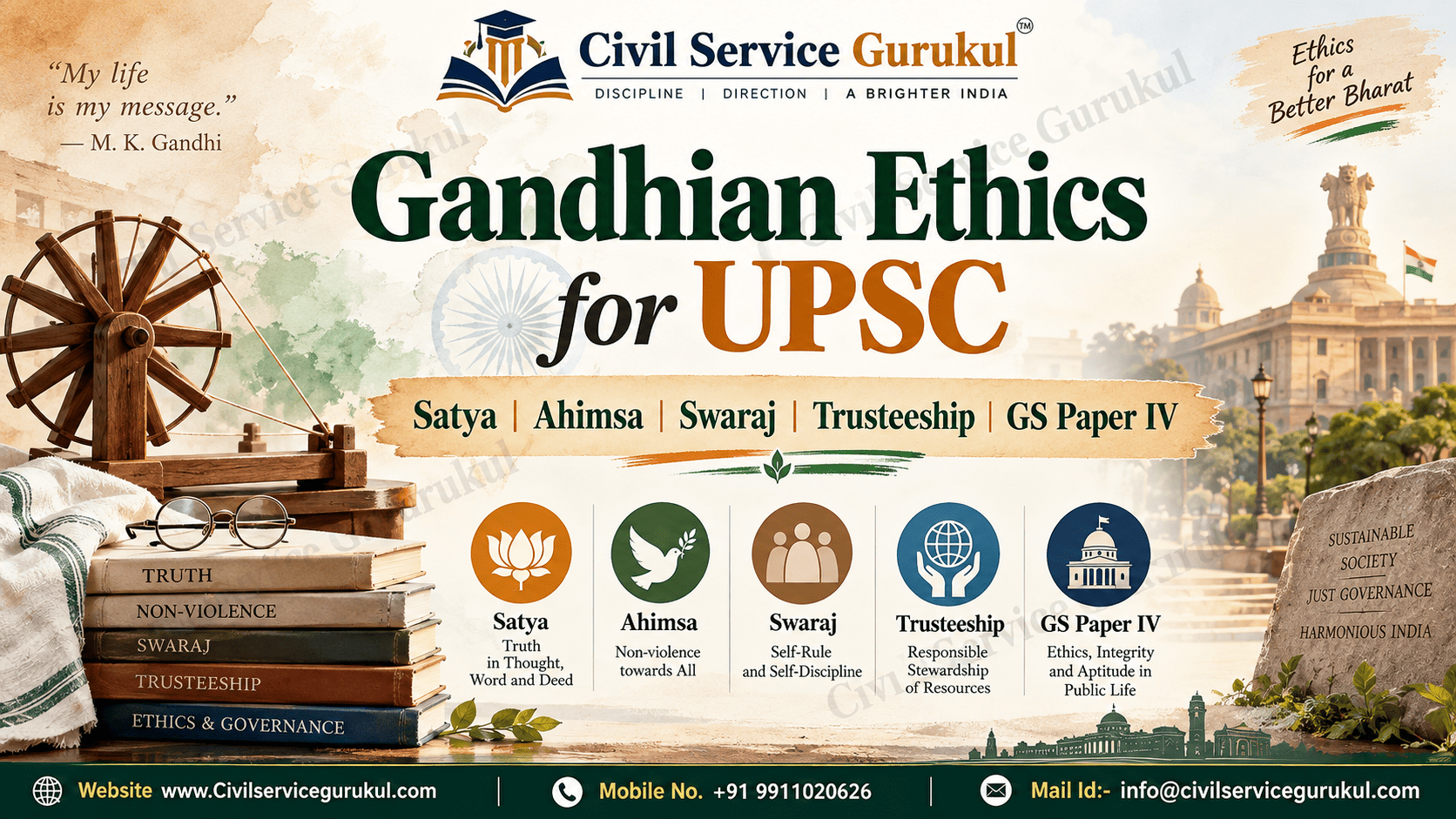
Mahatma Gandhi’s political legacy is widely studied in Modern Indian History, but for UPSC aspirants his ideas are equally important for GS Paper IV – Ethics, Integrity and Aptitude, Essay, Governance and even contemporary public policy.
On Gandhi Jayanti, the relevance of Gandhian thought extends beyond freedom struggle history. Concepts such as Satya, Ahimsa, Satyagraha, Swaraj, Trusteeship, Sarvodaya and Antyodaya can be applied to modern challenges including digital polarisation, inequality, environmental degradation, corporate responsibility and ethical governance. Insights IAS
1. Satya – Truth as an Ethical Foundation
For Gandhi, truth was not merely factual correctness. It was a moral principle guiding both private conduct and public action.
For a civil servant, Satya can be connected with:
- integrity,
- transparency,
- honesty in decision-making,
- evidence-based governance,
- and courage to communicate uncomfortable facts.
UPSC Mains Use
“Truth in public administration requires not only speaking honestly, but also ensuring that institutions do not hide inconvenient realities.”
2. Ahimsa – Non-Violence Beyond Physical Harm
Gandhian non-violence can be interpreted today in broader terms.
It can apply to:
- hate speech,
- online abuse,
- communal polarisation,
- institutional cruelty,
- exploitative economic practices,
- and environmental destruction.
In the digital age, Ahimsa can mean building public discourse that reduces hostility rather than amplifying it.
3. Satyagraha – Moral Force in Public Action
Satyagraha combined:
Truth + Non-Violence + Courage + Discipline + Willingness to Accept Consequences
It transformed non-violence from a private moral belief into a method of organised civic action.
This makes Satyagraha relevant to questions on:
- peaceful dissent,
- civil society,
- democratic protest,
- social movements,
- and conflict resolution.
A useful Ethics line:
“Satyagraha seeks to defeat injustice without dehumanising the opponent.”
4. Swaraj – Self-Rule as Self-Discipline
Gandhi’s concept of Swaraj was wider than political independence.
It included:
- self-restraint,
- individual responsibility,
- decentralised governance,
- civic participation,
- and moral autonomy.
For modern governance, Swaraj can be linked with:
- Panchayati Raj,
- community participation,
- cooperative institutions,
- and citizen accountability.
5. Trusteeship – Ethical Wealth Creation
Gandhi’s idea of Trusteeship suggested that wealth carries a social obligation.
The modern relevance can be seen in:
- CSR,
- ESG,
- responsible capitalism,
- philanthropy,
- inclusive business models,
- and ethical corporate governance.
For UPSC answers, this idea is useful in connecting economic growth with social responsibility.
6. Sarvodaya and Antyodaya
Sarvodaya means welfare of all.
Antyodaya emphasises uplift of the last person.
These concepts can be applied to:
- welfare schemes,
- inclusive growth,
- poverty reduction,
- social justice,
- public health,
- education,
- and last-mile service delivery.
A strong Mains line:
“The ethical quality of public policy can be tested by its impact on the most vulnerable citizen.”
7. Gandhian Talisman for Civil Servants
Gandhi’s famous ethical test asks decision-makers to recall the poorest and weakest person and consider whether a proposed action will help them.
For administration, this can serve as a framework for:
- welfare targeting,
- budget prioritisation,
- disaster relief,
- tribal policy,
- health access,
- and rural development.
8. Relevance in the Age of AI and Social Media
Gandhian thought is especially useful in understanding emerging challenges.
Digital Polarisation
Ahimsa and dialogue can counter online hostility.
AI and Ethics
Truth, accountability and human oversight can guide responsible AI.
Climate Change
Simple living, restraint and sustainable consumption echo Gandhian ideas.
Economic Inequality
Trusteeship and Antyodaya can inform inclusive economic policy.
Democratic Dissent
Satyagraha provides a framework for peaceful protest and civic participation.
9. Gandhi and Environmental Ethics
Gandhi’s philosophy stressed restraint and responsible consumption.
This is highly relevant to:
- climate change,
- sustainable lifestyles,
- circular economy,
- resource conservation,
- and intergenerational justice.
A good Essay line:
“Sustainability requires not only greener technology, but also a more restrained conception of consumption.”
10. Gandhi in GS Paper IV
You can use Gandhi in answers on:
- integrity,
- courage of conviction,
- leadership,
- empathy,
- public service,
- non-violence,
- accountability,
- ethical governance,
- conflict resolution.
Example
If asked about ethical leadership:
Gandhi demonstrated that leadership can derive authority from moral consistency rather than formal power.
Possible UPSC Mains Questions
Q1. Discuss the relevance of Gandhian ethics in addressing digital polarisation and social conflict.
Q2. Explain how the concept of Trusteeship can contribute to responsible capitalism.
Q3. “Swaraj is as much about self-discipline as political freedom.” Discuss.
Q4. How can Gandhian principles enrich ethical decision-making in public administration?
Quick Revision Table
| Gandhian PrincipleModern Application | |
| Satya | Transparency and integrity |
| Ahimsa | Peaceful governance and social harmony |
| Satyagraha | Democratic dissent |
| Swaraj | Decentralisation and civic responsibility |
| Trusteeship | CSR and responsible capitalism |
| Sarvodaya | Welfare of all |
| Antyodaya | Last-mile inclusion |
| Simple Living | Sustainability |
Conclusion
Gandhian philosophy remains relevant because it offers an ethical framework for questions that continue to shape modern India: inequality, social conflict, technological power, environmental stress and the quality of governance.
For UPSC aspirants, Gandhi should therefore be studied not only as a historical figure but as a moral thinker whose ideas can enrich Ethics, Essay, Governance and contemporary current-affairs answers. The 2 October current-affairs coverage also underscores his continuing relevance to non-violence, inclusive governance and 21st-century public challenges.
Prepare with Mentors Who Cleared the Exam
Get personalized study plans, evaluated answer models, and test series access.