
IIT Student Mental Health 2026: UPSC Analysis
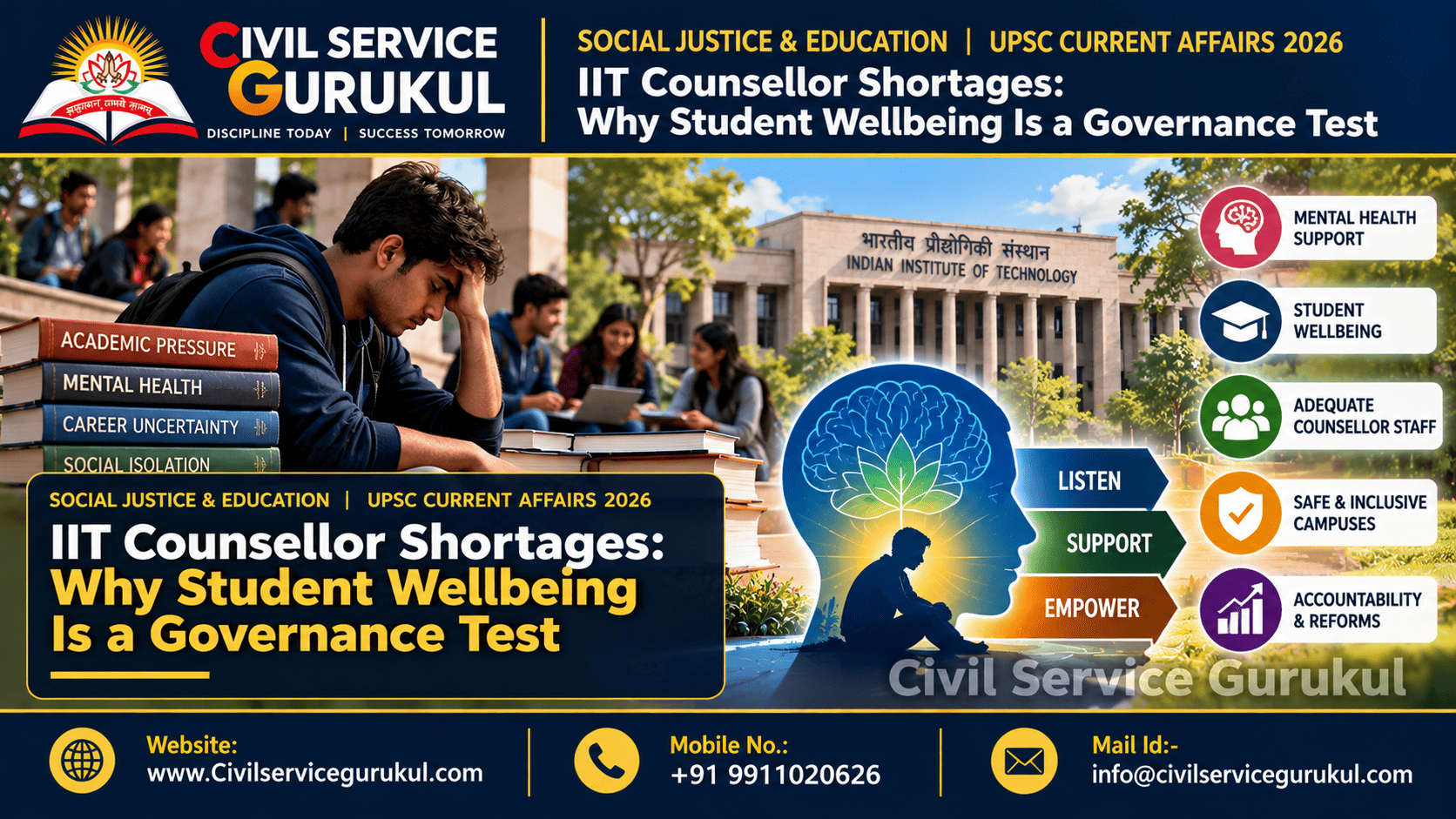
IIT Student Mental Health Crisis 2026: Counsellor Shortages, UGC Guidelines and the Need for Inclusive Campuses
Why student wellbeing, accessible counselling and institutional accountability are essential components of quality higher education in India.
October 2026 reporting based on Right to Information responses has raised concerns about mental-health counsellor availability at several Indian Institutes of Technology.
The reported staffing ratios differ across institutions, and some public summaries use inconsistent counting methods.
The central issue is not merely the number of counsellors but whether students can access timely, confidential, inclusive and effective support.
The discussion also highlights the importance of grievance redressal, anti-discrimination measures, faculty sensitisation and institutional accountability.
For UPSC, the issue connects education governance, social justice, public health, constitutional dignity and ethical administration.
*The 1:500 ratio is cited in the supplied reporting. Its precise guideline source, scope and legal status should be independently verified before treating it as a mandatory staffing rule.
Prelims: Public health, education governance, RTI and national mental-health support initiatives.
GS Paper II: Education, health, welfare and social justice.
GS Paper IV: Empathy, accountability, institutional ethics and public-service values.
1. Why Is IIT Student Mental Health in the News?
Higher education institutions are expected to provide not only academic excellence but also safe, inclusive and supportive learning environments.
October 2026 reporting based on RTI responses indicated concerns about the availability of mental-health counsellors at several IITs.
The reporting has renewed debate about whether leading technical institutions have adequate systems for student wellbeing.
It also raises broader questions about how educational quality should be measured.
Placements, research output and examination performance are important, but they cannot substitute for student safety, dignity and accessible support.
2. What Does the RTI-Based Reporting Indicate?
The supplied report indicates that several IITs may have fewer mental-health professionals than a benchmark cited in public coverage.
However, staffing figures can vary depending on whether full-time counsellors, visiting professionals and specialists are counted together or separately.
Some secondary summaries also differ in their campus-specific numbers.
Therefore, individual institutional ratios should not be presented as conclusively verified without checking the underlying RTI responses and definitions.
What should institutions disclose?
- Number of full-time counsellors.
- Number of visiting professionals.
- Student enrolment used in ratio calculations.
- Average counselling waiting time.
- Availability of emergency support.
- Accessibility of multilingual services.
- Referral and follow-up arrangements.
3. UGC Guidance and the Reported 1:500 Benchmark
The University Grants Commission has circulated guidance concerning mental health and wellbeing in higher education.
The October 2026 coverage cites a benchmark of one mental-health professional for every 500 students.
However, the exact source, definitions, applicability and legal status of this benchmark require verification.
A benchmark mentioned in reporting should not automatically be described as a binding statutory requirement.
Aspirants should distinguish between policy guidance, recommendations, institutional practices and enforceable legal obligations.
4. Barriers to Effective Campus Mental-Health Support
Having a counselling office does not necessarily mean that students can easily obtain help.
Barriers may arise from stigma, fear of disclosure, limited service hours, language differences or uncertainty about confidentiality.
Common institutional challenges
- Long waiting times.
- Insufficient counselling capacity.
- Limited multilingual support.
- Fear of academic consequences.
- Concerns about privacy.
- Weak referral networks.
- Lack of awareness about available services.
- Insufficient continuity of care.
These barriers can prevent students from using support services even when such services formally exist.
5. Mental Health, Social Inclusion and Non-Discrimination
Student wellbeing is influenced by the broader campus environment.
Experiences of exclusion, harassment, financial stress, disability-related barriers and social isolation can affect whether students feel safe seeking assistance.
Institutions must therefore address both individual support needs and structural problems.
Important institutional measures
- Responsive anti-discrimination mechanisms.
- Accessible grievance redressal.
- Inclusive teaching practices.
- Disability accommodation.
- Mentorship and peer-support networks.
- Faculty sensitisation.
- Support for students from diverse linguistic and social backgrounds.
Counselling cannot replace the need to address harassment, discrimination or exclusion.
6. Confidentiality, Privacy and Student Rights
Confidentiality is essential to building trust in mental-health support systems.
Students may hesitate to seek assistance if they believe that sensitive personal information will be disclosed to academic departments or other parties without appropriate justification.
Good governance principles
- Clear confidentiality policies.
- Appropriate handling of sensitive records.
- Professional referral protocols.
- Informed participation wherever appropriate.
- Limited access to personal information.
- Defined procedures for emergencies.
Institutions should avoid converting wellbeing programmes into intrusive monitoring systems.
Anonymous surveys and voluntary support arrangements may help identify institutional concerns while respecting student autonomy.
7. Tele-MANAS: National Mental-Health Support
Tele-MANAS is a government-supported national tele-mental-health service.
It provides a 24-hour support channel through the number 14416.
Such services can supplement campus counselling arrangements by providing additional access to support and referral.
Tele-MANAS helpline: 14416.
A national helpline can supplement, but should not be treated as a complete substitute for accessible campus-level professional services.
8. Institutional Accountability and Higher Education Governance
Student mental health should be understood as a governance responsibility rather than only an individual concern.
Institutions should evaluate whether support systems are accessible, trustworthy and responsive.
Key governance indicators
| Indicator | Why It Matters |
|---|---|
| Counsellor Availability | Measures basic staffing capacity |
| Waiting Time | Indicates practical accessibility |
| Confidentiality | Builds student trust |
| Multilingual Access | Supports diverse student populations |
| Referral Networks | Connects students with appropriate care |
| Grievance Redressal | Addresses institutional concerns |
| Independent Review | Strengthens accountability |
Transparent institutional reporting can improve public accountability without compromising student privacy.
9. Policy Priorities and the Way Forward
A comprehensive campus wellbeing strategy should combine accessible support with institutional reforms.
Recommended measures
- Publish annual wellbeing dashboards with clear staffing definitions.
- Conduct independent reviews of support systems.
- Provide confidential counselling.
- Expand multilingual and accessible services.
- Strengthen professional referral networks.
- Train faculty to recognise and appropriately respond to distress.
- Improve anti-discrimination and grievance mechanisms.
- Support preventive wellbeing programmes.
- Protect sensitive student information.
- Measure service quality rather than staffing alone.
The objective should be to create institutions where students can seek support without fear, stigma or exclusion.
10. UPSC Prelims Quick Revision Notes
- RTI: Right to Information is an important transparency mechanism.
- Reported issue: Counsellor availability at several IITs.
- Reported benchmark: One mental-health professional per 500 students; legal status requires verification.
- UGC: University Grants Commission.
- Tele-MANAS: National tele-mental-health support service.
- Tele-MANAS number: 14416.
- Core governance principles: Accessibility, confidentiality, equity and accountability.
- UPSC relevance: GS Paper II and GS Paper IV.
11. UPSC Prelims Practice MCQs
Which of the following provides the most comprehensive assessment of campus mental-health preparedness?
(a) Number of counsellors alone.
(b) Placement salary alone.
(c) Accessible staffing, confidentiality, response times, inclusion and effective referrals.
(d) Attendance at a single annual awareness event.
Institutional preparedness depends on staffing, service accessibility, confidentiality, inclusion and effective referral mechanisms.
With reference to Tele-MANAS, consider the following statements:
- It is a government-supported tele-mental-health service.
- Its helpline number is 14416.
- It eliminates the need for campus counselling services.
Which statements are correct?
(a) 1 and 2 only
(b) 2 and 3 only
(c) 1 and 3 only
(d) 1, 2 and 3
Tele-MANAS provides national support, but it does not replace the need for accessible campus-level services.
Why should RTI-based institutional staffing comparisons be interpreted carefully?
(a) RTI responses never contain useful information.
(b) Staffing definitions and reporting dates may differ across institutions.
(c) Counsellor availability is irrelevant to student wellbeing.
(d) Every reported benchmark is automatically statutory.
Different counting methods, definitions and reporting periods can affect institutional comparisons.
Which of the following measures can support inclusive campus wellbeing?
- Confidential counselling.
- Accessible grievance redressal.
- Anti-discrimination measures.
Select the correct answer:
(a) 1 only
(b) 1 and 2 only
(c) 2 and 3 only
(d) 1, 2 and 3
Effective campus wellbeing requires individual support and broader institutional safeguards.
12. UPSC Mains Practice Questions
Question 1 — GS Paper II
Discuss the responsibilities of higher-education institutions in creating mentally healthy and inclusive campuses. (150 words)
Suggested Answer Framework
Higher-education institutions have responsibilities extending beyond academic instruction to student safety, inclusion and wellbeing.
RTI-based reporting in October 2026 raised concerns about counsellor availability at several IITs, highlighting the importance of transparent institutional assessment.
Effective support requires timely access, confidentiality, multilingual services, trained referral networks and responsive grievance redressal.
Institutions must also address discrimination, exclusion and other structural barriers that can undermine student wellbeing.
Annual wellbeing reviews, faculty sensitisation, independent audits and privacy safeguards can improve accountability.
Therefore, student wellbeing should be treated as an integral dimension of educational quality and public institutional responsibility.
Question 2 — GS Paper IV
Empathy and accountability are essential to ethical educational administration. Examine with reference to student wellbeing in higher-education institutions. (250 words)
Answer Approach
- Define empathy and accountability in institutional governance.
- Explain the importance of recognising student vulnerabilities.
- Discuss confidentiality and dignity.
- Highlight inclusion and non-discrimination.
- Explain transparent reporting and independent review.
- Conclude with ethical, responsive administration.
13. Frequently Asked Questions
Why is IIT student mental health in the news in 2026?
RTI-based reporting raised concerns about counsellor availability and the adequacy of campus wellbeing support systems at several IITs.
Are all reported IIT counsellor ratios independently confirmed?
No. Public summaries differ in staffing definitions and institutional figures, so campus-specific ratios require verification.
Is the reported 1:500 counsellor benchmark a binding legal rule?
The supplied reporting cites this benchmark, but its exact source, applicability and legal status require independent verification.
What is Tele-MANAS?
Tele-MANAS is a government-supported national tele-mental-health service accessible through 14416.
Can counselling alone solve campus wellbeing problems?
No. Counselling should be complemented by anti-discrimination measures, accessible grievance systems and inclusive institutional practices.
Why is confidentiality important in student counselling?
Confidentiality helps build trust and encourages students to seek appropriate support without unnecessary fear of disclosure.
Why is the issue important for UPSC?
It connects education, public health and social justice under GS Paper II with empathy, accountability and institutional ethics under GS Paper IV.
14. Conclusion: Student Wellbeing Must Be Central to Educational Excellence
The debate over counselling availability at IITs highlights an important principle of educational governance.
Academic excellence cannot be measured solely through placements, rankings and research output.
A high-quality institution must also provide accessible support, protect confidentiality and respond effectively to discrimination and exclusion.
Transparent staffing data, independent review, professional referral systems and student-centred administration can strengthen institutional accountability.
For UPSC aspirants, the key lesson is that student mental health is not merely an individual issue but an important dimension of public health, social justice and ethical governance.
Prepare for UPSC with Civil Service Gurukul
Strengthen your preparation for UPSC Prelims and Mains with concept-based current affairs, Social Justice, Governance, Ethics and answer-writing practice.
Website: www.civilservicegurukul.com
Mobile: +91 9911020626
Email: info@civilservicegurukul.com
Disclaimer: This article is intended for UPSC educational preparation and does not provide medical advice. The staffing observations are based on the supplied reporting, and the precise status of the cited benchmark requires verification. Institutional policies and regulatory developments should be checked against authoritative current materials.
Prepare with Mentors Who Cleared the Exam
Get personalized study plans, evaluated answer models, and test series access.