
India Reaches 103 Ramsar Sites in 2026: New Wetlands, Biodiversity and UPSC Notes
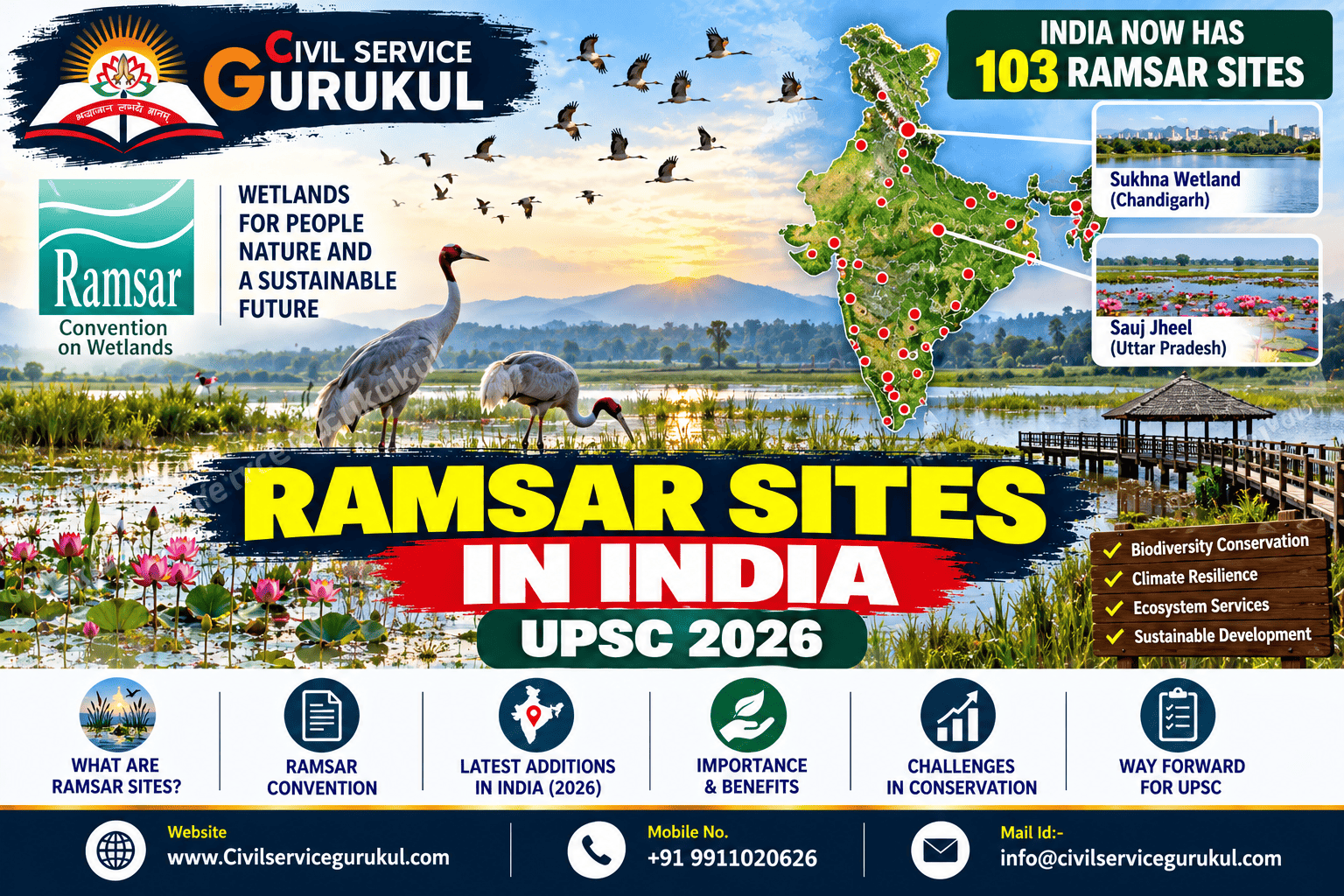
India Reaches 103 Ramsar Sites in 2026: Sukhna Wetland, Sauj Jheel and Wetland Conservation
Discover why India's expanding Ramsar network matters for biodiversity, water security, climate resilience and sustainable development.
GS Paper III | Geography | UPSC Prelims & Mains
India's network of Wetlands of International Importance reached 103 sites in October 2026 following the addition of Sukhna Wetland in Chandigarh and Sauj Jheel in Uttar Pradesh.
The newly designated wetlands highlight the ecological importance of migratory bird habitats, floodplain lakes and urban water bodies.
For UPSC, the topic connects the Ramsar Convention, wetland biodiversity, conservation laws, ecosystem services and sustainable development.
1. Why Are Ramsar Sites in the News?
India's Ramsar network expanded to 103 sites in October 2026, covering more than 13.87 lakh hectares of wetland ecosystems.
Two newly designated sites attracted attention:
- Sukhna Wetland, Chandigarh: An artificial rain-fed reservoir near the Shivalik foothills.
- Sauj Jheel, Uttar Pradesh: A shallow floodplain lake in Mainpuri district that supports large populations of waterbirds.
The development is important because wetlands provide essential services such as flood control, groundwater recharge, biodiversity protection and livelihood support.
2. What Is a Ramsar Site?
A Ramsar Site is a wetland recognised as internationally important under the Ramsar Convention on Wetlands.
The Convention was adopted in 1971 in Ramsar, Iran. Its central objective is the conservation and wise use of wetlands through national action and international cooperation.
Ramsar designation recognises ecological importance, but designation alone does not guarantee that a wetland is free from pollution, encroachment or degradation.
The Ramsar Convention is an international treaty concerning wetlands. It is not an Indian national park designation or a UNESCO World Heritage category.
3. What Types of Ecosystems Qualify as Wetlands?
Wetlands include natural and artificial ecosystems where water strongly influences soil conditions, vegetation and ecological processes.
- Marshes and swamps.
- Lakes and river floodplains.
- Mangroves and coastal lagoons.
- Peatlands and fens.
- Reservoirs and certain artificial water bodies.
- Shallow marine waters meeting the Convention's definition.
Under the Ramsar definition, certain marine areas are included where water depth at low tide does not exceed six metres.
4. India's New Ramsar Sites in 2026
| Site | Location | Ecological Importance |
|---|---|---|
| Surha Tal / Jai Prakash Narayan Bird Sanctuary | Ballia, Uttar Pradesh | Floodplain ecosystem and bird habitat; identified as India's 100th Ramsar Site. |
| Glaw Lake | Arunachal Pradesh | Eastern Himalayan lake ecosystem and biodiversity. |
| Sukhna Wetland | Chandigarh | Artificial reservoir and migratory bird habitat. |
| Sauj Jheel | Mainpuri, Uttar Pradesh | Floodplain lake supporting waterbirds and sarus crane habitat. |
These additions illustrate the diversity of Indian wetlands, from Himalayan lakes to the floodplain ecosystems of the Gangetic region.
5. Sukhna Wetland: Important Facts
Sukhna Wetland is located in Chandigarh near the foothills of the Shivalik range.
It is an artificial, rain-fed reservoir that provides ecological and recreational benefits.
Why Is Sukhna Important?
- Supports aquatic biodiversity.
- Provides habitat for resident and migratory birds.
- Forms part of the wider ecological landscape associated with the Central Asian Flyway.
- Contributes to the urban environment and landscape.
- Highlights the importance of conserving artificial wetlands.
6. Sauj Jheel: Important Facts
Sauj Jheel is located in Mainpuri district, Uttar Pradesh.
It is a shallow perennial floodplain lake associated with important waterbird habitats.
The October 2026 current-affairs report highlights its role in supporting large congregations of waterbirds and nesting habitat for the vulnerable sarus crane.
Why Is Sauj Jheel Important?
- Supports wetland biodiversity.
- Provides feeding and nesting habitats for birds.
- Contributes to floodplain ecological processes.
- Supports the conservation of threatened species.
- Demonstrates the importance of protecting smaller inland wetlands.
7. What Are the Nine Ramsar Criteria?
A wetland may qualify for Ramsar designation if it satisfies at least one of nine internationally recognised criteria.
| Criterion | Main Requirement |
|---|---|
| 1 | Representative, rare or unique wetland type. |
| 2 | Supports threatened species or ecological communities. |
| 3 | Supports biodiversity important to a biogeographic region. |
| 4 | Supports species at critical life stages or provides refuge. |
| 5 | Regularly supports 20,000 or more waterbirds. |
| 6 | Regularly supports at least 1% of a waterbird population. |
| 7 | Supports significant indigenous fish diversity. |
| 8 | Provides important fish spawning, nursery or migration habitat. |
| 9 | Regularly supports at least 1% of a population of a wetland-dependent non-avian animal species. |
Criterion 5 refers to at least 20,000 waterbirds, while Criterion 6 concerns 1% of a waterbird population. Do not confuse these numerical thresholds.
8. Why Are Wetlands Important?
A. Flood Regulation
Wetlands can store excess water during periods of heavy rainfall and reduce the intensity of flooding.
B. Groundwater Recharge
Some wetlands support groundwater recharge, depending on their geological and hydrological characteristics.
C. Biodiversity Conservation
Wetlands provide breeding, feeding and resting habitats for fish, birds, amphibians and other organisms.
D. Water Purification
Wetland vegetation and sediments can help retain nutrients and filter certain pollutants, although wetlands have limited treatment capacity.
E. Climate Regulation
Peatlands and mangroves can store substantial carbon, making their conservation important for climate mitigation.
F. Local Livelihoods
Wetlands support fishing, agriculture, tourism and traditional resource-based livelihoods.
9. Ramsar Sites and the Central Asian Flyway
The Central Asian Flyway is an important migratory bird route connecting breeding and non-breeding areas across a large region of Eurasia and the Indian subcontinent.
Wetlands along migration routes provide birds with essential places to rest, feed and recover energy.
Habitat degradation at even a few important locations can affect migratory populations across international boundaries.
10. Major Threats to Indian Wetlands
| Threat | Possible Impact |
|---|---|
| Urban Encroachment | Loss of wetland area and natural drainage. |
| Untreated Sewage | Water pollution and oxygen depletion. |
| Agricultural Runoff | Excess nutrients and eutrophication. |
| Invasive Species | Changes in native habitats and ecosystem functioning. |
| Siltation | Reduced water-holding capacity. |
| Hydrological Alteration | Disruption of natural water flows. |
| Climate Change | Changes in rainfall, temperature and water availability. |
11. Government Initiatives for Wetland Conservation
Wetlands (Conservation and Management) Rules, 2017
These rules provide a legal framework for the conservation and management of notified wetlands in India, with important roles for State and Union Territory Wetland Authorities.
Amrit Dharohar
This initiative focuses on conserving Ramsar Sites while supporting biodiversity, sustainable livelihoods and nature-based economic opportunities.
Mission Sahbhagita
Mission Sahbhagita encourages public participation and community involvement in wetland conservation.
Save Wetlands Campaign
The campaign promotes awareness, citizen engagement and the protection of wetland ecosystems.
MISHTI
The Mangrove Initiative for Shoreline Habitats and Tangible Incomes supports mangrove restoration and conservation in suitable coastal areas.
12. How Can India Improve Wetland Conservation?
- Scientific Mapping: Use GIS and remote sensing to identify wetland boundaries and catchments.
- Pollution Control: Improve sewage treatment and reduce harmful industrial discharges.
- Community Participation: Involve local residents, fishers and other stakeholders in conservation.
- Integrated Management: Coordinate wetland conservation across government departments.
- Ecological Flows: Protect water flows needed to sustain wetland ecosystems.
- Monitoring: Track changes in water quality, biodiversity and habitat condition.
- Climate Adaptation: Include wetlands in flood management and climate-resilience planning.
13. Ramsar Sites and Sustainable Development Goals
Wetland conservation contributes to several Sustainable Development Goals.
| SDG | Connection |
|---|---|
| SDG 6 | Clean Water and Sanitation. |
| SDG 11 | Sustainable Cities and Communities. |
| SDG 13 | Climate Action. |
| SDG 14 | Life Below Water. |
| SDG 15 | Life on Land. |
14. UPSC Prelims Quick Revision
- Ramsar Convention: Adopted in 1971 at Ramsar, Iran.
- India's Ramsar Site tally: 103 as reported on 26 October 2026.
- Sukhna Wetland: Chandigarh.
- Sauj Jheel: Mainpuri, Uttar Pradesh.
- Surha Tal: Ballia, Uttar Pradesh.
- Glaw Lake: Arunachal Pradesh.
- Ramsar designation: At least one of nine criteria.
- Criterion 5: At least 20,000 waterbirds.
- Criterion 6: At least 1% of a waterbird population.
- Wetlands Rules: 2017.
- Amrit Dharohar: Ramsar Site conservation and livelihoods.
15. UPSC Prelims Practice MCQs
Consider the following statements:
- The Ramsar Convention was adopted in Iran.
- Only naturally formed wetlands can receive Ramsar designation.
- A wetland may qualify by meeting at least one Ramsar criterion.
Which statements are correct?
(A) 1 only
(B) 1 and 3 only
(C) 2 and 3 only
(D) 1, 2 and 3
Sauj Jheel is located in which Indian state?
(A) Bihar
(B) Gujarat
(C) Uttar Pradesh
(D) Rajasthan
Which Ramsar criterion refers to regularly supporting 20,000 or more waterbirds?
(A) Criterion 1
(B) Criterion 3
(C) Criterion 5
(D) Criterion 9
The Amrit Dharohar initiative is primarily associated with:
(A) Urban metro development
(B) Conservation of Ramsar Sites and related livelihoods
(C) Semiconductor manufacturing
(D) Defence modernisation
16. UPSC Mains Practice Question
"Wetland ecosystems are increasingly vulnerable due to human activities despite their importance for biodiversity and climate resilience."
Analyse the major challenges in wetland conservation in India and suggest measures for their sustainable management.
Word Limit: 250 words
Suggested Answer Framework
- Introduce the ecological importance of wetlands.
- Explain biodiversity and hydrological benefits.
- Discuss encroachment, pollution and altered water flows.
- Examine existing conservation initiatives.
- Recommend scientific monitoring and community-led management.
- Conclude with the need to protect ecological functions beyond Ramsar designation.
17. Frequently Asked Questions
How many Ramsar Sites does India have in October 2026?
The current-affairs report dated 26 October 2026 places India's tally at 103 Ramsar Sites.
Which are the newly designated Ramsar Sites?
Sukhna Wetland in Chandigarh and Sauj Jheel in Uttar Pradesh are the October 2026 additions highlighted in the report.
What is the Ramsar Convention?
It is an international treaty adopted in 1971 to promote the conservation and wise use of wetlands.
Is Ramsar designation limited to natural wetlands?
No. Certain artificial wetlands can also qualify under the Convention's definition and selection criteria.
Why are Ramsar Sites important for UPSC?
They connect biodiversity, international environmental agreements, geography, ecosystem services, conservation policies and sustainable development.
18. Conclusion: Conservation Beyond Designation
India's expansion to 103 Ramsar Sites highlights the growing recognition of wetland ecosystems in environmental policy.
However, international designation alone cannot prevent ecological damage. Wetlands require effective protection against encroachment, pollution, invasive species and disruption of natural water flows.
Long-term success depends on scientific management, accountable institutions and active participation by local communities.
Final UPSC Takeaway: Wetland conservation is not only about protecting birds and aquatic species. It is also essential for water security, disaster resilience, climate adaptation and sustainable livelihoods.
Prepare for UPSC with Civil Service Gurukul
Strengthen your understanding of Environment, Ecology, Geography, Indian Polity, Economy and Current Affairs through structured UPSC-focused learning resources.
Website: www.civilservicegurukul.com
Mobile: +91 9911020626
Email: info@civilservicegurukul.com
Editorial Note: This article is original educational analysis for UPSC preparation based on the 26 October 2026 current-affairs topic. Ramsar Site counts and recent designations are time-sensitive and should be updated when new official notifications are issued.
Prepare with Mentors Who Cleared the Exam
Get personalized study plans, evaluated answer models, and test series access.