
India Reservoir Storage 2026: Complete UPSC Notes
India's Reservoir Storage Crisis 2026: CWC Report, Pennar–Cauvery Deficits and Water Security Explained
Complete UPSC notes on the Central Water Commission's October 2026 reservoir bulletin, geographical imbalances, irrigation risks, climate resilience, river-basin governance, Prelims MCQs and Mains answer writing.
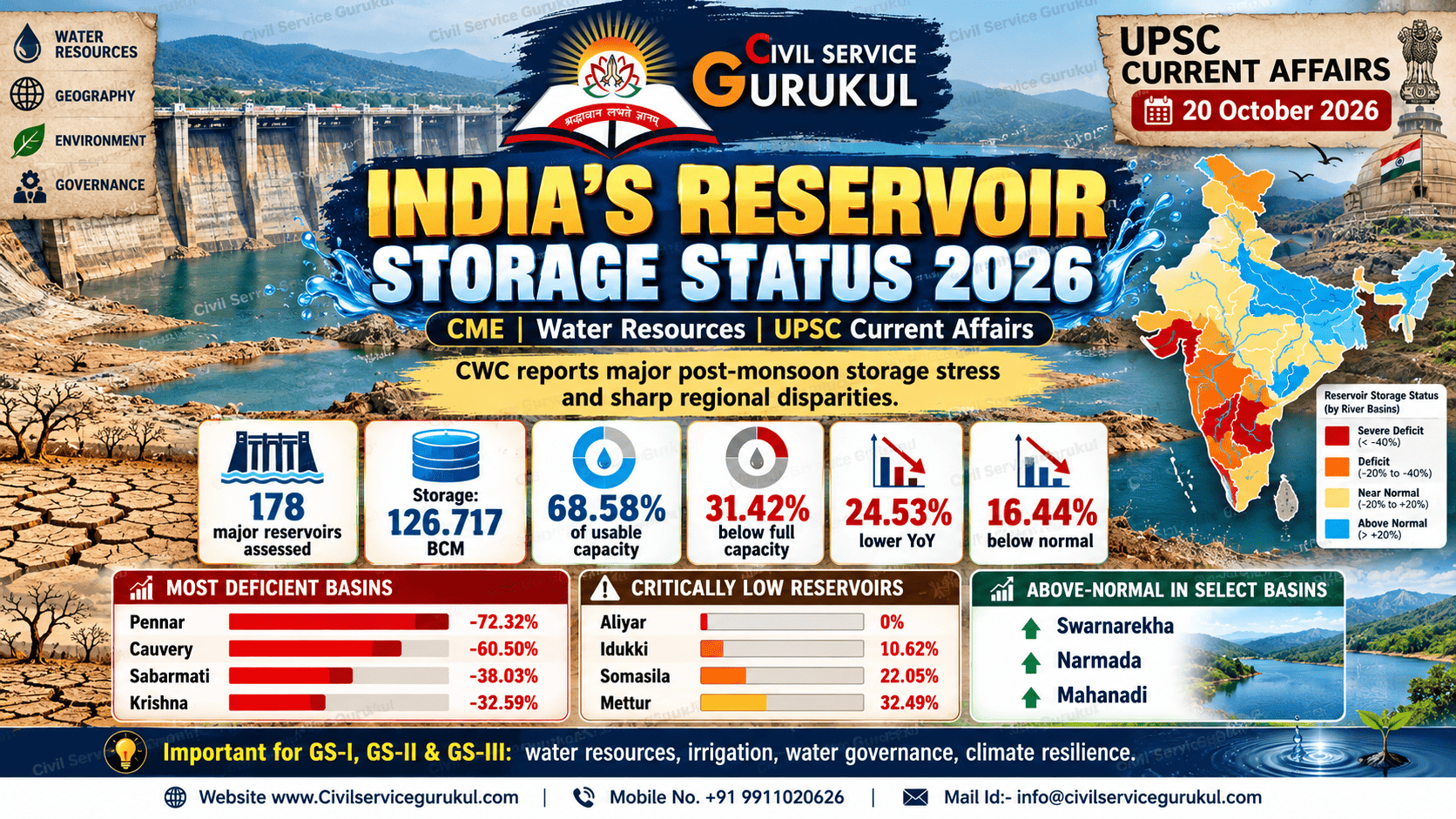
Why in News? The Central Water Commission's weekly reservoir storage bulletin dated 15 October 2026 reported that 178 monitored reservoirs held 126.717 billion cubic metres of water. This represented 68.58% of their usable live storage capacity and was 16.44% below normal. The Pennar and Cauvery basins registered severe deficits, raising concerns about India's dry-season water security.
UPSC Syllabus Relevance
GS-I: Indian geography, water resources, drainage systems and regional resource distribution.
GS-III: Irrigation, water conservation, agriculture, climate adaptation and environmental security.
GS-II: Water governance, inter-state coordination and public policy.
Prelims: CWC, reservoirs, major dams, rivers, basins and water-storage terminology.
1. Central Water Commission: October 2026 Findings
India's 178 monitored major reservoirs had a combined usable live storage capacity of approximately 184.762 BCM.
The water available on 15 October 2026 was 126.717 BCM, representing 68.58% of that capacity.
| Indicator | Reported Value |
|---|---|
| Bulletin date | 15 October 2026 |
| Reservoirs covered | 178 |
| Live storage | 126.717 BCM |
| Total monitored usable capacity | 184.762 BCM |
| Capacity currently filled | 68.58% |
| Capacity not filled | 31.42% |
| Storage below previous year | 24.53% |
| Storage below ten-year normal | 16.44% |
Three Percentages That Must Not Be Confused
31.42% below full usable capacity means the monitored reservoirs were not completely filled.
24.53% below last year compares available storage with the corresponding period in 2025.
16.44% below normal compares it with the long-term storage average for that time of year.
2. Essential Reservoir Terminology
| Term | Meaning |
|---|---|
| BCM | Billion Cubic Metres; a unit of water volume. |
| Live Storage | Usable reservoir water available above the minimum drawdown level. |
| Dead Storage | Water below the level from which normal gravity-based release is possible. |
| Full Reservoir Level | Designed maximum water level for normal reservoir operation. |
| Normal Storage | Historical average storage for the corresponding period, conventionally based on ten years. |
| Catchment Area | Land area that contributes runoff to a river or reservoir. |
| River Basin | Drainage area served by a river and its tributaries. |
These concepts allow analysts to distinguish available water, designed storage capacity, historical trends and basin-level stress.
3. Regional Disparities in Reservoir Storage
The southern region recorded the lowest reported live storage utilisation among India's five monitored regions.
| Region | Live Capacity Filled |
|---|---|
| Northern | 57.33% |
| Eastern | 79.89% |
| Western | 80.73% |
| Central | 86.36% |
| Southern | 44.31% |
Regional Storage Comparison
The central region was the only one among the five with storage above its corresponding normal level, according to the bulletin.
The data demonstrate why India requires basin-specific planning instead of relying only on national averages.
4. Pennar and Cauvery: The Most Stressed River Basins
Pennar River Basin
72.32% below normal.
The Pennar originates in Karnataka and flows eastward through Andhra Pradesh to the Bay of Bengal.
Its basin includes drought-prone regions with substantial irrigation dependence.
Cauvery River Basin
60.50% below normal.
The Cauvery originates at Talakaveri in Karnataka's Western Ghats and flows through southern India towards the Bay of Bengal.
It is important for irrigation, drinking water, hydropower and inter-state water management.
Additional Basin-Level Findings
| River Basin | Storage Relative to Normal |
|---|---|
| Pennar | 72.32% below normal |
| Cauvery | 60.50% below normal |
| Sabarmati | 38.03% below normal |
| Krishna | 32.59% below normal |
| Subarnarekha | Above normal |
| Narmada | Above normal |
| Mahanadi | Above normal |
A basin with a severe deficit may still contain water. The shortfall measures available storage relative to its historical benchmark.
5. Major Dams and Reservoirs for UPSC Prelims
| Dam or Reservoir | River | State |
|---|---|---|
| Mettur | Cauvery | Tamil Nadu |
| Krishnaraja Sagara | Cauvery | Karnataka |
| Somasila | Pennar | Andhra Pradesh |
| Srisailam | Krishna | Andhra Pradesh–Telangana region |
| Nagarjuna Sagar | Krishna | Andhra Pradesh–Telangana |
| Idukki | Periyar system | Kerala |
| Aliyar | Aliyar River | Tamil Nadu |
The October 2026 bulletin identified especially low storage levels at several individual reservoirs, including Aliyar, Somasila and Mettur.
For map-based questions, aspirants should learn the river, state and basin associated with each project.
6. Why Does Reservoir Water Stress Persist?
Uneven Monsoon Distribution
Rainfall varies considerably across regions, seasons and individual river catchments.
High Irrigation Demand
Water-intensive cultivation can increase demand on reservoirs during dry periods.
Climate Variability
Shifts in rainfall timing, heat and extreme weather can affect inflows and water requirements.
Reservoir Sedimentation
Sediment accumulation may reduce effective storage capacity over time.
Other factors can include reservoir release policies, inter-state allocation, groundwater extraction and rising urban demand.
7. Implications for Water Security and Development
1. Rabi Agriculture
Post-monsoon storage supports winter-season irrigation. Lower reserves may restrict sowing options or increase groundwater use.
2. Drinking-Water Supply
Cities, villages and industries compete for stored surface water when rainfall and river flows decline.
3. Hydropower Generation
Low reservoir levels can affect available head and operational flexibility at hydropower projects.
4. Inter-State Water Relations
Shortages can complicate water-sharing arrangements, particularly in basins already experiencing long-standing disputes.
5. Rural Livelihoods
Water stress can influence crop yields, agricultural employment, food prices and household resilience.
6. Environmental Flows
Reservoir management must also consider downstream ecological requirements and aquatic ecosystems.
8. Central Water Commission and Water Governance
The Central Water Commission is a premier technical organisation associated with India's water-resource planning and monitoring.
It functions under the Department of Water Resources, River Development and Ganga Rejuvenation in the Ministry of Jal Shakti.
Major CWC Functions
- Monitoring reservoir storage.
- Flood forecasting and warning support.
- Hydrological data collection.
- Technical appraisal of water projects.
- Assistance in water-resource planning.
- Technical coordination on water management.
Policy and Institutional Tools
PMKSY: Pradhan Mantri Krishi Sinchayee Yojana supports irrigation and water-use efficiency.
Atal Bhujal Yojana: Promotes community-led groundwater management in participating areas.
National Water Policy: Provides a policy framework for water conservation, allocation and management.
River-basin coordination: Effective allocation requires cooperation between states sharing water resources.
9. Way Forward: Making India's Water Security Climate-Resilient
- Basin-level water budgeting: Match seasonal availability with agricultural, domestic and ecological requirements.
- Improve irrigation efficiency: Adopt drip, sprinkler and other appropriate water-saving techniques.
- Promote suitable cropping patterns: Align crop selection with local water availability.
- Strengthen groundwater recharge: Use watershed development, rainwater harvesting and managed aquifer recharge.
- Improve reservoir operations: Use updated inflow forecasts, transparent data and adaptive release planning.
- Control sedimentation: Combine catchment management with reservoir maintenance.
- Promote treated-water reuse: Reduce unnecessary pressure on freshwater supplies.
- Enhance inter-state cooperation: Improve information exchange and institutional coordination.
10. UPSC Prelims 2027: Quick Revision
| Topic | Remember |
|---|---|
| Reporting institution | Central Water Commission |
| Ministry | Ministry of Jal Shakti |
| Bulletin date | 15 October 2026 |
| Reservoirs monitored | 178 |
| Reported storage | 126.717 BCM |
| Capacity filled | 68.58% |
| Below last year | 24.53% |
| Below ten-year normal | 16.44% |
| Most deficient basin | Pennar: 72.32% below normal |
| Next major deficient basin | Cauvery: 60.50% below normal |
| Lowest-storage region | Southern region: 44.31% of capacity |
| Above-normal basins | Subarnarekha, Narmada, Mahanadi |
11. UPSC Prelims Practice Questions
Question 1
With reference to the CWC bulletin of 15 October 2026, consider:
- 178 reservoirs were monitored.
- Storage was 68.58% of usable capacity.
- Storage was 68.58% below normal.
(a) 1 only
(b) 1 and 2 only
(c) 2 and 3 only
(d) All three
View answer and explanation
Answer: (b). Storage was 16.44% below normal, not 68.58% below normal.
Question 2
Which river basin recorded the largest reported deficit?
(a) Narmada
(b) Pennar
(c) Mahanadi
(d) Subarnarekha
View answer
Answer: (b) Pennar. The reported deficit was 72.32%.
Question 3
The Central Water Commission functions under:
(a) Ministry of Agriculture
(b) Ministry of Environment
(c) Ministry of Jal Shakti
(d) Ministry of Rural Development
View answer
Answer: (c).
Question 4
Which of the following pairs are correctly matched?
- Mettur — Cauvery
- Somasila — Pennar
- Nagarjuna Sagar — Narmada
(a) 1 and 2 only
(b) 2 and 3 only
(c) 1 and 3 only
(d) All three
View answer
Answer: (a). Nagarjuna Sagar is on the Krishna River.
Question 5
Which of the following basins reportedly had above-normal storage in October 2026?
- Narmada
- Mahanadi
- Subarnarekha
(a) 1 only
(b) 1 and 2 only
(c) 2 and 3 only
(d) All three
View answer
Answer: (d) All three.
Question 6
Normal reservoir storage in the bulletin broadly refers to:
(a) The maximum physical dam capacity
(b) The historical average for the corresponding period
(c) Dead storage below outlets
(d) Total annual rainfall
View answer
Answer: (b). The normal benchmark generally uses average storage over ten years.
12. UPSC Mains 2027: Model Answer
GS-III Practice Question — 15 Marks
"Declining post-monsoon reservoir storage highlights structural weaknesses in India's water management framework." Examine the causes, implications and measures necessary for long-term water security.
Word limit: 250 words
Model Answer
Introduction: The CWC bulletin dated 15 October 2026 reported 126.717 BCM of water in 178 major reservoirs, equivalent to 68.58% of usable capacity and 16.44% below normal. The Pennar and Cauvery basins recorded serious deficits, demonstrating regional water stress.
Causes: Uneven monsoon rainfall, increasing irrigation demand, groundwater depletion, urbanisation, reservoir sedimentation and inadequate basin-level coordination contribute to water stress. Climate variability may intensify these challenges.
Implications: Lower post-monsoon reserves may constrain rabi cultivation, drinking-water supply and hydropower generation. Water shortages can increase groundwater dependence, affect rural incomes and intensify inter-state disputes.
Way forward: India requires integrated river-basin planning, efficient irrigation, crop diversification, groundwater recharge, reservoir modernisation and transparent hydrological data. Water reuse, demand management and climate-resilient forecasting should complement infrastructure development. Cooperative federalism is essential for shared basins.
Conclusion: A sustainable water future requires shifting from supply-led infrastructure alone to integrated, equitable and climate-responsive water-resource governance.
Additional Mains Practice
- Analyse the implications of regional reservoir storage disparities for Indian agriculture. (10 marks)
- Discuss the importance of integrated river-basin management in strengthening water security. (15 marks)
- Explain how climate variability and groundwater extraction can aggravate surface-water stress. (15 marks)
13. Frequently Asked Questions
Q1. How much water was stored in India's monitored reservoirs?
126.717 BCM on 15 October 2026.
Q2. What percentage of storage capacity was filled?
Approximately 68.58%.
Q3. How far below normal was national storage?
16.44% below normal.
Q4. Which basins faced severe deficits?
Pennar and Cauvery recorded shortfalls of 72.32% and 60.50%, respectively.
Q5. Why is this relevant to UPSC?
It connects Indian geography, agriculture, climate adaptation, resource management and cooperative federalism.
14. Conclusion: From Reservoir Monitoring to Water Security
The October 2026 CWC data indicate that national reservoir storage was well below the corresponding previous-year level, with acute stress in parts of southern India.
The Pennar and Cauvery deficits demonstrate that water security must be understood through river basins, seasonal requirements and regional geography.
India needs a stronger combination of water conservation, efficient irrigation, groundwater recharge, hydrological forecasting and inter-state cooperation.
For UPSC aspirants, the central takeaway is that water scarcity is not merely a question of rainfall: it is also a question of resource management, climate resilience and governance.
Prepare for UPSC 2027 With Civil Service Gurukul
Join our Integrated Guidance Program for Indian Geography, Environment, Indian Economy and Current Affairs, with conceptual notes, Prelims practice and Mains answer-writing preparation.
Enquire About Courses Visit Our WebsitePrepare with Mentors Who Cleared the Exam
Get personalized study plans, evaluated answer models, and test series access.