
India’s Supercomputing Rise: From PARAM 8000 to the Quest for Compute Sovereignty
India’s Supercomputing Rise: From PARAM 8000 to the Quest for Compute Sovereignty
India’s journey from technology denial in the 1980s to an expanding indigenous high-performance computing ecosystem represents a major story of strategic autonomy, scientific capacity and digital sovereignty.
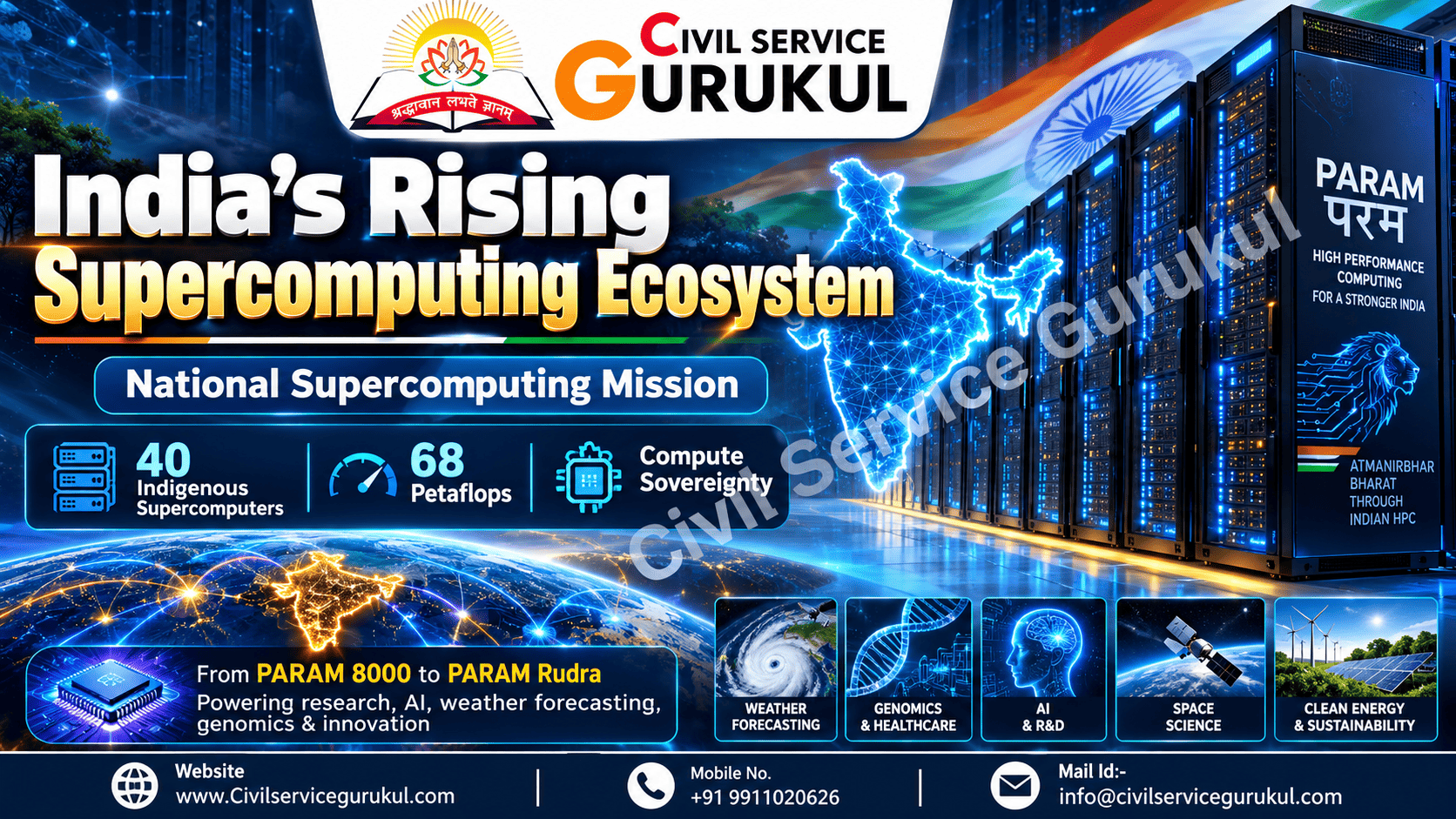
India has built a rapidly expanding supercomputing ecosystem under the National Supercomputing Mission, deploying 40 indigenous systems with a combined capacity of 68 Petaflops. From weather forecasting and disaster management to genomics, drug discovery, artificial intelligence and strategic research, high-performance computing is emerging as a critical pillar of India’s technological sovereignty. However, dependence on imported CPUs, GPUs and proprietary software remains a major challenge.
GS Paper III: Science and Technology, indigenisation of technology, IT and computers, achievements of Indians in science and technology, disaster management and infrastructure.
Essay: Technological self-reliance, digital sovereignty, innovation and Viksit Bharat.
Prelims: National Supercomputing Mission, PARAM series, C-DAC, MeitY, DST, National Knowledge Network.
Why India’s Supercomputing Ecosystem Is in News
India has significantly expanded its high-performance computing capacity under the National Supercomputing Mission (NSM).
The country has now deployed 40 indigenous supercomputers with a combined capacity of 68 Petaflops, marking a major step toward building a self-reliant national computing infrastructure.
The development is strategically significant because supercomputing is no longer restricted to scientific laboratories. It directly affects:
- Artificial intelligence
- Weather and climate modelling
- Defence research
- Genomics
- Drug discovery
- Space research
- Disaster management
- Energy exploration
- Advanced manufacturing
What Is the National Supercomputing Mission?
The National Supercomputing Mission was launched in April 2015 with an outlay of approximately ₹4,500 crore.
It is jointly steered by:
- Department of Science and Technology (DST)
- Ministry of Electronics and Information Technology (MeitY)
The mission is implemented primarily by:
- C-DAC, Pune
- Indian Institute of Science, Bengaluru
Its larger purpose is to develop a resilient and increasingly indigenous high-performance computing ecosystem capable of supporting scientific research, strategic applications and national development needs.
Core Idea: Compute Sovereignty
Compute sovereignty means that a country possesses sufficient domestic capability in hardware, software, networking, data infrastructure and advanced computing resources to pursue critical scientific, economic and strategic goals without excessive dependence on foreign suppliers.
In the age of artificial intelligence and strategic technology competition, computing power is increasingly becoming as important as physical infrastructure.
India’s Supercomputing Journey
India developed PARAM 8000 through C-DAC after access to advanced Western supercomputing technology was restricted. This became a landmark in India's technological self-reliance journey.
India entered the Teraflop era and expanded the use of high-performance computing in computational fluid dynamics, atmospheric science and bioinformatics.
India moved from isolated supercomputer projects toward a nationally coordinated and distributed supercomputing network.
PARAM Shivay at IIT (BHU), Varanasi became the first supercomputer installed under the National Supercomputing Mission.
PARAM Pravega at IISc Bengaluru significantly strengthened India's multi-Petaflop computing capacity.
The ecosystem moved toward indigenously designed Rudra server architectures, high-speed interconnects and locally developed cooling sub-systems.
Four Pillars of the National Supercomputing Mission
| Pillar | Purpose |
|---|---|
| Infrastructure | Deploy supercomputing systems across academic and research institutions. |
| Applications | Develop software and computational models for strategic and societal needs. |
| Research & Development | Build indigenous capability in servers, networking, cooling and future computing technologies. |
| Human Resource Development | Train researchers, engineers and students in high-performance computing. |
Important Achievements of India’s Supercomputing Programme
1. Expansion of National Computing Capacity
India has commissioned 40 supercomputing systems with a combined capacity of approximately 68 Petaflops.
2. Indigenous Rudra Servers
India has developed indigenous Rudra server boards and transferred them to domestic electronics manufacturing partners, reducing dependence on imported server infrastructure.
3. Indigenous Network Fabric
High-speed interconnect technologies such as Trinetra-A and Trinetra-B are helping strengthen domestic networking capability within supercomputing clusters.
4. Decentralised Access Through PARAM Shavak
Compact high-performance computing systems have been deployed in educational institutions beyond major metropolitan centres, helping democratise access to advanced computing.
5. Research and Human Capital
The ecosystem has supported more than 16,000 researchers, over 2,900 PhD scholars and nearly 2,000 peer-reviewed scientific publications.
How Are Supercomputers Used?
1. Weather Forecasting and Disaster Management
Supercomputers allow scientists to process enormous volumes of atmospheric and hydrological data.
This improves:
- Cyclone prediction
- Rainfall modelling
- Flood forecasting
- Extreme weather warnings
- Disaster preparedness
High-resolution modelling can help administrators move from reactive disaster response toward preventive action.
2. Ecological and Wildfire Modelling
Supercomputers can combine satellite data, terrain information and climate models to simulate wildfire behaviour and ecological risks.
This is particularly valuable in fragile Himalayan ecosystems and other climate-sensitive regions.
3. Drug Discovery
High-performance computing can simulate molecular interactions and screen large numbers of compounds digitally before expensive laboratory testing begins.
This can significantly accelerate:
- Drug discovery
- Protein analysis
- Molecular docking
- Vaccine research
4. Genomics and Biotechnology
Genome sequencing produces enormous amounts of data. Supercomputers can process genomic datasets much faster, supporting personalised medicine, biotechnology and disease research.
5. Energy Exploration
Advanced seismic modelling allows energy companies to analyse complex underground geological formations.
This can assist in identifying oil and gas reserves and improving domestic energy security.
6. Artificial Intelligence
The next stage of supercomputing increasingly intersects with artificial intelligence.
Large language models, foundation models and advanced machine-learning systems require extremely high computing capacity, especially GPU-based infrastructure.
Why Supercomputing Matters Strategically
Technological Sovereignty
Domestic computing infrastructure reduces vulnerability to technology denial, sanctions and supply-chain disruptions.
Scientific Leadership
Advanced research in climate science, medicine, aerospace, defence and materials science increasingly depends on access to massive computing resources.
National Security
Supercomputing supports cryptography, defence simulations, strategic modelling and advanced surveillance technologies.
Economic Competitiveness
Automotive, aerospace, pharmaceutical and manufacturing companies increasingly use digital simulation to reduce design and testing costs.
AI Leadership
Countries with access to large-scale computing infrastructure possess a strategic advantage in building frontier artificial intelligence systems.
Major Challenges Before India
1. Dependence on Imported CPUs and GPUs
Although India has made progress in servers, networking and system integration, the most advanced processors remain heavily dependent on foreign suppliers.
This creates strategic vulnerability because CPUs, GPUs and AI accelerators are central to modern high-performance computing.
2. Global Compute Gap
India’s cumulative capacity has grown substantially, but leading global supercomputers operate at much higher individual performance levels.
India therefore needs to move toward exascale computing to compete with the world's leading scientific and AI infrastructure.
3. Limited Private-Sector Utilisation
Much of India’s supercomputing infrastructure is still concentrated in academic and public research institutions.
Greater participation from:
- Automobile manufacturers
- Aerospace companies
- Biotechnology firms
- Deep-tech startups
- Defence companies
could significantly improve commercial utilisation.
4. Energy and Cooling Requirements
Supercomputers consume very large quantities of electricity and generate significant heat.
India’s climatic conditions can make cooling more energy-intensive, increasing operational costs.
5. Proprietary Software Dependence
High-performance computing and artificial intelligence ecosystems often depend on proprietary software platforms.
Excessive dependence on foreign programming frameworks can constrain technological autonomy even if physical hardware becomes more indigenous.
Way Forward for India
1. Build Indigenous Semiconductor Capability
India must move from assembling servers toward manufacturing high-performance processors, accelerators and semiconductor components domestically.
2. Integrate NSM With IndiaAI Mission
Future systems should increasingly support GPU-intensive artificial intelligence workloads and domestic foundation-model development.
3. Develop Exascale Computing
India needs to progressively move from Petaflop systems toward Exaflop-scale computing capability.
4. Promote Green Computing
Future supercomputing centres should be integrated with renewable energy, efficient cooling systems and energy-efficient data-centre designs.
5. Improve Startup Access
Deep-tech, biotech, defence and AI startups should receive affordable access to national computing infrastructure.
6. Strengthen Indigenous Software
India must invest in domestic libraries, programming environments, simulation tools and open computing architectures to reduce software dependence.
National Supercomputing Mission and Viksit Bharat 2047
India’s long-term ambition of becoming a developed economy cannot rely only on roads, factories and traditional infrastructure.
The emerging global economy increasingly depends on:
- Computing power
- Semiconductors
- Artificial intelligence
- Data infrastructure
- Quantum technologies
- Advanced scientific research
Supercomputing therefore represents an essential component of India's technological foundation for Viksit Bharat 2047.
UPSC Prelims Quick Facts
- National Supercomputing Mission was launched in 2015.
- NSM is jointly steered by DST and MeitY.
- Major implementing agencies include C-DAC and IISc Bengaluru.
- PARAM 8000 was India’s first indigenous supercomputer.
- PARAM Shivay was the first supercomputer installed under NSM.
- PARAM Shivay is located at IIT (BHU), Varanasi.
- PARAM Rudra represents India's newer indigenous server architecture.
- National Knowledge Network connects academic and research institutions.
UPSC Mains Practice Question
Q. “High-performance computing has become an essential component of technological sovereignty.” Discuss the achievements of India’s National Supercomputing Mission and examine the challenges that remain in achieving genuine compute sovereignty.
Suggested Answer Structure
- Introduction: Define supercomputing and NSM.
- Achievements: Indigenous systems, 40 supercomputers, Rudra servers, networking, research support.
- Applications: Weather, health, genomics, disaster management, AI, energy.
- Challenges: Imported silicon, global compute gap, software dependence, energy use.
- Way Forward: Semiconductor mission, IndiaAI integration, exascale systems, green computing.
- Conclusion: Link with technological sovereignty and Viksit Bharat 2047.
Frequently Asked Questions
What is a supercomputer?
A supercomputer is an extremely powerful computing system designed to perform complex calculations and process massive datasets far faster than conventional computers.
Which was India’s first indigenous supercomputer?
PARAM 8000, developed by C-DAC and launched in 1991, was India’s first indigenous supercomputer.
What is the National Supercomputing Mission?
The National Supercomputing Mission is a government initiative launched in 2015 to establish a distributed, increasingly indigenous high-performance computing ecosystem across India.
Why are supercomputers important for UPSC?
The topic is relevant to GS Paper III because it connects science and technology, indigenisation, artificial intelligence, disaster management, national security and strategic autonomy.
What is PARAM Rudra?
PARAM Rudra represents a newer generation of indigenously designed server architecture developed as part of India's broader high-performance computing ecosystem.
What is India’s biggest challenge in supercomputing?
One of the biggest challenges is continued dependence on imported high-end processors, GPUs and proprietary software ecosystems.
Conclusion
India’s rise in supercomputing represents one of the clearest examples of how strategic necessity can drive technological self-reliance.
From the development of PARAM 8000 in response to technology denial to today’s distributed National Supercomputing Mission, India has gradually built indigenous capabilities in server design, networking, applications and research infrastructure.
The next challenge is deeper and more complex: achieving sovereignty at the silicon, software and exascale computing levels.
If India can combine the National Supercomputing Mission with domestic semiconductor manufacturing, the IndiaAI Mission, green data infrastructure and wider private-sector participation, supercomputing can become a foundational pillar of scientific innovation, economic competitiveness and national security.
SEO Tags
India Supercomputing Ecosystem, National Supercomputing Mission, NSM India, PARAM Supercomputer, PARAM 8000, PARAM Shivay, PARAM Rudra, C-DAC, High Performance Computing, HPC India, Compute Sovereignty, Indigenous Technology India, Science and Technology UPSC, UPSC GS 3, Current Affairs UPSC, Artificial Intelligence India, IndiaAI Mission, Semiconductor Mission India, Digital Sovereignty, Exascale Computing, Viksit Bharat 2047, Civil Service Gurukul
Prepare with Mentors Who Cleared the Exam
Get personalized study plans, evaluated answer models, and test series access.