
India's Textile Industry in 2026: Can Festive Demand Offset Chinese Import Competition?
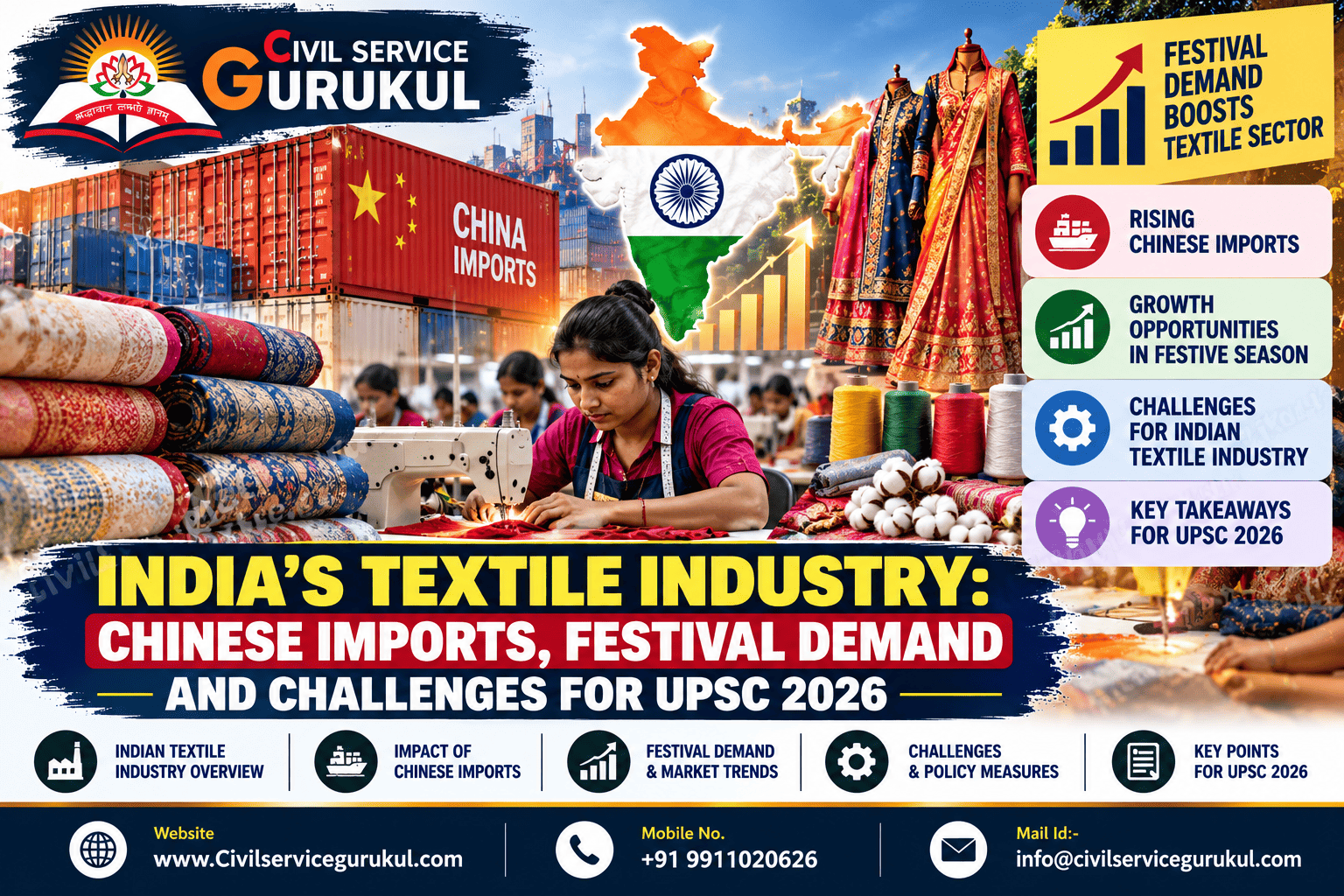
India's Textile Industry in 2026: Can Festive Demand Offset Chinese Import Competition?
Understand how festive consumption, import competition, MSME challenges, manufacturing costs and trade policy shape India's textile economy.
UPSC Current Affairs | October 2026
India's textile and apparel industry plays an important role in manufacturing, employment, exports and the livelihoods of millions of workers.
Festive demand can provide a seasonal boost to domestic textile sales.
However, competition from imported products, including goods from China, creates pressure on Indian manufacturers, particularly smaller firms.
The key policy challenge is to improve industrial competitiveness while protecting employment, supporting MSMEs and maintaining fair trade.
This topic is relevant to UPSC GS Paper III for industrial growth, trade and employment, and GS Paper I for society and livelihoods.
1. Why Is India's Textile Industry in the News?
An October 2026 business news discussion highlighted two important trends affecting the Indian textile sector.
First, festivals can increase consumer demand for clothing, fabrics and related products.
Second, imported textile products, including Chinese goods, create competition for domestic manufacturers.
The issue raises an important economic question: can short-term demand growth compensate for long-term weaknesses in competitiveness?
The answer depends on production costs, product quality, technology, logistics and market conditions.
2. Why Is the Textile Sector Important for India?
The textile industry connects agriculture, manufacturing, trade and consumer markets.
It includes activities ranging from fibre production to finished garments.
Major Contributions
- Creates manufacturing and service-sector jobs.
- Supports farmers producing cotton and other fibres.
- Provides opportunities for small enterprises.
- Contributes to merchandise exports.
- Supports rural and semi-urban livelihoods.
- Preserves traditional crafts and handloom skills.
- Provides employment opportunities for women.
The sector therefore has economic and social importance.
3. Understanding the Textile Value Chain
A textile value chain includes multiple stages before a finished product reaches the customer.
| Stage | Main Activity | Example |
|---|---|---|
| Fibre Production | Production of natural or synthetic fibres. | Cotton and polyester. |
| Spinning | Conversion of fibres into yarn. | Cotton yarn. |
| Weaving and Knitting | Conversion of yarn into fabric. | Woven or knitted fabric. |
| Processing | Dyeing, printing and finishing. | Finished textile fabric. |
| Garment Manufacturing | Cutting, stitching and assembling. | Shirts, dresses and trousers. |
| Distribution | Wholesale, retail and export. | Domestic and international markets. |
Weaknesses at any stage can affect the competitiveness of the entire supply chain.
4. How Do Festivals Increase Textile Demand?
Festivals often encourage households to purchase new clothing, traditional garments and decorative textile products.
Retailers may also offer discounts and special collections during festive periods.
Potential Economic Effects
- Higher retail sales.
- Increased orders for manufacturers.
- Greater demand for fabrics and garments.
- Temporary employment opportunities.
- Higher inventory movement.
- Improved business confidence.
However, festive demand is seasonal.
It does not automatically solve structural problems such as high production costs or outdated machinery.
5. Why Are Chinese Textile Imports a Concern?
China is a major participant in global textile manufacturing and supply chains.
Chinese manufacturers may benefit from large production networks, economies of scale and efficient supply chains.
Indian producers may face price competition from certain imported products.
Possible Challenges
- Pressure on domestic selling prices.
- Competition for price-sensitive consumers.
- Reduced margins for some manufacturers.
- Difficulty for smaller firms in matching scale.
- Greater need for quality and design differentiation.
However, competition from imports does not automatically mean that dumping has occurred.
Dumping is a specific trade concept requiring investigation and evidence under applicable rules.
6. What Is Dumping in International Trade?
In international trade, dumping generally refers to exporting a product at a price below its normal value under applicable trade rules.
A finding of dumping alone does not automatically justify an anti-dumping duty.
Authorities must also examine material injury to the domestic industry and the relevant causal relationship.
| Concept | Meaning |
|---|---|
| Import Competition | Domestic products compete with goods from foreign suppliers. |
| Dumping | Export pricing below normal value as determined under applicable trade rules. |
| Anti-Dumping Duty | A trade-remedy measure imposed following the required investigation and legal findings. |
| Safeguard Measure | A separate trade remedy addressing specified injury from increased imports, subject to legal conditions. |
UPSC aspirants should not confuse ordinary price competition with legally established dumping.
7. Major Challenges Facing Indian Textile MSMEs
A. Fragmented Production
Many small manufacturers operate with limited scale, which can increase per-unit costs.
B. Technology Gaps
Outdated equipment can reduce productivity and product consistency.
C. Working Capital Constraints
Manufacturers need funds for raw materials, wages and inventory before receiving customer payments.
D. Logistics Costs
Transport and delivery expenses can affect export competitiveness.
E. Quality Standards
International buyers often require consistent quality, traceability and compliance with technical standards.
F. Market Access
Smaller firms may struggle to access large buyers, global distribution channels and new export markets.
8. Employment and Social Importance
The textile industry has strong connections with labour-intensive manufacturing.
Its performance can influence employment in spinning, weaving, processing, garment manufacturing and retail.
It also supports traditional occupations and regional craft clusters.
Social Dimensions
- Livelihoods of handloom and powerloom workers.
- Employment opportunities for women.
- Income stability for small manufacturers.
- Migration between rural and urban areas.
- Preservation of traditional weaving skills.
This makes the sector relevant to GS Paper I as well as GS Paper III.
9. Government Initiatives for the Textile Sector
PM MITRA Parks
The PM Mega Integrated Textile Region and Apparel (PM MITRA) scheme seeks to promote integrated textile infrastructure and improve manufacturing competitiveness.
Integrated facilities can help reduce fragmentation and support economies of scale.
Production Linked Incentive Scheme
The PLI Scheme for Textiles aims to encourage investment and production in specified textile product categories.
It focuses on eligible man-made fibre apparel, fabrics and technical textile products.
National Technical Textiles Mission
The mission supports the development of technical textiles, including research, innovation and market development.
Support for Handlooms and MSMEs
Various programmes seek to improve skills, technology, marketing and livelihood opportunities for textile enterprises and traditional producers.
10. India–UK Trade Relations and Textiles
Trade agreements can influence market access for textile and apparel exporters.
The India–UK trade framework has attracted attention because textiles and apparel are important sectors for Indian exports.
Potential benefits depend on applicable tariff provisions, rules of origin, product standards and the implementation of trade commitments.
A trade agreement does not automatically guarantee higher exports for every manufacturer.
11. How Can India Improve Textile Competitiveness?
- Modernise Manufacturing: Encourage efficient machinery and improved production processes.
- Strengthen MSME Finance: Improve access to suitable working capital and investment funding.
- Develop Textile Clusters: Support shared infrastructure and integrated production facilities.
- Promote Skill Development: Improve workforce capabilities in design, production and quality control.
- Improve Logistics: Reduce avoidable transport delays and supply-chain inefficiencies.
- Encourage Innovation: Promote technical textiles, sustainable materials and advanced manufacturing.
- Support Export Readiness: Help firms meet international standards and buyer requirements.
- Apply Trade Remedies Lawfully: Investigate unfair trade practices using evidence and established legal procedures.
12. Sustainable Textiles and the Environment
Textile production can require significant water, energy and chemical inputs, depending on the production process.
Improving environmental performance can support long-term competitiveness.
Important Approaches
- Water-efficient processing.
- Wastewater treatment.
- Energy-efficient machinery.
- Textile recycling.
- Better waste management.
- Responsible sourcing.
- Cleaner production technologies.
Sustainability is relevant to industrial policy and environmental governance.
13. UPSC Prelims Quick Revision
- The textile value chain includes fibres, yarn, fabrics, processing and garments.
- Festive demand can temporarily increase textile sales.
- Import competition and dumping are different concepts.
- PM MITRA promotes integrated textile infrastructure.
- The Textile PLI Scheme targets specified eligible textile products.
- Technical textiles are designed primarily for functional performance.
- Textile MSMEs face challenges involving finance, technology and market access.
- Trade agreements can improve opportunities but do not guarantee export growth.
14. UPSC Prelims Practice MCQs
Consider the following statements regarding India's textile industry:
- The textile value chain includes spinning, weaving and garment manufacturing.
- Festive demand permanently eliminates structural manufacturing problems.
- Textile production supports employment across different regions.
Which statements are correct?
(A) 1 only
(B) 1 and 3 only
(C) 2 and 3 only
(D) 1, 2 and 3
Statements 1 and 3 are correct. Statement 2 is incorrect because seasonal demand cannot automatically resolve structural industry challenges.
The PM MITRA scheme is primarily associated with:
(A) Agricultural crop insurance
(B) Integrated textile infrastructure
(C) Urban housing finance
(D) Railway electrification
PM MITRA seeks to support integrated textile manufacturing infrastructure.
Which statement about dumping is most accurate?
(A) Every imported product is dumped.
(B) Low-priced imports automatically prove dumping.
(C) Dumping is assessed using specified trade-law criteria.
(D) Dumping can occur only in agricultural products.
Dumping is a specific trade-law concept. It requires assessment under the applicable legal framework.
Which of the following is an example of a technical textile application?
(A) Geotextiles used in infrastructure
(B) Only decorative household curtains
(C) Only traditional festival garments
(D) Only hand-painted clothing
Geotextiles are technical textiles designed for functional applications, including certain infrastructure uses.
15. UPSC Mains Practice Question
"Seasonal growth in domestic demand cannot substitute for long-term industrial competitiveness."
Discuss this statement with reference to India's textile sector and competition from imported products.
Word Limit: 250 words
Suggested Answer Structure
- Introduce the economic importance of textiles.
- Explain the role of festive demand.
- Discuss import competition and cost challenges.
- Analyse MSME and employment implications.
- Discuss PM MITRA, PLI and trade policy.
- Conclude with productivity-led, sustainable competitiveness.
16. Frequently Asked Questions
Why is the textile industry important for UPSC?
It connects manufacturing, employment, exports, MSMEs, trade policy and regional livelihoods.
How does festive demand affect textile sales?
Festivals can increase consumer spending on clothing and related products, creating a seasonal rise in demand.
Why do Chinese textile imports matter?
Imported products may create price and quality competition for Indian manufacturers, depending on the product segment.
Does competition from China automatically mean dumping?
No. Dumping requires a specific legal assessment and supporting evidence.
What is PM MITRA?
PM MITRA is a scheme designed to promote integrated textile manufacturing infrastructure in India.
Which UPSC papers cover this topic?
GS Paper III covers industry, employment and international trade. GS Paper I covers relevant social and livelihood dimensions. The topic is also useful for Prelims.
17. Conclusion: The Future of Indian Textiles
India's textile industry has strong potential because of its manufacturing base, workforce, domestic demand and cultural diversity.
Festive demand may improve sales in the short term.
However, sustainable growth requires better technology, efficient production, stronger MSMEs, skilled workers and reliable market access.
India must combine industrial modernisation with fair trade practices and environmental responsibility.
Final UPSC Takeaway: Long-term textile competitiveness depends not only on demand, but also on productivity, innovation, quality and inclusive growth.
Prepare for UPSC with Civil Service Gurukul
Strengthen your preparation for Indian Economy, Polity, International Relations, Geography, Environment and Current Affairs with structured UPSC learning resources.
Website: www.civilservicegurukul.com
Mobile: +91 9911020626
Email: info@civilservicegurukul.com
Editorial Disclaimer: This article provides independent educational analysis for UPSC preparation. The discussion of Chinese import competition does not establish dumping or injury under trade law. The effects of festive demand vary by market, product and business conditions. No specific October 2026 sales or import figures are claimed.
Prepare with Mentors Who Cleared the Exam
Get personalized study plans, evaluated answer models, and test series access.