
Just Energy Transition in India 2026: UPSC Analysis
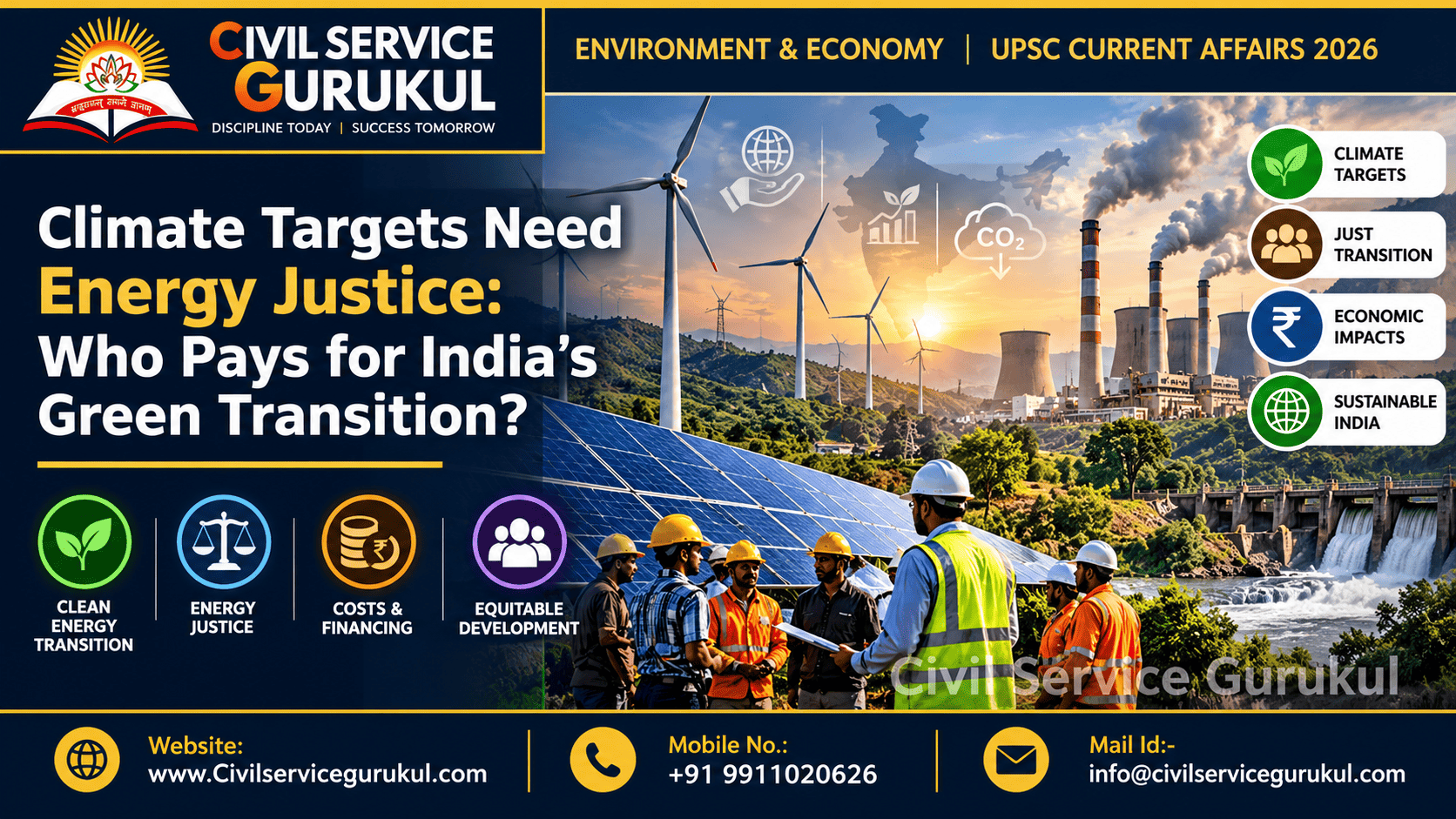
India's Just Energy Transition 2026: Climate Targets, Energy Justice, Coal Jobs and the Road to Sustainable Development
Why climate ambition must be accompanied by affordable energy, social protection, worker reskilling and fair distribution of costs and benefits.
India's climate transition involves more than reducing greenhouse gas emissions.
Energy policy also determines whether families can afford electricity, whether workers retain livelihoods and whether vulnerable regions can finance adaptation.
The concept of a just energy transition requires climate mitigation to advance alongside affordability, participation, livelihood security and social equity.
For India, the challenge is to expand reliable modern energy access while reducing the emissions intensity of economic development.
Prelims: Paris Agreement, NDCs, mitigation, adaptation and energy justice.
GS Paper II: Welfare, federalism, public participation and governance.
GS Paper III: Climate change, energy policy, environment and economy.
GS Paper IV: Equity, intergenerational responsibility and ethical governance.
1. Why Is Energy Justice in the News?
Climate negotiations are often discussed through emission-reduction percentages, renewable-energy capacity and target years.
However, climate policies also influence electricity prices, employment, land use and public expenditure.
An October 2026 analysis of climate targets and energy justice highlights the need to evaluate India's energy transition through social and economic outcomes.
An energy transition cannot be considered fully successful if cleaner technologies expand while vulnerable households face greater hardship.
2. What Is a Just Energy Transition?
A just energy transition refers to the movement towards cleaner energy systems while protecting workers, communities and vulnerable consumers.
It seeks to distribute the costs and benefits of decarbonisation fairly.
Essential characteristics
- Affordable access to reliable energy.
- Protection of vulnerable households.
- Worker reskilling and social protection.
- Meaningful community participation.
- Fair treatment of affected regions.
- Protection of future generations.
A just transition is not an argument for abandoning climate action. It is an approach for making climate action fair, practical and durable.
3. Three Important Dimensions of Energy Justice
A. Distributive Justice
Distributive justice concerns the fair allocation of benefits and burdens.
For example, cleaner energy may improve air quality, but upfront costs of grid modernisation or new technologies may disproportionately affect low-income consumers.
B. Procedural Justice
Procedural justice concerns meaningful participation in decisions.
Communities affected by renewable-energy projects, transmission corridors or industrial restructuring should have opportunities to express their concerns.
C. Recognition Justice
Recognition justice requires policymakers to acknowledge the distinct needs and vulnerabilities of different communities.
Coal-dependent districts, informal workers and low-income households may experience the transition differently.
| Dimension | Central Question | Example |
|---|---|---|
| Distributive | Who gains and who pays? | Affordable electricity and fair cost sharing |
| Procedural | Who participates in decisions? | Consultation before major energy projects |
| Recognition | Whose needs are acknowledged? | Protection for coal workers and vulnerable communities |
4. Paris Agreement and Nationally Determined Contributions
The Paris Agreement operates through nationally determined contributions, commonly called NDCs.
Countries communicate their climate commitments according to the agreement's framework rather than following one identical emissions target.
The global climate agenda also includes adaptation, finance and equitable transition.
Why this matters for India
- India has substantial development needs.
- Reliable energy is essential for economic activity.
- Climate policy must consider affordability.
- Climate finance can support implementation.
- Transition outcomes differ across regions.
India's climate strategy must therefore consider both environmental outcomes and developmental priorities.
5. Climate Mitigation vs Climate Adaptation
| Basis | Mitigation | Adaptation |
|---|---|---|
| Meaning | Reducing greenhouse gas emissions or enhancing sinks | Adjusting to actual or expected climate impacts |
| Objective | Limit the causes of climate change | Reduce vulnerability and damage |
| Examples | Cleaner power generation and energy efficiency | Flood preparedness and heat-resilient infrastructure |
Mitigation and adaptation are complementary components of climate policy.
A just transition must consider both the costs of emissions reduction and the distribution of climate impacts.
6. India's Distinctive Energy Transition Challenge
India must expand access to reliable modern energy while reducing the emissions intensity of economic growth.
This creates a complex policy challenge because the needs of industrial regions, urban households and rural communities are not identical.
Key considerations
- Reliable electricity for development.
- Affordable household energy.
- Industrial competitiveness.
- Employment and livelihoods.
- Environmental sustainability.
- Climate resilience.
Counting installed renewable-energy capacity alone does not reveal whether the benefits are equitably distributed.
7. Coal-Dependent Districts and Worker Livelihoods
Coal-dependent regions may face employment and revenue challenges as energy systems evolve.
Workers may require new skills, social protection and access to alternative employment.
Important policy responses
- District-level transition planning.
- Vocational education and reskilling.
- Support for alternative industries.
- Social protection for affected workers.
- Local economic diversification.
The objective should be to reduce emissions without creating avoidable economic distress in vulnerable regions.
8. Energy Affordability and Household Welfare
The energy transition may require investment in grids, new technologies and infrastructure.
These investments can create upfront costs that affect household energy bills.
Without appropriate safeguards, low-income consumers may experience disproportionate burdens.
Possible policy measures
- Well-targeted support for basic energy needs.
- Improved distribution efficiency.
- Transparent tariff design.
- Reduction of avoidable system losses.
- Protection against energy poverty.
Affordable energy access should be considered a central outcome of climate policy.
9. Land, Water and Community Rights
Renewable-energy projects and transmission infrastructure can create land-use and environmental challenges.
Large projects may affect agriculture, water resources, biodiversity and local livelihoods.
Why procedural safeguards matter
- Meaningful community consultation.
- Transparent land records.
- Fair compensation where applicable.
- Assessment of environmental impacts.
- Accessible grievance mechanisms.
Better participation can reduce conflict and strengthen the long-term durability of clean-energy investments.
10. Federalism and Climate Finance
India's federal structure makes climate-policy implementation a shared governance challenge.
Electricity distribution, land use, urban transport and adaptation involve states and local institutions.
Therefore, national targets must be supported by appropriate financing and local implementation capacity.
Important governance priorities
- Coordination between Union and state governments.
- Financial support for affected regions.
- Strengthening local institutions.
- Transparent monitoring of expenditure.
- Community-level accountability.
11. Intergenerational Justice and Climate Ethics
Intergenerational justice concerns fairness between present and future generations.
Delaying climate mitigation may transfer greater environmental harm to younger and future generations.
However, abrupt economic restructuring without adequate support may harm workers and communities today.
A credible transition must therefore protect both present livelihoods and long-term environmental security.
Climate justice involves responsibility, fairness, accountability and concern for vulnerable populations.
12. Policy Priorities and the Way Forward
- Develop district-level transition plans for coal-dependent regions.
- Provide reskilling and social protection for affected workers.
- Protect affordable basic electricity access.
- Improve the efficiency of electricity distribution.
- Assess land, water and biodiversity impacts.
- Strengthen community consultation.
- Improve access to climate finance.
- Support state and local implementation capacity.
- Track employment and household energy burdens.
- Measure social outcomes alongside emissions reductions.
Climate policy should be assessed not only by the quantity of clean energy installed, but also by the quality and fairness of the transition.
13. UPSC Prelims Quick Revision Notes
- Mitigation: Reduces emissions or enhances sinks.
- Adaptation: Manages actual or expected climate impacts.
- NDC: Nationally Determined Contribution.
- Paris Agreement: International climate framework using NDCs.
- Just Transition: Fairness for workers and communities during decarbonisation.
- Energy Justice: Fair distribution, participation and recognition.
- Distributive Justice: Fair allocation of costs and benefits.
- Procedural Justice: Meaningful participation in decisions.
- Recognition Justice: Acknowledgement of differing needs and vulnerabilities.
- Intergenerational Justice: Fairness between present and future generations.
14. UPSC Prelims Practice MCQs
With reference to a just energy transition, consider the following statements:
- It considers the distribution of costs and benefits.
- It includes protection of affected workers and communities.
- It evaluates success only through installed renewable-energy capacity.
Which statements are correct?
(a) 1 and 2 only
(b) 2 and 3 only
(c) 1 and 3 only
(d) 1, 2 and 3
A just transition considers social and economic fairness alongside environmental outcomes. Installed capacity alone is not a sufficient measure.
What does NDC stand for under the Paris Agreement?
(a) National Development Council
(b) Nationally Determined Contribution
(c) National Decarbonisation Commission
(d) New Development Commitment
NDC means Nationally Determined Contribution.
Which of the following best represents procedural energy justice?
(a) Excluding local communities from project decisions
(b) Meaningful consultation with affected communities
(c) Measuring only national emission totals
(d) Ignoring land-use impacts
Procedural justice concerns fair and meaningful participation in decision-making.
Consider the following statements:
- Climate mitigation aims to reduce greenhouse gas emissions or enhance sinks.
- Climate adaptation aims to manage climate impacts.
- Mitigation and adaptation are identical concepts.
Which statements are correct?
(a) 1 only
(b) 2 only
(c) 1 and 2 only
(d) 1, 2 and 3
Mitigation addresses the causes of climate change, while adaptation addresses its impacts. They are complementary, not identical.
15. UPSC Mains Practice Questions
Question 1 — GS Paper III
India's climate commitments cannot be separated from questions of energy justice. Discuss. (250 words)
Suggested Answer Framework
Climate action requires reductions in greenhouse gas emissions and stronger resilience to climate impacts.
However, the costs of transition may affect low-income households, coal-dependent districts and informal workers.
A just transition must therefore combine mitigation with affordability, social protection and participation.
India's federal structure makes state and local institutions important for electricity distribution, land use and adaptation.
District-level planning, worker reskilling, climate finance and transparent monitoring can improve outcomes.
The objective is to ensure that environmental sustainability advances alongside economic and social justice.
Question 2 — GS Paper IV
Explain how intergenerational justice and distributive justice should influence India's climate policy. (150 words)
Answer Approach
- Define intergenerational justice.
- Explain distributive justice.
- Discuss future climate risks.
- Highlight present livelihood concerns.
- Suggest balanced and accountable policy measures.
16. Frequently Asked Questions
What is energy justice?
Energy justice concerns who receives energy benefits, who bears the costs and who participates in decisions.
What is a just energy transition?
It is the shift towards cleaner energy systems while protecting vulnerable workers, communities and consumers.
Does a just transition mean delaying climate action?
No. It means implementing climate action with appropriate social and economic safeguards.
Why are coal-dependent districts important?
They may face employment and economic challenges during energy-sector restructuring.
What is the role of states in India's energy transition?
States and local bodies influence electricity distribution, land use, transport, employment and adaptation.
What is the difference between mitigation and adaptation?
Mitigation addresses the causes of climate change, while adaptation addresses its impacts.
Why is energy justice important for UPSC?
It connects environment, economy, governance, welfare, federalism and ethics across multiple UPSC papers.
17. Conclusion: A Fair Transition Is a Durable Transition
India's energy transition must advance climate ambition while protecting economic development and social equity.
Affordable electricity, worker livelihoods, public participation and regional fairness are essential to long-term policy success.
A credible transition should measure jobs, energy access, household costs and community participation alongside emissions.
For UPSC aspirants, the central lesson is that environmental sustainability and social justice must be pursued together.
Prepare for UPSC with Civil Service Gurukul
Strengthen your UPSC Prelims and Mains preparation with concept-based current affairs, Indian Economy, Environment, Governance and Ethics.
Website: www.civilservicegurukul.com
Mobile: +91 9911020626
Email: info@civilservicegurukul.com
Educational analysis for UPSC preparation. Climate commitments and regulatory developments should be checked against their latest authoritative versions before professional reliance.
Prepare with Mentors Who Cleared the Exam
Get personalized study plans, evaluated answer models, and test series access.