
Kashmir Rice Genome Study 2026: UPSC Analysis
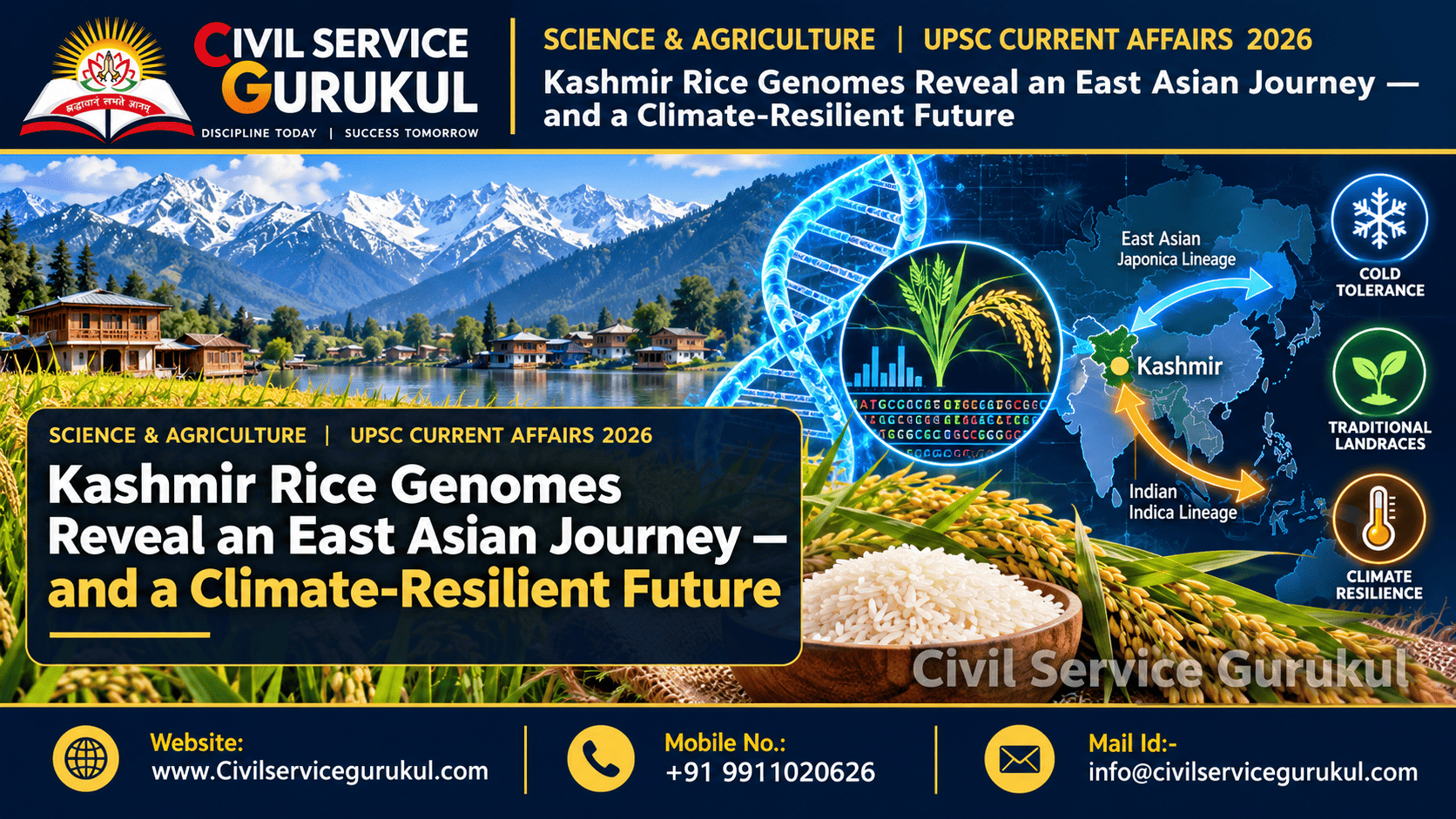
Kashmir Rice Genome Study 2026: East Asian Ancestry, Cold-Tolerant Genes and Climate-Resilient Agriculture for UPSC
A genomic investigation of traditional Kashmir rice varieties reveals temperate japonica ancestry and genetic diversity relevant to climate-resilient crop breeding.
A 2026 genomic study examined 142 rice accessions from Kashmir and compared them with the 3,000 Rice Genomes Project.
The findings indicate that several traditional Kashmir rice landraces possess genetic affinities with temperate japonica rice populations associated with Northeast Asia.
The researchers reported approximately 3.94 million high-confidence single-nucleotide polymorphisms and identified cold-adaptation-related genetic signatures, including loci associated with CTB4a and HAN1.
The study is important for understanding rice genetic diversity, historical crop movement and the potential role of traditional varieties in climate-resilient agriculture.
Prelims: General Science, biodiversity, agriculture and biotechnology.
GS Paper I: Historical exchanges and the movement of crops across regions.
GS Paper III: Agriculture, biotechnology, biodiversity conservation, climate adaptation and food security.
1. Why Is the Kashmir Rice Genome Study in the News?
Rice is one of the world's most important food crops and also provides evidence about agricultural history, genetic diversity and ecological adaptation.
A genomic study published in 2026 examined traditional rice varieties cultivated in Kashmir.
Researchers associated with Sher-e-Kashmir University of Agricultural Sciences and Technology of Kashmir analysed 142 germplasm lines.
The study compared these samples with the 3,000 Rice Genomes Project to investigate their genetic ancestry and adaptive characteristics.
The findings are relevant to both the historical movement of cultivated crops and modern efforts to develop climate-resilient agriculture.
2. Major Findings of the Kashmir Rice Genome Study
The research identified important differences between traditional Kashmir rice landraces and several modern improved varieties.
Key findings
- The study analysed 142 rice accessions.
- It used the 3,000 Rice Genomes Project as a comparative reference.
- Researchers identified approximately 3.94 million high-confidence SNPs after filtering.
- Traditional landraces showed temperate japonica genetic signatures.
- These signatures indicated genetic affinity with Northeast Asian rice populations.
- Cold-adaptation-related alleles included those associated with CTB4a and HAN1.
- Several modern improved regional varieties showed stronger affinity with indica-derived lineages.
Genetic affinity with Northeast Asian rice populations does not prove a single precisely dated migration route.
Genomic ancestry should not be confused with definitive evidence of when or how rice seeds crossed the Himalayan region.
3. Understanding Indica and Japonica Rice
The scientific name of Asian cultivated rice is Oryza sativa.
Indica and japonica are two major genetic groups within cultivated Asian rice.
Temperate japonica varieties are often associated with adaptation to cooler growing conditions.
| Feature | Indica | Temperate Japonica |
|---|---|---|
| Genetic Group | Major group within Oryza sativa | Group within japonica rice |
| Common Ecological Association | Many tropical and subtropical environments | Many cooler temperate environments |
| Relevance to Kashmir Study | Affinity in several improved varieties | Affinity in traditional landraces |
| UPSC Importance | Crop diversity and breeding | Adaptation and genetic ancestry |
These are broad ecological associations, not absolute rules applying to every variety.
4. Genome Sequencing, SNPs and the 3K Rice Genomes Project
What is genome re-sequencing?
Genome re-sequencing involves examining the DNA of an organism and comparing its sequence with a reference genome.
It helps researchers identify genetic variation among individuals or populations.
What is a Single-Nucleotide Polymorphism?
A single-nucleotide polymorphism, or SNP, is a variation at a single DNA base position.
SNPs are useful genetic markers for studying population relationships and identifying genomic regions associated with important traits.
What is the 3,000 Rice Genomes Project?
The 3,000 Rice Genomes Project provides a large comparative genomic resource containing information from approximately 3,000 rice accessions.
Researchers can use this dataset to investigate genetic diversity and population structure.
The 3,000 Rice Genomes Project is a genomic research resource. It is not a programme involving cultivation of 3,000 hectares of rice.
5. Cold-Tolerance Genes: CTB4a and HAN1
The Kashmir rice study identified genetic signatures associated with adaptation to cooler environments.
The supplied research summary highlights cold-adaptation-related alleles associated with CTB4a and HAN1.
These genetic associations are relevant because low temperatures can affect rice growth and productivity in mountain environments.
Why cold tolerance matters
- Cool temperatures may shorten growing seasons.
- Unexpected cold spells can affect crop development.
- Traditional varieties may retain useful adaptive traits.
- Genetic markers can support crop improvement research.
- Field trials are necessary to confirm practical performance.
The presence of a genetic marker does not automatically guarantee that a variety will perform well under every field condition.
6. Historical Significance: What Does East Asian Genetic Affinity Suggest?
The genetic similarities between traditional Kashmir rice landraces and Northeast Asian temperate japonica populations may offer clues about historical crop movement.
The findings are compatible with the possibility of long-distance agricultural exchanges through trans-Himalayan networks.
However, genetic evidence alone cannot establish a precise route, date or sequence of human migration.
Important distinction for UPSC
Genetic ancestry describes relationships among populations based on inherited DNA variation.
Historical migration routes require additional evidence, including archaeology, historical records and other relevant research.
A balanced UPSC answer should distinguish scientific inference from historical certainty.
7. Importance for Climate-Resilient Agriculture
Climate change creates multiple challenges for agriculture, including irregular rainfall, altered seasonal patterns and extreme weather.
Mountain agriculture may experience erratic cold spells, changing snowmelt patterns and new pest pressures.
Traditional crop varieties can preserve genetic diversity that may be useful for future breeding programmes.
How traditional rice varieties can support resilience
- Preserving useful adaptive genetic traits.
- Providing material for breeding programmes.
- Maintaining crop diversity.
- Supporting farmer choice.
- Reducing dependence on a narrow genetic base.
- Contributing to long-term food security.
Successful climate-resilient breeding requires both genetic research and multi-location agronomic testing.
8. Germplasm, Landraces and Biodiversity Conservation
What is germplasm?
Germplasm refers to genetic material maintained for conservation, research or crop improvement.
What is a landrace?
A landrace is a traditionally cultivated population that has developed adaptation to local conditions over time.
Ex-situ conservation
Ex-situ conservation involves preserving genetic resources outside their original growing environments, such as in gene banks.
In-situ conservation
In-situ conservation involves maintaining genetic diversity in the environments where it occurs, including continued cultivation by farming communities.
| Conservation Method | Approach | Importance |
|---|---|---|
| Ex-situ | Gene banks and seed collections | Long-term preservation of genetic material |
| In-situ | Continued cultivation in local environments | Maintenance of evolving crop populations |
| Community Seed Systems | Farmer-managed seed exchange and preservation | Conservation of local knowledge and diversity |
| Participatory Breeding | Collaboration between farmers and researchers | Development of locally suitable varieties |
9. Policy Priorities and the Way Forward
The study demonstrates the value of combining modern genomic tools with traditional agricultural knowledge.
Important policy priorities
- Strengthen public gene banks and local seed libraries.
- Promote participatory plant breeding with farmers.
- Combine genetic markers with field trials.
- Evaluate soil health and water-use requirements.
- Support access to diverse seed varieties.
- Protect farmer knowledge and benefit-sharing interests.
- Encourage conservation of traditional landraces.
- Avoid replacing all local varieties with a single cultivar.
A balanced approach should integrate genetic research, ecological suitability and farmer participation.
10. UPSC Prelims Quick Revision Notes
- Scientific name of Asian cultivated rice: Oryza sativa.
- Major genetic groups: Indica and japonica.
- Rice accessions analysed: 142.
- Comparative resource: 3,000 Rice Genomes Project.
- Reported high-confidence SNPs: Approximately 3.94 million.
- Traditional Kashmir rice affinity: Temperate japonica.
- Relevant genetic markers: CTB4a and HAN1.
- Landrace: Traditionally cultivated, locally adapted crop population.
- Germplasm: Preserved genetic material.
- Major policy relevance: Climate-resilient agriculture and biodiversity conservation.
11. UPSC Prelims Practice MCQs
With reference to the 2026 Kashmir rice genome study, consider the following statements:
- The study examined 142 rice accessions.
- Traditional Kashmir rice landraces showed temperate japonica genetic affinity.
- The study established the exact historical year when rice entered Kashmir.
Which of the statements given above are correct?
(a) 1 and 2 only
(b) 2 and 3 only
(c) 1 and 3 only
(d) 1, 2 and 3
The study analysed 142 accessions and identified temperate japonica genetic signatures. Genomic similarity does not establish a precise historical migration date.
What is the primary significance of a Single-Nucleotide Polymorphism (SNP)?
(a) It represents variation at a single DNA base position.
(b) It is a method of measuring rainfall.
(c) It refers to a type of irrigation system.
(d) It is a category of soil nutrient.
SNPs are single-base DNA variations that can be used as genetic markers to study diversity, population structure and trait associations.
Consider the following statements about crop landraces:
- They may contain useful locally adapted genetic traits.
- They can contribute to crop improvement programmes.
- Their conservation has no relevance to climate resilience.
Which of the statements given above are correct?
(a) 1 only
(b) 1 and 2 only
(c) 2 and 3 only
(d) 1, 2 and 3
Traditional landraces may preserve useful adaptive traits and provide genetic diversity for breeding. Their conservation is relevant to climate-resilient agriculture.
The 3,000 Rice Genomes Project is primarily associated with:
(a) Construction of irrigation canals.
(b) Comparative genomic analysis of rice diversity.
(c) Cultivation of 3,000 hectares of rice.
(d) Classification of agricultural soils.
The project provides genomic information from approximately 3,000 rice accessions, supporting research on genetic diversity and population relationships.
12. UPSC Mains Practice Questions
Question 1 — GS Paper III
How can the conservation of traditional crop landraces contribute to climate-resilient agriculture in India? Discuss with reference to recent rice-genomics research. (150 words)
Suggested Answer Framework
Traditional landraces are locally adapted crop populations that preserve valuable genetic diversity.
The 2026 Kashmir rice genome study, involving 142 accessions, identified temperate japonica genetic signatures and cold-adaptation-related alleles in traditional varieties.
Such diversity can help breeders identify traits useful for coping with environmental stress. Landraces also preserve farmer knowledge and provide alternatives to genetically narrow crop portfolios.
However, genetic associations require field validation. Conservation must combine gene banks, continued cultivation, participatory breeding and fair benefit-sharing.
Therefore, traditional seeds should be treated as valuable resources for future food security, supported by scientific testing and farmer participation.
Question 2 — GS Paper III
Discuss the role of genomic technologies in improving agricultural productivity and climate resilience. What are their limitations? (250 words)
Answer Approach
- Introduce genome sequencing and molecular markers.
- Explain identification of useful adaptive traits.
- Use the Kashmir rice study as an example.
- Discuss breeding applications and biodiversity conservation.
- Highlight field validation, access, farmer rights and ecological trade-offs.
- Conclude with integrated scientific and participatory approaches.
13. Frequently Asked Questions
What is the Kashmir Rice Genome Study 2026?
It is a genomic investigation of 142 Kashmir rice accessions that examined genetic diversity, ancestry and adaptive traits using comparative rice genome data.
How many rice accessions were studied?
Researchers analysed 142 rice accessions.
What did the study reveal about traditional Kashmir rice?
Several traditional landraces showed temperate japonica genetic signatures with affinity to Northeast Asian rice populations.
What are CTB4a and HAN1?
They are genes associated with cold-adaptation-related traits highlighted in the supplied study summary.
What is the 3,000 Rice Genomes Project?
It is a comparative genomic resource containing information from approximately 3,000 rice accessions.
Does the study prove rice migrated directly from Korea to Kashmir?
No. Genetic affinity does not establish a precise historical route or date of crop movement.
Why is the study relevant for UPSC?
It connects biotechnology, agricultural biodiversity, climate adaptation, food security and historical crop exchanges, making it relevant to Prelims and GS Papers I and III.
14. Conclusion: Traditional Rice Diversity Is an Important Resource for Climate Adaptation
The Kashmir rice genome study demonstrates how modern genomic research can reveal valuable information about traditional agricultural varieties.
Its findings concerning temperate japonica ancestry, genetic diversity and cold-adaptation-related alleles highlight the importance of conserving local crop resources.
The research also illustrates the limits of genetic inference in reconstructing precise historical crop movements.
For UPSC aspirants, the topic provides an integrated example of biotechnology, biodiversity conservation, climate-resilient agriculture and evidence-based policy analysis.
The key policy lesson is that traditional crop diversity should be conserved, scientifically evaluated and responsibly used in breeding programmes.
Prepare for UPSC with Civil Service Gurukul
Strengthen your preparation for UPSC Prelims and Mains with concept-based current affairs, Indian Economy, Science and Technology, Agriculture and answer-writing practice.
Website: www.civilservicegurukul.com
Mobile: +91 9911020626
Email: info@civilservicegurukul.com
Disclaimer: This article is intended for UPSC educational preparation. The study findings are presented according to the supplied research summary. Genetic associations should not be interpreted as proof of precise historical migration routes or guaranteed field performance. Aspirants should verify scientific and policy developments against authoritative publications when preparing examination answers.
Prepare with Mentors Who Cleared the Exam
Get personalized study plans, evaluated answer models, and test series access.