
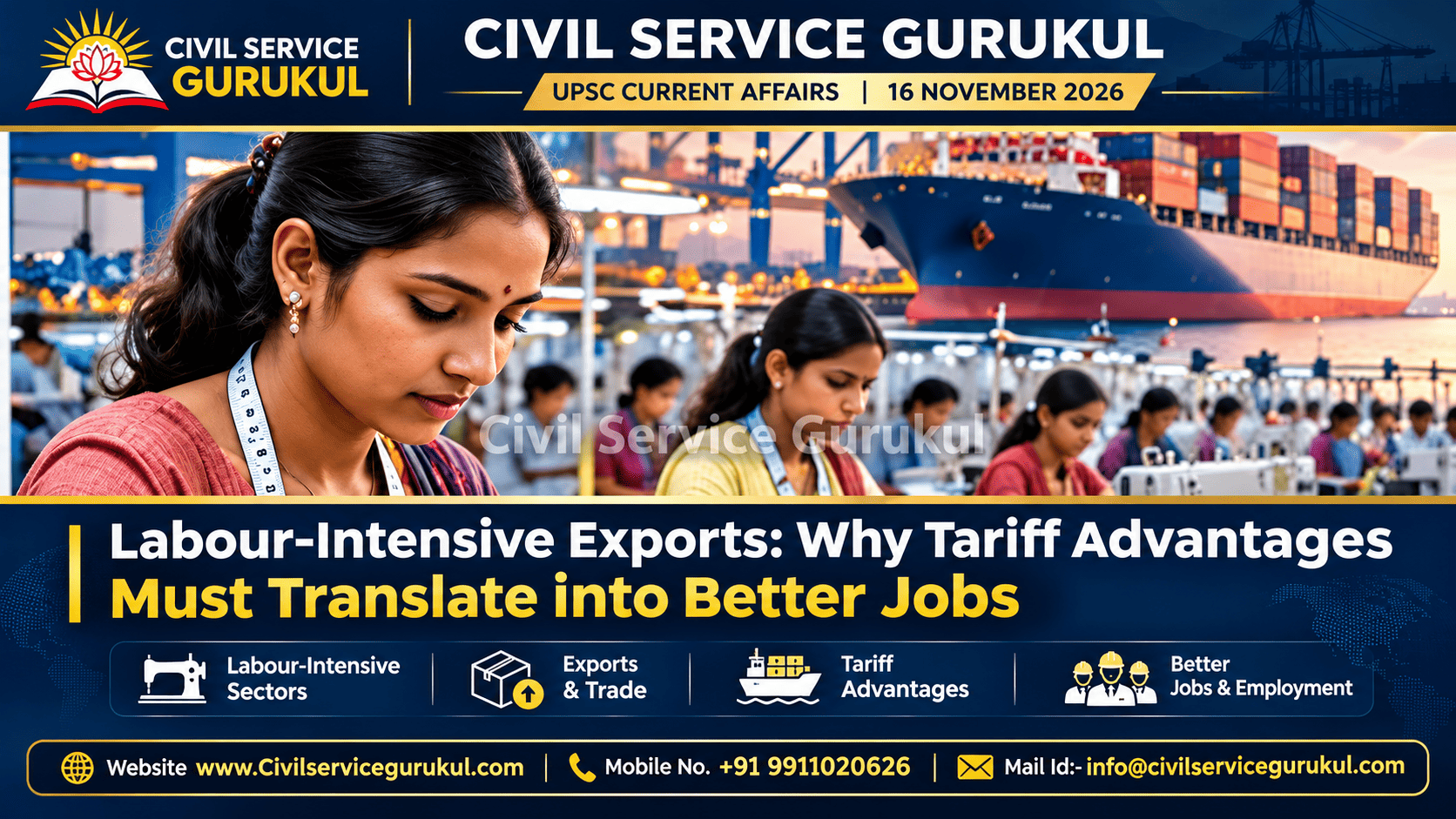
Why Is This Topic in the News?
Recent discussions on possible tariff advantages for Indian exporters have renewed attention to the relationship between international trade and employment.
Labour-intensive sectors such as garments, textiles, leather and footwear may benefit when foreign markets offer more favourable tariff treatment.
However, a reduction in import duties does not automatically generate export orders or create better jobs.
The broader policy question is whether improved market access can translate into higher domestic production, employment and household incomes.
UPSC Syllabus Relevance
| UPSC Paper | Relevant Areas |
|---|---|
| GS Paper I | Social empowerment, women's participation, employment and regional development |
| GS Paper III | Indian economy, employment, industrial policy, international trade, infrastructure and inclusive growth |
| GS Paper IV | Ethical governance, fairness, transparency and public accountability |
| Prelims | Tariffs, rules of origin, export competitiveness, trade agreements and economic concepts |
What Are Labour-Intensive Exports?
Labour-intensive exports are goods whose production typically requires relatively high levels of human labour compared with capital-intensive industries.
Such sectors can create employment opportunities for workers with different skill levels.
Examples of Labour-Intensive Sectors
- Textiles and readymade garments
- Leather and footwear
- Furniture and selected wood products
- Gems and jewellery manufacturing
- Handicrafts and traditional products
- Selected food-processing industries
The labour intensity of individual products and production units can vary depending on technology, scale and automation.
Understanding Tariffs and Tariff Preferences
What Is a Tariff?
A tariff is a tax imposed on goods imported into a country.
Import tariffs can influence the relative prices of domestic and foreign products.
What Is a Preferential Tariff?
A preferential tariff is a lower import duty available to eligible goods under a particular trade arrangement or preference scheme.
Such preferences may improve the price competitiveness of eligible exported products.
How Can Lower Tariffs Support Indian Exports?
Tariff advantages may influence export competitiveness through several economic mechanisms.
- Improved price competitiveness: Lower import duties may reduce the landed cost of eligible Indian products in foreign markets.
- Potential export demand: More competitive prices may encourage foreign buyers to consider Indian suppliers.
- Higher production: Additional confirmed orders may encourage firms to increase output.
- Employment opportunities: Expanding production may increase demand for workers where labour is a significant production input.
- MSME participation: Smaller manufacturers may benefit when they can satisfy buyer requirements and access export markets.
These are possible economic transmission channels, not guaranteed outcomes.
Why Tariff Advantages Alone Are Not Enough
1. High Logistics Costs
Expensive freight, delays and inefficient transport networks may reduce the price advantage created by lower tariffs.
2. Electricity Reliability
Unreliable power supply may raise production costs and disrupt delivery schedules.
3. Product Quality and Standards
Exporters must meet applicable technical, quality and safety standards in destination markets.
4. Rules of Origin
Trade preferences may depend on whether products satisfy specific origin requirements.
5. Exchange-Rate Movements
Currency changes can influence export prices, imported input costs and profit margins.
6. Global Demand Conditions
Weak consumer demand in destination markets may limit orders even when tariffs are favourable.
7. Production Capacity
Firms require working capital, skilled workers, reliable inputs and production capacity to fulfil larger export orders.
From Export Growth to Better Jobs: The Missing Link
Export growth should not be evaluated only through the value of goods shipped abroad.
The quality and distribution of employment also matter.
Important Employment Indicators
| Indicator | Why It Matters |
|---|---|
| Number of jobs | Measures employment generation |
| Real wages | Shows purchasing power of workers |
| Formal employment | Indicates greater access to formal protections |
| Women workers' participation | Measures gender inclusion |
| Working conditions | Reflects occupational safety and labour standards |
| Domestic value addition | Shows how much economic value is created within India |
| MSME participation | Indicates inclusion of smaller enterprises |
Role of MSMEs in Export-Led Employment
Micro, Small and Medium Enterprises play an important role in labour-intensive production networks.
However, smaller firms may face constraints related to finance, technology, quality certification and international market access.
Potential Policy Priorities
- Improve access to affordable working capital.
- Support product testing and quality certification.
- Strengthen industrial clusters and common infrastructure.
- Promote digital market access and export information.
- Improve worker skills and production efficiency.
Women, Employment and Inclusive Export Growth
Labour-intensive industries may provide employment opportunities for women, including in manufacturing and processing activities.
However, greater participation depends on workplace safety, fair wages, transport, skills and other enabling conditions.
An inclusive export strategy should examine whether women gain access to stable and reasonably paid employment.
Balanced Analysis: Opportunities and Challenges
| Potential Opportunities | Major Challenges |
|---|---|
| Improved export competitiveness | High logistics and production costs |
| Higher production and employment | Uncertain global demand |
| Greater MSME participation | Finance and compliance constraints |
| Women’s economic participation | Unequal access and workplace barriers |
| Domestic value addition | Dependence on imported inputs |
| Industrial development | Regional disparities and infrastructure gaps |
The central policy challenge is to convert market access into competitive production and inclusive economic outcomes.
Way Forward: Building an Inclusive Export Strategy
- Improve logistics infrastructure: Reduce transport delays and unnecessary transaction costs.
- Strengthen industrial clusters: Develop shared facilities and reliable infrastructure for smaller firms.
- Support skills development: Align worker training with industry requirements.
- Improve compliance capabilities: Help exporters understand standards, documentation and rules of origin.
- Promote domestic value addition: Strengthen local supplier networks where commercially viable.
- Protect labour standards: Monitor wages, safety and working conditions.
- Measure inclusive outcomes: Publish employment, wage, gender and MSME participation indicators.
Implementation should use transparent baselines, periodic monitoring, independent evaluation and accessible grievance mechanisms.
UPSC Prelims Quick Revision
- A tariff is a tax on imported goods.
- Preferential tariffs may apply only to eligible products.
- Rules of origin help determine whether goods qualify for specific trade preferences.
- Lower tariffs do not guarantee export orders.
- Freight costs, quality standards and exchange rates affect competitiveness.
- Export earnings and employment quality are different indicators.
- Domestic value addition is not identical to gross export value.
Original UPSC Prelims Practice MCQs
Question 1
Consider the following statements:
1. Preferential tariffs automatically guarantee export orders for eligible countries.
2. Rules of origin may determine eligibility for preferential tariff treatment.
3. High logistics costs can reduce the benefits of tariff preferences.
Which of the statements given above are correct?
(a) 1 and 2 only
(b) 2 and 3 only
(c) 1 and 3 only
(d) 1, 2 and 3
View Answer and Explanation
Correct Answer: (b) 2 and 3 only.
Statement 1 is incorrect because preferential tariffs do not guarantee buyer demand.
Statement 2 is correct because rules of origin may determine preference eligibility.
Statement 3 is correct because logistics costs influence final competitiveness.
Question 2
Which of the following is the most appropriate indicator of inclusive export-led growth?
(a) Export value alone
(b) Number of trade agreements alone
(c) Export value, real wages, employment quality and domestic value addition
(d) Reduction in import tariffs alone
View Answer and Explanation
Correct Answer: (c).
Inclusive export growth requires assessment of both economic performance and social outcomes.
Question 3
With reference to labour-intensive exports, consider the following statements:
1. Improvements in productivity can strengthen export competitiveness.
2. Currency movements may affect exporters' profit margins.
3. Labour-intensive production always ensures formal employment.
Which statements are correct?
(a) 1 only
(b) 2 and 3 only
(c) 1 and 2 only
(d) 1, 2 and 3
View Answer and Explanation
Correct Answer: (c) 1 and 2 only.
Productivity and currency movements can influence competitiveness. Labour-intensive production does not automatically ensure formal jobs.
UPSC Mains Practice Question
"Preferential market access is a necessary opportunity but not a sufficient condition for inclusive export-led growth." Critically examine the statement in the context of India's labour-intensive industries.
Suggested Answer Framework
Introduction: Define preferential market access and explain its potential role in export competitiveness.
Body — Opportunities: Discuss lower landed prices, export orders, industrial production and employment opportunities.
Body — Constraints: Analyse logistics, standards, rules of origin, working capital, global demand and productivity.
Social Dimension: Discuss wages, formalisation, women's participation, MSMEs and regional disparities.
Way Forward: Recommend cluster development, skills, trade facilitation, labour protections and measurable employment outcomes.
Conclusion: India should evaluate export success through both global competitiveness and improvements in the quality of domestic employment.
GS Paper IV: Ethical Dimension
Trade and industrial policies should be evaluated through principles of fairness, transparency, accountability and inclusion.
A policy that increases export earnings but fails to improve working conditions raises important questions about the distribution of economic benefits.
Public institutions should therefore use transparent indicators and independent monitoring to assess policy outcomes.
Key Takeaways for UPSC Aspirants
- Tariff preferences can improve price competitiveness, but do not guarantee orders.
- Logistics, product standards and exchange rates remain important.
- Labour-intensive exports can support employment, but job quality must be measured.
- MSMEs and women workers are important to inclusive industrial development.
- Domestic value addition and real wages should be tracked alongside export receipts.
- Strong governance requires measurable outcomes and transparent evaluation.
Frequently Asked Questions
1. What are labour-intensive exports?
They are exported goods whose production typically requires relatively high human labour inputs.
2. What is a preferential tariff?
It is a lower import duty available to eligible products under a trade arrangement or preference scheme.
3. Do lower tariffs guarantee more jobs?
No. Actual employment outcomes depend on orders, production capacity, productivity and business conditions.
4. Why are rules of origin important?
They help determine whether a product qualifies for specific preferential trade treatment.
5. How is this topic relevant to UPSC?
It connects Indian economy, international trade, employment, social justice and ethical governance.
6. What should a UPSC Mains conclusion emphasise?
Export success should be linked to competitive production, domestic value addition and decent employment.
Conclusion: Export Competitiveness Must Deliver Inclusive Growth
Tariff preferences can create opportunities for India's labour-intensive export sectors.
However, sustained gains depend on competitive production, reliable infrastructure, compliance capabilities and global demand.
More importantly, export-led growth should translate into meaningful improvements in employment, wages, formalisation and domestic value addition.
For UPSC aspirants, the central lesson is to connect international trade with development outcomes and social justice.
Prepare for UPSC Prelims & Mains with Civil Service Gurukul
Strengthen your understanding of Indian Economy, Current Affairs, Governance and International Relations through conceptual learning, practice questions and answer-writing guidance.
Visit Civil Service Gurukul Contact Our TeamEditorial Note
This is an original educational analysis prepared for UPSC examination preparation.
The current-affairs context is drawn from the supplied editorial, which references a 14 November 2026 source index.
Possible tariff advantages should not be interpreted as confirmed new trade concessions without verification from official notifications.