Lal Bahadur Shastri: Simplicity, Integrity and Nation-Building for UPSC Preparation
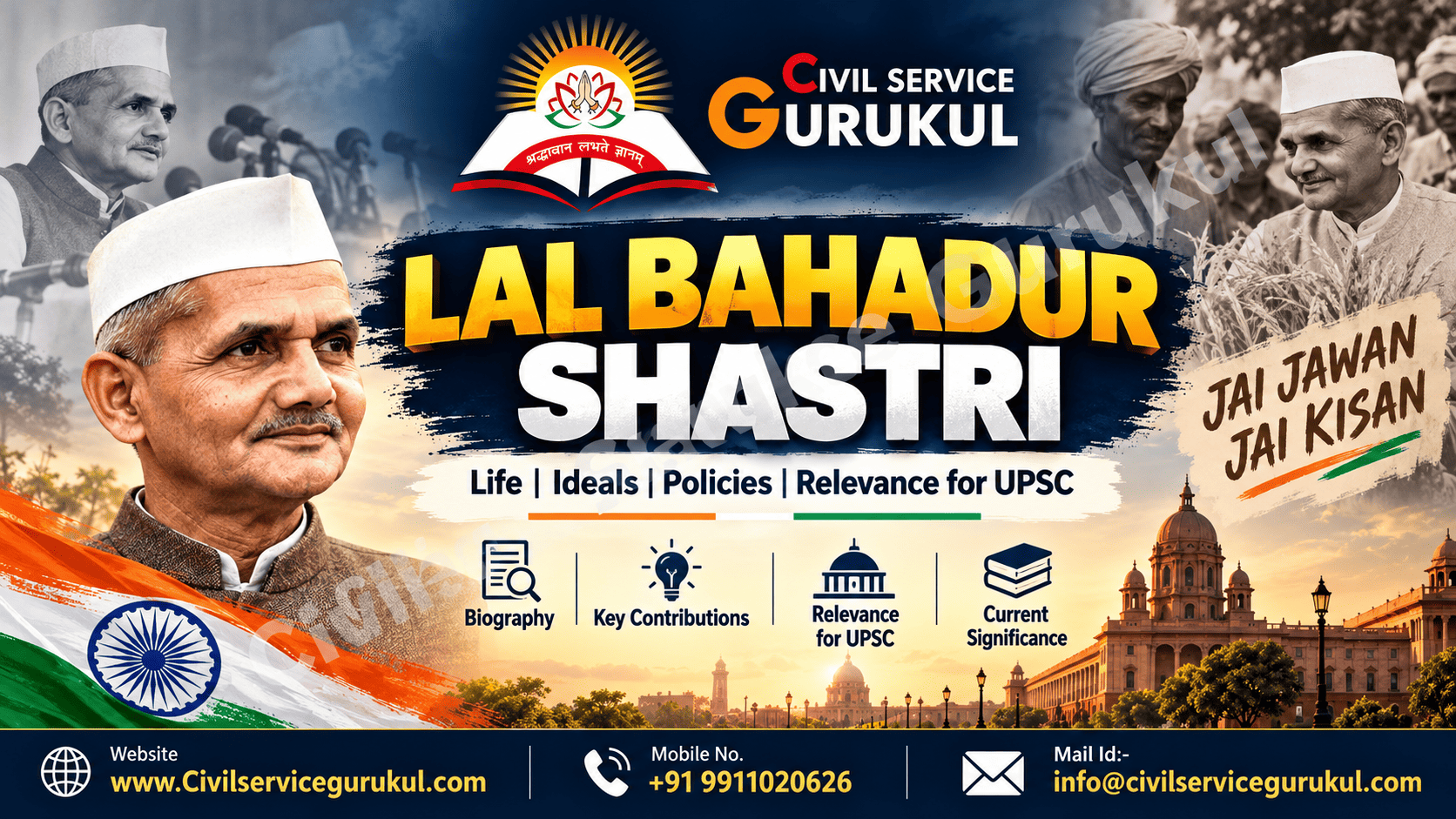
Lal Bahadur Shastri remains one of the most respected leaders in modern Indian history. The current-affairs reference highlights his birth anniversary on 2 October and recalls his association with moral integrity, agrarian self-reliance and national security. For UPSC aspirants, Shastri is important not only as India’s second Prime Minister, but also as an example of ethical public life, administrative accountability and quiet yet firm leadership.【turn295164view0†L443-L480】
Born on 2 October 1904 at Mughalsarai near Varanasi, Lal Bahadur Shastri grew up in modest circumstances after the early death of his father. He studied in Varanasi, walked long distances to school, and later joined Kashi Vidya Peeth, where he received the title “Shastri.” These early experiences shaped the values of discipline, simplicity and resilience that later defined his public career.【turn308454view0†L63-L77】
Shastri was drawn early to the freedom struggle. Inspired by Mahatma Gandhi, he left formal schooling during the Non-Cooperation Movement, later took part in major nationalist campaigns including the Salt Satyagraha, Individual Satyagraha and the Quit India Movement, and spent about seven years in British prisons. This long participation in the national movement helped transform him into a committed organiser and a dependable Congress leader.【turn295164view0†L463-L466】【turn308454view0†L73-L79】
After Independence, Shastri served in several important administrative roles. He first worked in Uttar Pradesh and later held major Union portfolios such as Railways, Transport and Communications, Commerce and Industry, and Home Affairs. One of the most cited examples of his ethical conduct was his resignation as Railway Minister after the Ariyalur train disaster, where he accepted moral responsibility. That decision is still remembered as a model of constitutional propriety and public accountability.【turn308454view0†L79-L85】【turn295164view0†L471-L475】
Shastri became the second Prime Minister of India, serving from 9 June 1964 to 11 January 1966. During this short but important tenure, he provided leadership during the 1965 Indo-Pak War and is associated with the famous national call “Jai Jawan, Jai Kisan.” The same period also saw steps that strengthened India’s food-security framework, including support for institutions such as the Food Corporation of India (FCI) and the Agricultural Prices Commission, which helped lay the foundation for long-term agricultural self-sufficiency. He also supported the dairy cooperative movement that later contributed to the White Revolution.【turn295164view0†L456-L480】
The enduring importance of Lal Bahadur Shastri lies in the values he represented: humility, inner strength, administrative honesty and service before self. The PM India biography describes him as a man of integrity, competence and deep Gandhian influence. For UPSC, this makes him relevant not only for history, but also for ethics, governance and leadership answers.【turn308454view0†L80-L85】
Why Lal Bahadur Shastri is Important for UPSC
For UPSC aspirants, Lal Bahadur Shastri is relevant in multiple parts of the syllabus:
- Prelims: Birth anniversary, tenure as Prime Minister, freedom movement participation, Kashi Vidya Peeth, 1965 Indo-Pak War, FCI, Agricultural Prices Commission, Tashkent Declaration.
- GS Paper I: Modern Indian history and post-independence nation-building.
- GS Paper II: Leadership, governance and institutional responsibility.
- GS Paper IV: Ethics, integrity, accountability and moral responsibility in public life.【turn295164view0†L456-L480】【turn308454view0†L80-L85】
Value Addition for Mains
A good line for Mains answers can be:
“Lal Bahadur Shastri showed that leadership does not require loud authority; it requires moral credibility, administrative courage and service-oriented simplicity.”
Another useful angle is his resignation as Railway Minister, which can be cited as a classic example of:
- ministerial responsibility,
- ethical accountability, and
- public trust in governance.【turn295164view0†L471-L475】
Prelims Quick Facts
- Born: 2 October 1904, Mughalsarai, Uttar Pradesh
- Prime Minister: 9 June 1964 – 11 January 1966
- Freedom Struggle: Non-Cooperation, Salt Satyagraha, Quit India
- Education: Kashi Vidya Peeth
- Known for: Integrity, simplicity, moral responsibility
- Major legacy: 1965 war leadership, food-security framework, support to dairy development, “Jai Jawan, Jai Kisan”【turn308454view0†L63-L85】【turn295164view0†L467-L480】
Conclusion
Lal Bahadur Shastri occupies a unique place in Indian public life because he combined personal simplicity with national resolve. His life is especially relevant for UPSC because it connects history with ethics and governance. In an era where leadership is often judged by visibility, Shastri reminds us that the strongest legacy may come from quiet integrity, principled action and responsibility toward the nation.【turn308454view0†L84-L85】【turn295164view0†L456-L480】
Prepare with Mentors Who Cleared the Exam
Get personalized study plans, evaluated answer models, and test series access.