
Odisha Cyclone 2026: Recovery & Disaster Management
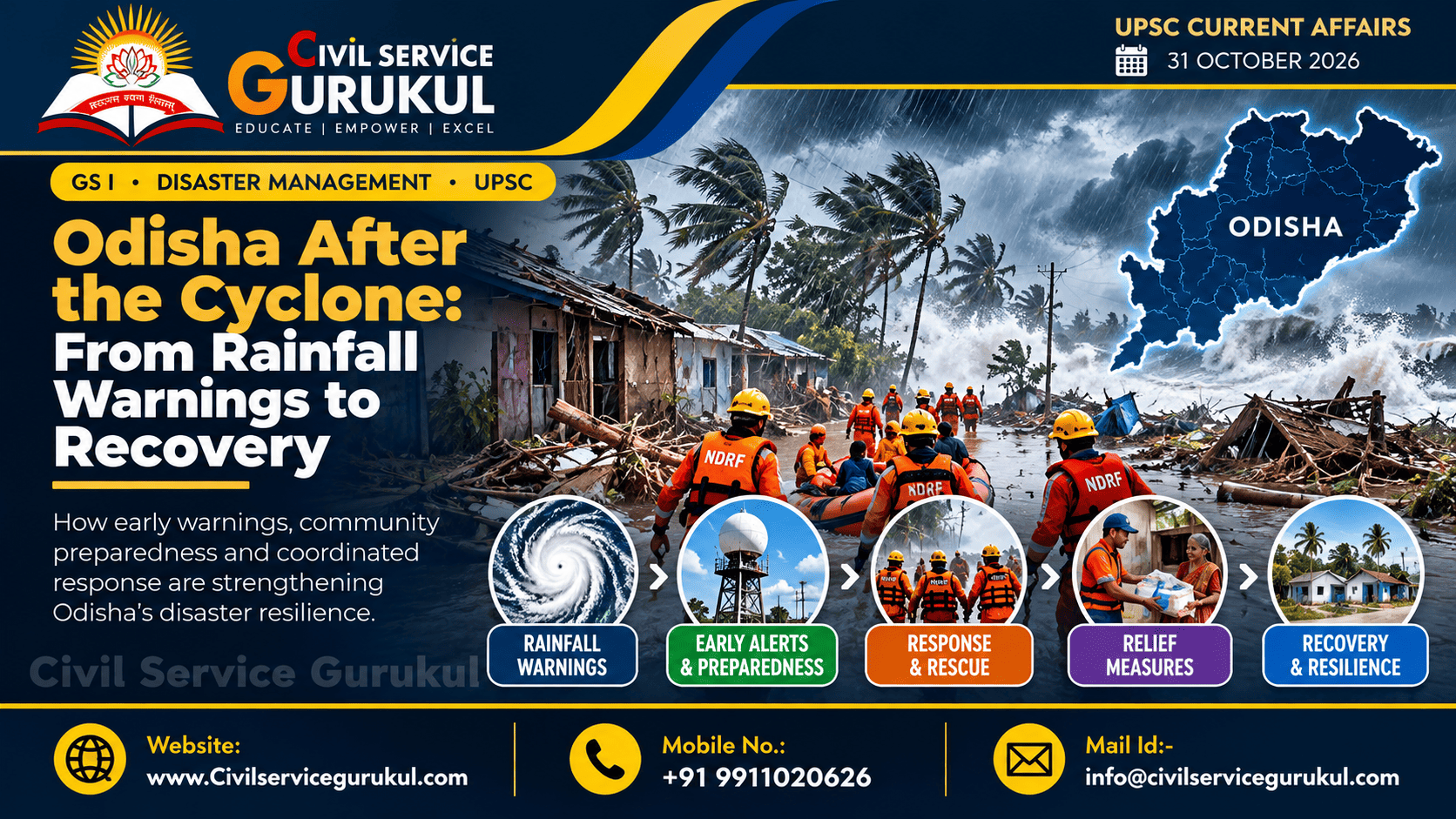
Odisha Cyclone Aftermath 2026: Heavy Rainfall, Disaster Recovery and Climate-Resilient Governance
A comprehensive UPSC analysis of cyclone-related flooding, early warning systems, IMD, NDMA, SACHET, post-disaster recovery, coastal resilience and governance challenges.
Heavy rainfall and disruption in Odisha following a cyclone have highlighted the need for effective disaster management beyond the immediate emergency response.
Cyclone-related risks may continue after the storm centre moves away.
Flooding, damaged roads, power disruption, contaminated drinking water and livelihood losses can prolong hardship for affected communities.
Effective recovery requires early warnings, safe evacuation, reliable public services, transparent relief systems and risk-informed reconstruction.
GS Paper I: Physical geography, tropical cyclones, coastal processes and natural hazards.
GS Paper II: Governance, public service delivery, institutional coordination and vulnerable populations.
GS Paper III: Disaster management, climate resilience, infrastructure protection and risk reduction.
Prelims: IMD, NDMA, tropical cyclones, storm surge, early warning systems and SACHET.
Why Is Odisha's Cyclone Aftermath in the News?
A current-affairs report dated 30 October 2026 highlighted heavy rainfall and disruption in Odisha following a cyclone.
The report draws attention to the importance of post-disaster recovery and the need to maintain essential services after extreme weather events.
The immediate passage of a cyclone does not necessarily end the associated public-safety risks.
The supplied material does not provide verified district-wise rainfall totals, casualty figures or damage estimates.
Such statistics should be taken from dated official bulletins rather than inferred from the headline.
What Are Tropical Cyclones?
Tropical cyclones are organised low-pressure weather systems that develop over sufficiently warm tropical or subtropical ocean waters.
They are associated with strong winds, intense rainfall and potentially dangerous coastal conditions.
Important Conditions
- Warm ocean waters.
- Adequate atmospheric moisture.
- Favourable atmospheric instability.
- Sufficient Coriolis influence.
- Relatively low vertical wind shear for development.
Major Hazards
- Damaging winds.
- Heavy rainfall.
- Storm surge.
- Coastal inundation.
- River and urban flooding.
- Infrastructure damage.
Why Is Coastal Odisha Vulnerable?
Odisha's location along the Bay of Bengal exposes parts of the state to cyclonic weather systems and associated coastal hazards.
Coastal Exposure
Low-lying coastal areas may be vulnerable to storm surge and inundation.
Heavy Rainfall
Intense rainfall can overwhelm drainage systems and increase flood risk.
River Systems
Heavy rainfall across river catchments can contribute to flooding beyond the immediate coastal zone.
Livelihood Dependence
Agriculture, fisheries, informal employment and coastal economic activity may be disrupted by severe weather.
Why Do Risks Continue After a Cyclone?
1. Flooding
Rainfall may continue to affect drainage systems, rivers and low-lying settlements even after the storm weakens.
2. Damaged Infrastructure
Roads, bridges, electricity networks and communications may require urgent repair.
3. Drinking Water and Sanitation
Floodwater contamination can threaten safe drinking water and sanitation services.
4. Public Health
Disrupted healthcare, unsafe water and crowded shelters can create additional health concerns.
5. Livelihood Loss
Farmers, fishers, daily-wage workers and small businesses may face interruptions to income.
Disaster management does not end with evacuation.
Recovery requires restoration of services, livelihood protection and reduction of future vulnerability.
Role of Early Warning Systems
An effective early warning system helps authorities and communities prepare before hazardous conditions become severe.
Meteorological Forecasting
The India Meteorological Department issues official meteorological forecasts and cyclone-related warnings.
Last-Mile Communication
Warnings must reach the people who need them, including residents in remote settlements.
Accessible Alerts
Communication methods should consider language, disability, connectivity and other accessibility barriers.
Community Preparedness
Local awareness, evacuation drills and clear shelter information can improve emergency readiness.
Institutional Framework for Disaster Management
| Institution | Principal Role | UPSC Relevance |
|---|---|---|
| IMD | Weather forecasting and cyclone warnings | Meteorological services |
| NDMA | National disaster management policies and guidelines | Disaster governance |
| State Disaster Authorities | State-level planning and coordination | Federal governance |
| District Administration | Local preparedness, evacuation and relief | Last-mile implementation |
| SACHET | Geo-targeted disaster alerts | Technology in disaster management |
Disaster Management Act, 2005
The Disaster Management Act, 2005 established an institutional framework for disaster management in India.
Its provisions and subsequent amendments should be read in their applicable current form.
From Immediate Relief to Long-Term Recovery
Emergency Response
Immediate priorities include saving lives, evacuation, shelter, emergency healthcare and essential supplies.
Restoration of Services
Electricity, drinking water, sanitation, transport and communications need coordinated restoration.
Livelihood Rehabilitation
Recovery programmes should consider farmers, fishers, informal workers and small enterprises.
Housing Reconstruction
Rebuilding should consider location-specific hazards and appropriate construction standards.
Social Protection
Support mechanisms should reach vulnerable households and minimise exclusion.
Major Challenges in Post-Cyclone Recovery
- Remote Settlements: Difficult access can delay relief and service restoration.
- Damaged Communications: Disruption may weaken coordination and information-sharing.
- Inaccurate Beneficiary Lists: Eligible households may be missed.
- Shelter Inequality: Some vulnerable residents may face barriers to safe shelter.
- Infrastructure Weakness: Reconstruction may repeat earlier vulnerabilities.
- Livelihood Disruption: Income losses may continue after immediate physical dangers decline.
- Public Health Risks: Water, sanitation and healthcare disruptions can prolong hardship.
Climate-Resilient Governance and Build Back Better
Risk-informed recovery seeks to reduce future vulnerability rather than merely restore damaged assets to their previous condition.
Resilient Infrastructure
Power networks, roads, schools and public facilities should be assessed against relevant hazard risks.
Coastal Ecosystems
Nature-based coastal buffers, including suitable mangrove restoration, may contribute to risk reduction in appropriate locations.
Risk Mapping
District-level hazard and vulnerability assessments can inform land use and infrastructure planning.
Inclusive Recovery
Recovery planning should consider children, older persons, persons with disabilities and economically vulnerable households.
Way Forward: A Practical Reform Agenda
- Conduct district-level damage and needs assessments.
- Strengthen accessible early warning systems.
- Improve evacuation and shelter readiness.
- Maintain drainage and critical infrastructure.
- Track relief delivery through transparent systems.
- Provide effective grievance redressal.
- Support livelihood restoration and social protection.
- Use risk-informed housing standards.
- Protect drinking water, sanitation and essential healthcare.
- Consider nature-based coastal buffers where suitable.
- Conduct independent recovery audits.
- Coordinate among national, state and district institutions.
UPSC Prelims Practice Questions
Question 1
Which institution issues official cyclone forecasts in India?
(a) Securities and Exchange Board of India
(b) India Meteorological Department
(c) Comptroller and Auditor General
(d) NITI Aayog
The India Meteorological Department is responsible for official meteorological forecasts and cyclone warnings.
Question 2
Consider the following statements:
- Cyclone-related flooding may continue after the storm centre moves away.
- Disaster recovery is limited only to restoring roads and electricity.
Which of the statements given above is/are correct?
(a) 1 only
(b) 2 only
(c) Both 1 and 2
(d) Neither 1 nor 2
Statement 1 is correct. Flooding and related hazards may persist.
Statement 2 is incorrect. Recovery also includes health, sanitation, livelihoods and social protection.
Question 3
SACHET is associated with:
(a) Securities market regulation
(b) Geo-targeted disaster alerts
(c) International trade negotiations
(d) Agricultural commodity pricing
SACHET is an NDMA-linked system for location-based disaster alerts.
Question 4
Which approach best reflects the principle of risk-informed post-disaster recovery?
(a) Rebuilding without considering future hazards
(b) Focusing only on immediate relief
(c) Combining resilient infrastructure, livelihood restoration, inclusive services and future risk reduction
(d) Avoiding all community participation
Risk-informed recovery aims to restore essential services while reducing future vulnerability.
UPSC Mains Practice Question
Question: "Effective cyclone management requires a transition from emergency response to risk-informed recovery and long-term resilience." Evaluate this statement with reference to coastal states such as Odisha. (250 words)
Suggested Answer Framework
Introduction: Explain Odisha's exposure to tropical cyclones and coastal hazards.
Disaster Risks: Discuss heavy rainfall, storm surge, flooding and infrastructure disruption.
Institutional Role: Explain IMD warnings, disaster authorities and district administration.
Recovery Challenges: Highlight livelihood losses, public-health concerns and unequal access to relief.
Way Forward: Recommend resilient housing, early warning, transparent relief and nature-based measures.
Conclusion: Sustainable disaster management requires reducing vulnerability before, during and after extreme events.
Frequently Asked Questions
Why is Odisha vulnerable to tropical cyclones?
Its Bay of Bengal coastline is exposed to cyclonic weather, storm surge and heavy rainfall.
Does cyclone risk end after landfall?
No. Flooding, damaged infrastructure and health hazards may persist.
What is SACHET?
SACHET is an NDMA-linked platform for geo-targeted disaster alerts.
What is the role of IMD?
IMD provides meteorological forecasts and official cyclone warnings.
What is Build Back Better?
It is an approach to recovery that seeks to reduce future vulnerability during reconstruction.
Which UPSC papers cover this topic?
GS Paper I covers physical geography. GS Paper II covers governance. GS Paper III covers disaster management.
Key Takeaway for UPSC Aspirants
Odisha's post-cyclone recovery challenges demonstrate that disaster management extends beyond warnings, evacuation and relief.
Effective governance requires resilient infrastructure, inclusive recovery, transparent assistance, livelihood protection and long-term risk reduction.
SEO Keywords and Tags
Prepare for UPSC with Civil Service Gurukul
Strengthen your understanding of geography, disaster management, climate resilience, governance and current affairs through examination-focused UPSC preparation.
Website: www.civilservicegurukul.com
Mobile: +91 9911020626
Email: info@civilservicegurukul.com
Prepare with Mentors Who Cleared the Exam
Get personalized study plans, evaluated answer models, and test series access.