
Rural 4G Saturation in India 2026: 75% Drop in Uncovered Villages, Digital Bharat Nidhi & Digital Inclusion | UPSC 2027
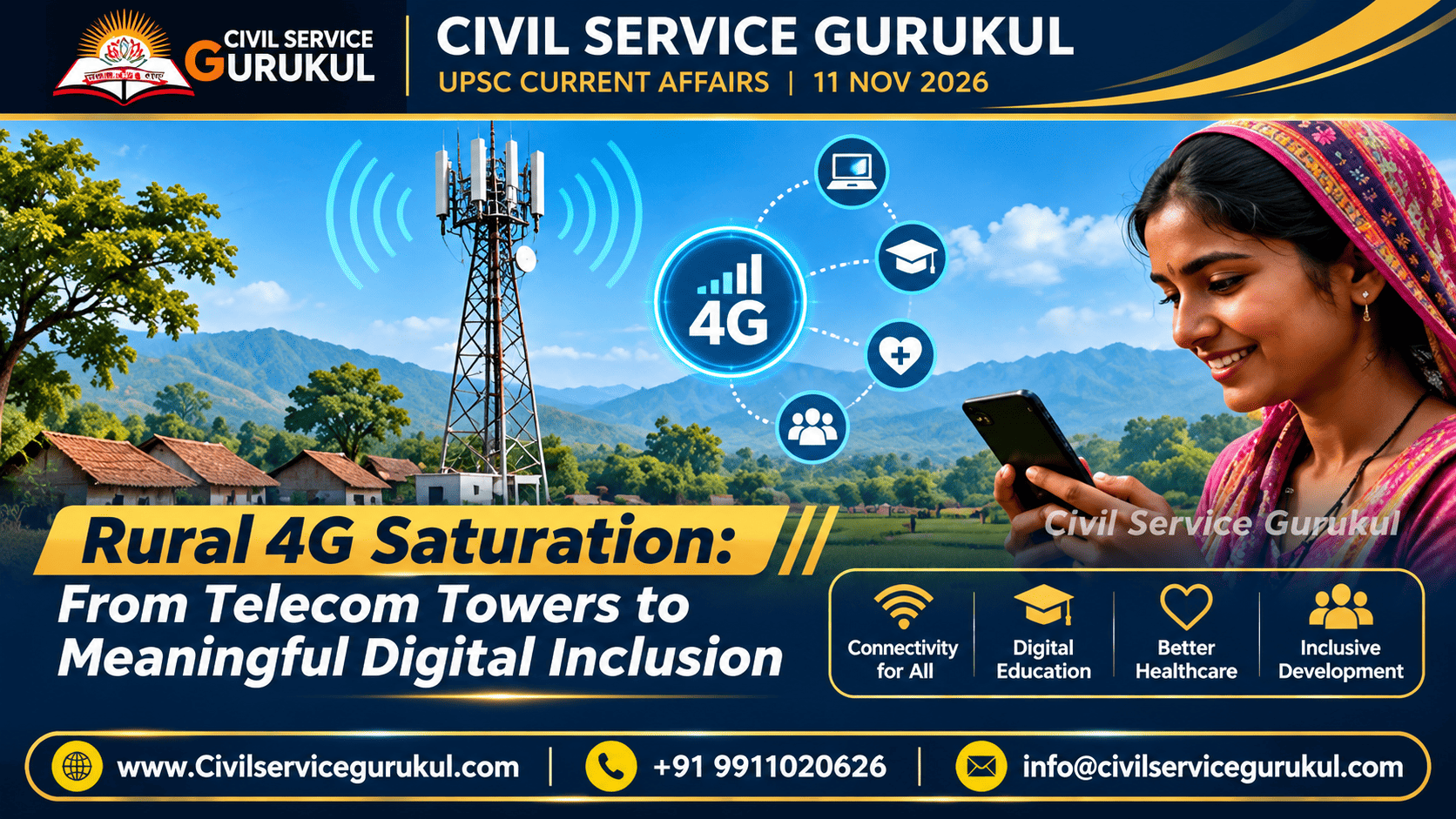
Rural 4G Saturation in India 2026: 75% Drop in Uncovered Villages, Digital Bharat Nidhi and Meaningful Digital Inclusion
India's rural 4G expansion marks an important infrastructure milestone. But true digital inclusion requires reliable connectivity, affordable devices, digital literacy and accessible services.
Excerpt / Brief Summary
The Department of Telecommunications reported on 11 November 2026 that the number of villages without 4G coverage in India declined from 45,180 in 2022 to 11,372 in 2026.
The nearly 75% decline reflects the expansion of rural mobile connectivity through government-supported programmes and private telecom network development.
BSNL's 4G Saturation rollout has commissioned 18,291 sites, while additional mobile network sites have been sanctioned to address remaining gaps.
However, mobile coverage is only the foundation of digital inclusion. Affordable internet, reliable electricity, accessible digital services, device ownership, digital skills and cybersecurity are also essential.
The issue is relevant to UPSC Governance, Social Justice, Infrastructure, Digital India and Inclusive Development.
Prelims: Digital India, Telecommunications, Digital Bharat Nidhi, BharatNet, BSNL and Government Schemes.
GS Paper II: Governance, E-Governance, Public Service Delivery, Social Justice and Government Interventions.
GS Paper III: Infrastructure, Telecommunications, Information Technology, Inclusive Growth and Rural Development.
Essay: Digital Divide, Technology for Development, Equity and Access.
1. Why in the News?
On 11 November 2026, the Ministry of Communications highlighted India's progress in expanding rural 4G mobile coverage.
According to the Department of Telecommunications, the number of villages without 4G connectivity declined from 45,180 in 2022 to 11,372 in 2026.
This represents a reduction of approximately 75% over four years.
The government also reported that 18,291 BSNL sites had been commissioned under the 4G Saturation rollout.
These sites recorded approximately 1.86 crore GB of data consumption during October 2026.
The government further announced the sanctioning of 26,000 additional mobile network sites for future connectivity expansion.
The decline in uncovered villages reflects progress, not complete elimination of rural connectivity gaps.
The figures for villages, mobile sites and users represent different statistical units. They must not be treated as interchangeable.
2. What Is the 4G Saturation Project?
The Union Cabinet approved the project for saturation of 4G mobile services in uncovered villages on 27 July 2022.
The approved project cost was ₹26,316 crore.
The scheme aims to provide 4G mobile connectivity to villages in remote and geographically challenging areas where commercial network expansion has been inadequate.
Important Features
- Coverage of 24,680 originally identified uncovered villages.
- Provision for additional villages under specified circumstances.
- Upgradation of 6,279 villages with only 2G or 3G service.
- Implementation by Bharat Sanchar Nigam Limited.
- Use of an indigenous 4G technology stack.
- Public support for network deployment in difficult areas.
Why Is Public Funding Necessary?
Private telecom operators generally consider expected commercial returns when expanding networks.
Remote villages may have low population density, difficult terrain, high infrastructure costs and lower expected revenue.
Government-supported connectivity can help address these market limitations.
3. Digital Bharat Nidhi: Important UPSC Prelims Topic
Digital Bharat Nidhi, or DBN, supports the extension of telecommunication services to underserved areas.
It operates under the framework of the Telecommunications Act, 2023.
The earlier Universal Service Obligation Fund was renamed Digital Bharat Nidhi under the new telecommunications framework.
Objectives of Digital Bharat Nidhi
- Support connectivity in underserved regions.
- Bridge geographical differences in telecom access.
- Finance eligible telecommunications projects.
- Support rural and remote digital infrastructure.
- Promote wider availability of communication services.
| Particular | Important Fact |
|---|---|
| Full Name | Digital Bharat Nidhi |
| Abbreviation | DBN |
| Earlier Funding Mechanism | Universal Service Obligation Fund |
| Legal Framework | Telecommunications Act, 2023 |
| Associated Ministry | Ministry of Communications |
| Purpose | Support telecommunications connectivity and related services in underserved areas |
Universal service funding helps address situations where market incentives alone may not ensure telecom connectivity in remote or commercially unattractive areas.
4. BharatNet and 4G Saturation: What Is the Difference?
BharatNet and the 4G Saturation Project both support connectivity, but their primary infrastructure approaches are different.
| Feature | BharatNet | 4G Saturation Project |
|---|---|---|
| Primary Focus | Broadband and optical fibre connectivity infrastructure | Mobile network coverage in uncovered areas |
| Technology | Primarily optical fibre and related broadband infrastructure | 4G mobile network infrastructure |
| Target | Gram Panchayats and wider village broadband connectivity | Uncovered and underserved villages |
| Potential Services | Broadband backhaul, Wi-Fi and last-mile connections | Mobile voice and data services |
| Role in Digital Inclusion | Strengthens broadband availability and capacity | Extends wireless mobile access |
The two initiatives can complement one another.
Optical fibre networks can provide backhaul capacity, while mobile infrastructure delivers wireless connectivity to users.
5. What Is Meaningful Digital Inclusion?
Digital inclusion means that individuals and communities have practical opportunities to access and benefit from digital technology.
The presence of a telecom tower is only one component.
A. Network Availability
A mobile network must be available in the relevant settlement or area.
B. Network Reliability
Users need stable connectivity, reasonable speed and limited service interruptions.
C. Affordability
Mobile devices and data plans must be affordable for intended users.
D. Digital Literacy
People need the skills to use applications, search for information and access online services.
E. Accessibility
Digital services should accommodate different languages, disabilities and levels of literacy.
F. Trust and Safety
Users require confidence in digital payments, data protection and cybersecurity.
Network Coverage does not automatically equal Meaningful Digital Inclusion.
Coverage measures infrastructure availability, while digital inclusion concerns actual and effective use.
6. Importance of Rural 4G for Inclusive Development
1. E-Governance
Reliable internet can help rural residents access government applications, certificates and public service information.
2. Digital Financial Services
Connectivity can support digital payments, banking applications and financial information.
3. Telemedicine
Healthcare providers may use digital platforms for remote consultations and follow-up services.
4. Digital Education
Students may access online learning materials, educational videos and digital study resources.
5. Agricultural Services
Farmers can access market information, weather advisories and agricultural extension services.
6. Rural Entrepreneurship
Connectivity can support online marketing, business communication and access to digital marketplaces.
7. Emergency Communication
Reliable networks can improve communication during natural disasters and other emergencies.
These are potential development benefits. Actual outcomes depend on the quality and accessibility of the services provided.
7. Challenges in Achieving Universal Digital Inclusion
A. Difficult Geography
Mountains, forests and remote settlements can increase installation and maintenance costs.
B. Electricity Reliability
Mobile infrastructure requires dependable power supply and backup systems.
C. Network Quality
A nominally covered village may still experience weak indoor reception, low speed or frequent outages.
D. Device Affordability
Households may not be able to purchase suitable smartphones.
E. Digital Gender Divide
Women and girls may encounter additional barriers related to affordability, device access, social norms and digital skills.
F. Elderly and Disabled Users
Older persons and persons with disabilities may require accessible interfaces and additional assistance.
G. Cybersecurity
Online fraud, misinformation and weak data protection can discourage digital adoption.
H. Last-Mile Service Delivery
A digital platform has limited value when users cannot complete essential transactions or receive timely services.
8. From Telecom Towers to Meaningful Outcomes
Governments need to measure more than the number of installed towers.
| Indicator | What It Measures |
|---|---|
| Village Coverage | Whether a village is reported within mobile network coverage |
| Network Uptime | Percentage of time the network remains operational |
| Download and Upload Speed | Practical data performance experienced by users |
| Indoor Coverage | Usability within homes, schools and public buildings |
| Affordability | Cost of devices and internet plans relative to household resources |
| Digital Literacy | Ability to use essential digital applications |
| Service Completion | Successful use of online public and financial services |
| Accessibility | Availability of inclusive interfaces for different user groups |
| User Safety | Protection from fraud, misuse and privacy risks |
A comprehensive monitoring framework should combine infrastructure indicators with outcomes experienced by citizens.
9. Way Forward: Building an Inclusive Digital India
- Complete Coverage Gaps: Prioritise remote, tribal and difficult geographical areas.
- Improve Service Quality: Publish transparent uptime, speed and network reliability indicators.
- Strengthen Maintenance: Provide sustainable funding for power, repairs and network operations.
- Encourage Infrastructure Sharing: Improve the efficient use of existing telecom assets.
- Promote Digital Literacy: Expand practical, local-language digital skills training.
- Ensure Accessibility: Design services for women, older persons, persons with disabilities and low-literacy users.
- Improve Cyber Safety: Strengthen awareness of online fraud and privacy protection.
- Evaluate Outcomes: Measure citizen satisfaction and successful service delivery, not just network coverage.
10. UPSC Mains Practice Question
"Universal mobile network coverage is necessary but insufficient for meaningful digital inclusion."
Discuss with reference to India's rural 4G expansion and digital governance initiatives.
Model Answer
Introduction: Digital infrastructure is an important foundation of inclusive development. India's rural 4G expansion demonstrates this progress, with the number of villages lacking 4G connectivity declining by nearly 75% between 2022 and 2026.
Importance of Mobile Coverage: Rural connectivity can support e-governance, digital payments, telemedicine, online education, agricultural information and rural entrepreneurship.
Why Coverage Is Insufficient: Network availability does not guarantee reliable speed, affordable devices, digital literacy, accessible interfaces or user safety.
Remote terrain and electricity constraints may also affect service reliability. Gender, age, income and disability-related barriers can further limit digital participation.
Way Forward: India should complete last-mile network expansion, improve infrastructure maintenance, publish service-quality indicators and promote local-language digital literacy.
Affordable devices, accessible public services and stronger cybersecurity are also necessary.
Conclusion: Digital inclusion must be measured by the ability of citizens to use technology effectively. The ultimate goal is not merely more telecom towers but better human development outcomes.
11. UPSC Prelims Practice MCQs
1. It was approved by the Union Cabinet in July 2022.
2. It is implemented by BSNL.
3. Its original target included 24,680 uncovered villages.
Which of the statements are correct?
(a) 1 and 2 only
(b) 2 and 3 only
(c) 1 and 3 only
(d) 1, 2 and 3
Show Answer and Explanation
Correct Answer: (d) 1, 2 and 3.
The Union Cabinet approved the project in July 2022. BSNL is the implementing agency, and 24,680 uncovered villages were included in the original coverage plan.
(a) Information Technology Act, 2000
(b) Telecommunications Act, 2023
(c) Companies Act, 2013
(d) Digital Personal Data Protection Act, 2023
Show Answer and Explanation
Correct Answer: (b) Telecommunications Act, 2023.
Digital Bharat Nidhi is established under the new telecommunications legal framework, succeeding the Universal Service Obligation Fund.
(a) Number of telecom towers alone
(b) Availability of network coverage without considering users
(c) Affordable, reliable and accessible use of digital technology and services
(d) Exclusive use of digital systems by urban residents
Show Answer and Explanation
Correct Answer: (c).
Meaningful inclusion requires network access, affordability, quality, skills, accessibility and useful services.
1. BharatNet primarily supports broadband connectivity infrastructure.
2. The 4G Saturation Project focuses on mobile network coverage.
3. Both initiatives can complement each other.
Which statements are correct?
(a) 1 only
(b) 1 and 2 only
(c) 2 and 3 only
(d) 1, 2 and 3
Show Answer and Explanation
Correct Answer: (d).
BharatNet strengthens broadband infrastructure, while the 4G Saturation Project focuses on mobile coverage in uncovered areas.
The initiatives are complementary.
(a) Number of mobile advertisements
(b) Network uptime and service reliability
(c) Village population alone
(d) Number of telecom company logos
Show Answer and Explanation
Correct Answer: (b).
Network uptime and service reliability measure whether the available infrastructure provides dependable connectivity.
12. Quick Revision Notes for UPSC 2027
- Ministry: Ministry of Communications.
- Department: Department of Telecommunications.
- 4G Saturation Approval: 27 July 2022.
- Approved Cost: ₹26,316 crore.
- Original Uncovered Village Target: 24,680.
- Implementing Agency: BSNL.
- Funding Mechanism: Digital Bharat Nidhi, formerly USOF.
- Legal Framework: Telecommunications Act, 2023.
- Villages Without 4G in 2022: 45,180.
- Villages Without 4G in 2026: 11,372.
- Reduction: Nearly 75%.
- Commissioned Saturation Sites: 18,291, as reported 11 November 2026.
- Additional Sanctioned Sites: 26,000.
- BharatNet: Broadband infrastructure programme.
- Key Concept: Coverage is not the same as meaningful digital inclusion.
- GS-II Keywords: E-Governance, Social Justice, Last-Mile Delivery.
- GS-III Keywords: Telecommunications, Infrastructure, Inclusive Growth.
13. Frequently Asked Questions
How many villages lacked 4G connectivity in 2026?
The Department of Telecommunications reported 11,372 villages without 4G connectivity in its 11 November 2026 update.
What is the purpose of the 4G Saturation Project?
The project aims to extend 4G mobile connectivity to uncovered and remote villages where commercial network expansion has been inadequate.
Who implements the 4G Saturation Project?
Bharat Sanchar Nigam Limited, commonly known as BSNL.
What is Digital Bharat Nidhi?
It is a statutory funding mechanism supporting the provision of telecommunications services in underserved areas.
Does 4G coverage guarantee digital inclusion?
No. Digital inclusion also requires affordable devices, dependable networks, digital literacy, accessibility and useful digital services.
Why is rural 4G important for UPSC?
It connects governance, social justice, digital infrastructure, inclusive growth and government schemes under GS-II and GS-III.
14. Conclusion: From Connectivity to Digital Empowerment
India's rural 4G expansion demonstrates significant progress towards wider digital connectivity.
The decline in uncovered villages and the deployment of additional mobile infrastructure are important achievements.
However, the ultimate development objective should go beyond network coverage.
A digitally inclusive society requires people to access affordable and reliable services confidently and safely.
Public policy must therefore combine infrastructure development with digital literacy, accessibility, affordability, consumer protection and effective service delivery.
UPSC Key Takeaway: Digital inclusion should be evaluated by citizens' real capabilities and outcomes, not merely the number of telecom towers.
15. Prepare for UPSC 2027 with Civil Service Gurukul
Civil Service Gurukul provides structured UPSC preparation resources covering current affairs, Indian Polity, Governance, Indian Economy and Technology.
Master Governance and Digital India for UPSC 2027
Build strong conceptual understanding through UPSC-oriented notes, current affairs analysis, Prelims practice and Mains answer writing.
Explore Courses and Study ResourcesWebsite: www.civilservicegurukul.com
Mobile: +91 9911020626
Email: info@civilservicegurukul.com
Educational Disclaimer: This article has been prepared by Civil Service Gurukul for UPSC Civil Services Examination preparation. The statistical figures are based on the Department of Telecommunications update dated 11 November 2026 and the relevant government scheme information available at publication. Connectivity estimates may vary according to reporting date, village classification, coverage definition and measurement methodology. Reported infrastructure coverage does not necessarily demonstrate service quality or digital usage at household level. This publication is independent educational content and is not an official UPSC publication.
Prepare with Mentors Who Cleared the Exam
Get personalized study plans, evaluated answer models, and test series access.