
US–Russia–China Summit 2026: What Great-Power Diplomacy Means for India's Strategic Autonomy | UPSC GS-II
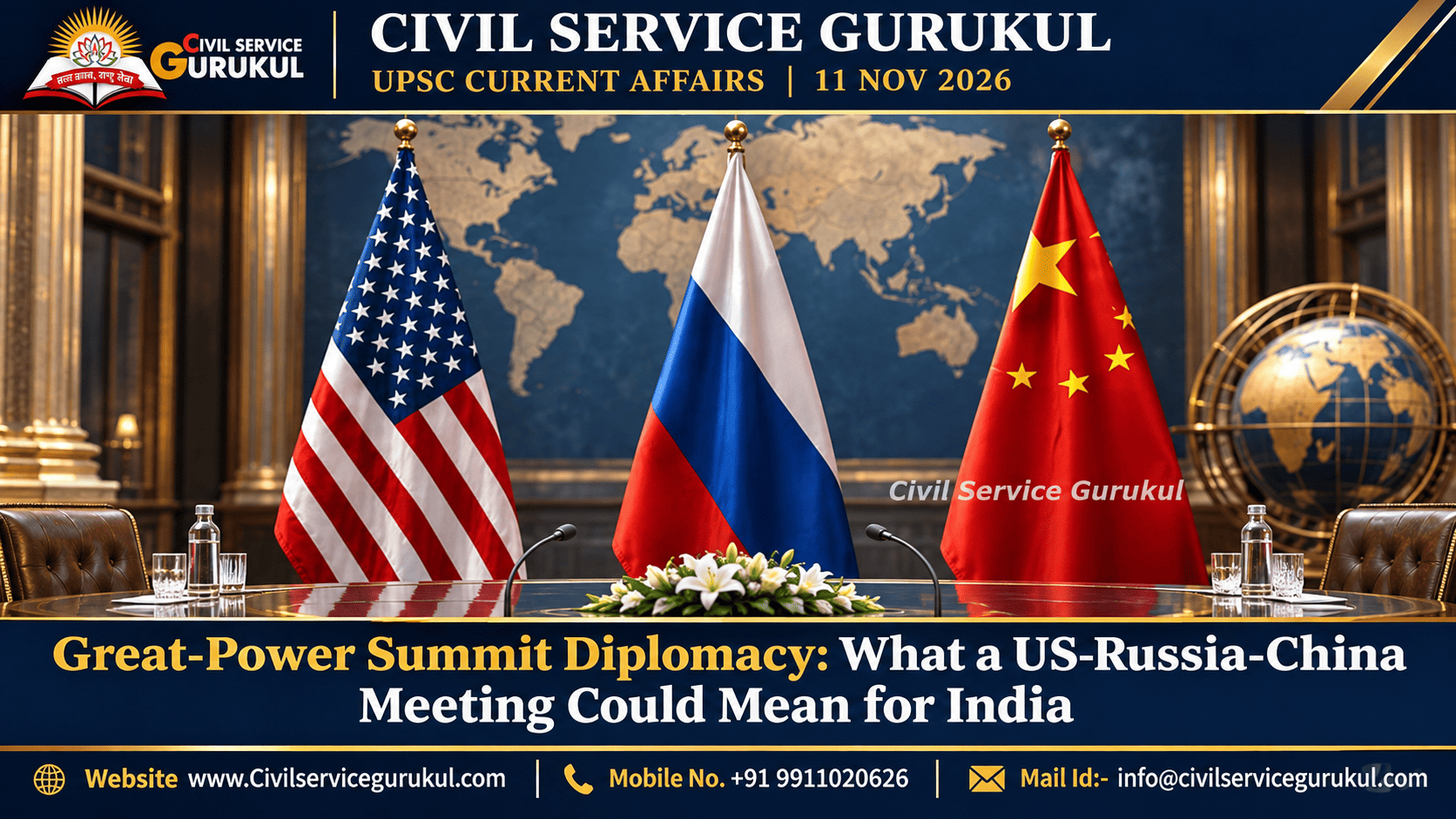
US-Russia-China Summit 2026: What Great-Power Diplomacy Means for India's Strategic Autonomy
A possible meeting between the leaders of the United States, Russia and China raises important questions about global power politics, nuclear security, multilateralism and India's foreign-policy choices.
Excerpt / Brief Summary
The possibility of a trilateral summit involving US President Donald Trump, Russian President Vladimir Putin and Chinese President Xi Jinping has renewed debate over the changing international order.
Reports suggest that such a meeting could be discussed on the sidelines of the APEC summit scheduled for 18-19 November 2026 in Shenzhen, China.
However, as of 11 November 2026, the meeting has not been officially finalised.
The issue is important for UPSC because it connects great-power rivalry, nuclear arms control, multipolarity, India's strategic autonomy, and the future of global governance.
GS Paper II: India's relations with major powers, international groupings, global institutions, foreign policies affecting India and international relations.
GS Paper III: External security, economic vulnerabilities, supply chains and strategic technology.
Prelims: APEC, QUAD, BRICS, multilateralism, strategic autonomy and international institutions.
1. Why in the News?
In November 2026, diplomatic discussions have focused on the possibility of a meeting among the leaders of the United States, Russia and China.
The proposed meeting could take place on the sidelines of the Asia-Pacific Economic Cooperation (APEC) summit in Shenzhen, China.
The proposed dates are 18-19 November 2026.
US President Donald Trump has expressed interest in discussing nuclear arms control and denuclearisation.
Russia has indicated an interest in the wider Ukraine conflict and security questions.
China's position reflects the need to manage relations with both Washington and Moscow.
However, differences over the proposed format and agenda have generated uncertainty.
As of 11 November 2026, the proposed trilateral meeting is not a confirmed summit with an agreed final agenda.
UPSC aspirants should not describe any hypothetical agreement as an accomplished diplomatic outcome.
2. Background: The Changing Global Order
International relations have witnessed increasing strategic competition among major powers.
The United States remains an important economic, military and technological power.
China has expanded its economic, technological and strategic influence.
Russia continues to play an important role in Eurasian security, energy and nuclear deterrence.
At the same time, India, the European Union and other regional actors seek greater participation in global decision-making.
A possible trilateral meeting must be viewed within this changing distribution of power.
3. Conceptual Clarity: Important Terms for UPSC
A. Multipolarity
Multipolarity refers to an international order with several significant centres of power and influence.
It differs from unipolarity, where one power dominates, and bipolarity, where two major powers occupy the central positions.
B. Strategic Autonomy
Strategic autonomy means retaining the ability to make independent foreign-policy decisions based on national interests.
It does not require India to remain equidistant from every country on every issue.
C. Multilateralism
Multilateralism involves cooperation among multiple countries through international institutions, rules or agreements.
Examples include the United Nations and the World Trade Organization.
D. Minilateralism
Minilateralism involves cooperation among a relatively small number of countries to address particular strategic or economic issues.
A possible meeting of three great powers can be examined as a form of limited-group diplomacy.
E. Balance of Power
Balance of power refers to arrangements in which states seek to prevent one actor from achieving overwhelming dominance.
4. Comparison: Different Forms of World Order
| Concept | Meaning | UPSC Example |
|---|---|---|
| Unipolarity | One dominant centre of power | Post-Cold War discussions of US predominance |
| Bipolarity | Two dominant centres of power | US-Soviet rivalry during the Cold War |
| Multipolarity | Several significant centres of influence | Contemporary debates about the emerging global order |
| Multilateralism | Broad institutional cooperation | United Nations and WTO |
| Minilateralism | Cooperation within a smaller group | Issue-specific strategic arrangements |
5. What Do the United States, Russia and China Want?
A. United States
The United States may use such diplomacy to explore nuclear arms control, manage competition with China and address broader security challenges.
Washington also has significant interests in trade, technology and the Indo-Pacific.
B. Russia
Russia may view a trilateral meeting as an opportunity to discuss Eurasian security and the Ukraine conflict.
Participation at the highest level could also carry diplomatic significance.
C. China
China may seek stable relations with major powers while retaining control over the diplomatic agenda.
It must balance its relationship with Russia against its substantial economic relationship with the United States.
These are strategic considerations rather than evidence of a negotiated agreement among the three countries.
6. What Could the Summit Mean for India?
1. India-US Relations
India and the United States cooperate across defence, technology, trade and the Indo-Pacific.
Any change in Washington's relations with China or Russia could influence strategic calculations.
2. India-Russia Relations
Russia remains an important partner in areas including defence, energy and international diplomacy.
India must evaluate any new US-Russia understanding in light of its own interests.
3. India-China Relations
India and China share major economic interactions but also face significant strategic challenges, including border issues.
A trilateral great-power arrangement would not automatically resolve India-China differences.
4. Indo-Pacific Security
The Indo-Pacific is an important region for trade, maritime security and strategic competition.
India's partnerships must remain responsive to the regional security environment.
5. Energy Security
Changes in sanctions, geopolitical tensions or international energy markets could influence India's economic choices.
6. Technology and Supply Chains
Export controls, critical minerals, semiconductors and industrial supply chains remain areas of strategic competition.
India needs diversified partnerships to reduce external vulnerabilities.
7. APEC: Important Prelims Facts
APEC stands for Asia-Pacific Economic Cooperation.
It is a regional economic forum established in 1989.
Its members are described as member economies, reflecting its economic-cooperation structure.
| Feature | Important Fact |
|---|---|
| Full Form | Asia-Pacific Economic Cooperation |
| Established | 1989 |
| Members | 21 member economies |
| Nature | Regional economic cooperation forum |
| India's Membership | India is not an APEC member economy |
| Main Focus | Trade, investment and economic cooperation |
India is a member of BRICS and the G20, but it is not a member of APEC.
Do not confuse APEC with ASEAN, QUAD or BRICS.
8. Potential Benefits of Great-Power Dialogue
A. Nuclear Risk Reduction
Dialogue may create opportunities for discussion on arms control, strategic stability and nuclear risk reduction.
B. Crisis Management
Direct communication between major powers can reduce the risk of misunderstanding during international crises.
C. Economic Stability
Reduced tensions could help improve confidence in international trade and investment.
D. Diplomatic Communication
Regular engagement may provide channels for handling strategic disagreements.
E. International Cooperation
Successful diplomacy could provide momentum for further discussions within established international forums.
9. Risks and Limitations: Can Great-Power Diplomacy Undermine Multilateralism?
1. Exclusion of Smaller States
Negotiations among a few major powers may overlook the interests of countries directly affected by their decisions.
2. Spheres of Influence
Exclusive great-power bargaining can encourage the perception that major states may determine the security choices of others.
3. Weakening of Institutions
Important international issues may be handled outside broader institutions.
4. Conflicting Interests
The United States, Russia and China have competing strategic goals.
A meeting would not automatically produce agreement.
5. Diplomatic Symbolism
High-profile summits can generate public attention without producing substantive outcomes.
Positive View: Limited-group diplomacy may create faster channels for crisis communication.
Critical View: It can weaken inclusiveness if important decisions are made without affected countries.
Balanced Conclusion: Minilateral diplomacy should complement, not replace, effective and inclusive multilateralism.
10. India's Way Forward: Strategic Autonomy in a Changing Global Order
- Maintain Independent Decisions: Evaluate each international issue according to India's national interests.
- Diversify Partnerships: Expand cooperation across trade, technology, energy and defence.
- Strengthen Multilateral Institutions: Support reforms that improve representation and effectiveness.
- Protect Indo-Pacific Interests: Promote maritime security, connectivity and regional stability.
- Strengthen Economic Resilience: Reduce vulnerabilities in strategic supply chains.
- Support Dialogue: Welcome peaceful dispute resolution without endorsing exclusive spheres of influence.
- Champion the Global South: Promote broader participation in international decision-making.
11. UPSC Mains Answer-Writing Practice
"Minilateral great-power diplomacy can both strengthen and weaken multilateralism."
Examine this statement with reference to India's strategic autonomy and the emerging multipolar world order.
Model Answer
Introduction: Minilateral diplomacy involves cooperation among a small group of states on selected issues. The proposed US-Russia-China meeting illustrates its growing significance within a changing multipolar world.
Potential Benefits: Great-power dialogue can reduce strategic miscalculation, improve crisis communication and support negotiations on nuclear arms control and economic stability.
Limitations: However, exclusive diplomatic arrangements can marginalise smaller states, create spheres-of-influence concerns and weaken the legitimacy of broader international institutions.
India's Perspective: India's strategic autonomy requires independent, issue-specific decisions while maintaining constructive relations with the United States, Russia and China.
India should support peaceful dialogue, diversify economic and technological partnerships, protect Indo-Pacific interests and advocate inclusive multilateral reforms.
Conclusion: Minilateral diplomacy can be useful when it complements multilateral institutions. India must preserve policy flexibility while supporting a rules-based, representative global order.
12. UPSC Prelims Practice MCQs
(a) Refusing all international partnerships
(b) Making independent foreign-policy decisions based on national interests
(c) Maintaining identical relations with all countries
(d) Avoiding all defence cooperation
Show Answer and Explanation
Correct Answer: (b).
Strategic autonomy means preserving independent decision-making. It does not require neutrality or equal distance on every issue.
1. APEC was established in 1989.
2. India is one of its 21 member economies.
3. APEC focuses on regional economic cooperation.
Which statements are correct?
(a) 1 only
(b) 1 and 3 only
(c) 2 and 3 only
(d) 1, 2 and 3
Show Answer and Explanation
Correct Answer: (b) 1 and 3 only.
APEC was established in 1989 and has 21 member economies. India is not an APEC member.
(a) Complete dominance by one country
(b) Two equal superpowers controlling international politics
(c) Several significant centres of international power
(d) Absence of national sovereignty
Show Answer and Explanation
Correct Answer: (c).
A multipolar international order contains several important centres of power and influence.
1. Minilateralism usually involves a relatively small number of states.
2. Multilateralism can involve broad institutional cooperation.
3. Minilateralism always requires a legally binding treaty.
Which statements are correct?
(a) 1 and 2 only
(b) 2 and 3 only
(c) 1 and 3 only
(d) 1, 2 and 3
Show Answer and Explanation
Correct Answer: (a) 1 and 2 only.
Minilateral arrangements need not always be legally binding. Multilateralism involves broader cooperation among states and institutions.
1. Discussions concerned a possible meeting during the APEC summit.
2. As of 11 November 2026, a final trilateral agreement had been confirmed.
3. Nuclear arms control was among the reported possible subjects of discussion.
Which statements are correct?
(a) 1 only
(b) 1 and 3 only
(c) 2 and 3 only
(d) 1, 2 and 3
Show Answer and Explanation
Correct Answer: (b) 1 and 3 only.
The meeting remained under discussion as of 11 November 2026. A final summit agreement had not been confirmed.
13. Quick Revision Notes for UPSC 2027
- APEC: Asia-Pacific Economic Cooperation.
- Established: 1989.
- Members: 21 member economies.
- India: Not an APEC member.
- Proposed Summit: US-Russia-China trilateral meeting.
- Proposed Context: Shenzhen APEC, 18-19 November 2026.
- Status on 11 November: Not finalised.
- Strategic Autonomy: Independent, issue-based policy choices.
- Multipolarity: Several centres of international power.
- Minilateralism: Cooperation among a small group of countries.
- Major Indian Concerns: Defence, energy, trade, technology, Indo-Pacific and multilateral reform.
- GS-II Keywords: Balance of Power, Global South, Strategic Autonomy, Multilateralism.
14. Frequently Asked Questions
Is the proposed US-Russia-China summit confirmed?
As of 11 November 2026, the trilateral meeting had not been officially finalised.
Why is the summit relevant for India?
It may influence great-power relations, security diplomacy, energy markets, technology access and the Indo-Pacific.
What is strategic autonomy?
It is India's ability to make foreign-policy decisions independently based on national interests.
Is India a member of APEC?
No. India is not among APEC's 21 member economies.
Can minilateralism support multilateralism?
Yes. Limited-group dialogue can support crisis management and practical cooperation, provided it does not replace inclusive international institutions.
15. Conclusion: India's Strategic Autonomy in a Multipolar World
The proposed US-Russia-China trilateral meeting illustrates the complexity of contemporary great-power diplomacy.
Such dialogue may create opportunities for nuclear risk reduction, crisis communication and improved international stability.
However, it could also raise concerns about exclusive great-power bargaining and the exclusion of smaller states.
For India, the appropriate response is to preserve independent foreign-policy choices, strengthen diversified partnerships and support inclusive global institutions.
For UPSC aspirants, the essential lesson is that strategic autonomy means flexibility and independent judgement, not automatic neutrality or political isolation.
16. Prepare for UPSC 2027 with Civil Service Gurukul
Civil Service Gurukul provides UPSC Prelims and Mains study resources, current affairs analysis and answer-writing guidance.
Master International Relations for UPSC CSE 2027
Build conceptual clarity through syllabus-based study material, current affairs analysis, Prelims questions and Mains practice.
Explore Courses and Study ResourcesWebsite: www.civilservicegurukul.com
Mobile: +91 9911020626
Email: info@civilservicegurukul.com
Educational Disclaimer: This article is prepared for UPSC Civil Services Examination preparation and is based on developments reported as of 11 November 2026. The proposed US-Russia-China meeting was not confirmed as completed or finalised at the time of preparation. Possible diplomatic outcomes are presented as analytical scenarios rather than established facts. The article does not represent an official UPSC publication or government position.
Prepare with Mentors Who Cleared the Exam
Get personalized study plans, evaluated answer models, and test series access.