
Technological Sovereignty in India | UPSC 2027
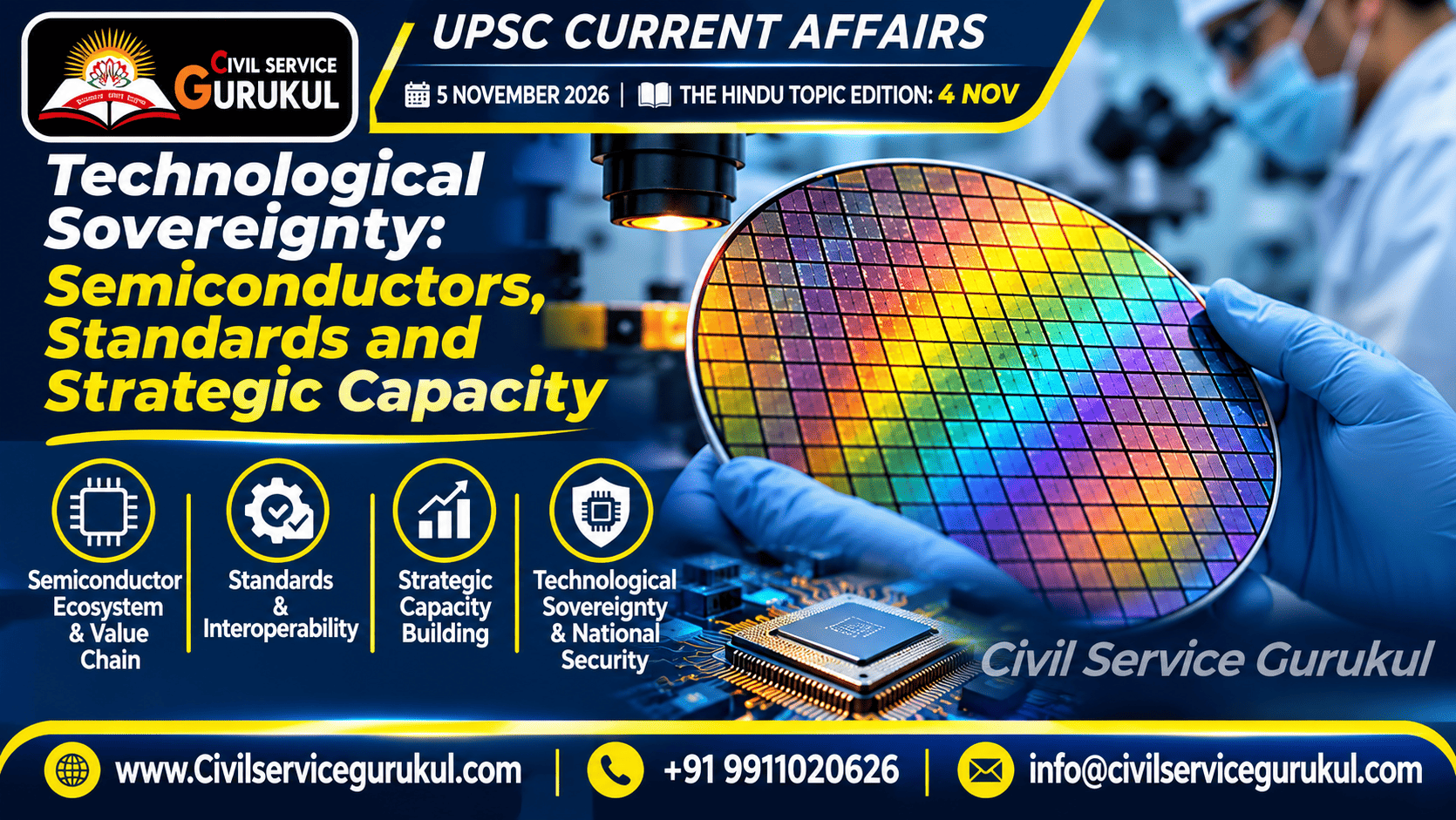
UPSC CURRENT AFFAIRS | SCIENCE & TECHNOLOGY | NATIONAL SECURITY
India's Technological Sovereignty: Semiconductor Mission, Defence Innovation, Global Standards and Strategic Autonomy
Comprehensive UPSC Prelims and Mains analysis of critical technologies, semiconductor supply chains, domestic research, technology standards and India's strategic capacity.
Published: 5 November 2026
1. Why Is Technological Sovereignty in News?
A current-affairs topic index dated 4 November 2026 highlighted a statement attributed to Defence Minister Rajnath Singh emphasizing that India must achieve technological sovereignty.
The headline brings attention to India's need to develop reliable capabilities in critical technologies, including semiconductors, defence systems, digital infrastructure, advanced manufacturing and strategic supply chains.
The complete speech and any associated policy announcements require confirmation from official records.
2. What Is Technological Sovereignty?
Technological sovereignty refers to the capacity of a country to make secure, informed and independent strategic choices concerning critical technologies.
It involves the ability to develop, access, operate, maintain and govern technologies that are essential for national development and security.
Technological sovereignty does not necessarily require producing every component domestically.
Instead, it requires a combination of indigenous capabilities, diversified supply chains, trusted partnerships, skilled manpower and control over critical technological decisions.
3. Technological Sovereignty vs Technological Self-Reliance
| Technological Sovereignty | Technological Self-Reliance |
|---|---|
| Focuses on strategic decision-making capacity | Focuses on developing domestic technological capabilities |
| Can involve trusted global partnerships | Emphasizes reducing excessive dependence on imports |
| Includes standards, intellectual property and supply-chain resilience | Emphasizes domestic production, skills and research |
| Seeks freedom from coercive technological dependence | Seeks stronger indigenous capabilities |
Both approaches can reinforce each other when combined with openness to innovation and international cooperation.
4. Why Are Semiconductors Strategically Important?
Semiconductors are foundational components of modern electronic systems.
They are used in smartphones, computers, communication networks, automobiles, medical equipment, industrial machinery and defence technologies.
Modern economies depend on reliable access to semiconductor components and related technologies.
Disruptions in semiconductor supply chains can therefore affect multiple sectors simultaneously.
5. Understanding the Semiconductor Value Chain
The semiconductor industry includes several interconnected stages.
Chip Design
Engineers design integrated circuits according to specific functional requirements.
Fabrication
Semiconductor fabrication plants manufacture chips using specialized equipment and processes.
Assembly, Testing and Packaging
Manufactured chips are assembled, tested and packaged for use in electronic products.
Equipment and Materials
Fabrication depends on specialized machinery, chemicals, materials and software tools.
6. India Semiconductor Mission
The India Semiconductor Mission is an important policy initiative supporting the development of India's semiconductor and display manufacturing ecosystem.
Its broader objectives include strengthening domestic capabilities, supporting investment and developing the semiconductor ecosystem.
The success of semiconductor policy depends not only on financial incentives but also on infrastructure, skilled manpower, reliable utilities, technology partnerships and commercial viability.
Specific project approvals, subsidy amounts and implementation milestones should be verified against current official releases.
7. Why Domestic Assembly Alone Is Not Enough
Domestic assembly can create employment and strengthen manufacturing capacity.
However, assembly facilities may still rely heavily on imported components, equipment, software and intellectual property.
Technological sovereignty requires attention to the complete value chain rather than focusing only on final-stage manufacturing.
This includes research, design, testing, equipment access, skilled workers and secure software systems.
8. Critical Technologies and National Security
Critical technologies are technologies whose availability, security or performance can significantly affect national security and economic resilience.
Examples include:
- Semiconductors and advanced electronics.
- Artificial intelligence and high-performance computing.
- Cybersecurity technologies.
- Secure communication systems.
- Advanced materials.
- Defence electronics and sensors.
- Space technologies.
- Strategic manufacturing equipment.
Dependence on a limited number of foreign suppliers can create strategic vulnerabilities during geopolitical tensions or supply disruptions.
9. Defence Technology and Strategic Autonomy
Modern defence systems depend increasingly on advanced electronics, secure software, communication networks, sensors and specialized materials.
Strategic autonomy is strengthened when a country can maintain, upgrade and adapt critical defence technologies without excessive dependence on external suppliers.
Indigenous research and development, trusted procurement and domestic industrial capacity can contribute to this objective.
International cooperation may also remain essential for accessing advanced technologies and developing complex systems.
10. Role of Standards in Technological Sovereignty
Technical standards help ensure that products and systems meet agreed requirements for safety, quality, compatibility and performance.
Standards can influence market access, industrial competitiveness and technological interoperability.
Participation in international standards-setting processes can help countries shape the rules governing emerging technologies.
Technological sovereignty therefore includes the capacity to understand, implement and contribute to relevant technical standards.
11. Bureau of Indian Standards
The Bureau of Indian Standards, or BIS, is India's national standards body.
It operates under the Bureau of Indian Standards Act, 2016.
BIS performs functions relating to standardization, conformity assessment and quality assurance within its statutory framework.
For UPSC, the role of standards should be linked with manufacturing competitiveness, consumer protection and technological governance.
12. Intellectual Property and Technology Transfer
Intellectual property rights influence access to technological knowledge, commercial incentives and innovation.
Patents, trade secrets, licensing arrangements and technical know-how can affect the ability of firms to develop and manufacture advanced products.
Technology transfer may support domestic capability building, but it does not automatically guarantee mastery of complex production processes.
Long-term capacity requires domestic research, skilled workers, practical experience and the ability to innovate independently.
13. Research Institutions and Human Capital
Universities, public research laboratories, engineering institutions and industrial research centres are important parts of a national innovation ecosystem.
They support:
- Fundamental research.
- Applied research and prototyping.
- Skilled workforce development.
- Testing and certification.
- Industry–academia collaboration.
- Commercialization of research.
Technological sovereignty requires sustained investment in both physical infrastructure and human capital.
14. Global Semiconductor Supply-Chain Risks
Semiconductor production involves geographically distributed and highly specialized activities.
Concentration of important capabilities in limited locations or suppliers can create vulnerabilities.
Potential risks include:
- Geopolitical restrictions.
- Export controls.
- Supply disruptions.
- Natural disasters.
- Shortages of specialized equipment.
- Cybersecurity incidents.
- Dependence on proprietary design tools.
Supply-chain diversification can reduce some risks, although complete elimination of dependence is neither simple nor necessarily efficient.
15. Atmanirbhar Bharat and Technological Capacity
Atmanirbhar Bharat emphasizes strengthening domestic productive capabilities and reducing vulnerabilities arising from excessive dependence.
In the technology sector, self-reliance can involve domestic research, manufacturing capacity, skill development and stronger supply chains.
However, self-reliance should not be confused with complete withdrawal from global technology networks.
India can pursue indigenous capability building while continuing to benefit from international research, trade and trusted partnerships.
16. Challenges to India's Technological Sovereignty
High Capital Requirements
Advanced semiconductor manufacturing and testing facilities can require substantial investment.
Technology Complexity
Modern chip production depends on highly specialized knowledge and equipment.
Skill Gaps
Specialized engineering and manufacturing talent takes time to develop.
Supply-Chain Dependence
Critical materials, tools and components may remain concentrated among a small number of suppliers.
Research Commercialization
Research outcomes must be translated into commercially useful products and processes.
Fiscal Trade-Offs
Public subsidies must be evaluated against measurable economic and strategic benefits.
17. Balancing Strategic Autonomy with Global Trade
Technological sovereignty does not require rejecting international trade.
Global cooperation can provide access to specialized capabilities, markets, investment and knowledge.
The central policy challenge is to avoid excessive dependence while preserving innovation and competitiveness.
| Overdependence | Resilient Technological Sovereignty |
|---|---|
| Concentrated suppliers | Diversified trusted supply chains |
| Limited domestic research | Strong research and innovation ecosystem |
| Dependence on imported design tools | Greater domestic capability and secure access |
| Limited participation in standards | Active standards development and cooperation |
| Subsidies without evaluation | Transparent, outcome-based industrial support |
18. Governance and Ethical Dimensions
Accountability
Public funding for strategic industries should be subject to transparent evaluation.
Fair Competition
Industrial policy should consider market competition and opportunities for smaller firms.
Public Interest
Technology policy should support national security, economic opportunity and social welfare.
Transparency
Policy outcomes should be assessed using clear and measurable indicators.
Long-Term Responsibility
Public investment decisions should consider fiscal sustainability and future technological needs.
19. Way Forward: Building India's Strategic Technology Capacity
- Invest in semiconductor design and advanced packaging.
- Strengthen public research institutions.
- Develop shared testing and prototyping facilities.
- Support specialized technical education.
- Improve secure software supply chains.
- Participate actively in international standards development.
- Diversify trusted technology partnerships.
- Promote domestic intellectual property creation.
- Support commercially viable technology enterprises.
- Evaluate industrial subsidies using measurable outcomes.
20. UPSC Prelims Quick Revision
- Technological sovereignty does not require complete isolation from global trade.
- Semiconductors are essential components of modern electronic systems.
- Chip design, fabrication, assembly, testing and packaging are distinct stages.
- Semiconductor fabrication requires specialized equipment and materials.
- The India Semiconductor Mission supports semiconductor ecosystem development.
- BIS is India's national standards body.
- The Bureau of Indian Standards Act was enacted in 2016.
- Technical standards influence quality, safety and interoperability.
- Intellectual property can affect access to advanced technologies.
- Strategic autonomy depends on domestic capacity and resilient international partnerships.
21. UPSC Prelims Practice MCQs
Question 1
Which statement best describes technological sovereignty?
- Complete isolation from international technology trade
- Capacity to make strategic choices using resilient domestic and international capabilities
- Mandatory domestic production of every technological component
- Elimination of international standards
Technological sovereignty emphasizes strategic capacity, resilience and informed technological choices.
Question 2
Which activity is part of the semiconductor value chain?
- Chip design
- Fabrication
- Testing and packaging
- All of the above
The semiconductor value chain includes design, fabrication, assembly, testing and packaging.
Question 3
The Bureau of Indian Standards is primarily associated with:
- Monetary policy
- Standardization and quality assurance
- Electoral registration
- Foreign exchange reserves
BIS is India's national standards body.
Question 4
Which of the following can create semiconductor supply-chain vulnerability?
- Concentration of specialized suppliers
- Export restrictions
- Disruption of critical equipment access
- All of the above
All these factors can increase supply-chain risk.
Question 5
Which approach is most consistent with long-term technological sovereignty?
- Subsidies without performance evaluation
- Eliminating all foreign research cooperation
- Research, skills, trusted partnerships and transparent policy evaluation
- Depending permanently on a single supplier
Long-term strategic capacity requires a combination of research, talent, partnerships and accountability.
22. UPSC Mains Practice Questions
GS Paper II — International Relations
Question: Explain how technological sovereignty can strengthen India's strategic autonomy in an increasingly interdependent global economy. (250 words)
GS Paper III — Science and Technology
Question: Discuss the importance of the semiconductor ecosystem for India's economic resilience and national security. (250 words)
GS Paper III — Economy
Question: Evaluate the benefits and limitations of public subsidies for strategic technology industries. (150 words)
23. Model UPSC Mains Answer
Question: Explain how India can build technological sovereignty without sacrificing innovation and trade.
Introduction:
Technological sovereignty is the capacity to make independent strategic choices concerning critical technologies, supply chains, standards and intellectual property.
Body:
- Domestic capabilities: Invest in research, design, manufacturing and advanced packaging.
- Human capital: Develop specialized engineering skills and research talent.
- Supply-chain resilience: Diversify suppliers and strengthen trusted partnerships.
- Standards: Participate in global standards-setting while improving domestic quality infrastructure.
- Innovation: Support startups, research institutions and industry–academia collaboration.
- Industrial policy: Use transparent, measurable criteria to evaluate public incentives.
- Global engagement: Preserve access to international knowledge, investment and markets.
Conclusion:
India should pursue technological sovereignty through competitive domestic capabilities and resilient international integration rather than technological isolation.
24. Key Takeaways for UPSC Aspirants
- Define technological sovereignty clearly.
- Distinguish strategic autonomy from technological isolation.
- Understand the semiconductor value chain.
- Revise the role of the India Semiconductor Mission.
- Remember the role of BIS and technical standards.
- Connect intellectual property with technology transfer.
- Discuss the importance of R&D and specialized skills.
- Explain why domestic assembly alone cannot guarantee strategic independence.
- Balance industrial policy with international trade and innovation.
Frequently Asked Questions
What is technological sovereignty?
It is the capacity to make secure and independent strategic decisions concerning critical technologies through domestic capabilities, resilient supply chains and trusted partnerships.
Why are semiconductors important for India?
Semiconductors support modern electronics, communication, industry, healthcare, transport and defence systems.
What is the India Semiconductor Mission?
It is an Indian policy initiative supporting the development of the semiconductor and display ecosystem.
Does technological sovereignty require banning imports?
No. Technological sovereignty can be strengthened through diversified international partnerships alongside domestic research and production capabilities.
What is the role of BIS?
The Bureau of Indian Standards is India's national standards body and performs statutory functions relating to standardization and conformity assessment.
Why is domestic assembly alone insufficient?
Assembly operations may still depend on imported chips, equipment, design tools, intellectual property and specialized materials.
Why is technological sovereignty important for UPSC 2027?
It connects science and technology, national security, industrial policy, economic development and international relations.
Prepare for UPSC with Civil Service Gurukul
Strengthen your UPSC preparation with structured Science and Technology notes, current affairs, International Relations, Prelims MCQs and Mains answer-writing practice.
Visit Civil Service GurukulWebsite: www.civilservicegurukul.com
Mobile: +91 9911020626
Email: info@civilservicegurukul.com
Prepare with Mentors Who Cleared the Exam
Get personalized study plans, evaluated answer models, and test series access.