
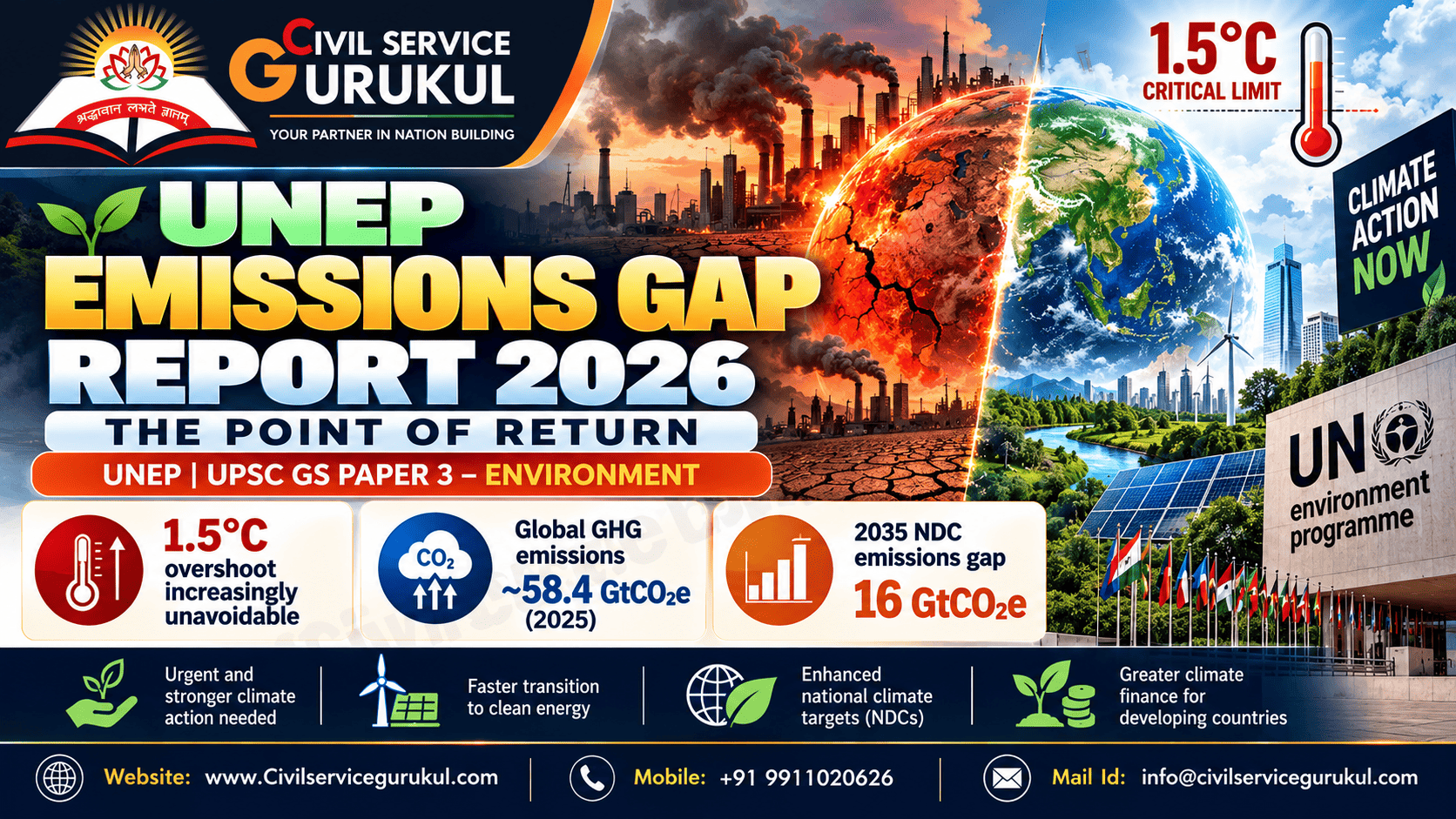
1. Why Is the Emissions Gap Report 2026 Important?
The United Nations Environment Programme's Emissions Gap Report 2026, titled The Point of Return, warns that global climate action remains far below the level required to meet the most ambitious temperature objective of the Paris Agreement.
The world is now expected to exceed the 1.5°C warming threshold above pre-industrial levels.
Nevertheless, the report concludes that deep and sustained emissions reductions could limit the magnitude of overshoot and potentially bring warming back to or below 1.5°C by 2100.
This makes the report important for UPSC because it connects climate science, global governance, environmental policy, energy transition and India's development priorities.
2. UPSC Syllabus Relevance
| UPSC paper | Relevant syllabus area |
|---|---|
| Prelims GS I | Environment, climate change and international environmental institutions |
| GS Paper III | Environmental conservation, pollution, degradation and climate change |
| GS Paper III | Energy security, renewable energy and sustainable development |
| GS Paper II | International treaties, global institutions and climate diplomacy |
| Essay | Climate justice, sustainable growth and intergenerational equity |
| GS Paper IV | Environmental ethics and responsibility towards future generations |
3. What Is the Emissions Gap?
The emissions gap is the difference between the amount of greenhouse gases expected to be released under existing policies or climate pledges and the amount consistent with a specified global temperature pathway.
Illustrative example
Suppose projected global emissions in a particular year are 50 gigatonnes of carbon dioxide equivalent, while the pathway compatible with a climate objective requires 35 gigatonnes.
The illustrative emissions gap would be 15 gigatonnes.
These figures are hypothetical and are not the reported 2026 emissions gap.
Who publishes the report?
The United Nations Environment Programme publishes the annual Emissions Gap Report.
The 2026 edition is the seventeenth assessment in the series.
4. Major Findings of the Emissions Gap Report 2026
| Indicator | Major finding |
|---|---|
| Report title | The Point of Return |
| 1.5°C temperature threshold | Overshoot is considered unavoidable under present circumstances |
| Lowest-overshoot peak | Approximately 1.7–1.8°C around mid-century |
| 2030 reduction requirement | 18% below 2025 emissions |
| 2035 reduction requirement | 45% below 2025 emissions |
| 2040 reduction requirement | 69% below 2025 emissions |
| Warming under current policies | About 2.8°C during this century, potentially rising further thereafter |
| Warming with full NDC implementation | Approximately 2.6°C if similar efforts continue |
| Carbon dioxide removal | Approximately 320 gigatonnes over the century in the lowest-overshoot scenario |
5. The Emissions Reduction Pathway for Returning to 1.5°C
UNEP's lowest-overshoot scenario requires rapid reductions in global emissions.
| Year | Required GHG reduction | Reference year |
|---|---|---|
| 2030 | 18% | 2025 |
| 2035 | 45% | 2025 |
| 2040 | 69% | 2025 |
These figures represent a global pathway for minimising temperature overshoot.
They should not be confused with identical binding targets for every country.
Country-level responsibilities depend on national circumstances, historical contributions, capabilities and the international climate framework.
Why early action is essential
Delaying cuts adds greenhouse gases to the atmosphere and increases cumulative warming.
It can also increase the future dependence on carbon dioxide removal technologies.
6. Comparing Global Temperature Scenarios
| Policy or mitigation scenario | Projected warming |
|---|---|
| Continuation of current policies | Approximately 2.8°C during this century, with potential further increase |
| Full implementation of NDCs with comparable efforts continuing | Approximately 2.6°C |
| Implementation of NDCs and additional net-zero commitments | Approximately 2.1°C |
| Lowest possible 1.5°C overshoot pathway | Peak of about 1.7–1.8°C near mid-century, potentially returning to 1.5°C by 2100 |
The scenarios demonstrate that current national commitments are insufficient to achieve the lowest overshoot pathway.
Even the more ambitious cases require strong policy implementation and continued emissions reductions.
7. What Does Overshooting 1.5°C Mean?
Climate overshoot occurs when the global temperature temporarily exceeds a specified threshold before potentially falling back.
In UNEP's lowest-overshoot scenario, warming could reach around 1.7–1.8°C near the middle of the century.
It may then return to or below 1.5°C by 2100 if deep emissions cuts and carbon dioxide removal are achieved.
Why overshoot is dangerous
- Greater exposure to extreme heat.
- Higher risks to biodiversity and ecosystems.
- Additional pressure on glaciers and ice sheets.
- Greater threats to coastal communities.
- More severe climate impacts on agriculture and water resources.
- Risk of irreversible changes even if temperatures later decline.
8. Paris Agreement, NDCs and the Global Stocktake
Paris Agreement
The Paris Agreement was adopted in 2015 under the United Nations Framework Convention on Climate Change.
It seeks to hold global temperature increase well below 2°C while pursuing efforts to limit warming to 1.5°C above pre-industrial levels.
Nationally Determined Contributions
NDCs are national climate action commitments communicated under the Paris Agreement.
They set out measures and targets countries intend to pursue to address climate change.
Global Stocktake
The Global Stocktake is a collective assessment of progress towards the Paris Agreement's long-term objectives.
It informs subsequent rounds of stronger national climate action.
Major global priorities
- Accelerating renewable energy deployment.
- Improving energy efficiency.
- Transitioning away from fossil fuels in energy systems.
- Reducing methane and other non-CO₂ greenhouse gases.
- Protecting forests and ecosystems.
- Scaling climate finance and technology cooperation.
9. Carbon Dioxide Removal: Opportunities and Limitations
Carbon Dioxide Removal, or CDR, means removing carbon dioxide from the atmosphere and storing it for a meaningful period.
UNEP's lowest-overshoot scenario requires approximately 320 gigatonnes of CO₂ removal over this century.
Examples of removal approaches
Afforestation and reforestation
Trees and vegetation absorb atmospheric carbon through photosynthesis, although storage can be reversed by fire, degradation or land-use change.
Bioenergy with Carbon Capture and Storage
BECCS combines biomass energy production with capture and storage of associated CO₂.
Direct Air Capture
DAC uses engineered systems to capture CO₂ directly from ambient air.
Soil and ecosystem carbon restoration
Improved land management may enhance carbon storage in soils and natural ecosystems.
Limitations
- High cost of many engineered removal technologies.
- Significant energy and infrastructure requirements.
- Competition for land and water.
- Challenges in measuring permanent carbon storage.
- Uncertain scalability and environmental consequences.
10. India and the Emissions Gap Report 2026
India is an important participant in global climate negotiations because of its population, development needs, energy demand and commitment to low-carbon growth.
India's major climate commitments
| Commitment | Target or objective |
|---|---|
| Emissions intensity of GDP | 45% reduction by 2030 compared with 2005 |
| Non-fossil electricity capacity | About 50% of cumulative installed power capacity by 2030 |
| Additional carbon sink | 2.5–3 billion tonnes CO₂ equivalent through additional forest and tree cover by 2030 |
| Long-term net zero | 2070 target |
| Mission LiFE | Promoting sustainable lifestyles and responsible consumption |
Emissions intensity versus absolute emissions
Emissions intensity measures greenhouse gas emissions relative to economic output.
A country may reduce emissions per unit of GDP while its total absolute emissions continue to increase.
This distinction is important for understanding India's development strategy and climate commitments.
India's strengths
- Expanding non-fossil electricity capacity.
- Growth of solar and other renewable technologies.
- Energy efficiency policies.
- Electric mobility and clean energy innovation.
- Climate adaptation and resilient development initiatives.
India's continuing challenges
- Meeting rising electricity demand.
- Managing dependence on coal-based generation.
- Financing energy transition infrastructure.
- Supporting coal-dependent communities.
- Strengthening adaptation to heatwaves, floods and droughts.
11. Climate Justice and the Major Obstacles to Global Action
Historical responsibility
Industrialised countries account for a large share of cumulative historical greenhouse gas emissions.
Unequal economic capabilities
Developing economies often have more limited financial and technological resources for rapid transitions.
Energy security
Countries must maintain reliable and affordable energy supplies while reducing fossil-fuel use.
Climate finance gap
Large-scale mitigation and adaptation require sustained public and private investment.
Geopolitical fragmentation
Changing government policies and international tensions can delay collective climate action.
These problems make climate cooperation a question of equity as well as environmental science.
12. Way Forward: How to Narrow the Emissions Gap
- Strengthen national commitments: Align future NDCs more closely with science-based global pathways.
- Accelerate renewables: Invest in solar, wind, grids and energy storage.
- Improve energy efficiency: Reduce energy waste in industry, buildings and transport.
- Reduce fossil-fuel dependence: Plan an equitable and orderly energy transition.
- Cut methane: Address emissions from energy, agriculture and waste.
- Protect ecosystems: Reduce deforestation and restore degraded landscapes.
- Expand climate finance: Support affordable capital and technology transfer for developing countries.
- Govern carbon removal carefully: Adopt clear standards for measurement, sustainability and permanence.
- Prioritise adaptation: Strengthen resilience to unavoidable climate impacts.
13. UPSC Prelims Practice MCQs
Question 1
The Emissions Gap Report is published by which organisation?
(a) World Meteorological Organization
(b) United Nations Environment Programme
(c) International Monetary Fund
(d) International Energy Agency
UNEP publishes the annual Emissions Gap Report.
Question 2
Consider the following statements about Emissions Gap Report 2026:
- The report is titled The Point of Return.
- The lowest-overshoot scenario requires a 45% global GHG reduction by 2035 from 2025 levels.
- The report states that no carbon dioxide removal would be needed to return to 1.5°C.
Which statements are correct?
(a) 1 only
(b) 1 and 2 only
(c) 2 and 3 only
(d) 1, 2 and 3
The report identifies substantial carbon dioxide removal as a component of the lowest-overshoot pathway.
Question 3
Which statement best describes climate overshoot?
(a) A permanent decrease in global temperature
(b) A temporary exceedance of a temperature threshold
(c) An immediate halt to all greenhouse gas emissions
(d) A fall in ocean temperatures without atmospheric change
Overshoot means warming rises above a threshold before potentially declining again.
Question 4
India's updated 2030 NDC target for reducing the emissions intensity of GDP uses which reference year?
(a) 1990
(b) 2000
(c) 2005
(d) 2025
India's updated target is a 45% reduction in emissions intensity of GDP by 2030 relative to 2005.
Question 5
Which of the following can qualify as carbon dioxide removal approaches?
- Direct Air Capture with durable storage
- Afforestation that increases carbon stocks
- Bioenergy with Carbon Capture and Storage
Select the correct answer:
(a) 1 and 2 only
(b) 2 and 3 only
(c) 1 and 3 only
(d) 1, 2 and 3
All three can remove atmospheric carbon, subject to the relevant accounting and storage conditions.
14. UPSC Mains Practice Question and Model Answer
"The Emissions Gap Report 2026 shows that the global response to climate change remains inadequate." Discuss the key findings and suggest a balanced way forward, with special reference to India.
Model Answer
The UNEP Emissions Gap Report 2026, titled The Point of Return, examines the difference between projected global greenhouse gas emissions and levels compatible with climate temperature goals.
Key findings: The report warns that overshooting 1.5°C is now effectively unavoidable. Its lowest-overshoot pathway requires global emissions cuts of 18% by 2030, 45% by 2035 and 69% by 2040, relative to 2025. Under current policies, warming could reach about 2.8°C during this century.
Challenges: Continued fossil-fuel dependence, insufficient climate finance, unequal technological capabilities and geopolitical tensions undermine global mitigation efforts. Heavy reliance on carbon removal also creates technological and ecological risks.
India's perspective: India has committed to reducing GDP emissions intensity by 45% by 2030 from 2005 levels and pursuing net-zero emissions by 2070. Its energy transition must protect developmental needs, energy access and vulnerable communities.
Way forward: Countries should strengthen NDCs, expand renewable energy, improve efficiency, cut methane emissions and mobilise equitable climate finance.
Conclusion: Closing the emissions gap requires urgent action anchored in climate justice, scientific evidence and international cooperation.
15. Frequently Asked Questions
What is the title of UNEP's Emissions Gap Report 2026?
The report is titled The Point of Return.
Which organisation publishes the Emissions Gap Report?
The United Nations Environment Programme.
What is the required emissions reduction by 2035?
A 45% reduction in global greenhouse gas emissions compared with 2025 levels under the lowest-overshoot scenario.
What is the projected warming under current policies?
Approximately 2.8°C during this century, with potential further warming thereafter.
What is climate overshoot?
It is a temporary exceedance of a specified temperature threshold before a possible later decline.
What are NDCs?
Nationally Determined Contributions are countries' climate commitments under the Paris Agreement.
What is India's long-term net-zero target year?
2070.
How is emissions intensity different from total emissions?
Emissions intensity measures emissions per unit of economic output, while total emissions measure the absolute quantity released.
16. Conclusion: The World Must Act Before the Climate Gap Widens
The Emissions Gap Report 2026 delivers an important warning: existing climate policies and commitments remain insufficient to limit warming to the lowest possible overshoot.
Yet the report also highlights the opportunity to accelerate proven climate solutions.
Renewable energy, energy efficiency, methane reduction, ecosystem protection and stronger international cooperation can collectively reduce future risks.
For India, the path forward requires reconciling rapid economic development with clean energy, climate resilience and equitable international action.
For UPSC aspirants, the report is a valuable case study linking environmental science, sustainable development, global governance and climate justice.
Prepare Smarter for UPSC Prelims & Mains
Civil Service Gurukul
Strengthen your civil services preparation through current affairs, conceptual GS notes, Prelims questions and Mains answer-writing practice.
Visit Civil Service Gurukul Contact Us
Website: www.civilservicegurukul.com
Mobile: +91 9911020626
Email: info@civilservicegurukul.com
Educational disclaimer: This original UPSC study guide was prepared on 22 October 2026 using publicly available climate assessments and policy information. Temperature projections are scenario-based, not guaranteed outcomes. Aspirants should distinguish global pathway requirements from individual countries' formal NDC targets.