
Voter Form 6 & Electoral Roll Revision | UPSC 2027
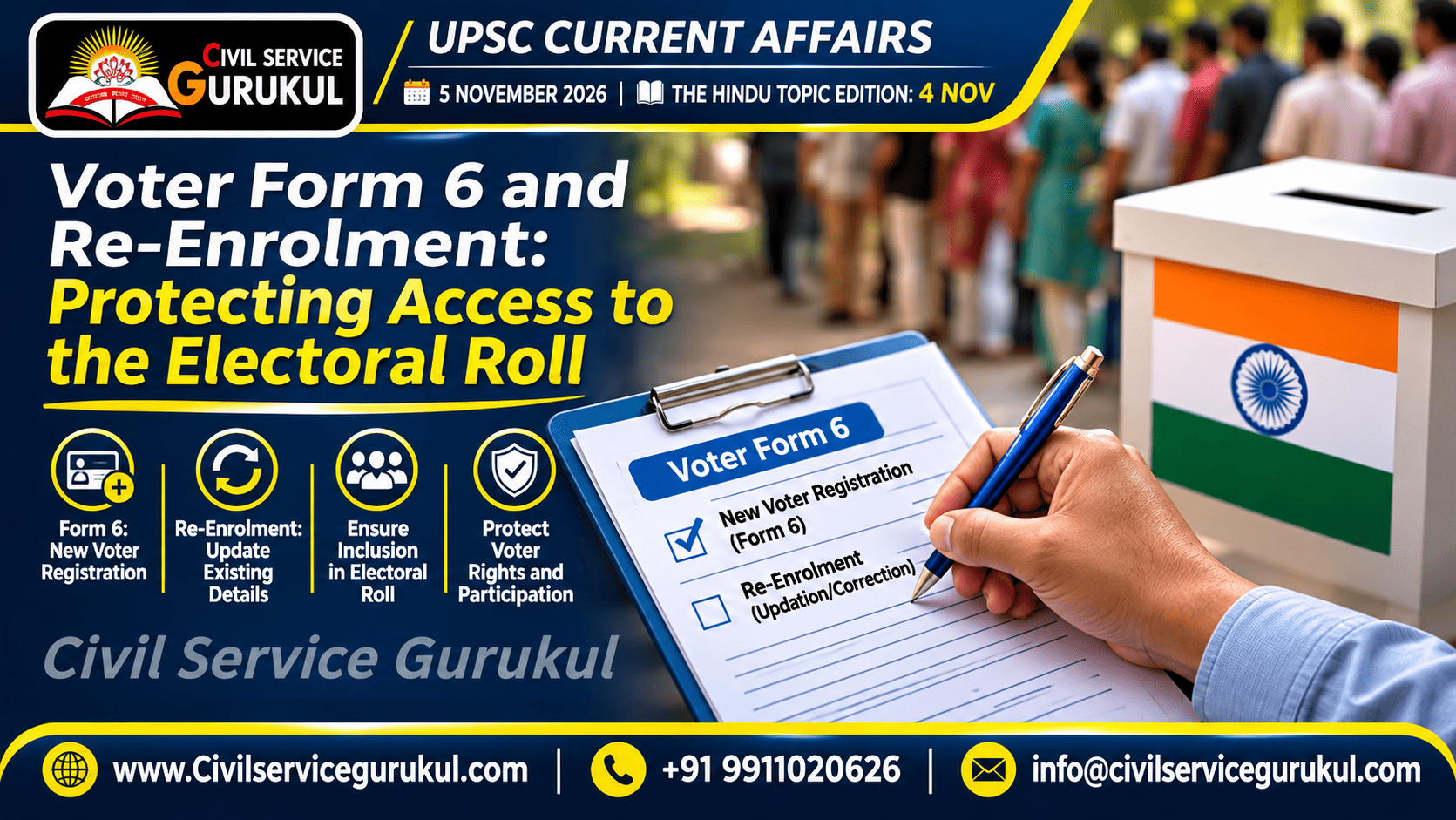
UPSC CURRENT AFFAIRS | INDIAN POLITY | GOVERNANCE
Voter Form 6 Explained: ECI Re-Enrolment Clarification, Electoral Roll Revision and Voting Rights in India
Comprehensive UPSC Prelims and Mains analysis of voter registration, electoral roll accuracy, constitutional provisions and democratic inclusion.
Published: 5 November 2026
1. Why Is Voter Form 6 in News?
A current-affairs topic index dated 4 November 2026 highlighted a reported clarification from the Election Commission of India concerning voters using Form 6 for re-enrolment.
The headline stated that voters using Form 6 for re-enrolment would not face action.
However, the complete scope and conditions of this reported clarification require verification from the relevant official communication.
The issue raises important questions about electoral roll accuracy, voter inclusion, administrative fairness and safeguards against duplicate entries.
2. What Is Voter Form 6?
Form 6 is an application used for inclusion of a name in the electoral roll under the applicable voter registration framework.
It is commonly used by eligible citizens seeking registration as electors.
Eligibility, declarations and supporting documentation are governed by electoral law and applicable ECI instructions.
3. Constitutional Framework of Elections in India
India's Constitution provides the foundation for electoral governance.
Article 324
Article 324 vests the superintendence, direction and control of elections to Parliament, State Legislatures and the offices of President and Vice-President in the Election Commission.
Article 325
Article 325 provides for one general electoral roll for every territorial constituency and prohibits ineligibility for inclusion or claims to special electoral rolls on specified grounds such as religion, race, caste or sex.
Article 326
Article 326 provides for elections to the Lok Sabha and State Legislative Assemblies on the basis of adult suffrage.
The voting age is 18 years, subject to constitutional and statutory qualifications.
4. Representation of the People Act, 1950
The Representation of the People Act, 1950 provides the statutory framework for several aspects of electoral registration.
It addresses matters including:
- Electoral rolls.
- Qualifications for registration.
- Ordinary residence.
- Preparation and revision of rolls.
- Inclusion and correction procedures.
- Appeals and related administrative processes.
The Registration of Electors Rules, 1960 provide procedural details.
5. Universal Adult Franchise in India
Universal adult franchise is a foundational principle of Indian democracy.
It enables eligible adult citizens to participate in the electoral process without property or educational qualification requirements.
The principle supports political equality and representative government.
However, actual electoral participation also requires eligible voters to be correctly included in the electoral roll.
6. Why Are Accurate Electoral Rolls Important?
Electoral rolls identify registered electors for a constituency.
Their accuracy is important for both democratic inclusion and electoral integrity.
Voter Inclusion
Eligible citizens should have a fair opportunity to register and correct their records.
Preventing Duplicate Entries
Electoral authorities must maintain safeguards against duplicate or improper entries.
Public Confidence
Transparent procedures strengthen confidence in electoral administration.
Administrative Efficiency
Accurate records support smoother electoral processes.
7. Form 6, Form 7 and Form 8: Key Differences
| Form | Primary Purpose |
|---|---|
| Form 6 | Application for inclusion of name in electoral roll |
| Form 7 | Objection to proposed inclusion or request for deletion of an existing entry |
| Form 8 | Shifting of residence, correction of entries, replacement EPIC or marking as person with disability, as applicable |
The appropriate form depends on the applicant's circumstances and current ECI instructions.
8. What Is Electoral Roll Revision?
Electoral roll revision is the process of updating electoral records to reflect eligible electors and relevant changes.
It may involve:
- Adding eligible voters.
- Correcting inaccurate entries.
- Updating residence-related information.
- Removing entries where legally justified.
- Verifying relevant registration details.
Revision processes must balance accuracy with procedural fairness.
9. Electoral Registration Officer and Booth Level Officer
Electoral Registration Officer
The Electoral Registration Officer, or ERO, performs statutory functions relating to preparation and revision of electoral rolls.
The ERO examines registration matters according to applicable law and procedure.
Booth Level Officer
Booth Level Officers support electoral administration at the local level, including assigned verification and voter assistance tasks.
Their functions operate within the relevant administrative framework.
10. Re-Enrolment and Procedural Fairness
A person whose name is missing from an electoral roll may need an accessible process for seeking inclusion, subject to applicable eligibility requirements.
The administration must distinguish genuine correction or inclusion requests from deliberate misrepresentation.
A fair registration process should include:
- Clear eligibility information.
- Accessible application procedures.
- Acknowledgement of applications.
- Transparent verification.
- Reasons for adverse decisions.
- Available remedies and appeals.
11. Duplicate Registration and Electoral Integrity
Electoral integrity requires safeguards against duplicate entries and fraudulent registration.
However, administrative mistakes and genuine applications should not automatically be treated as evidence of deliberate fraud.
Authorities should rely on appropriate verification, legal standards and fair decision-making.
12. Challenges Faced by Voters
Migration
People changing residence may face difficulties understanding registration procedures.
Digital Divide
Some citizens may lack internet access or digital literacy.
Documentation
Applicants may need assistance understanding permitted documents and declarations.
Accessibility
Older persons and persons with disabilities may require additional support.
Administrative Delays
Delays can reduce confidence in the registration process.
13. Technology in Electoral Roll Management
Digital systems can support electoral administration through application submission, tracking and record management.
Potential benefits include:
- Improved application tracking.
- Faster communication.
- Better record organization.
- Reduced administrative duplication.
- Improved access to registration information.
However, technology must be supported by privacy safeguards, human review and accessible offline alternatives.
14. Ethical Dimensions of Voter Registration
Electoral registration raises important questions of public ethics.
Fairness
Eligible applicants should receive consistent treatment.
Transparency
Administrative decisions should be understandable.
Accountability
Officials should follow applicable law and review procedures.
Empathy
Administrative systems should recognize difficulties faced by vulnerable citizens.
Integrity
Registration processes must protect both voter inclusion and electoral accuracy.
15. Way Forward: Inclusive and Accurate Electoral Rolls
- Provide clear voter registration guidance.
- Strengthen application acknowledgement and status tracking.
- Offer accessible offline assistance.
- Improve support for migrants and elderly citizens.
- Ensure transparent verification procedures.
- Record reasons for rejection or deletion decisions.
- Preserve available appeal mechanisms.
- Publish privacy-protective administrative statistics.
- Conduct regular staff training.
- Improve public awareness of registration forms.
16. UPSC Prelims Quick Revision
- Article 324 concerns the Election Commission.
- Article 325 addresses general electoral rolls and specified non-discrimination protections.
- Article 326 provides for adult suffrage in Lok Sabha and State Assembly elections.
- The voting age is 18 years, subject to applicable qualifications.
- The Representation of the People Act, 1950 is central to electoral registration.
- The Registration of Electors Rules, 1960 provide procedural rules.
- Form 6 is used for inclusion in the electoral roll.
- Form 7 concerns objection or deletion.
- Form 8 concerns specified changes and corrections.
- ERO means Electoral Registration Officer.
- BLO means Booth Level Officer.
17. UPSC Prelims Practice MCQs
Question 1
Form 6 is primarily used for:
- Applying for inclusion in the electoral roll
- Filing a presidential nomination
- Registering a political party
- Applying for postal voting
Form 6 is associated with inclusion of a name in the electoral roll.
Question 2
Which constitutional article concerns the Election Commission of India?
- Article 280
- Article 324
- Article 356
- Article 368
Article 324 concerns the Election Commission and its constitutional functions.
Question 3
Adult suffrage for Lok Sabha and State Assembly elections is provided under:
- Article 14
- Article 21
- Article 326
- Article 370
Article 326 provides for adult suffrage in the relevant elections.
Question 4
Which legislation is central to electoral roll registration in India?
- Representation of the People Act, 1950
- Companies Act, 2013
- Income-tax Act, 1961
- Indian Contract Act, 1872
The Representation of the People Act, 1950 provides key statutory provisions for electoral registration.
Question 5
Which principle best supports fair electoral roll management?
- Automatic rejection of all repeat applications
- Inclusion without any eligibility verification
- Transparent verification with accessible remedies
- Removal without communicating reasons
Electoral roll management should combine accuracy, inclusion and procedural fairness.
18. UPSC Mains Practice Questions
GS Paper II — Governance
Question: How can electoral roll accuracy be reconciled with universal adult franchise? Discuss. (250 words)
GS Paper II — Constitutional Bodies
Question: Examine the role of the Election Commission in ensuring inclusive and credible electoral registration. (250 words)
GS Paper IV — Ethics
Question: Discuss the importance of fairness, transparency and accountability in voter registration procedures. (150 words)
19. Model UPSC Mains Answer
Question: How can electoral roll accuracy be reconciled with universal adult franchise?
Introduction:
Universal adult franchise requires eligible citizens to have meaningful access to electoral participation. Accurate electoral rolls support the credibility of this process.
Body:
- Inclusion: Eligible citizens need accessible registration mechanisms.
- Accuracy: Verification should reduce duplicate and improper entries.
- Transparency: Applicants should understand decisions affecting registration.
- Procedural fairness: Adverse decisions should follow applicable law and review procedures.
- Accessibility: Migrants, elderly citizens and persons with disabilities may need additional assistance.
- Technology: Digital tools can improve efficiency but require privacy and human-review safeguards.
Conclusion:
An inclusive electoral system must combine accurate records, transparent procedures, accessible remedies and respect for democratic participation.
20. Key Takeaways for UPSC Aspirants
- Remember the distinction between Forms 6, 7 and 8.
- Revise Articles 324, 325 and 326.
- Understand the role of the Representation of the People Act, 1950.
- Connect electoral roll revision with democratic inclusion.
- Differentiate administrative errors from deliberate misrepresentation.
- Discuss both voter access and electoral integrity.
- Use transparency, accountability and procedural fairness in Mains answers.
- Verify the exact scope of any new ECI clarification before quoting it as an official rule.
Frequently Asked Questions
What is Form 6 in voter registration?
Form 6 is an application used for inclusion of a name in the electoral roll under the applicable registration framework.
What is the difference between Form 6 and Form 8?
Form 6 concerns inclusion, while Form 8 covers specified changes such as shifting residence, corrections and replacement EPIC, as applicable.
What is the role of the Election Commission?
The Election Commission performs constitutional functions under Article 324 and operates within the applicable electoral legal framework.
What is the voting age in India?
The minimum voting age is 18 years, subject to constitutional and statutory qualifications.
What is electoral roll revision?
It is the process of updating electoral records through legally prescribed inclusion, correction, verification and deletion procedures.
Does the reported ECI clarification mean all Form 6 applications are exempt from legal scrutiny?
No such blanket conclusion can be drawn from the headline alone. The precise official clarification and applicable legal requirements must be considered.
Why is this topic relevant for UPSC 2027?
It connects constitutional bodies, electoral reforms, governance, democratic participation and public ethics.
Prepare for UPSC with Civil Service Gurukul
Strengthen your UPSC preparation with structured Indian Polity notes, current affairs, Prelims MCQs and Mains answer-writing practice.
Visit Civil Service GurukulWebsite: www.civilservicegurukul.com
Mobile: +91 9911020626
Email: info@civilservicegurukul.com
Prepare with Mentors Who Cleared the Exam
Get personalized study plans, evaluated answer models, and test series access.