
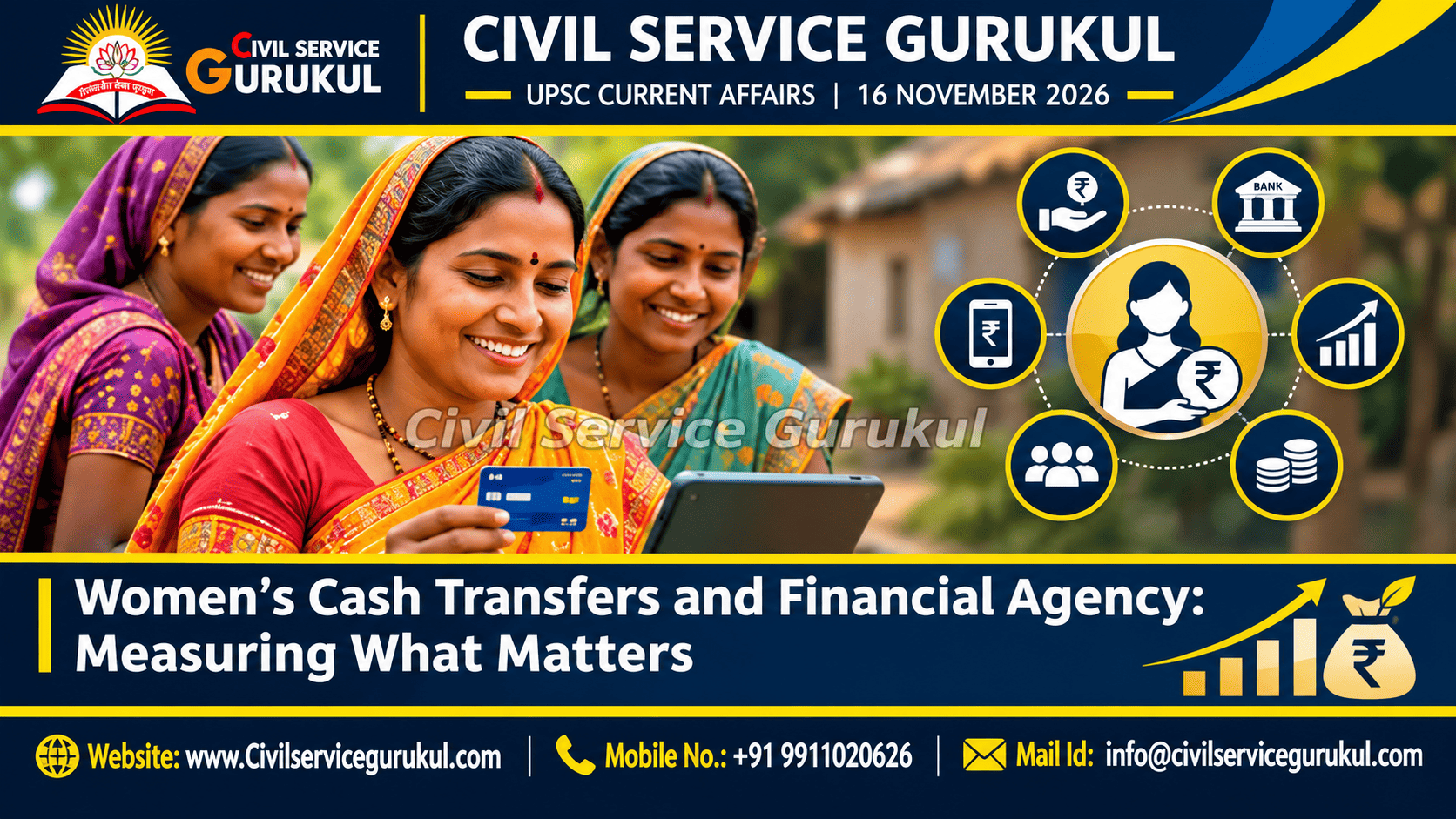
Why Are Women's Cash Transfers in the News?
Women-focused cash transfer programmes have become an important topic in India's welfare policy and public finance discussions.
The supplied editorial refers to a 14 November 2026 news index discussing a women's assistance proposal in Himachal Pradesh.
However, the final eligibility rules and operational conditions require verification against the relevant state notification.
The larger policy question is whether direct financial assistance improves women's economic agency and long-term empowerment.
The uploaded material refers to a reported Himachal Pradesh women's assistance proposal.
This article does not treat the proposal as a confirmed operational scheme or assert unverified eligibility conditions.
UPSC Syllabus Relevance
| UPSC Paper | Relevant Topics |
|---|---|
| GS Paper I | Role of women, gender inequality, social empowerment and social change |
| GS Paper II | Government welfare interventions, social justice, vulnerable groups and public service delivery |
| GS Paper III | Inclusive growth, public finance, financial inclusion, employment and fiscal sustainability |
| GS Paper IV | Gender justice, autonomy, dignity, distributive fairness and accountability |
| Prelims | Direct Benefit Transfer, welfare targeting, cash transfers and financial inclusion |
What Are Women-Focused Cash Transfers?
Women-focused cash transfers are financial assistance programmes in which eligible women receive monetary support under specified policy conditions.
Payments may be periodic, one-time or linked to particular eligibility criteria.
The policy objective may include income support, social protection or enhanced access to financial resources.
Potential Objectives
- Support household consumption.
- Reduce immediate income insecurity.
- Improve access to basic necessities.
- Expand individual financial choices.
- Strengthen social protection.
- Support inclusion in formal financial systems.
The actual effects depend on programme design, payment reliability and beneficiary circumstances.
Direct Benefit Transfer and Financial Inclusion
Direct Benefit Transfer, or DBT, refers to the transfer of eligible benefits through designated delivery arrangements, including direct payments to bank accounts.
Such arrangements can support transparent and traceable delivery when implemented effectively.
However, the successful credit of money into an account does not automatically mean that the intended beneficiary controls or can freely use the funds.
A bank account and a successful transfer are not identical to financial autonomy.
Financial agency also concerns access, control and decision-making.
What Is Financial Agency?
Financial agency refers to a person's practical ability to make and implement decisions concerning financial resources.
For women, this may involve control over income, savings, spending and other financial choices.
Important Dimensions
- Ability to access one's bank account.
- Control over money received.
- Freedom to decide how funds are used.
- Knowledge of financial services.
- Ability to save or plan expenditure.
- Freedom from financial coercion.
- Access to safe and affordable banking services.
Receiving a cash transfer is a financial transaction.
Exercising control over that money is a dimension of empowerment.
The two should be measured separately.
Cash Transfers vs Genuine Economic Empowerment
Cash assistance can improve short-term financial resources, but economic empowerment is a broader and multidimensional concept.
| Dimension | Cash Transfer Outcome | Empowerment Outcome |
|---|---|---|
| Income | Receipt of financial assistance | Greater control over economic resources |
| Banking | Money credited to an account | Ability to access and independently use funds |
| Consumption | Additional purchasing capacity | Meaningful choices over expenditure |
| Mobility | Possible financial support for travel | Practical freedom to access services and opportunities |
| Employment | Income support | Access to safe and remunerative work |
| Long-term welfare | Immediate financial relief | Improved agency, security and opportunities |
Different Types of Welfare Instruments
Welfare policies use different eligibility and delivery mechanisms.
1. Categorical Transfers
Eligibility is based on membership in a specified category, subject to programme rules.
2. Means-Tested Benefits
Eligibility depends on defined income or economic criteria.
3. Employment Guarantees
Such programmes provide an employment-related entitlement under applicable legal and programme conditions.
4. Conditional Transfers
Benefits may depend on meeting specified conditions.
Potential Benefits of Women's Cash Transfers
1. Consumption Support
Additional resources may help eligible households meet immediate consumption needs.
2. Income Security
Regular assistance may reduce short-term financial uncertainty.
3. Financial Inclusion
Transfer programmes may encourage participation in formal financial delivery systems.
4. Greater Choice
Where women control the funds, assistance may expand their financial choices.
5. Social Protection
Cash transfers may complement other welfare and public service programmes.
These are potential benefits, not guaranteed outcomes for every recipient.
Why Cash Transfers May Not Guarantee Empowerment
1. Limited Control Over Money
A woman may receive a transfer without having independent control over the amount.
2. Payment Delays
Irregular payments may reduce the usefulness of financial assistance.
3. Banking Access Barriers
Distance, documentation or digital difficulties may affect access.
4. Mobility Restrictions
Limited mobility may constrain access to financial services and employment.
5. Childcare Responsibilities
Unpaid care work can restrict participation in paid employment.
6. Weak Employment Opportunities
Cash assistance does not automatically create formal jobs or sustainable livelihoods.
Women, Unpaid Care Work and Employment
Women's economic participation is influenced by the distribution of unpaid care responsibilities.
Childcare, household work and other care duties can affect the time available for education, training and paid work.
Cash assistance may provide financial relief, but broader economic empowerment may also require supportive services and safe employment opportunities.
Complementary Policy Measures
- Accessible childcare services.
- Safe public transport.
- Skills and training opportunities.
- Financial literacy programmes.
- Support for women's entrepreneurship.
- Improved workplace safety and accessibility.
Targeting, Exclusion and Inclusion Errors
Welfare programmes must determine who qualifies for assistance.
Poorly designed or implemented eligibility rules may create exclusion and inclusion errors.
Exclusion Error
An eligible person is left out of the programme.
Inclusion Error
A person who does not satisfy eligibility conditions receives benefits.
| Issue | Potential Effect | Policy Response |
|---|---|---|
| Exclusion error | Eligible women do not receive assistance | Accessible enrolment and grievance correction |
| Inclusion error | Benefits reach ineligible recipients | Appropriate eligibility verification |
| Payment failure | Intended benefits are delayed or inaccessible | Reliable payment and resolution systems |
| Limited financial control | Receipt does not translate into agency | Privacy-preserving beneficiary research |
Fiscal Sustainability and Opportunity Cost
Cash transfer programmes require public financial resources.
Their fiscal implications depend on the number of beneficiaries, payment amounts, administrative costs and funding arrangements.
Governments must also consider the opportunity cost of public expenditure.
What Is Opportunity Cost?
Opportunity cost refers to the value of the next-best alternative forgone when resources are used for a particular purpose.
For welfare policy, this means considering how expenditure on one programme relates to other public priorities.
Fiscal sustainability should be assessed alongside programme effectiveness, equity and the value of alternative public expenditures.
How Should Women's Cash Transfer Schemes Be Evaluated?
A strong evaluation framework should measure more than the total amount disbursed or the number of beneficiaries.
| Evaluation Dimension | Possible Indicator | Policy Significance |
|---|---|---|
| Coverage | Share of eligible women receiving benefits | Measures access |
| Payment reliability | Timeliness and consistency of transfers | Measures delivery quality |
| Financial agency | Beneficiary-reported control over funds | Measures autonomy |
| Exclusion | Eligible applicants unable to access benefits | Measures fairness |
| Economic outcomes | Changes in financial security and opportunities | Assesses broader effects |
| Fiscal efficiency | Administrative costs and opportunity costs | Assesses resource use |
| Accountability | Grievance resolution quality | Measures responsiveness |
Privacy and Ethical Evaluation of Welfare Schemes
Programme evaluation may involve sensitive information about financial access, household decisions and personal circumstances.
Evidence collection should therefore protect beneficiary privacy and avoid unnecessary data exposure.
Important Ethical Safeguards
- Collect only necessary information.
- Protect personal and financial data.
- Use transparent evaluation methods.
- Ensure voluntary and respectful participation where applicable.
- Provide accessible grievance mechanisms.
- Avoid discrimination and coercion.
Constitutional and Ethical Dimensions
1. Equality
Welfare policy should advance fair and non-discriminatory access.
2. Dignity
Beneficiaries should be treated as rights-bearing individuals rather than passive recipients.
3. Autonomy
Financial agency requires meaningful control over economic decisions.
4. Distributive Justice
Public resources should be allocated through fair and transparent criteria.
5. Accountability
Governments should monitor whether programmes deliver their intended outcomes.
A welfare programme should be evaluated not only by financial disbursement but also by its contribution to dignity, autonomy and fairness.
Way Forward: From Cash Transfers to Genuine Empowerment
- Ensure reliable payments: Improve transfer timeliness and delivery systems.
- Strengthen account access: Reduce avoidable barriers to banking services.
- Measure financial agency: Assess women's practical control over transferred funds.
- Reduce exclusion errors: Provide accessible enrolment and correction mechanisms.
- Support employment: Complement assistance with skills, livelihood and job opportunities.
- Improve childcare access: Address barriers created by unpaid care responsibilities.
- Protect privacy: Use responsible and privacy-preserving evaluation methods.
- Evaluate fiscal costs: Assess sustainability and alternative public spending priorities.
- Strengthen accountability: Publish meaningful programme indicators and improve grievance resolution.
Women's cash transfers should be treated as one component of a wider empowerment strategy that includes financial agency, public services and economic opportunities.
UPSC Prelims Quick Revision
- Cash transfers provide monetary assistance under programme rules.
- DBT is a benefit delivery mechanism, not a guarantee of empowerment.
- Financial agency concerns practical control over financial decisions.
- Categorical transfers and means-tested benefits use different eligibility approaches.
- Employment guarantees are distinct from unconditional cash assistance.
- Exclusion errors leave eligible persons outside a programme.
- Inclusion errors involve benefits reaching ineligible persons.
- Opportunity cost concerns the next-best alternative forgone.
- Cash assistance alone does not guarantee formal employment.
- Programme evaluation should measure outcomes as well as disbursements.
Original UPSC Prelims Practice MCQs
Question 1: Cash Transfers and Empowerment
Consider the following statements:
1. A cash
transfer may
support household
consumption.
2. A bank
transfer always
guarantees independent
control over
the funds.
3. Financial
agency includes
the ability
to make
financial decisions.
Which statements are correct?
(a) 1 and 2 only
(b) 1 and 3 only
(c) 2 and 3 only
(d) 1, 2 and 3
View Answer and Explanation
Correct Answer: (b) 1 and 3 only.
Cash assistance may support consumption, but receipt of money does not necessarily establish independent control over the funds.
Question 2: Welfare Instruments
Consider the following statements:
1. Means-tested
benefits use
specified economic
eligibility criteria.
2. Categorical
transfers and
employment guarantees
are identical
policy instruments.
3. Employment
guarantees involve
employment-related
entitlements under
applicable rules.
Which statements are correct?
(a) 1 and 2 only
(b) 1 and 3 only
(c) 2 and 3 only
(d) 1, 2 and 3
View Answer and Explanation
Correct Answer: (b) 1 and 3 only.
Means-tested benefits and employment guarantees have different purposes and eligibility mechanisms.
Question 3: Welfare Targeting
Consider the following statements:
1. Exclusion
errors may
prevent eligible
people from
receiving benefits.
2. Inclusion
errors may
result in
benefits reaching
ineligible recipients.
3. A programme
with high
disbursement automatically
has no
exclusion errors.
Which statements are correct?
(a) 1 and 2 only
(b) 2 and 3 only
(c) 1 and 3 only
(d) 1, 2 and 3
View Answer and Explanation
Correct Answer: (a) 1 and 2 only.
High total disbursement does not establish that every eligible person received assistance.
Question 4: Financial Agency
Which of the following best reflects a meaningful evaluation of women-focused cash transfer programmes?
(a) Counting total disbursement alone
(b) Assuming all beneficiaries have independent financial control
(c) Measuring coverage, payment reliability, financial agency, exclusion and fiscal costs
(d) Ignoring employment and childcare constraints
View Answer and Explanation
Correct Answer: (c).
Programme effectiveness requires evaluation of delivery, financial autonomy, equity and resource use.
UPSC Mains Practice Question
"Women-focused cash transfers can improve short-term financial security, but economic empowerment requires more than the transfer of money." Critically evaluate with reference to financial agency, employment, welfare targeting and fiscal sustainability.
Suggested Answer-Writing Framework
Introduction: Define women-focused cash transfers and financial agency.
Benefits: Discuss consumption support, income security and financial inclusion.
Limitations: Explain limited control over money, payment barriers and employment constraints.
Governance: Discuss exclusion errors, privacy and accountability.
Fiscal Dimension: Explain sustainability and opportunity cost.
Conclusion: Recommend a multidimensional, evidence-based empowerment strategy.
Key Takeaways for UPSC Aspirants
- Cash transfers can provide financial support but do not guarantee empowerment.
- Financial agency means practical control over resources and decisions.
- DBT delivery and beneficiary autonomy must be assessed separately.
- Employment, mobility and childcare affect economic opportunities.
- Exclusion and inclusion errors are important governance concerns.
- Fiscal sustainability and opportunity cost matter for public finance.
- Privacy-preserving evaluation can improve policy accountability.
- Empowerment should be measured through outcomes, not announcements alone.
Frequently Asked Questions
1. What are women-focused cash transfers?
They are financial assistance programmes providing monetary benefits to eligible women under specified conditions.
2. What is financial agency?
Financial agency means the practical ability to access, control and make decisions about financial resources.
3. Does DBT automatically empower women?
No. Successful transfer of money does not necessarily guarantee independent control over the funds.
4. What is an exclusion error?
An exclusion error occurs when an eligible person does not receive the intended benefit.
5. Why is fiscal sustainability important?
Public expenditure must be assessed against available resources, programme outcomes and alternative spending priorities.
6. Why is this topic relevant for UPSC?
It connects gender equality, social justice, public finance, financial inclusion and ethical governance.
Conclusion: Financial Assistance Must Lead to Financial Agency
Women-focused cash transfers can provide important financial support and help reduce immediate economic insecurity.
However, empowerment cannot be measured solely through the number of beneficiaries or the amount transferred.
Financial agency, reliable payments, accessible banking, childcare support, mobility and employment opportunities are equally important dimensions.
A well-designed policy should therefore combine financial assistance with accountable delivery, inclusive services and evidence-based evaluation.
The ultimate objective should be to strengthen women's dignity, autonomy and long-term economic opportunities.
Prepare for UPSC Prelims & Mains with Civil Service Gurukul
Strengthen your understanding of Social Justice, Indian Economy, Gender Equality and Current Affairs through conceptual learning, original MCQs and structured Mains answer-writing practice.
Visit Civil Service Gurukul Contact Our TeamEditorial Note
This is an original educational analysis based on the topic and context supplied in the uploaded editorial.
The supplied material refers to a reported Himachal Pradesh women's assistance proposal in a 14 November 2026 news index.
Specific scheme eligibility conditions are not asserted without verification against the relevant state notification.